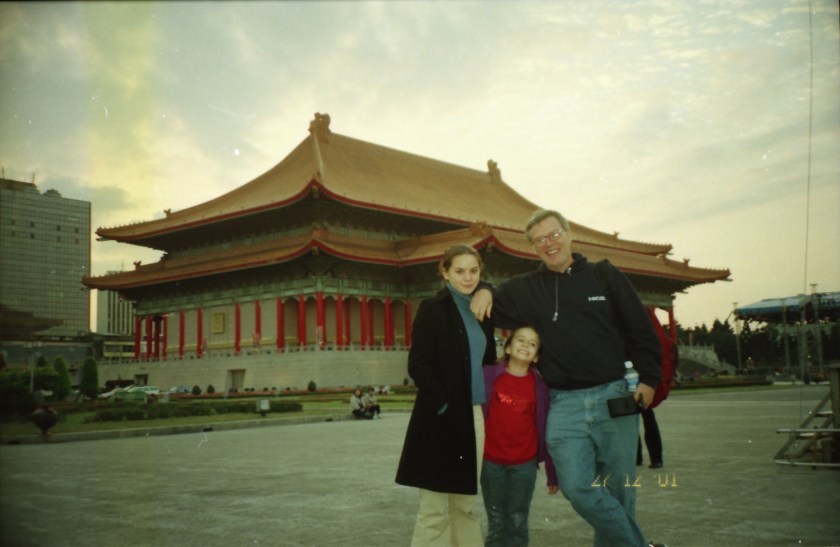
I began my studies of Chinese at the University of Montana – on a whim. As a student of the 60’s, the James Legge translation of The I Ching: The Book of Changes and translations of the Tang dynasty poets Li Bai, Tu Fu, and Han Shan by Arthur Waley, Kenneth Rexroth, and Gary Snyder were on my reading list. Chinese was cool. My first Chinese language teacher was Father John Wang, a Catholic Priest from Shandong province who was also head of the U of M Spanish department. We studied a chapter of John DeFrancis’ Beginning Chinese every week, and we finished the year by reading “The Lady in the Painting”(畫兒上的美人). By the end of my first year, I was hooked. I wanted to go to China. Unfortunately, for an American in the mid-1970’s, mainland China was not an option. Father Wang said, “No problem. Go to Taiwan.”
At that time I was working on a ranch on Horse Prairie, near Dillon, Montana to support my university studies and was thinking about picking up my first horse, a dun mare. I checked prices on tickets to Taiwan and the cost of the horse, and the cost of a round trip ticket to Taiwan were about the same. So I did what any red-blooded American would have done. I flipped a coin. Taiwan won. Father Wang assured me that his brother (also a Catholic priest) would find me a job teaching English for 60 NT$ an hour (about $1.50 US) and living in Taiwan was cheap, so I said OK. I cut my hair, borrowed a corduroy coat from a friend, and was on my way.
America, at that time, recognized Taiwan as the “real” China. Chiang Kai-Shek was still President and Mandarin was called Guoyu (the national language). The Kuomintang (Nationalists or KMT) ruled with an iron fist – and the people in Taiwan seemed to really like Americans. One of my first impressions of the Chinese in Taiwan was how gracious and welcoming the people were. Later, I found out that most Chinese had a similar opinion of people from Taiwan. An oft heard expression among Chinese was “台灣人的 人情味很濃 “ (Táiwān rén de rénqíngwèi hěn nóng) which literally means “the hospitality of the people from Taiwan is really thick.” It really meant, “People from Taiwan are really nice.”
The first people in Taiwan were, most likely, not Chinese. The indigenous people in Taiwan were Austronesian. Chinese have been settling in Taiwan for centuries, however. Most came from Fujian and the dialect of Chinese which was most common in Taiwan before the KMT came in 1949 was the southern Min dialect (also called Taiwanese), the same dialect which is spoken in Xiamen (Amoy), Fujian. The Dutch occupied Taiwan for about 20 years in the mid-17th century. The Dutch called Taiwan “Ilha Formosa” (beautiful island). Taiwan is still referred to by many as “Formosa”. China ceded Taiwan to the Japanese in the Treaty of Shimonoseki after losing the first Sino-Japanese War in 1895 during the waning years of the Qing Dynasty. Taiwan remained a part of Japan for 50 years until the end of WW2 when it was reunited with China. When I first went to Taiwan, I encountered quite a few old people who did not speak Guoyu. They only spoke the Taiwanese dialect of Chinese and Japanese.
On January 1, 1979, America joined a majority of nations by formally recognizing the People’s Republic of China as the legitimate government of China. The USA acknowledged that there was only one China and that Taiwan was a part of China. At the writing of this post, there are currently 17 countries (out of 193 member states of the United Nations) – plus the Holy See in the Vatican – who continue to have diplomatic relations with Taiwan.
Chinese Odyssey 8
I read something new
in those dots, strokes, and lines.
Gates will soon open,
just look for the signs
An island awaits you
with jungles and snakes.
Fly over the pole
then put on your brakes.
 The Panda in the Room PD
All from a flip of a coin?!?! WOW!
LikeLiked by 1 person