It was the end of the summer of 1970. A good friend had written me a letter saying that she was going to have to beg out on our open ended and barely planned adventure to Mexico in the Fall. She had thrown the coins and the I Ching had responded. Like many college students in the ‘60’s, I had also read the I Ching and somehow her choice made perfect sense. The Vietnam War Draft lottery had taken place on December 1, 1969 and my number was 256. I went back to the University of Montana and enrolled in the U of M’s first ever Chinese Language class.
The earliest of China’s “Classics” and the source for much of what is observed and practiced in many Chinese temples today is the I Ching, aka 易經 Yì Jīng, aka The Book of Changes. The I Ching dates back to at least the beginning of Zhou Dynasty 1000 BCE, and parts may predate the Zhou by hundreds of years. It is a book of cosmology and divination.
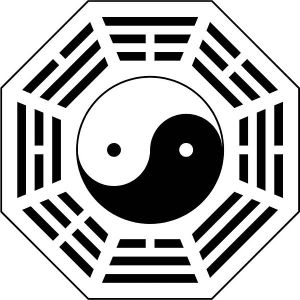
The most basic of the building blocks of the I Ching are the two lines. They are a solid line (一) representing the yang and a broken line (- –) representing the yin. The yin (陰 yīn) is represented by dark or the feminine. Other attributes and characteristics of yin include earth, receptive, water, and the negative. The yang (陽 yáng) is represented by light or the masculine. Other attributes and characteristics of yang include heaven, active, fire, and the positive. An interesting observation is that there is a bit of yin in all of yang and a bit of yang in every yin.
There are only 8 possible ways that these two lines can be put together in groups of three, and those eight trigrams most commonly appear in a symbol known as the Ba Gua (八卦 Bāguà) or the 8 Trigrams. The 8 trigrams in the Ba Gua surround the symbol for the Yin and the Yang. Each of the trigrams have a name representing 8 forces of nature. These are Heaven or sky (creativity), lake or marsh, fire, mountain, thunder, wind, water, and Earth (receptivity.)
By combining two sets from these 8 trigrams, there are sixty-four possible hexagrams. Each of these hexagrams has a number and a name. They also have a description. After that description, each of the lines is explained. Like the poems in the Kau Cim, the lines and descriptions are open to multiple interpretations. But for me or anyone else with such a cursory understanding of the I Ching to attempt to interpret those lines completely out of context is ludicrous.
I thought of the I Ching on my plane ride back to America. My knowledge and understanding of the I Ching was similar to my understanding of China. I had a very basic knowledge of the pieces, but I was a long way from understanding how they all fit together.
Chinese Odyssey 20
I’d had my first taste
but I yearned to see more
Taiwan and Hong Kong were
too far from the core.
Sacred mountains awaited,
great cities, and art.
Next time I’d try harder
to get to the heart.
 The Panda in the Room PD