You can take the cowboy out of China, but you can’t take China out of the cowboy. In Spring, 1979, I needed to go back to Oklahoma. My sister’s kidneys were failing from Type 1 diabetes. She needed a kidney transplant. After prelimary tests at Taipei’s Veteran’s Hospital 臺北榮民總醫院, Táiběi Róngmín Zǒngyīyuàn, and a follow up consultation with the head of the Nephrology department at UCLA, I was good to go. No kidneying.
Everything worked out well. During my recuperation, I received a note from H.J. Green, the Principal of Booker T. Washington High School, in Tulsa. BTW was a magnet school located in the heart of north Tulsa. Even before it became an official “magnet” for the Tulsa Public Schools, Booker T. had been a magnet for Tulsa’s Black community. When it opened its doors to students from all over Tulsa, to purposely promote racial integration, it did so with the promise of combining a stellar athletic program with an academic curriculum which was second to none. We were home to Tulsa’s 1stever International Bacculaureate program and students from all over Tulsa wanted in. HJ Green was a visionary and he really wanted a Chinese language program at Booker T. Even after I confessed that I had never taught Chinese before, HJ was willing to give me a try.
Before the 1980’s, there weren’t a lot of Chinese Language programs in the USA. Two of the early intensive programs were the Defense Language Institute Foreign Language Center at the Presidio in Monterey, California, and the LDS Missionary Training Center in Utah, but they both had pretty specific agendas and clientele. Universities like Harvard, Stanford, and Yale had developed Chinese language programs in the US, and also had well established programs in China, Taiwan, and Hong Kong. But all of these programs were for adults who had graduated from high school.
The earliest initiative in secondary school education that I’m aware of in the US was from the Carnegie Foundation in the early 1960’s. There were 230 high schools involved. But by the end of the 1960’s, when the funding stopped, so did most of the programs. By the 1980’s few of the programs which had been seeded by the Carnegie Foundation were still in existence. The second wave came with the Geraldine R. Dodge Foundation. From 1982, the Dodge foundation helped start and fund 60 high school programs in the US.
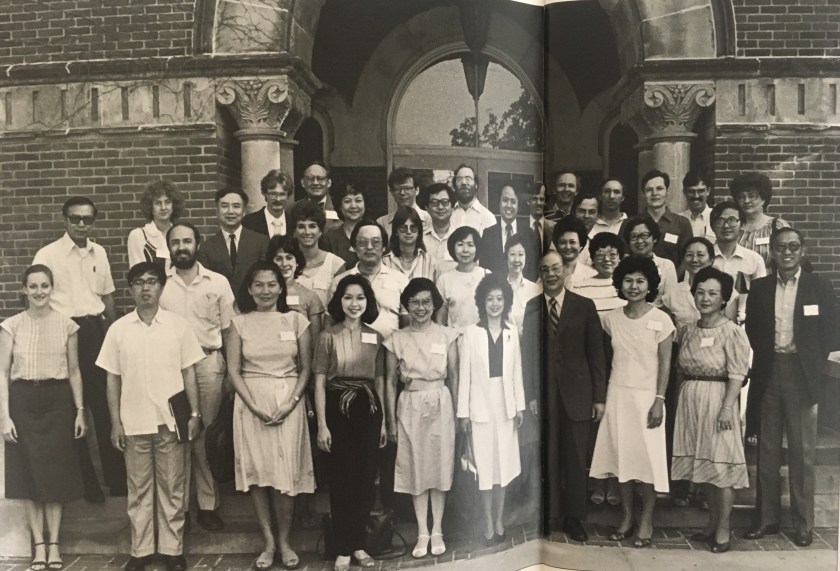
In 1982, I was at the right place at the right time. In Tulsa, Nancy McDonald wrote a grant proposal to the Geraldine R. Dodge Foundation and Timothy Light from Ohio State University was sent to check us out. I was fortunate to meet and to learn from amazing people like Dr. Light, T.T. Ch’en and Zhou Zhi Ping from Princeton, Perry Link from UCLA, Ron Walton from the University of Maryland, and John Berninghausen from Middlebury College. Nearly every summer in the 1980’s, secondary school Chinese language teachers from all over America met and helped one another become better teachers of Chinese. One summer 20 of us converged at the Beijing Language and Culture University (at that time called 北京语言学院 Běijīng Yǔyán Xuéyuàn) to learn together with 20 Chinese language teachers from all over China.
Chinese Odyssey 21
So I boarded the plane
and headed due west.
I had more great teachers.
My Chinese progressed
Then one day while watching
my clothes tumble dry
a voice called out softly
“Get ready to fly.”
 The Panda in the Room PD