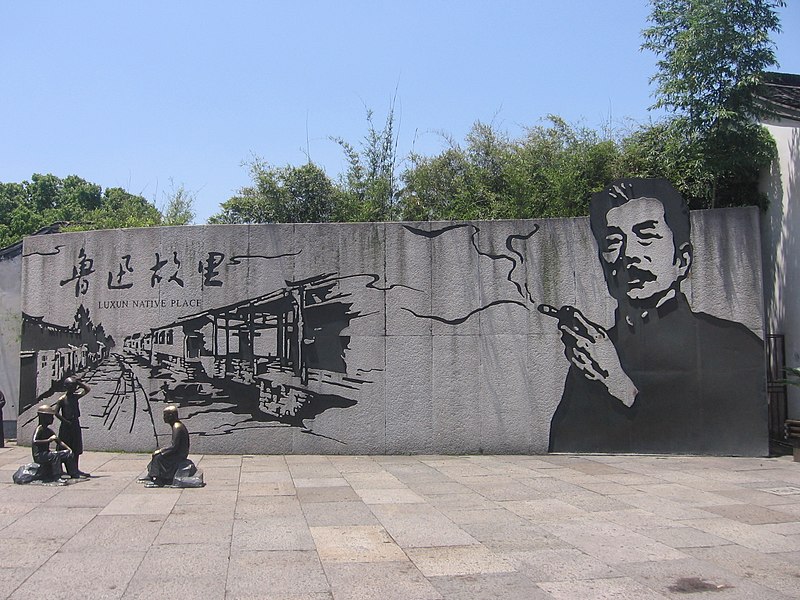
 Zhou Guanhuai [CC BY-SA 4.0 (https://creativecommons.org/licenses/by-sa/4.0)%5D, from Wikimedia Commons
What was it about Lu Xun’s writing that led Mao Ze Dong to call him the “commander of China’s Cultural Revolution“?
Although Lu Xun (魯迅 Lǔ Xùn) aka Lu Hsun – had a formal education, he was much more interested in the stories he heard from uneducated peasants than in the great works of literature. Born in 1881, he was 38 when the 1919 May 4th movement championed writing in the vernacular “白话” instead of in classical Chinese (文言文). Lu Xun opened windows into the lives of uneducated peasants, of women who were branded by superstitions and beliefs which relegated them to roles of shame and dishonor they could never hope to climb out of. His writings were not hopeful. They were often dark and desperate and were an honest reflection of the lives of vast numbers of Chinese lǎo bǎi xìng 老百姓 (common people) during the early part of the 20th century. His most popular works were his short stories. Many are available on-line and I’ll mention three which I have read and believe would be a good introduction to Lu Xun.
Probably, the most iconic Lu Xun story is “The True Story of Ah-Q”. Nobody knew what Ah-Q’s name really was or where he came from. It is evident from the beginning though, that Ah-Q is a loser – in everything he tries. He has no family. His only claim to fame is that the handi-work he does around town to pay for his food and drink seems to be acceptable. He is a blowhard, a braggart and a drunk, all of which bring on more ridicule and bullying from the townspeople. Ah Q represented much of China’s peasant population in the tragedy of his life, and the reader can’t help but feel that his lot was not his fault.
In the story, “Medicine”, a peasant couple whose son is dying of tuberculosis spend their last penny on steamed bread soaked in the blood of an executed criminal. The story was a powerful scream aimed directly at the ignorance which was burdening the masses. Ironic that Lu Xun himself would die at the age of 55 from the same disease.
“New Years Sacrifice” was one of the saddest stories I read. It was an almost voyeuristic glimpse at the lives of widows who were blamed for their own bad fortune both in this life and in the next. After being forced to remarry, Xiang Lin’s wife found herself pregnant and for the briefest of moments was happy with the son she bore until tragedy visited her again in the form of a wolf.
So much of what Lu Xun wrote was a commentary on the superstitions that enveloped China during the chaos of China’s Republican period. Maybe the reason that Lu Xun became Mao’s revolutionary poster boy was that he died in 1936. Mao Zedong, along with 4,000 stalwarts had completed the two year, 6,000 mile Long March which cemented his position as the undisputed leader of the revolution only one year earlier. The revolution was still young and those who died in its name were heroes. Although Lu Xun never joined the Communist Party, Mao understood Lu Xun to be someone who appreciated the plight of the peasants and was trying through his writing to help them rise up.
“The True Story of Ah-Q” (阿Q正传) and “The New Year’s Sacrifice”(祝福) are both available in the Public Domain to read in English.
Chinese Odyssey 28
Xiamen had been open
for less than a year.
The colors were drab
but the air was quite clear.
Lu Xun used to write
in the Nan Putuo temple
and the Gulangyu
musical island felt gentle.
 The Panda in the Room PD