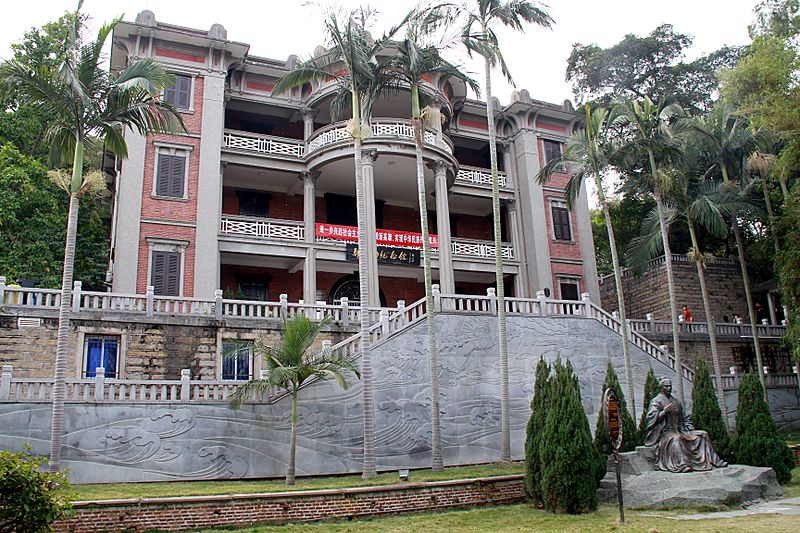
Koxinga Museum in Gulangyu – Rolfmueller [CC BY-SA 3.0 (https://creativecommons.org/licenses/by-sa/3.0)%5D, from Wikimedia Commons
When I first visited the island of Gulangyu in 1981, it was truly a magical place. Anyone could step up to the ferry terminal in front of the Lujiang Harbourview Hotel in Xiamen, and enjoy a five minute hop over to “Piano Island.” There were no cars or other motorized vehicles and one could walk the 3 mile circumference of the island in a couple of hours. As we walked around 1981 Gulangyu, we were awed by the architecture. Crowded stalls were gateways to 1930’s art deco mansions which used to be consulates, banks, and homes to the wealthy foreign and Chinese elite. During the Cultural Revolution the mansions had been subdivided and many families occupied what had once been the lavish get aways for Chinese Jay Gatsby’s. Wandering through the rolling hills on this tiny island, it was easy to imagine grand parties with alcohol flowing, dapper multinational sheiks, beautiful shebas in cocktail dresses, and Whitey Smith jazz wannabes drifting south from Shanghai. One could stand on the balconies, stroll in the beautifully kept gardens, and listen to the natural drum beat from the waves pounding on the shores.
A lot can change in 30 years, however. The quiet island of 1981 Gulangyu made famous for its classical music, its churches, tunnels where people escaped the summer heat, and laid back locals has been transformed into an island of Airbnb’s for young lovers. The five minute ferry is still there, but since it became so popular, only local people are allowed to use it. Foreigners must take a 25 minute taxi to a ferry station where an advanced booking has been made for them and a passport is required. The island’s still beautiful and many of the old mansions have been restored. The former Christ the King Catholic Cathedral (now a UNESCO World Heritage site) has been newly painted and you can visit the Trinity Church (三一堂 Sān Yī Táng) there. The former US Consulate and the former HSBC mansion are both privately owned, but both have survived nicely.
Zheng Chenggong (Zhèng Chénggōng 鄭成功) aka Koxinga 國姓爺 Guóxìngyé (man given an imperial surname by the government) was the only Chinese commander ever to win a decisive battle against a major Western power, when he forcibly ejected the Dutch from Taiwan 350 years ago. He was a Ming Loyalist who fought against the newly established Qing Dynasty.
Zheng Chenggong was born in Japan. His father was the head of a large merchant group based in Japan and Taiwan. His mother was Japanese. When he was young, he went by the name of Fukumatsu. He often traveled with his father and went to live and study in Fujian, his father’s ancestral home, when he was only 8 years old. He was well schooled in Confucianism and studied at the imperial university in Nanjing and was given his imperial name when he was 21. When the invading Qing army from Manchuria conquered the Ming, Zheng Chenggong’s father (who had become a general in the Ming army) was executed by the Qing, and Zheng Chenggong dedicated himself to rebellion against the Qing Dynasty and the restoration of the Ming. It was in Xiamen, that Zheng first set up his base. But when the Ming army pushed south, Zheng sailed east across the Taiwan Strait where he founded Dōngníng Wángguó 東寧王國 (the Kingdom of Dongning). It was from this base that he, along with 25,000 Chinese troops and the infamous Black Guard, “made up of ex-African slaves brought to Asia by the Portuguese” (https://www.scmp.com/article/993666/idol-worship)defeated the 10,000 strong private army of ‘red-haired barbarians’ stationed at Fort Zeelandia aka Rèlánzhē Chéng 熱蘭遮城, near the current city of Tainan, and routed the Dutch East India Company and the Dutch from Taiwan.
From Xiamen to Taiwan to Japan to Beijing, stories of Zheng Chenggong abound. Britannica calls him the “pirate leader of the Ming Court”. Taiwan sees him as a champion of the struggle for independence, where Beijing points to his reclaiming Taiwan for China, and Japan used him as a way to connect during their 50 year occupation of Taiwan during the first half of the 20thcentury. Was he a selfless patriot or a self serving entrepreneurial pirate? Probably more than a little bit of all of the above.
Chinese Odyssey 29
Commander Koxinga
really didn’t do much —
just resisted the Manchus,
defeated the Dutch.
On the island stood mansions
like F. Scott’s Gatsby
might have owned on West Egg
old now, and drafty.
 The Panda in the Room PD