Wuyi Shan was like a mini-Guilin with karst mountains and a river called the Nine Bend Stream (九曲溪 Jiǔ qū xī) winding through it. We floated on 4” diameter bamboo pole rafts and fell off into the cooling waters which we weren’t supposed to swim in. I found out early in my travels in China that it was a lot easier to ask for forgiveness than for permission. There are very few natural water areas in China where swimming is actually permitted.
I would be remiss to leave Wuyi Shan without mentioning Da Hong Pao, one of the world’s most renowned and expensive teas. Nearly a thousand years ago, it was leaves from these tea plants growing under Tianxin Rock which were highly coveted by the emperor. I never thought that tea grew on trees until I visited Xishuangbanna, in southeastern China, home of Pu Er tea and saw tea trees that reminded me of the apple and cherry trees growing in my grandparents orchard in Missoula. Prior to that experience, I thought all tea grew on bushes like the wonderful green tea plants around Hangzhou and Moganshan. What I discovered was that tea plants let to grow wild, grew into trees. Da Hong Pao (大红袍 dàhóngpáo), a very dark Oolong tea, grows in the heavily oxidized soil of Wuyi Shan where, in 2002, 20 grams of a very high grade Da Hong Pao sold for around US$28,000. By 2016, there were only six of the Ming Dynasty Da Hong Pao trees left.
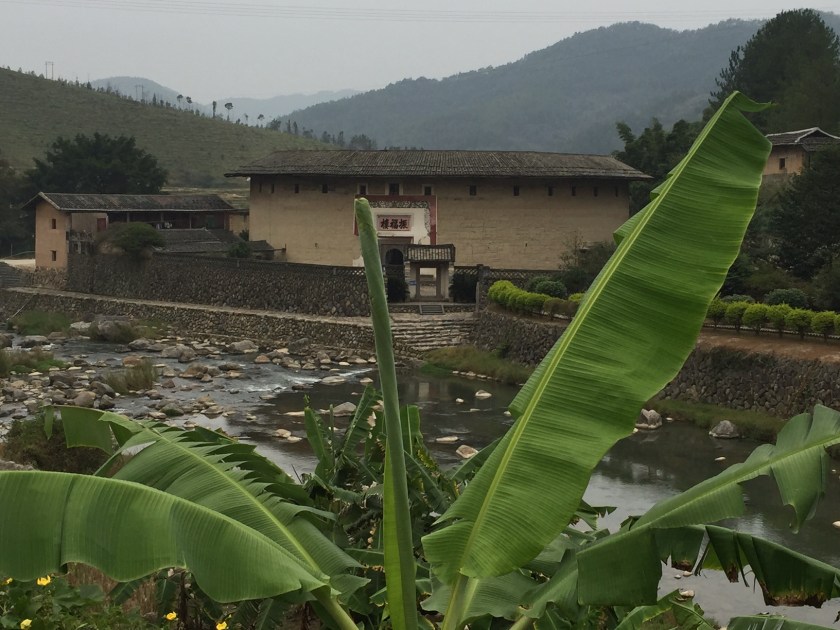
Before leaving Fujian, I also need to direct you south from Wuyi Shan to some amazing homes called “tulous” (土楼 tǔlóu)which have graced southeastern China for almost a millennia. Appearing like natural outgrowths among the terraced fields and persimmon trees in southern Fujian, these massive bagel shaped homes were built by the Hakka people aka 客家 Kèjiā (lit. translation – “guest families”– sometimes referred to as the “Gypsies of China”). These multi-story units, some over 70 metres in diameter with six foot thick walls, could house hundreds of people. One wonders how a building made out of mud could withstand the weather until one actually approaches the structure and feels the walls. The rammed earth has hardened like cement and these homes have proven to be remarkably resistent to wind, rain, and even earthquakes.
Several of the tulous, which served as family homes for centuries, have now opened up to accommodate tourists – complete with flush toilets, showers, and breakfasts. Fall is a beautiful time to bicycle through the low hills of southern Fujian and experience these magnificent structures from a distant past.
Chinese Odyssey 31
As we coasted downstream
on a long bamboo raft,
Sliding into the river
and feeling quite daft.
The clouds up above
formed a quizzical cast
like a sail held high
overhead on a mast.
 The Panda in the Room PD