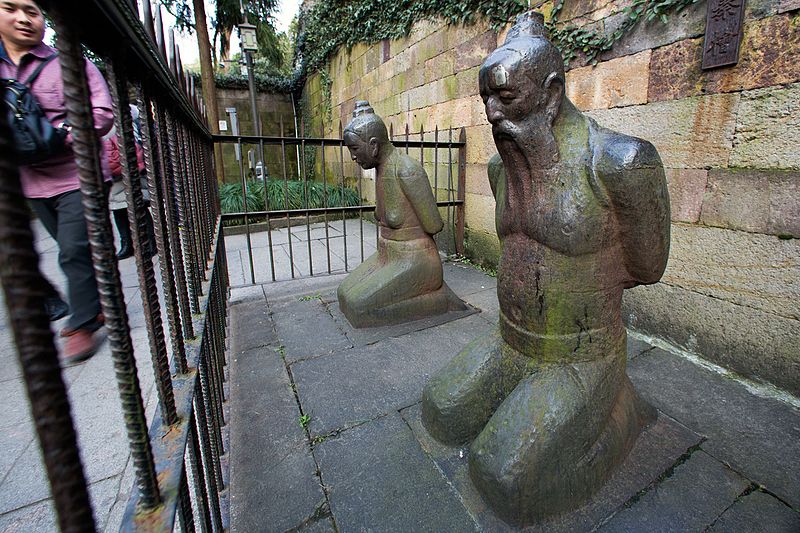
 Qin Hui and Lady Wang – Morio [CC BY-SA 4.0 (https://creativecommons.org/licenses/by-sa/4.0)%5D, from Wikimedia Commons
My introduction to Hangzhou was poetry. When I first gazed on West Lake, I couldn’t wait to search out Ping Hu Qiu Yue aka Placid Lake Autumn Moon (平湖秋月 Pínghú Qiūyuè). It was the nexus of West Lake, where one could watch clouds flying and the reflection of distant hills, while sipping the perfect cup of Long Jing Green Tea under a full Autumn moon. Visually, it was all I had hoped for. I knew the tea house would look and feel old and weather-worn, but that was OK. Pen and notepad in hand, I sat down to compose a poem. Unfortunately, a very loud and excited member of our China tour named Bill, from the Bronx, saw me sitting alone and thought I wanted company. I never did get my poem written. Thankfully, I can borrow and share one from Tang Dynasty poet, Su Shi (aka Su Dongpo 苏东坡.)
阳关曲:中秋作
暮云收尽溢清寒
银汉无声转玉盘。
此生此夜不长好
明月明年何处看?
Yang Guan Qu: Zhong Qiu Zuo by 苏轼 Su Shi
Mu yun shou jin yi qing han
Yin han wu sheng zhuan yu pan.
Ci sheng ci ye lou chang hao,
Ming yue ming nian he chu kan ?
Mid-Autumn Composition by Su Shi
Sunset clouds together and then dissipate, air clear and cold
Milky Way without a sound, moon moves across the sky。
This life, like this evening, not always so good
Next year, where will I be living to see this moonlight?
I did, however, get to see much of the West Lake the poets wrote about. There was the mountain crag called the “Peak Who Flew in from Afar” (飞来峰 Fēilái Fēng), that legend claims transported itself from India, the Six Harmonies Pagoda (六和塔 Liùhé Tǎ), which, for centuries served as a lighthouse on the Qiantang River, and the Broken Bridge (断桥duàn qiáo), backdrop for the Legend of the White Snake, where a young boy innocently consumed immortality pills, thinking he was eating sweet dumplings. The sweets seller, actually one of the eight immortals, seeing what had happened, made the boy regurgitate the pills into the water by Broken Bridge where they were consumed by a small white snake swimming by. As you might imagine, there is a lot more to that story.
My favorite tale, however, is about the patriot, Yue Fei (岳飛 Yuè Fēi). He was born into a poor, but very patriotic family. When he was young, his own mother engraved the tatoo, 盡忠報國 jìn zhōng bào guó “serve the country with the utmost loyalty”, on his back, and that message served as Yue Fei’s driving force. Yue Fei later managed to become both educated and a respected general in the Jin military. While fighting to recover Kaifeng, the Northern Song capital, Yue Fei was called back to Hangzhou by the Emperor Gaozong (宋高宗Sòng Gāozōng), but he failed to heed that call initially. Qin Hui (秦桧) falsely accused Yue Fei of being a traitor to his country on some trumped up charges and Yue Fei was put to death. Although later history points much of the finger of guilt at Emperor Gaozong, it was Qin Hui and his wife, Lady Wang, who were to ultimately be remembered – in a very unique manner – as traitors to China.
One of the most popular pastries in China is called You Tiao (油條). Some people liken You Tiao to a donut without sugar, but it’s shape is a bit like that of two foot-long hotdogs glued together. In Taiwan, we used to eat youtiao with steaming hot doujiang (soybean milk) for breakfast. In Hong Kong, people will often eat these alongside their morning jok, aka congee (粥 zhōu).
The story goes that a doughmaker and his friend were sitting around at the end of the day, reeling about the unjust death of Yuefei and the dispicable nature of Qin Hui and his wife, and the doughmaker picked up a couple of pieces of remaining dough and said. “This is what I’d really like to do with those two. He stuck two long pieces of dough together, fashioned faces for each, and dropped them into boiling oil. Take that, you traitors, you “deep-fried devils” (油炸鬼 yóuzháguǐ). The Cantonese term, yàuhjagwái, is still popularly used for youtiao.
I would be remiss, however, if I didn’t update my story to the year 2018. As my Chinese friends would say, “bian hua hen da” (變化很大 biànhuà hĕn dà) – the change is enormous. I really didn’t recognize Hangzhou the last time I went there. I flew into a small, but very modern, airport. My friend, Stan, said its faster for him to fly from the old Songshan airport in Taipei to Hangzhou than it is to go from his home in Taipei to the main Taipei airport. Streets once crowded with bicycles are now jammed pack with cars, and the air is a constant grey from the accompanying smog. Although many of the low-rise places along West Lake itself have been preserved, high rise, modern architecture abounds. There is a Starbucks now not far from Ping He Qiu Yue. Maybe great poems are being written there now over Caramel Macchiatos.
Chinese Odyssey 35
Our next stop, Hangzhou,
placid lake, autumn moon
broken Bridge, riding bikes—
took a break around noon.
Paid respects to Yue Fei,
ate some zongzi for free.
Like the Emperor Qian Long,
sipped Dragon Well tea
 The Panda in the Room PD