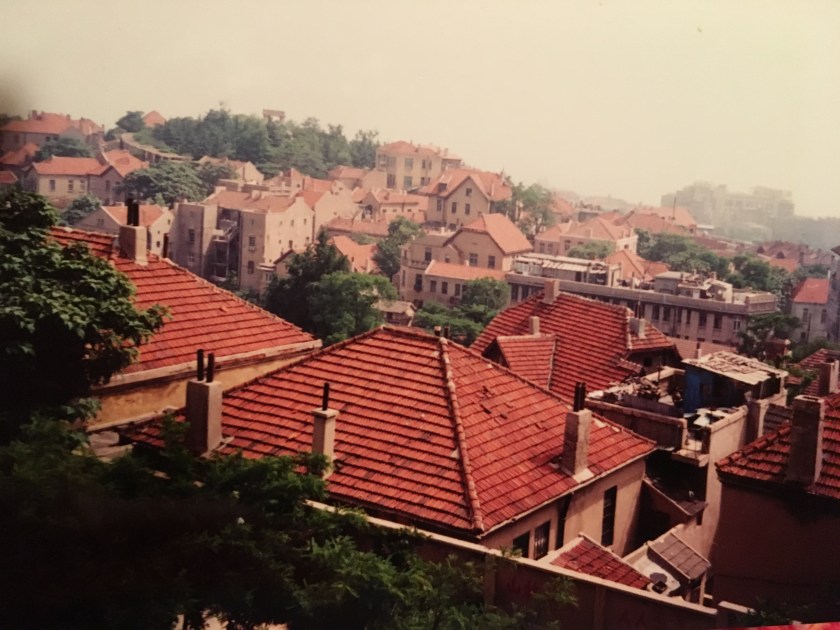
Most people know Qingdao (青岛) as Tsingtao . . . like the beer. Today, quite a few are pronouncing the name of this city of nine million people as “ching dow” which is fairly close to the correct pronunciation. Located on the coast, in the province of Shandong (山东), Qingdao is about 500 km due north of Shanghai. In 1897 during an observation of the Chinese coast, the German high command decided that Qingdao would be the perfect place for a German naval base. They had been eying this sleepy little fishing village since the early 1890s and gradually transformed Qingdao into a modern port. The weak Qing government was bullied by Germany to cede a portion of Qingdao (about 200 square miles) to the Germans as a “concession”. The Germania-Brauerei was established in 1903 as a joint venture between German and British investors. This was the birth of Tsingtao Beer. In addition to outstanding beer, Germans in Qingdao had developed amazing schools and established several Protestant and Roman Catholic missions. The Germans also based their Far East Squadron in Qingdao. The Japanese, with the aid of 1500 British troops, wrested Qingdao from the Germans in 1914, but the Republic of China reasserted its control in 1922. The bombing of German ships in the harbor by a Japanese Farman seaplane is said to have been the first air to sea battle in history. The Japanese then re-occupied Qingdao in 1938 and remained there until their surrender at the Tientsin racecourse in October of 1945. The US Navy, at the invitation of the KMT, was then allowed to station its Western Pacific Fleet in Qingdao until the Red Army, under the leadership of the Chinese Communist Party, finally took control in 1949.
One of China’s most beloved novels has several different titles in English. In 1948, Pearl Buck named it “All Men are Brothers”. “Outlaws of the Marsh” and variations of that theme are also popular English titles for translations. The Chinese title, however, Shuǐhǔ Zhuàn 水滸傳, translates to “The Water Margin Story”. It is about a band of outlaws and is based on an actual historical figure, Sòng Jiāng 宋江, the charismatic leader, and his followers, who roamed the hills and marshes of Shandong and Henan during the Song Dynasty. Song Jiang led attacks and started a rebellion against the government who initially felt powerless against this Chinese style Robin Hood, the “Protector of Justice (呼保義 Hū Bǎoyì)”.
The authorship of “Shui Hu Zhuan” is unclear. Stories have circulated about Song Jiang and his band of outlaws since they were active in the 12th century. There were early manuscripts of the book in the 14th century, but the first full-on 100 chapter version doesn’t appear until the Ming Dynasty in the 16th century.
In the “Water Margin Story”, Song Jiang commands 108 “Stars of Destiny” (宿星 sù xīng), former “demonic overlords” who had been accidentally redeemed. These erstwhile bad guys then took it upon themselves to turn over new leaves and became heroes who dedicated themselves to fighting for justice.
Kind of like Clark Kent, “mild man and reporter for a great metropolitan newspaper”, Song Jiang, by day, serves as a clerk for a county magistrate, but this identity underlies the complexity of who he really is, both a trained scholar and a martial arts warrior. He is a handsome, dark complexioned man with “phoenix eyes”. There’s a little bit of everything in the Water Margin – love, lust, loss, betrayal, violence, death, flight, and secret hideouts in the Liangshan Marsh (水泊梁山 Shuǐ Pō Liáng Shān).
In the book, Song Jiang is eventually caught, his face branded with a prisoner tattoo, and he is exiled to a prison camp in Jiangzhou (江州), in present-day Jiangxi. Considered by the people as a great patriot, who first and foremost loved China, Song Jiang was given a chance to prove his loyalty to the Emperor by commanding his band of outlaws against Liao rebel forces invading the Song. Song Jiang survives these campaigns, but at a terrible price. Two-thirds of the “108 Stars of Destiny” perish.
In the end, Song Jiang is rewarded by the Emperor Huizong (宋徽宗 Sòng Huīzōng), by being named as Governor of Chuzhou. Not long after, he is poisoned by corrupt officials. But after his spirit visits the Emperor in his sleep, he is once again redeemed by the Emperor and rewarded posthumously for his loyalty and courage.
It was a breath of fresh air when we stepped out of the train and began to explore the hills and tunnels of Qingdao with our three young daughters in the mid-’90s. The area called Badaguan (八大关) still had many of the old German style mansions and villas and an underground passage Chiang Kai-shek used to get from his villa to the beach. I also remember the Laoshan hills (嶗山 Láo Shān), to the northeast of Qingdao, where the local folks told us the Qingdao Beer was too pricey for them. They preferred the local Laoshan Pijiu, anyway. No arguments from us. It was perfect.
Chinese Odyssey 39
Shanghai to Qingdao
the train chugged along,
played xiangqi, ate noodles
sang Chinese folk songs.
Walked under a mountain
to a German cathedral.
Shared a walk on the beach
with seagulls and people.
 The Panda in the Room PD