During his travels, Confucius was approaching the foot of Mount Tai (Taishan) when he encountered a lone woman weeping and obviously distraught. When he asked why she was sad, she told him that her son had recently been devoured by a tiger. She went on to say that her husband and her father-in-law had also been killed by tigers in the same area. Confucius invited her to join his retinue and asked why she remained in this place. The woman politely declined his offer and said that in this place, she felt free and was not subject to the tyranny of the government. His words, “Tyranny is more ferocious than tigers” (苛政猛于虎 kē zhèng měng yú hǔ) are still used today to describe how some people believe that the benefits of living in isolation or in isolated communities outweigh the benefits of living near a repressive government.
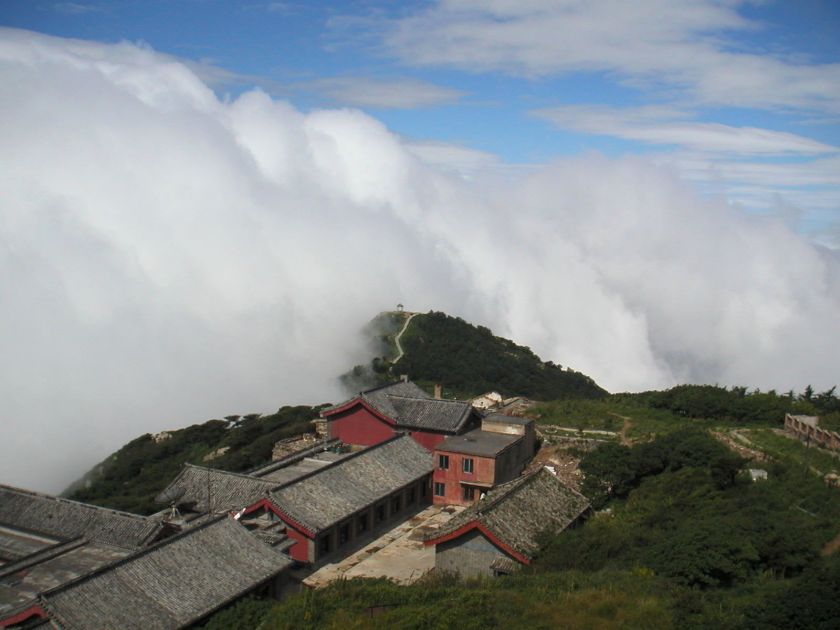
Buddhism, Daoism, and Confucianism all have long histories in Shandong Province. Mount Tai (泰山 Tài Shān) is located near the city of Tai ‘an in the middle of Shandong, and is, perhaps, the most revered of all China’s “sacred mountains”. It is said that 72 emperors from China’s ancient past journeyed to Taishan to pay homage and make sacrifices to Heaven and Earth and pray for peace and prosperity Fengshan Ceremony (封禅仪式 fēng shàn yí shì). There are over 6,000 steps one needs to climb in order to summit the east peak of Mount Tai, but these days, most people opt for the combination bus and cable car ascent. Expedience does, however, have its costs. Many of the hundreds of stone tablets and engravings, numerous temples and ruins, and a scattering of archways, gates, pavilions, and kiosks line the steps up the mountain.
Some of the earliest artifacts of Chinese history come from the province of Shandong. During the Neolithic period (4100 to 2600 BCE), the Dawenkou culture (大汶口文化 Dàwènkǒu wénhuà) existed alongside the Yangshao culture (仰韶文化 Yǎngsháo wénhuà) and there is strong evidence that there was strong interaction between the two cultures. There is also interesting research going on which suggests links between Dawenkou culture and Austronesian languages and culture. The Dawenkou culture was also believed to have been the first to practice trepanation (boring a hole in the skull to relieve pressure) in prehistoric China.
But it’s the ceramics that I find most fascinating. Some of the pottery was made on pottery wheels and was colorfully decorated with geometric patterns similar to those found in indigenous pottery throughout the world. Black “egg-shell” Longshan pottery from the Neolithic Age has been discovered which was both delicate and amazingly strong. Sophisticated tools and ornaments were made out of jade and bone.
登泰山而小天下 Dēng Tàishān ér xiǎo tiānxià
If you want to see how small the world is, climb Tai Shan.
Chinese Odyssey 41
Once tigers roamed foothills
surrounding Mount Tai
but now tourists ride,
they don’t climb to the sky.
Gondolas replaced
six thousand stone stairs.
So, welcome back tigers.
return to your lairs!
 The Panda in the Room PD