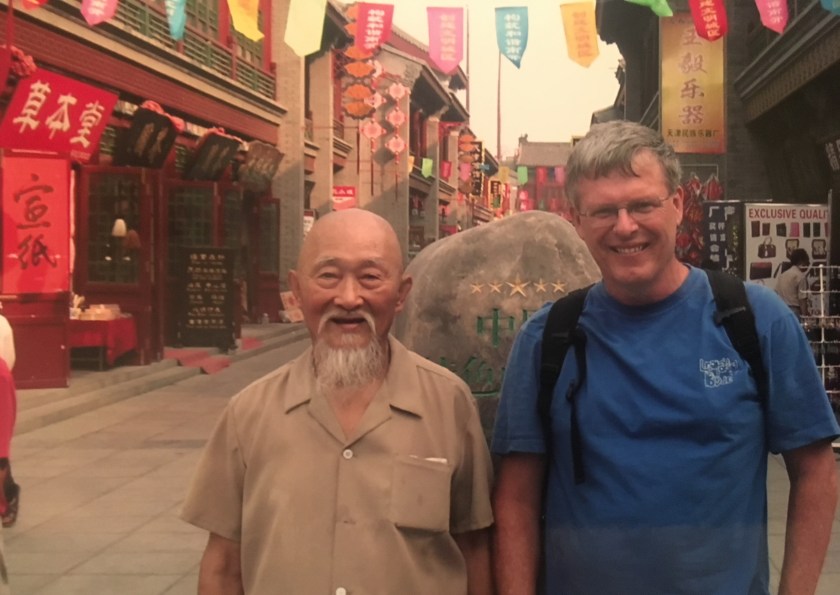
I first went to Tianjin to see an old friend from Taiwan who was teaching there. Jeff took me to meet a buddy of his who sold paintings and porcelain on Ancient Culture Street. Enter, Harry Liu. Originally from Shanghai, Harry Liu studied at Tientsin Anglo-Chinese College in the early 1940s with Eric Liddell (remember “Chariots of Fire”?) After graduating, Harry went on to study and complete his medical degree in the Japanese and German program at Beijing University. But largely because of a part-time post-war job, Harry never got to practice medicine. Somehow, he had been co-opted by the American Marines in Tianjin where his Scottish accented English changed into that kind of hybrid English found among English speakers today who live between America and the UK. In addition to speaking Putonghua, German, and Japanese, Harry also spoke Cantonese, Shanghainese, and a smattering of European Romance languages. Harry loved America – or, at least the idea of it. Two things I would often take Harry were Whitman’s Chocolate Samplers and American 20th-century non-fiction books about China. Harry’s work as a Jeep driver and general lackey for the American marines post-WW2 earned him both his nickname, “Harry Jeep”, and a protracted period of reeducation from the “real teachers” in China during the early days of the revolution – the workers and the peasants. Harry loved Kiessling’s Café (起士林饭店 Qǐshìlín Fàndiàn) a German-Austrian bakery and restaurant renowned for its fine European cuisine. I remember taking Harry there in the late 1990s and treating him to a couple of his favorite dishes that he hadn’t eaten since the 1940s. For years after that, whenever I would lead a group to Beijing, we would invariably detour to Tianjin where Harry would walk us through the European concessions and regale us with stories of his life in Tianjin. We would often take kids to 狗不理包子(Gǒubulǐ Bāozi), a 200-year-old local favorite whose name defies translation, but it’s something like “Dogs don’t pay attention steamed buns.” Harry Liu passed away in 2010 at the age of 86, never having fulfilled his lifelong dream to visit America.
Although it is one of 4 municipalities in China (the other three being Beijing, Shanghai, and Chongqing), and has been a prominent trading port in China since the 13th century, most people outside of China know very little about this “Shanghai of the North.” After the French and British gunboats attacked Tianjin and forced the Treaty of Tianjin in 1858, opium was made legal, and foreign trade was opened wide. Following the British and the French into Tianjin were the Germans, the Japanese, the Austrians, the Italians, the Belgians, and the Russians. There was also a sizable American population there. The “Concessions” (公共租界 Gōnggòng Zūjiè) were physical “settlements” in Tianjin, Shanghai and several other cities which were ceded by the Chinese to European countries, the USA, and Japan. Tianjin had eight foreign concessions. Each concession had its own schools, hospitals, stores, prisons, and restaurants.
The flower of the British Concession was the Astor Hotel (利顺德大饭店), located next door to British built Victoria Park. It was the prime address for diplomats and social functions among the international upper crust in Tianjin in the late 19th and early 20th centuries. Ulysses S. Grant stayed there in the 1870s. The American consulate in Tianjin was located in the Astor until 1929, and Herbert Hoover stayed there numerous times before he became 31st President of the United States. Pu Yi, China’s last emperor called the Astor his home for many years after abdicating in 1910 and before becoming the puppet ruler of Manchuria during the Japanese occupation. Starting as a single level hotel, by 1924 it had built up to three levels and later added an eight-story wing with one of China’s first American Otis elevators. Today, the newer portion has been refurbished while portions of the old Astor retain their former Old World décor, memorabilia, and furnishings. The Astor remains one of Tianjin’s finest luxury hotels.
I ran across this interesting description of Tianjin in Isabelle Maynard’s book, China Dreams: Growing up Jewish in Tientsin: She wrote “Not until I was living in the safety of America did I realize that the land where I was born and raised would now be as inaccessible to me as Russia was to my father. It was then that the dreams began. Tientsin dreams of growing up; of joys and sorrows; of boyfriends and girlfriends; of blood red mimosas in Victoria Park, cerulean blue quilted rickshaw covers, yellow soft-as-powder sands of Pei-tai-ho Beach; of the silvery bridge joining the French and Italian concessions; of murky green water of the Hai-Ho Canal; of white signs that said, ‘No dogs or Chinese allowed’; and of the blackness into which war had plunged us.”
Now, less than an hour from cosmopolitan Beijing by fast train, Tianjin retains both the charm and a feeling of “renqingwei” (warmth and hospitality) that I had not encountered since leaving Taiwan.
Chinese Odyssey 43
Ending up in Tianjin
with my friend, “Harry Jeep”.
An amazing old man
selling art on the street.
Eric Liddell, his teacher
M.D. from Bei Da
worked for US Marines,
unforgivable flaw.
 The Panda in the Room PD