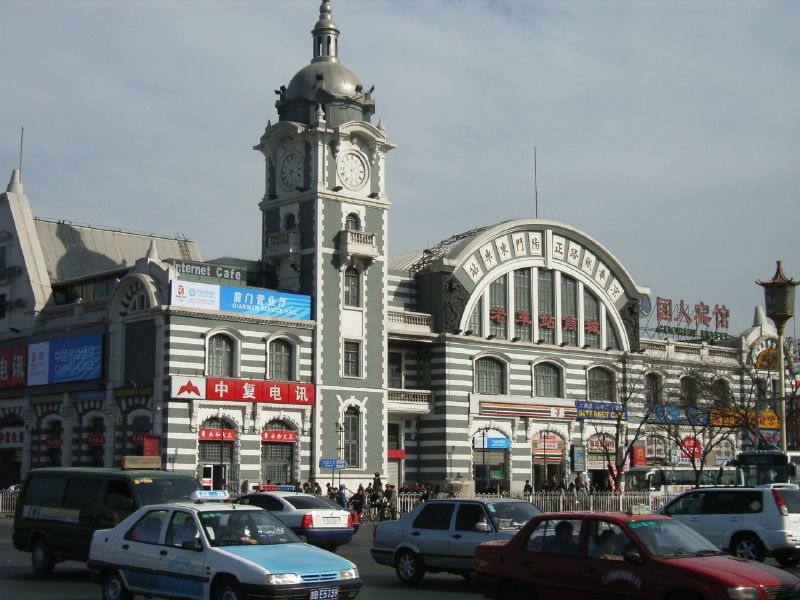
Gene Zhang [CC BY 2.0 (https://creativecommons.org/licenses/by/2.0)]
My first trip from Beijing to Tianjin took over three hours on a slow-moving passenger train. Today, one can get from Beijing South Railway Station to Tianjin Railway Station on the Beijing-Tianjin High-Speed Train in 30 minutes.
There was a vibrancy in the air when we stepped off of the train at the Beijing Station 北京站 Běijīngzhàn on a hot July day in 1982. The grey, blue, and green colors of day faded softly into the concrete and stone buildings and bridges and the air of China’s capital city. Moving like a snail in a Didi Chuxing car (China’s Uber), it’s hard to imagine many of these same streets packed chock-a-block with bicycles. There still seem to be bunches (not billions) of bikes in Beijing, but most of them are shared bikes. And an increasing number of shared bikes are broken bikes. Bikes no longer own the road, cars do.
So many things taken for granted a few decades ago are a shadow of what they used to be. Barbers had spots on the street and at sidewalk intersections in the parks. It’s said that one can still find old men at Yùyuāntán Park 玉渊潭公园 who will trim your hair for a few yuan. And in the early morning, men walking their birds and Taiqi “boxers” have been joined by practioners of Qigong, a variety of wǔ shù (武术) martial arts, badminton players, gymnasts, and ballroom dancers.
Beijing lawmakers banned bāozi (包子) and jettisoned jiānbǐng (煎饼) when they made the Haidian hawkers close down shop. Baozi is the quintessential northern comfort food. It’s a fist-sized wheat flour pastry filled with meat and/or vegetables and then steamed. Jianbing is more difficult to describe. It’s made with flour (millet or wheat), thickness somewhere between a crepe and a dosa. After the flour mixture is poured and spread onto the large, round cast iron pan, it becomes the “bing”. Add an egg (or two) by spooning or brushing it onto the bing. Then a generous sprinkling of green onions and a pinch of salt; some sweet bean paste; a shake or two of sugar; maybe a little baste of hot pepper sauce aka là jiāo jiàng (辣椒酱). On top of all of that spread a few shards of guǒ bì (馃箅), that crispy fried dough that goes on top of everything else. Then roll it up like a big burrito, fold it in two, cut it in half, and put into a paper or plastic bag. Beijing breakfast.
I heard the street food’s also gone in Xidan and Sanlitun. Is there still someone selling green onion cakes aka cōng yóubǐng 葱油饼 outside of the Temple of the Azure Clouds in Xiangshan? Thank God for Wangfujing. Rumor has it, the night market is still going strong. I’m sure they still have the amazing Xinjiang kebabs (串儿Chuànr) and sugar coated haw fruit aka tánghúlu 糖葫芦 . It’s been a few years, but I’m heading up to Beijing next week. Guess I get to see for myself.
Chinese Odyssey 45
Three hours from Tianjin
to the heart of Beijing.
There were vendors on bikes
hawking fresh congyoubing.
Haircuts on the corners,
men walking their birds,
Sword Taiqi at daybreak
not saying a word.
 The Panda in the Room PD