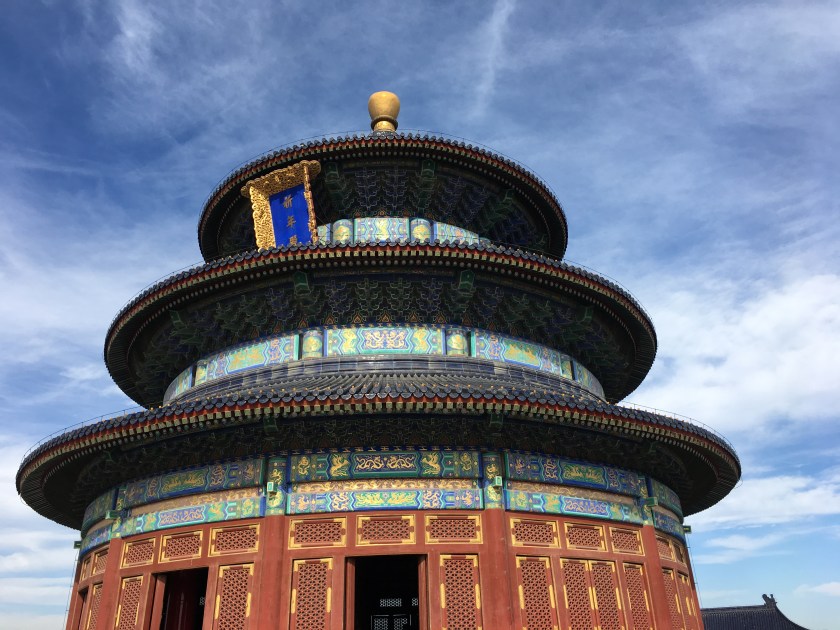
Built in the early 15th century during the rule of Emperor Yong Le (永樂帝 Yǒnglè Dì), 3rd Emperor of the Ming Dynasty, the Temple of Heaven (天壇 Tiāntán) is internationally recognized as the symbol of Beijing. The cobalt blue tiles which make up the roof of the Hall of Prayer for Good Harvests are earthly manifestations of heaven and the sky. The nail-less structure of the wooden building, supported by “dougong brackets” https://multimedia.scmp.com/culture/article/forbidden-city/architecture/chapter_02.html) further compel anyone who visits to celebrate this monument, and to wonder and to smile at its magnificence. Like beautiful mosques, amazing cathedrals, and temples of faith around the world, the Temple of Heaven aspires to be a conduit between heaven and earth. Emperors of both the Ming and the Qing Dynasty would visit the Temple of Heaven at least once a year to pray for good harvests. After briefly wresting power from Sun Yat-sen in 1913, the last imperial wannabe, Yuan Shi Kai visited the Temple of Heaven in 1914, in hopes of moving from provisional President of the newly established Republic of China to Emperor of a new Hongxian ( 洪憲) dynasty. He actually declared himself Emperor of China on January 1, 1916. Unfortunately for Yuan Shi Kai, neither heaven nor the masses smiled at this usurpation of power. 83 days into his rule, he abandoned his emperorship, and by June 1916, Yuan Shi-Kai succumbed to a natural death from uremia at age 56.
20 kilometers to the west of the Temple of Heaven lies another famous landmark in Beijing, the Summer Palace. Only about 3 kilometers square, once you’re inside the park it seems much larger than that. About three-quarters of the park is occupied by Kunming Lake.
During the reign of the Qing Dynasty Emperor Qianlong, the original natural lake was dredged and sculpted like the park itself. When I go to the Temple of Heaven, I like to walk around the lake. Like so many places in China, if you walk away from the center of the action, the crowd diminishes by about one half after ten minutes. Continue for another 10 minutes and it starts to feel quiet. 30 minutes out from the focus of main tourist areas in China, you can be by yourself. At the Summer Palace, there is the Long Corridor stretching along one side of Kunming Lake, hand painted from top to bottom with landscapes, temples, flowers, birds, musicians, and figures from China’s history, Suzhou Street with its Qing Dynasty like shops, the pagodas on Longevity Hill, and the Marble Boat that could never float. A connection that not everyone makes, however, is between the Summer Palace and the Dowager Empress Cixi. It was Cixi who actually renovated the already existing marble party boat using funds embezzled from the Chinese navy.
A “dowager” is a widow who assumes a title from her deceased husband. Although never technically China’s “empress”, the “Empress Dowager” aka 慈禧太后 Cíxǐ Tàihòu, assumed the mantle of leadership for nearly 50 years in China during the waning years of the Qing Dynasty (late 19th and early 20th centuries) as the “Empress Dowager Cixi.” Cixi was actually one of the many young imperial concubines of the Xianfeng Emperor (咸豐帝 Xiánfēngdì). Her son, Zaichun (載淳 Zǎichún) became the Tong Zhi Emperor (同治帝 Tóngzhìdì) from 1861-1875. Zaichun died of smallpox (or possibly syphilis) in 1875 leaving no male heir. Cixi then appointed his three-year-old cousin as successor in the new Guangxu (光緒) era and so, was able to continue her rule. The new emperor’s mother mysteriously died soon after, thus securing Cixi’s rule and continued dominance. As the Guangxu emperor grew up, although he was emperor by name, the Empress Dowager Cixi was the de facto ruler of China. In 1898, Cixi actually had the Emperor removed from power and imprisoned in the Hall of Jade Ripple (玉澜堂) in the Summer Palace, where he remained until his death at age 37, just one day before the death of Cixi in 1908. Cixi had already named Puyi, her two-year-old nephew, as the new (turned out to be “the last”) emperor of China.
A final note on the Summer Palace. The Summer Palace was where the Imperial Family would move to as a respite from the summer heat, and the walls of the Forbidden City. Even though the current “Summer Palace” was built in the early Qing Dynasty, until 1860, the real summer palace, Yuan Ming Yuan (圓 明 園; Yuánmíng Yuán), was a complex of a much grander scale and was only a short distance away from the current Summer Palace. It was actually known in Chinese as the “Imperial Garden” (御 園 Yù Yuán). It contained extensive gardens and was replete with beautiful buildings as well as historical and artistic treasures. When I first visited the “old Summer Palace”, I erroneously assumed that the smashed up statues and destroyed buildings had fallen victim to the Cultural Revolution. That idea was quickly put to rest when our guide told us that this park had been destroyed by the French and the British. In 1860, after the 2nd Opium War, a small delegation made up of British and Indian troops was sent to meet and discuss the Qing surrender with Prince Yi (怡親王). While negotiations were going on, British and French troops took it upon themselves to do a little pillaging and plundering of the old Summer Palace. After it was learned that 20 members of that delegation had been tortured and killed by the Chinese, all hell broke loose. Lord Elgin, British High Commissioner to China, ordered the complete destruction of the Summer Palace. After three days, nearly 4,000 French and British soldiers had turned the summer palace into a war zone. Looted pieces of art that were not destroyed can still be seen in museums and in private collections around the world today.
A Chinese Odyssey 47
The Temple of Heaven’s
dome shone cobalt blue.
We stared at the sky
where dragon kites flew.
Sailed round Kunming Lake
In a grand marble boat
which the dowager empress
could never make float.
 The Panda in the Room PD