Walls in China pre-date the earliest historical dynasties. Built as enclosures, walls have been a part of every Chinese village and city for most of China’s history. Indeed the character chéng (城), depending on how it is used, can colloquially mean either wall or city. Beijing, Shanghai, and Nanjing all had walls surrounding them, long gone now. Today, you can rent a bicycle to ride the nearly 14 km perimeter on the top of the city wall of Xi’an, one of the few remaining city walls in China.
In his quest for immortality, Emperor Qin Shi Huang burned books and destroyed historical records so that Chinese history would recognize him as China’s first emperor. Some historians believe that the name “China” came from Qin (pronounced “chin”). It was this emperor who had over 6,000 life-sized terra cotta soldiers and horses made to protect him in the after-life. And, it was Emperor Qin, China’s most narcissistic ruler ever, who decided that he wanted to unite the already existing walls into a barrier wall that would protect all of China and keep the northern barbarian invaders from entering into his kingdom.
Stretching from Shanhaiguan (山海关区) in Hebei Province, 270 km northeast of Tianjin, the Great Wall stretches about 2,250 km (1400 miles) across northern China to the final resting post, Jiayuguan (嘉峪关) in Gansu province. It varies in dimensions, but is nearly 10 meters tall (over 30 feet) in some places and is as wide as a single lane road on the top. It crosses deserts, steep mountain passes, and plains. Combining the lengths of all the tributary walls with that of the northern wall, it is estimated that the Great Wall stretches for nearly 8,000 km (5,000 miles) in length.
Only a fraction of the current Great Wall was initially connected together by Emperor Qin. Most of the Great Wall was built during the Ming Dynasty (1368-1644). The Ming Dynasty overthrew the Yuan Dynasty which had been ruled by the Mongolian people to the north. A large portion of the Great Wall was built to prevent another invasion from the Mongolian steppes. There is no way of ascertaining the human cost of building the wall. Historians believe that the number of people who died constructing the wall exceeds 1,000,000. Scientists all agree that there’s no way that a person could make out the Great Wall or any other man-made construction from the moon. And most military minds agree that a wall is an ineffective way of protecting a border.
That said, the Great Wall is impressive. And it’s crowded. Remember my formula for visiting Chinese sites. Walk for 10 minutes and the crowd diminishes by half; another 10 and it can be quiet; 30 minutes and you can be by yourself. Definitely the case for the Great Wall. All the sites are impressive. That’s why they were chosen in the first place. I think my favorite – so far – is the 10 km stretch of the ‘wild’ wall starting at Jinshanling (金山岭) and ending at Simatai (司马台). One used to be able to walk the entire stretch pretty much hassle free. In recent years, certain parts have been closed off for a variety of reasons. At the Simatai end, there used to be an amazing zip-line that would take you from the wall itself over a reservoir onto a platform right outside the tourist area of Simatai. Probably not the safest of Chinese tourist attractions, but maybe they’ve upped the standards. Sure was fun!
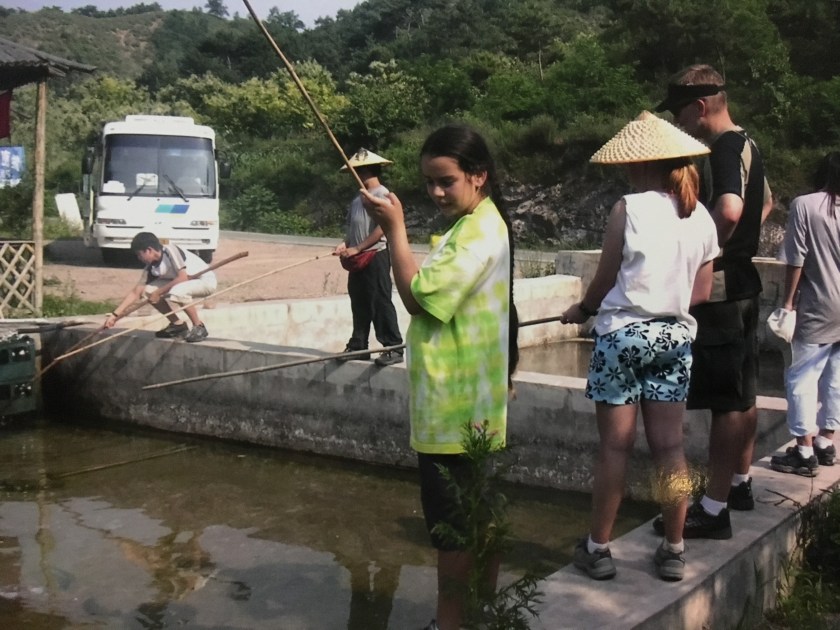
Outside the walls at Badaling (八达岭), Simatai (司马台), and Mutianyu (慕田峪), there were fishing ponds where you could rent cane poles with hooks covered in balls of dough which you cast into small concrete fishing pools teaming with rainbow trout and salmon. After catching a trout, it would then be barbequed on a wood fire and served with local greens and a kind of cornbread. My Montana fly-fishing father is probably turning in his grave reading this, and it wasn’t much of a fishing experience, but the local people did know how to barbeque the fish and they were delicious.
Chinese Odyssey 48
Outside of Beijing
at the Jinshanling wall,
we scrambled and trekked
trying hard not to fall.
We slid down the zip line
into Si-Ma-Tai,
went fishing for trout
on the 4th of July.
 The Panda in the Room PD