 https://all-free-download.com/free-vector/download/china-political-map-vector_587825.html
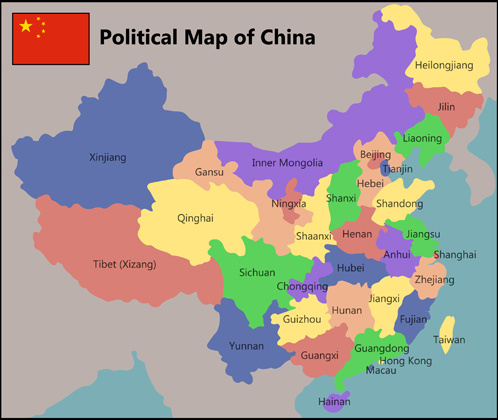
Look closely at the map. I started in Taiwan, then to Hong Kong. From Hong Kong almost due north to Beijing, mostly along the coast. I had skirted the eastern edge of China. Like visiting the east coast of America from Florida to Massachusetts and thinking I’d seen the USA. The Gobi Desert, the Himalayas, Guilin, the Silk Road, the Terra Cotta Warriors. What else was I missing?
Politically, China has 23 provinces (省shěng) – if you count Taiwan as a province (which both China and Taiwan do.) Provinces are like states in the USA. In addition, China has 5 autonomous regions (自治区 zìzhìqū) which are similar to provinces, but each houses a major ethnic minority group which makes up much of its population. Autonomous Regions are supposed to have more freedom to make decisions; 4 municipalities (直辖市 zhíxiáshì) which are huge cities which have the same rights as provinces; and 2 Special Administrative Regions (特别行政区 Tèbié Xíngzhèngqū). The two SAR’s are Hong Kong and Macau. Both Hong Kong and Macau have “high degrees of autonomy” and enjoy the constitutional principle of “one country, two systems”. SAR’s are parts of China, but they get to have their own governments and can make their own laws for 50 years.
From where we left off after leaving the Great Wall, Inner Mongolia lay to my immediate north. From 1271 to 1368 AD, Kublai Khan (忽必烈 汗Hū bì liè hàn), grandson of Genghis Khan (成吉思汗 Chéng jí sī hàn) officially established the Yuan Dynasty ( 元朝 Yuán Cháo) where he claimed all of China to be ruled by Mongolia.
The far western part of China is made up of only two regions: the Tibet (Xizang) Autonomous Region (西藏自治区 Xīzàng Zìzhìqū), and the Xinjiang Uyghur Autonomous Region (新疆维吾尔自治区 (Xīnjiāng Wéiwú’ěr Zìzhìqū).
Until recently, most people in the west had never heard of Xinjiang, and Tibet was associated with esoteric Buddhism, Shang-ri-la, yak butter tea, the Dalai Lama, and to some, the Tibetan independence movement.
Tibet has an interesting history. Often referred to as the “rooftop of the world”, the average elevation of Tibet is 4,500 meters (nearly 15,000 feet). It was in 1271 AD, that China first claimed a portion of Tibet as its own during the Yuan Dynasty when Kublai Khan reigned. This claim of Chinese suzerainty over Tibet continued through the Ming and well into the Qing Dynasty. In 1912, the Republic of China stipulated Tibet as one of its 22 provinces, but in 1913, Tibet declared its independence from China. In 1951, however, China re-asserted its suzerainty over when the People’s Republic of China and Tibet signed a 17 point agreement officially reaffirming that Tibet was a part of China.
Tibet is the most sparsely populated region of China averaging about 2 people per square kilometre. In The Times of India on April 6, 2017, the Dalai Lama clearly stated “We are not seeking independence. We want China to give us meaningful autonomy. We want to remain with the People’s Republic of China.” He went on to say. “Tibet is materialistically backward, but spiritually advanced. We want to develop materialistically by remaining with China and it should also feel the same way for mutual benefit.”
About the same size as Iran, Xinjiang can be separated into two distinct regions by the Tianshan Mountains. To the north of the Tianshan Mountains, the people are composed of a variety of minorities including Kazakhs, Mongols, and Russians, and the predominant religion is Buddhism. South of the Tianshan Mountains in the Tarim Basin, live about 8 million Turkish speaking Uyghur people who practice Islam. The modern Uyghurs who look more Turkish than Han Chinese, descend from the Turkic Uyghurs. Occupying a huge portion of the Tarim basin is the Taklamakan Desert (塔克拉玛干沙漠 Tǎkèlāmǎgān Shāmò). This massive desert has an area about the same size as Germany.
The Chinese first claimed a portion of Xinjiang nearly 2000 years ago during the Han Dynasty. The nomadic people from the far north-western part of Xinjiang supplied Chinese courts with their richest jade as early back as the Shang Dynasty. In the 1990s there were clashes between the 40% Han Chinese and the 47% Uyghurs and in 2009, a series of demonstrations led to 200 people losing their lives and nearly 2000 people suffering injuries in Urumqi. In March 2017, China established new “Regulations on De-extremification” and began arresting Uyghurs and sending them to “re-education camps.” It is estimated that at the time of this writing there are well over 1,000,000 Uyghurs being held against their will in an attempt to educate them on the pitfalls of extremist views on religion.
Chinese Odyssey 51
So we looked at a map
and saw she was right.
We’d just scratched the surface
on our line of sight.
We had to continue
this road to somewhere
so we took a step forward
and said a short prayer.
 The Panda in the Room PD