China was only “conquered” twice. First, by Mongolians during the Yuan Dynasty (1271-1368 A.D.) and then by Manchus in the Qing Dynasty (1644-1912 A.D.) Most of what we know today as Inner Mongolia was a part of Mongolia which defeated the Chinese during the Yuan Dynasty. At the fall of the Mongolians to the Ming armies, there were already divisions among the various tribes. At the end of the Qing Dynasty, the new Republic of China incorporated both Manchuria and a large segment of Mongolia into its new Republic. And it wasn’t until 1945 that most of the rest of the world recognized what we now know as Mongolia as an independent country. Inner Mongolia is an autonomous region of China. Mongolia remains an independent country.
Inner Mongolia reminds me of parts of Montana. It’s the 3rd largest political region of China and is a bit off the normal tourist track. Horseback riding and livestock are abundant on the lush grasslands. There are no really big cities. It also has the longest northern border in China, bordering both Mongolia and Russia. In Inner Mongolia, horse riding, archery, and wrestling used to be known as the “three manly skills.” Rodeo is still big in Montana, but few Montanans wrestle, and guns trumped bows and arrows shortly after Crazy Horse and Sitting Bull defeated Custer at the Little Big Hole in 1876.
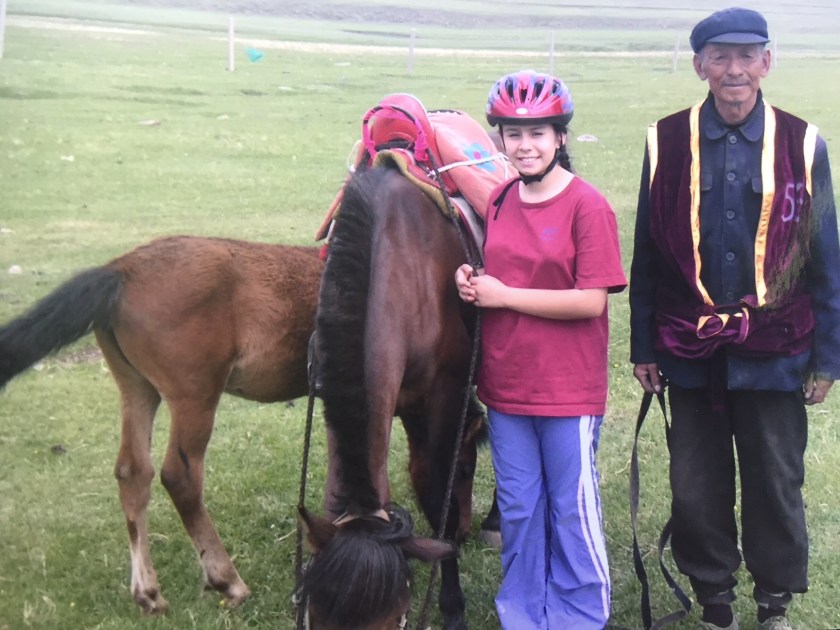
We rode horses on rolling grasslands a few hours from Hohhot. Colorful prayer flags like those in Tibet flew from mounds of stones topped with willow branches (敖包 áobāo) and a local family invited us into their house to have tea and sweet cheese. We spoke Putonghua with kids and asked what they would most like and they said “better schools” and asked us if we could stay and teach. After spending time in the schools and hills, it was time to trot back to our cement yurts complete with bathrooms, western sit-down toilets, air conditioners, and hot showers.
The salty butter tea we drank in the yurts we visited was probably made from cow’s milk and not yak. The “cheese” was sweet and chewy and more like candy than the cheese we were used to.
Inner Mongolia’s traditional musical claim to fame is throat singing – Khoomei (songs of eternity), as it is called in Mongolian, starts with a single pitch. As that pitch is being produced, a second, and sometimes a third pitch comes from the same throat and one is able to hear two and sometimes three sounds simultaneously. This happens by the singer tightening or loosening his throat and manipulating his tongue to produce multiple sounds at the same time.
I first heard Mongolian throat singers in Hong Kong in the 1990s and marveled how one person could produce several sounds simultaneously. Traditionally a male art, females are now becoming quite adept at the technique. Khoomei was once practiced only on the pastoral highlands of Mongolia, but has found its way into many parts of Inner Mongolia. “Khoomei” means “song of eternity” and dates back more than 1000 years. In Inner Mongolia, where the Heilongjiang (Amur River in Russia) forms the border between Russia and China, Mongolian hunters began settling in as nomadic farmers and it is in this environment Khoomei is said to have begun. If you’re curious to hear Khoomei, try listening to a youTube entitled “Huun-Huur-Tu – Live” at
https://www.youtube.com/watch?v=i0djHJBAP3U&feature=youtu.be&t=9m41s In 1929, Arthur Miles tried his luck at Tuvan overtone singing in his rendition of “Lonely Cowboy” Parts 1 & 2 (Dallas, Texas, 1929) hillbilly https://www.youtube.com/watch?v=DpAFZnMyC7o
Chinese Odyssey 53
Our journey continued,
we too headed west
to the grasslands near Hohhot
Mongolian steppes.
Shared yak butter tea
with a family of peasants.
At night we retired
to our yurts, warm and pleasant.
 The Panda in the Room PD