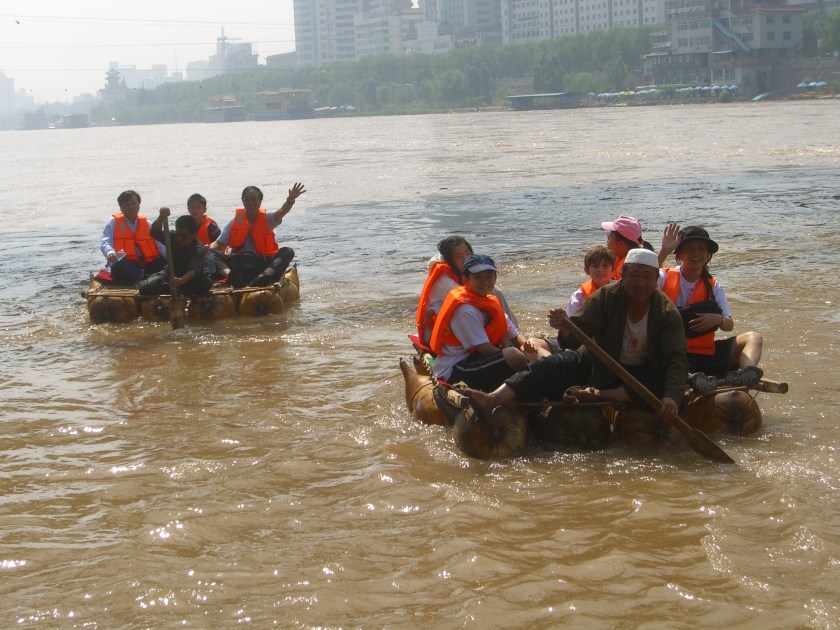
When I saw these boats on the Yellow River outside of Lanzhou for the first time, I was mesmerized.
100 years ago. 1000 years ago. Kids the age of our kids would have ridden on the same boats across the same river at the same place. Were these the first inflatable boats?
The wool must have first been shorn and put away to be made into thread, to be woven into cloth. Then meticulously, the head would have been severed and the flesh, the sinew, the bones, and internal organs would have been removed from that single orifice. Back in the day, there were no raft specialists living on the Yellow River. It would have been the boatmen, the raftsmen, who first painstakingly removed the precious internal organs, the lungs, the heart, the stomach, and the intestines, before taking out the meat and bones. Were there scraping and cutting tools specially designed for removing organs, bones, and meat? Sheep carcasses didn’t need to be discarded. Through a process of trial and error, these craftsmen learned how to dry and scrape and tie and sew the carcasses so that no air was able to get out. The one hole for air was ingeniously cut into one of the hoofs and the owners, after blowing the sheep full with air, would simply fold the trotter in half and tie a few loops of sinew around the hoof.
I imagined ancestors of today’s rafters seeing the floating carcass of a bloated sheep on the river . . .
Big Joe (周大哥) and his two younger brothers, Erdi and Sandi, trudged along a high bank of the Huang He as it meandered across the southern part of the province we call Gansu. They had gone to their normal swimming hole, but found men building a giant water wheel where they used to play. Up ahead was an area Erdi and Sandi had told him looked like a great new place to swim and bathe at the end of a hot day in the fields. As they eased themselves into the water, in the distance Erdi spotted a couple of black dots far up the river and warned his two siblings. Probably some kind of dead animals. His mother had told him when he was young that he should never touch these animals because it might make him sick. Still, the closer they got, the more he was drawn. His parents had always told him not to let anything go to waste and floating past him were two sheep carcasses which would eventually rot and sink into the river. The Huang He was a massive river and Big Joe and his brothers knew they could never afford to own one of the cool wooden barges carrying merchants and soldiers from the northeast. As the dead sheep got closer, Sandi shouted, “Look, Erdi, there are kittens on top of that dead sheep.” Sure enough, two forlorn-looking calico kittens were trapped on the carcass of one of the sheep.
“I’ll get ‘em.” Shouted Sandi as he waded into a shallow trough of the Huang He. Too late. Big Joe could only watch as his brother plunged slow motion into a deep hole and was caught in a strong current. Sandi was a pretty good swimmer, but he was no match for the Huang He.
“Grab the sheep!” yelled Big Joe “and hang on.”
Without thinking, Sandi reached out and grabbed a hunk of wool dragging in the water. As he pulled himself closer, he found that the sheep was buoyant enough for him to climb on top. The poor cats didn’t know what to do. “It’s OK,” said Sandi with a smile. “I’ve come to rescue you.”
At the same time, he thought, “Who’s going to rescue me?”
Big Joe and Erdi ran along the bank shouting, “Paddle in, San Di. Use your hands.”
But Sandi had a better idea. Now that he knew the sheep was strong enough to hold him, he lowered himself back into the water and began to kick. In no time, he found himself getting closer and closer to the river bank. Just before dark, his feet felt the bottom and he was able to walk onto the shore with his calico kittens. He also pulled the stinky sheep on shore.
Big Joe and Erdi ran down to the riverbank and they all hugged. Erdi had some little fish that he gave to the kittens so they were happy, too.
Sandi just sat with a big grin on his face. “You know those dream boats we always wanted, but never could afford?” Sandi asked his brothers. Pinching his nose with one hand, with the other he pointed his finger at the dead sheep and said, “Meet the future.”
The rafts we rode on were made of 12 sheep, and saplings, tied together with sinew and twine. Probably not much different from those made 1000 years ago. Riding on the Huang He on those rafts was a magical trip on a way-back machine.
Chinese Odyssey 56
Then we climbed on the first
“rubber raft” made from sheep.
As we crossed the Huang He,
some of us fell asleep.
Around Gansu and Qinghai,
Tibetans abounded.
In a town called Xia He,
we all stood confounded
 The Panda in the Room PD