Chinese Odyssey 59
We came to some walls
in the midst of the sand
doors lead into caves
remarkably grand
where they preserved
statues, sutras and art
the oldest, the Diamond
the deepest, the Heart
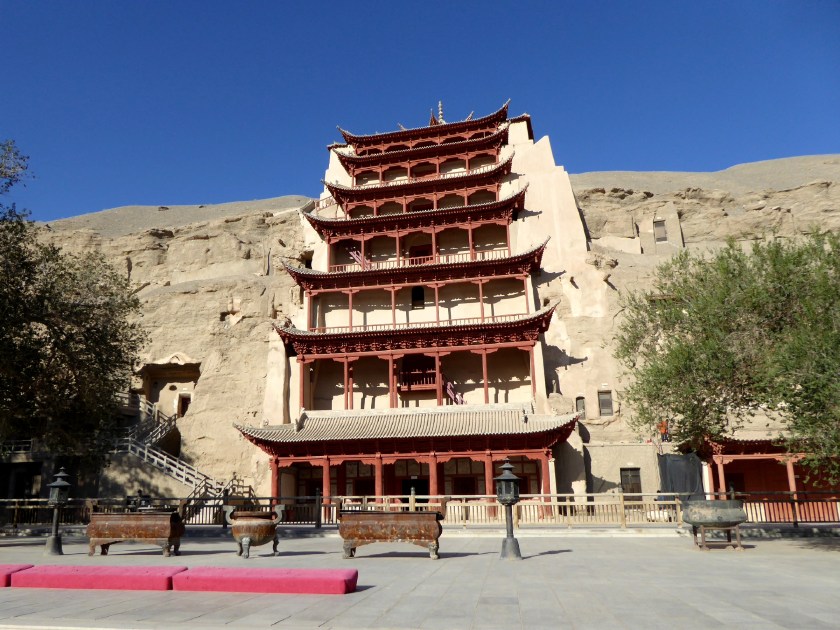 Hiroki Ogawa [CC BY (https://creativecommons.org/licenses/by/3.0)%5D
Located in western China, 200 plus miles west of Jiayuguan on the eastern edge of the Taklamakan Desert, Dunhuang was a nexus where merchants and traders from China and the west interacted with Buddhist pilgrims on the western edge of the Gobi desert. About 25 km southeast of Dunhuang lies an area known as the “Caves of a Thousand Buddhas” (千佛洞 Qiānfó Dòng). It is also called the “Mogao Grottos” (莫高窟Mògāo Kū). They are, in fact, a one mile stretch of nearly 500 caves which were burrowed into sandstone by 366 monks in the middle of nowhere about 1000 years ago.
In 1900, a Daoist monk by the name of Wang Yuan Lu (王圓籙Wáng Yuánlù), discovered a hidden door in one of those caves (cave #17 aka the Library Cave) while doing some painting restoration work. Behind the mysterious door, Wang discovered nearly 50,000 ancient manuscripts, rare textiles, silk embroideries, and other artefacts dating back more than a millenium.
In 1907, Hungarian born British archaeologist Aurel Stein first arrived at the Mogao Grottos. A year later, Paul Pelliot, the French Sinologist and Orientalist followed. Between the two of them, they “purchased” thousands of manuscripts, paintings, embroideries, and other artefacts from Wang Yuan Lu which they sent back to museums in London and Paris. Russian and Japanese explorers and collectors followed close behind.
Stein and Pelliot were also followed by the likes of Langdon Warner of the Fogg Museum in Boston who (according to Dong Linfu) cut out pieces from twelve frescoes because he wanted to preserve Chinese culture and thought that the Chinese were “subhuman, uncivilized, and unable to appreciate their past culture.” Alan Priest followed Warner carving out fourteen pieces of a stone frieze and carrying away six heads of Buddhist statues bound for the Metropolitan Museum of Art. (from Dong, Linfu. Cross Culture and Faith: the Life and Work of James Mellon Menzies. University of Toronto Press, 2005.)
The Mogao caves were designated as a UNESCO World Heritage Site in 1987.
The Heart Sutra was one of the documents retrieved from the Mogao caves. It’s recent translation by Thich Nhat Hanh as “The Insight that Brings Us to the Other Shore” (2014) is licensed under a Creative Commons Attribution-Non Commercial 4.0 International License.
Avalokiteshvara, while practicing deeply with
the Insight that Brings Us to the Other Shore, suddenly discovered that
all of the five Skandhas are equally empty, and with this realisation
he overcame all Ill-being.
“Listen Sariputra, this Body itself is Emptiness
and Emptiness itself is this Body. This Body is not other than Emptiness and Emptiness is not other than this Body. The same is true of Feelings, Perceptions, Mental Formations, and Consciousness.
“Listen Sariputra, all phenomena bear the mark of Emptiness; their true nature is the nature of no Birth no Death, no Being no Non-being, no Defilement no Purity, no Increasing no Decreasing.
“That is why in Emptiness, Body, Feelings, Perceptions, Mental Formations and Consciousness are not separate self entities.
The Eighteen Realms of Phenomena which are the six Sense Organs, the six Sense Objects, and the six Consciousnesses are also not separate self entities.
The Twelve Links of Interdependent Arising and their Extinction are also not separate self entities. Ill-being, the Causes of Ill-being, the End of Ill-being, the Path, insight and attainment, are also not separate self entities.
Whoever can see this no longer needs anything to attain.
Bodhisattvas who practice the Insight that Brings Us to the Other Shore see no more obstacles in their mind, and because there are no more obstacles in their mind, they can overcome all fear, destroy all wrong perceptions and realize Perfect Nirvana.
“All Buddhas in the past, present and future by practicing the Insight that Brings Us to the Other Shore are all capable of attaining Authentic and Perfect Enlightenment.
“Therefore Sariputra, it should be known that
the Insight that Brings Us to the Other Shore is a Great Mantra,
the most illuminating mantra, the highest mantra,
a mantra beyond compare, the True Wisdom that has the power
to put an end to all kinds of suffering. Therefore let us proclaim
a mantra to praise the Insight that Brings Us to the Other Shore:
Gate, Gate, Paragate, Parasamgate, Bodhi Svaha! Gate, Gate, Paragate, Parasamgate, Bodhi Svaha! Gate, Gate, Paragate, Parasamgate, Bodhi Svaha!” (completely gone to the further shore)
 The Panda in the Room PD