Chinese Odyssey 61
From Gansu to Xinjiang,
we traveled by rail.
By bus on a highway
where wind mill farms wail.
Karezes of Turfan
flowed down from Tian Shan.
Flaming Mountains nearby
were too hot for man
 Samuel Bailey (sam.bailus@gmail.com) [CC BY (https://creativecommons.org/licenses/by/3.0)%5D
Looking out the window of our air conditioned bus, the Flaming Mountains (火焰山 Huǒyànshān) aka Gaochang Mountains (高昌 Gāo Chāng) seem incredibly inhospitable. In summer the temperature of the Flaming Mountains frequently exceeds 50 °C (122 °F). Passing by in the early evening, the low hills seem to be on fire, henceforth their name. It was hard to believe that beneath these Flaming Mountains there were manmade tunnels built 2000 years ago carrying crystal clear water from the alluvial plain at the base of the Tianshan Mountains (天山) into the farmlands of Turfan nearly forty kilometres away.
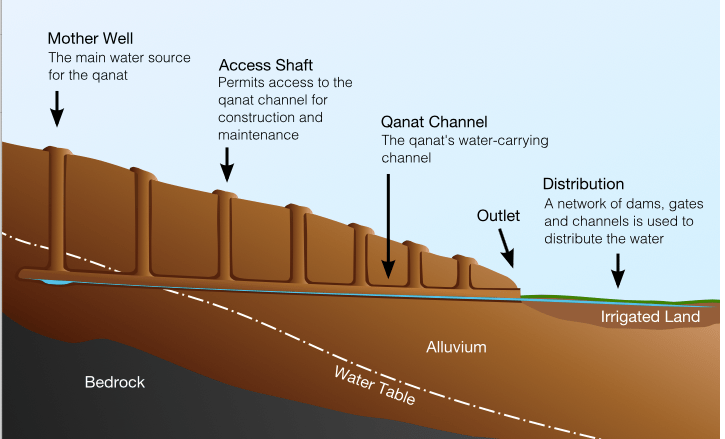
Turfan aka Turpan (吐鲁番市 Tǔlǔfānshì) lies about 180 km southeast of Urumqi. The 1.27 cm of rainfall a year it receives could never support an agricultural community. Nearly two thousand years ago, farmers and engineers figured out an elaborate system which would transport the snowmelt from the base of the Tianshan Mountains underneath the Flaming Mountains and into Turfan. This underground system (called karez a.k.a. qanats) was comprised of wells of varying depths, some up to 100 feet deep. Between the wells (from 20-70 meters apart) they dug tunnels large enough for a person to stand up and walk through. These connecting tunnels would eventually carry pure sweet water to the grape, pear, pomegranate, apricot, apple, peach, fig, and walnut growing farms of Turfan. Most of the water in Turfan begins with the snow melt at the foot of the Tianshan mountains. This city of 600,000 rests in the Turfan Depression, an area whose average elevation sits 154 m (505 ft) below sea level.
Today, there are only a couple of hundred working karezes in Turfan, down from over 1800 in the 1950’s. Located in a fault bounded trough, the 4,000 sq. kilometers of land situated below sea level called the Turfan Basin is shrinking because of oil-drilling, agricultural use, and glacier melting caused by global warming. To maintain the karezes, now, as in ancient times, once a week someone needs to be lowered down each well into the tunnels to clean out the silt and do whatever maintenance is necessary to keep the water flowing. Like the disappearing rice terraces north of Guilin in the Guanxi Zhuang Autonomous Region, young people who used to maintain these kinds of labor intensive agricultural jobs, no longer want to stay in rural China, but instead choose the more lucrative paths of factory work in mega-cities called Special Economic Zones like Shenzhen and Donguan in Guangdong province.
In the 1920’s when the French sisters and Cable, first arrived in this amazing oasis, they commented “. . . Turfan lies like a green island in a sandy wilderness, its shores lapped by grit and gravel instead of ocean waters, for the division between arid desert and fertile land is as definite as that between shore and ocean. Its fertility is amazing, and the effect on the traveller, when he steps from the sterility and desiccation into the luxuriance of Turfan is overwhelming.” The Gobi Desert by Mildred Cable w/ Francesca French, The Macmillan Company 1944.
 The Panda in the Room PD