Chinese Odyssey 62
“Assalamu Alaikum”
heard more than “Ni hao”.
Was this really China?
If so, where was Mao?
A lake named for Heaven
felt just like my home.
Lake McDonald in Xinjiang
a picture, a poem.
Oo-loo-moo-chee is more or less how this far western Chinese city is pronounced in Mandarin. Ürümqi is the name of the same city on a map. In Pinyin and in Chinese characters, it looks like this – Wūlǔmùqí 乌鲁木齐. Located a little north and west of the center of the Xinjiang Uyghur Autonomous Region, some say that Wulumuqi “is not the end of the world – but you can see it from there.” That said, the estimated population of Urumqi today is 3.5 million, by far the largest city in far western China.
Although some say that Xinjiang has historical claims going back to the Han Dynasty where China called the area a “protectorate of western regions”, most understand China’s legal claim to Xinjiang to have occurred in the Qing Dynasty as a result of the Dungan Revolt in 1884. The name “Xinjiang” actually means “new border” and refers to any area previously claimed to be a conquered region of China and was lost and then regained.
Islam has played a major role in Xinjiang for a millennium. The majority of people living in Urumqi are Han Chinese, but close behind are the Hui and the Uyghurs who are Sunni Muslims. Walking through this colorful city, I received many more smiles when I greeted people with the traditional “Assalamu Alaikum” greeting than I did when I tried to open a conversation with “ni hao”. But Urumqi also felt Chinese. Ethnicities abound, all having occupied this city since its beginning. Most of the stores and goods look the same as those available all over western China. I thought Urumqi to be a really nice amalgamation of people unlike any other city in China I had ever visited.
A little over 100 km due east of Urumqi is a lake called Tian Chi (Heavenly Lake). Located in the Tianshan mountain range, it receives the same snow melt as do the karezes in Turfan. Surrounded by glacial peaks, it really did remind me of Glacier National Park in Montana. Heavenly Lake reminded me of a smaller version of Lake McDonald in Glacier. On a small tour boat I asked the tour operator where people swam. She was adamant that no one could swim in Heavenly Lake. It was much too cold. When I told her about swimming in Lake McDonald, she assured me that it could not have been the same. No one could survive swimming in Heavenly Lake. I beg to disagree.
Although Xiwangmu (西王母) predates Daoism, no one knows her origin story. Time is imperceptible to her, “a thousand years, like a cricket’s chirp.” First appearing in oracle bone inscriptions 1500 years before the birth of Christ, Xiwangmu was revered as the Western Mother. Some incarnations portray her has having the teeth of a tiger early in her life. She was said to have lived in a palatial paradise where gods and humans could come together. She was a Daoist master who enamored King Mu at Turquoise Pond (thought to have been Heavenly Lake) in the Zhou Dynasty. She was said to have visited the Emperor Han Wu Di in a chariot made of purple clouds. But neither King Mu nor Emperor Han Wu Di was able to complete her teachings which would have allowed them to attain immortality. She is also mentioned in the Journey to the West where she had a peach tree garden which only blossomed every three thousand years. The monkey king was still out of control at this time, insisting that everyone refer to him as Qítiān Dàshèng (齊天大聖), or the “Great Sage Equal to Heaven”. For eating all of the immortality peaches in the Jade Emperor’s garden, Sun Wu Kong (the Monkey King) was imprisoned under a mountain for 500 years.
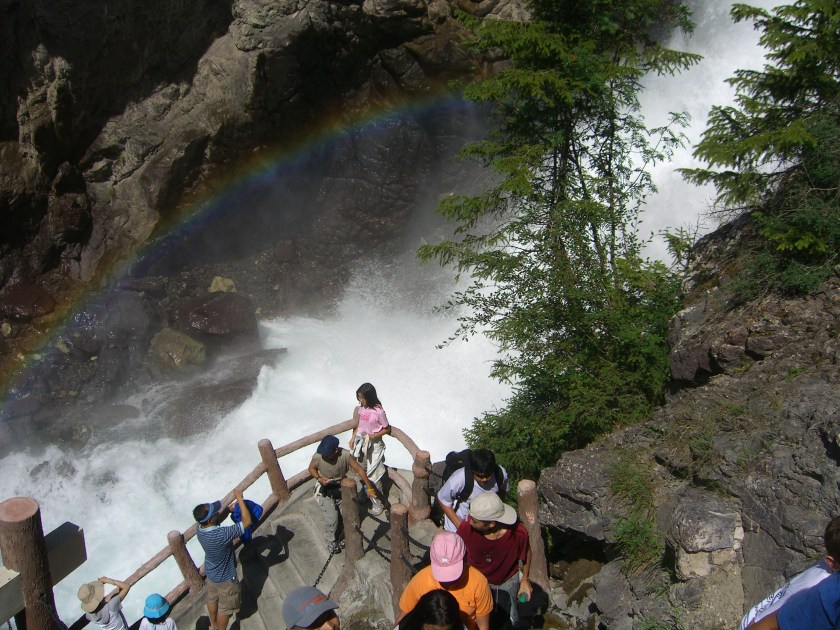
Walking down a manicured path beside Heavenly Lake we eventually began our descent down wooden steps alongside a beautiful stream which turned into an amazing rainbow shrouded waterfall. The splashing water and the crisp air breathed new life into all of us before boarding the bus back to a birthday banquet in Urumqi.
 The Panda in the Room PD