Chinese Odyssey 67
Southwest into Sichuan
where four rivers flowed
Gold monkeys and pandas
roamed through Jiuzhaigou
Du Fu and Li Bai
two poets of Tang
Remembered today
in poems, paintings, and song.
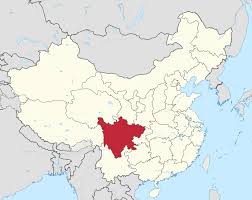 https://commons.wikimedia.org/wiki/File:Sichuan_in_China_(%2Ball_claims_hatched).svg
Sichuan is the Pinyin spelling of Szechuan. Many westerners who see this word associate it with spicy food. The word Si (四 sì) means “4”. The word Chuan (川 chuān) means “river”. The four rivers are the Jiālíng, the Jīnshā, the Mín, and the Tuó. So Sichuan means “Four Rivers.” As you can see from the map, Sichuan is located in the dead center of China, but most Chinese think of it being in western China (kind of like Ohio and Indiana referred to as mid-western states in the USA.) Sichuan used to include the city in China with the largest population – Chongqing (重庆 Chóngqìng) aka Chungking (30.8 million people). In 1997, Chongqing was declared China’s 4th municipality which meant it was self-governing (like Beijing, Shanghai, and Tianjin) and no longer belonged to any province. Kind of like Washington D.C. not being a part of any state.
Now, back to the two things that people know about Sichuan:
- Sichuan has hot, spicy food: Kung Pao Chicken (宫保鸡丁Gōngbǎojīdīng), Mother Po’s Beancurd (麻婆豆腐 Mápó dòufu), Dandan Noodles (担担面Dàndàn miàn), and Chongqing Hot Pot(重庆火锅 Chóngqìng Huǒguō)
- Pandas – Although there are pandas in Shaanxi and Gansu, most wild pandas live in the cool, moist bamboo forested mountainous northern regions of Sichuan at elevations over 5,000 feet (1500 meters). It is almost impossible for a tourist in China to spot a panda in the wild. There are, however, Panda research centers in Sichuan where tourists can see and interact with pandas.
In Dr. John C.H. Wu (吳經熊)’s classic, The Four Seasons of Tang Dynasty Poetry, he called the poet, Li Bai aka Li Po (李白 Lǐ Bái), the “Prince of Spring”. Li Bai’s contemporary and good friend, Du Fu, once said of Li Bai:
“All the world wants to kill him
I alone dote on his genius
Quick-witted,
he has hit off a thousand poems
A waif in the world,
his only home is a cup of wine.”
Born in far western China, or possibly present day Kyrgyzstan, Li Bai was living in Chengdu, Sichuan at age 4 and continued to spend his next two decades there before he began to wander. Li Bai was a living testament to Tolkien’s great line, “not all who wander are lost.” A great friend and soul-mate to Daoist holy men, after meeting Li Bai, Ho Chih Chang (賀之章 Hè Zhī zhāng), a Daoist poet said of Li Bai “Why, you do not belong to this world. You are an angel banished from Heaven.” Li Bai reminds me of the American poet and song writer of the depression era, Woodie Guthrie. They were both prolific in their writing and their poetry had mass appeal. Neither one was able to keep a family together, so strongly were they drawn to the road and their poetry.
送別 Sòngbié
下馬飲君酒 Xiàmǎ yǐn jūn jiǔ,
問君何所之? wèn jūn hé suǒ zhī?
君言不得意 Jūn yán bù déyì,
歸臥南山陲 guī wò nánshān chuí.
但去莫復聞 Dàn qù mò fù wén,
白雲無盡時。 báiyún wújìn shí.
Farewell – Li Bai
Come down off your horse, my friend, and have a drink!
Where are you off to?
Nowhere in particular.
Heading towards the Southern Hills.
That’s all I know for sure.
Just plan to drift like the clouds.
Dr. Wu said of Li Bai: “He is the perfect embodiment of the spirit of romanticism, in life, as well as in letters. He is romantic, imaginative, passionate, contemptuous of form and convention, grandiose and picturesque in thought and language, remote from experience, and visionary – there is no romantic quality that he lacks.”
If we consider Li Bai as the “party poet”, then Du Fu, aka Tu Fu (杜甫Dù Fǔ), could rightfully be called the “Poet Sage” (詩聖 shī sheng.) The young Du Fu was a great admirer of Li Bai, who was twelve years his senior. Li Bai, a romantic, reckless alcoholic, married multiple times, much more drawn to Daoist alchemists than he was to the Analects of Confucius, was the polar opposite of Du Fu, devoted Confucian scholar, who desired nothing more than to be a contributing civil servant, and a devoted family man. And yet, the “yin” and the “yang” were friends who held one another in the greatest esteem.
Climbing High – Du Fu
Swift wind, heaven high, an ape’s cry of grief,
At the islet of clear white sand, birds circle round.
Endlessly, trees shed leaves, rustling, rustling down,
Without cease, the great river surges, surges on.
Ten thousand miles in sorrowful autumn, always someone’s guest,
A hundred years full of sickness, I climb the terrace alone.
Suffering troubles, I bitterly regret my whitening temples,
Frustratingly I’ve had to abandon my cup of cloudy wine.
登高 Dēng Gāo
风急天高猿啸哀 Fēng jí tiān gāo yuán xiào āi
渚清沙白鸟飞回 zhǔ qīng shā bái niǎo fēi huí
无边落木萧萧下 wú biān luò mù xiāo xiāo xià
不尽长江滚滚来 bú jìn cháng jiāng gǔn gǔn lái
万里悲秋常作客 wàn lǐ bēi qiū cháng zuò kè
百年多病独登台 bǎi nián duō bìng dú dēng tái
艰难苦恨繁霜鬓 jiān nán kǔ hèn fán shuāng bìn
潦倒新停浊酒杯 liáo dǎo xīn tíng zhuó jiǔ bēi
 The Panda in the Room PD
.svg)