Chinese Odyssey 68
Ate juicy tomatoes
which monkeys all wanted
Monasteries at Emei
Van Gulikly haunted
Slurped Chong Qing hot pot
at Laozao in Cheng Du
The Dandan Mian
made me run to the loo
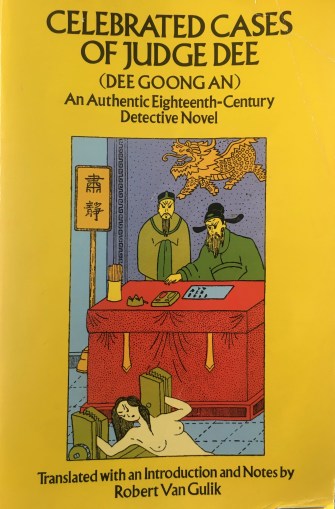
“He can have anyone arrested, he can put the question to suspects under torture, have recalcitrant witnesses beaten up on the spot, use hearsay evidence, bully a defendant to tell a lie, and then trip him up with relish, . . .” (Gulik, Robert Hans van. Celebrated Cases of Judge Dee = Dee Goong An: an Authentic Eighteenth-Century Chinese Detective Novel. Dover Publications, 1976)
Robert Hans van Gulik (髙羅佩Gāo Luópèi) , Dutch diplomat, correspondent, amateur primatologist, musician, calligrapher, and “Orientalist” will probably be best remembered as a mystery writer. Van Gulik wrote seventeen mysteries about a Tang Dynasty judicial super star by the name of Judge Dee aka 狄公案 Dí Gōng’àn . Fashioned after a real-life judge who lived in the Tang Dynasty during the reign of China’s only female emperor, Wu Zetian (武則天Wǔ Zétiān.) Judge Dee’s real name was 狄仁傑 Dí Rén jié (607-700), and he was a Tang dynasty prime minister under Empress Wu Zetian.
Born in the Netherlands, van Gulik’s family moved to Jakarta in 1913 when he was only three. His father was a physician and medical officer in the Dutch army corps. At that time, Jakarta was called Batvia and Indonesia went under the name of the Dutch East Indies. It was during his childhood there that van Gulik first began his studies of Chinese, something he continued throughout his life. His university studies focused on East Indian law and culture and he joined the Dutch foreign service in 1935. He served in various capacities in Japan, China, Lebanon, India, and in the USA. While stationed in Chongqing during WW2, he fell in love with and married Shui Shifang and they had four children.
In late 1940’s post-war Japan, while stationed in Tokyo , van Gulik picked up a book called 武則天四大奇案 (Four Great Strange Cases of Empress Wu’s Reign) in a used book store in the back alleys of Tokyo. This was van Gulik’s first translation. He called it Celebrated Cases of Judge Dee. Since he was living in Japan at the time, his first editions were in Japanese and in Chinese. In 1949, he first self-published 1200 signed English copies.
What’s amazing about the van Gulik books though is the window they provide us to look into a legal system very far removed from ones that most of us are used to. The judge is not only the person who decides the outcome of a case, he also directs the investigations and with the proper mixture of intelligent questioning and irrefutable evidence compels even the most resistant to eventually confess. Torture, beratement, discomfort, humiliation, and even communication with spirits are all legitimate tools for the judge to apply with full compliance of the public. The judge is fully in charge from the initial arraignment through the public executions (of which he has a variety to select from depending on the nature of the crime.)
Starting at a trail near the base of Mt. Emei (峨眉山 Éméi shān), one of the “4 sacred Buddhist mountains” of China, we walked on a trail alongside a crystal clear stream. Bought fresh tomatoes and watermelon slices from local vendors and were surprised by monkeys (actually Tibetan macaques) who demanded their fair share. I wish I could say we walked the “10,000 steps to Heaven” to summit Emei, but I can say that we walked many a step before we arrived at a Buddhist temple (Baoguo Temple报国寺 Bàoguó Sì) which also served as our accommodation for the night. As soon as I set my back pack down in my room, I imagined myself smack in the middle of the Chinese Bell Murders. I was immediately transported to the “Buddhist Temple of Boundless Mercy” and imagined Judge Dee prowling its halls.
 The Panda in the Room PD