Chinese Odyssey 73
A mini-Potala,
old homes from Tibet.
Zhongdian had a prayer wheel
I’ll never forget.
The summer horse games
headlined racing yaks.
Tiansheng Hot Springs
best place to relax.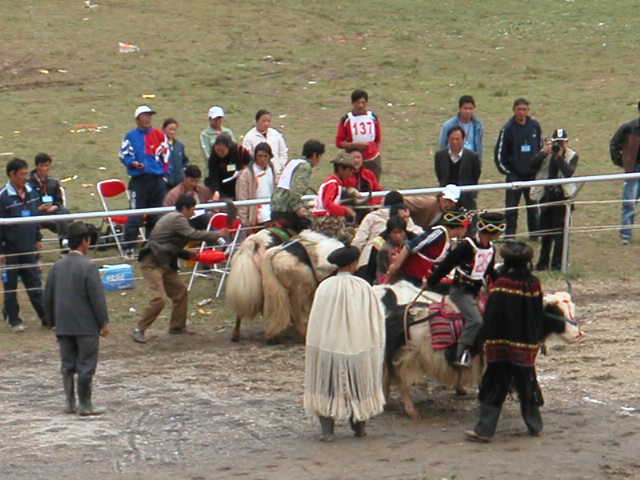
One of the best experiences during my college years was my ‘gap year.’ Although I wasn’t aware of the term back then, I knew was that sitting in classrooms at a state university wasn’t really working for me. When a friend phoned in early June and asked me to come join a hay crew at a ranch in Horse Prairie near Dillon, Montana, I jumped at the chance. It turns out that my friend, Katie, had been talking to our mutual friend Kate, whose mother happened to be in the room with Katie and Kate. It turned out that Katie’s mother had once had a huge crush on my father when she had been at the same university. The deal was sealed, and later that week I set off from Missoula for Dillon and eventually to Grant and a ranch on Horse Prairie. As the ‘new kid on the block’, I started off shoveling shit in the barn. The next day I found myself armed with a pitchfork at the bottom of a beaver slide awaiting the next mound of hay from above. As the hay was dumped on top of me and a couple of other young crew members, we spread it out across the temporary frame, and in a few hours we had built a 12 ton hay stack with us proudly standing on the top. I lived in a bunkhouse with two other ranch hands. There was one bare bulb hanging from the ceiling and a pot-belly stove on one side of the room. The toilet and shower were located in the back of the cook house across from us, and it was there we ate “three squares” a day. Three squares meant gobbling down as many eggs and as much bacon, beef, bread, and potatoes as we needed to sustain us through a 12 hour work day of haying. All washed down with percolated coffee and fresh milk from the two dairy cows that were there to supply the ranch families with their daily needs.
Haying was just the first of my “general education classes” at the ranch. I had similar hands on courses in branding, calving, and fencing. Working alongside families who had grown up on the ranch, I learned how to fix machinery, build buck rakes, pound posts and string barbed wire, construct beaver slides from scratch, and how to build and fix fences made out of pine poles that we harvested ourselves. Night courses consisted of boomers and bars, country music, poker, and hangovers. Finally, there was Old Timers Day in Jackson Montana. It turns out that Captain Clark and Sacajawea had passed through there a century and a half ago and Sacajawea had cooked up some pretty good beef herself. This was the day when local ranchers baked bread, dug a giant barbecue pit where they slow cooked the best beef I’ve ever had. Chunks and slices of beef were put between slices of homemade bread slavered with butter and the sandwiches were given away. With a delicious sandwich in one hand and a bottle of Bud in another, we sat down on a blanket on the ground with our friends on freshly cut fields of hay interspersed with camomile and clover. Cowboys, families, from Big Hole, Bannock, Horse Prairie, Dillon, and tourists who were passing through all joined in. I swear to God, my year out of University spent at Horse Prairie might just have been the year of my education where I learned the most.
And it’s here that I segue back into western China. With a history going back nearly two millennia, every year during the 5th month of the Lunar calendar, on the same day as the Dragon Boat Festival, a three day horse festival is held near a city 120 km due north of Lijiang called Shangri-la (香格里拉, Xiānggélǐlā). Up until 2001, the city now called Shangrila was known as Zhongdian. The Five Phoenix Mountain Horse Racing Festival (五峰山赛马节 Wǔfēngshān Sàimǎ Jié) takes place in a 10,787 foot high meadow at the base of the snow-capped Five Phoenix Mountains. In a similar fashion to the people from southwestern Montana folks coming together from the prairies, hills and valleys for Old-Timers Day, people from north western Yunnan came in from the mountains and grasslands to gather with neighbours and family that they may only see once a year. Children play in the lush grass on the hillside as families vie for the best places to set up their colourful tents. While the boys are busy prepping their horses, saddles, and bridles for the races, girls are dressing up in traditional costumes for dancing and singing competitions. There is wrestling, tug-of-war and a plethora of merchants walking around plying their wares. And there’s a fair amount of drinking and gambling. Finding a spot, we watched horse racing on a make-shift track and finally got to see the Yak racing competition. Not all of the yaks who raced were experienced and some wanted to go in different directions, but in the end, there were winners. Actually, aside from hangovers and betting losses, I witnessed very few losers in this fun time in the hills of northern Yunnan.
Don’t go to Xiānggélǐlā hoping to find James Hilton’s Shangrila. You’ll be disappointed. Although there is no train to Zhongdian, there is an airport and a fairly major highway that will get you there from Lijiang in under four hours. Xiānggélǐlā is very similar to other towns of its size in western China. What makes it cool are its surprises: The Little Potala (松赞林寺 Sōngzànlín Sì) is a magnificent temple belonging to the Yellow Hat sect of Tibetan Buddhism. At a distance, it reminds one very much of the Potala in Tibet. The Songzanlin Temple houses 1500 monks and stands on the outskirts of Zhongdian on the edge of the grasslands.
In 2014, a devastating fired swept through Zhongdian gutting much of the old Tibetan town. Some of the Tibetan style houses remain. We had a beautiful meal in an impressive 400 year old dark and slightly smoky wooden home with steep stairs and colourful Tibetan wall hangings leading up to the main dining area. Not far away, on a small hill in the middle of town was a giant prayer wheel with Om Mani Padme Hum inside of it where we couldn’t help but feel part of the cycle of life as we joined the line of local people and tourists who kept the prayer wheel turning. The next day we travelled south for about 10 km to some hot springs at Tianshen Qiao (天生橋 Tiānshēngqiáo) where we spent a few hours floating around an oval shaped pool on inflatable toys and mattresses provided by the pool. Once again, we found ourselves the only guests in a magic hot pot that I’m guessing is a lot more popular nowadays.
 The Panda in the Room PD