Chinese Odyssey 75
The roads there were narrow
and sometimes we worried,
turned blind mountain curves
where June snow still flurried.
Descending at last
to a Yunnan plateau
like James Hilton’s hero
we, too, chose to go.
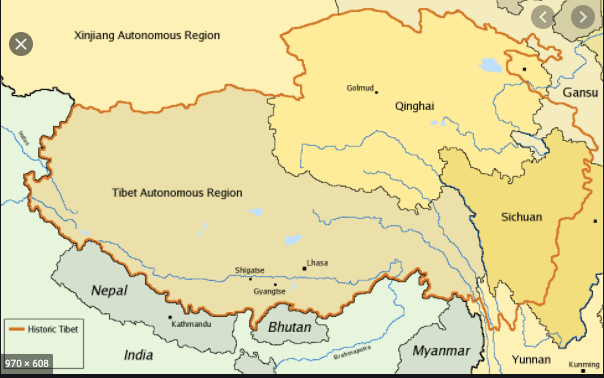 “File:Historic Tibet Map.png.” Wikimedia Commons, the free media repository. 8 Jul 2019, 02:51 UTC. 26 Jun 2020, 01:00 <https://commons.wikimedia.org/w/index.php?title=File:Historic_Tibet_Map.png&oldid=357437409
Tibet Tidbits
- Tibet is about the size of the entirety of western Europe. Tibet is larger in area than the states of Alaska and California combined.
- Tibet exists on a plateau which averages 4,500 meters or a little under 15,000’. It would be safe to say that the 3.2 million people who inhabit Tibet all live their daily lives at an elevation that most people in the world have never experienced.
- Tibet is the southern of the two autonomous regions which make up far western China.
- Tibet is commonly referred to as the “Rooftop of the World.”
- The highest mountain in the world, Qomolangma (Mount Everest) is called by many names: Sagarmatha सगरमाथा in Nepali; Chomolungma ཇོ་མོ་གླང་མ in Tibetan; and 珠穆朗玛 Zhūmùlǎngmǎ in Chinese. It sits on the border of Tibet and Nepal.
- The name, Everest, comes from British surveyor Colonel George Everest since it was determined in 1865 to have “no name intelligible to civilised men.” It is said that Colonel Everest was somewhat embarrassed by the honor.
Deqin is as close as I have come to actually being in Tibet. Deqin and other parts of northern Yunnan, western Sichuan, Gansu and almost all of present day Qinghai used to be parts of Tibet.
Zipping around the turns on the single two lane road from Zhongdian to Deqin reminded me of mountain roads we used to take in Montana. I’m talking about those paved country roads that weave through mountain passes connecting one valley to another. The bus driver was a little crazy and we had to ask him to slow down several times. Looking out the window, the countryside appeared mostly wild and mostly untamed. Untamed, except for the red, pink and white azaleas popping up around what seemed like every corner as we approached Fēiláisì (飞来寺), a temple complex on the mountain road overlooking Deqin and the Beijiang River Gorge. The multi-colored prayer flags and bright white chortens set against the electric blue sky combined with a stunning view of Kawakarpo Peak (梅里雪山 Méi lǐ xǔe shān) in the distance made me stop in my tracks. It must have been what Hugh Conway experienced when he turned the corner in the tunnel leading from the harsh, bitter, and snowy winds where his plane had crash landed and stared into the idyllic and pastoral setting of Shangri-la. For the briefest moment, as our bus turned the corner and came to a halt, I, too was awestruck and couldn’t help but utter, “Thank you, God.”
Curious about the mountains, I learned that Kawakarpo is the highest of 13 peaks in the range and that it has never been conquered although there have been attempts by Americans, Europeans, Japanese, and Chinese to summit this 6,740 meter peak. The loss of 17 lives of a joint Sino-Japanese expedition in 1991 combined with an increased sensitivity to both the religious and the cultural norms of the area caused the local government to ban further climbing attempts in the year 2000.
I remember Lord Gainsford’s lines from the 1937 film, “Lost Horizon”: “They’ll never forget the devil-eyed stranger who six times tried to go over the mountain pass that no other human being dared to travel. And six times he was forced back by the severest storms. They’ll never forget the mad man who stole their food and clothing, who they locked up in their barracks, but who fought six guards to escape. Their soldiers are still talking about their pursuit to overtake him and shuddering at the memory. Oh, he led them on the wildest chase through their own country and finally he disappeared over that very mountain pass that they themselves dared not travel.”
Was Conway’s Shangri-la a place which could only be found by conquering Kawakarpo? Was Shangri-la a pure land which could only be found and only be entered by one who was pure of heart and was invited in.
“How pure are the mountain peaks
Shining in the sunlight
Such is the purity of my heart
The purity I sing to you . . .
How pure is the mountain air
permeating the peaks and valleys
Such is the purity of my heart
The purity I sing to you. . .”
(Sonam Act 1, Scene 1 p.5 “Ago” by Stan Lai)
Tibet/China Timeline
- China and Tibet were certainly well aware of one another’s existence as early as the Tang Dynasty when Tibet sent its first official diplomatic mission to China in 634 CE.
- Mongol rulers first conquered Tibet for China during the Yuan Dynasty, but Tibet was granted a high degree of autonomy. According to the PRC, from that point until now, Tibet has been under Chinese suzerainty.
- In 1912, the Dalai Lama proclaimed Tibet’s independence to the world, created its own national flag, printed its own stamps, and attempted to establish diplomatic relationships with neighbouring countries. The Republic of China’s government, however, did not recognize their claim for independence even after the death of the 13th Dalai Lama in 1933.
- In 1951, Tibet was forced to sign a treaty known as the “17 point agreement” which guaranteed Tibetan autonomy but which allowed China to set up both civilian and a military headquarters in Lhasa.
- In 1959 there was a large scale revolt in Lhasa where thousands of lives were lost; the current Dalai Lama, Tenzin Gyatso fled to Dharamsala, in northern India where he continues to reside as a political refugee.
- Since 1974, the Dalai Lama has stated many times that Tibet does not demand independence, but does seek “meaningful autonomy.” In 2017, in a speech to the Chamber of Commerce in Kolkata, the Dalai Lama reiterated, “The past is the past. We will have to look into the future.” He went on to say, “We are not seeking independence… We want to stay with China. We want more development.”
I really do love the words and the attitude of the current Dalai Lama. He is amazingly humble and does not consider himself to be more special or significant than anyone else. In an interview with Jörg Eigendorf for the German newspaper Die Welt, the Dalai Lama seemed optimistic about both Xi Jinping and the future of Tibet. Here a few of the Dalai Lama’s words from that 2014 interview which I believe should be mulled over:
- “A few years ago when I met students, they were serious and reserved. Today they smile. Those are signs of change.”
- “A new era has begun with the presidency of Xi Jinping. He wants to create a more harmonious society than the one under his predecessor”
- “The leader of the Communist Party saying something positive about Buddhism is definitely new. He has Buddhists in the family; his mother even practices Tibetan Buddhism. And many Chinese people are fascinated by our religion.”
- “He resolutely fights corruption. And corruption is the main source of mistrust. Xi Jinping is brave. He has alienated large parts of the old cadres. Some high-ranking Chinese officials have been arrested. The president seriously thinks about values.”
- “It is good that China was integrated into the world economy. I’ve always said so. What matters now is that the modern world supports China becoming a democratic country — with rule of law, human rights and freedom of press. So integration is good, for Tibet as well.”
 The Panda in the Room PD
