Chipping Away

Chinese Odyssey 84

The mountain called Zhongguo

which we had ascended 

the tip of an iceberg

to be apprehended

The thousand mile journey’s

first step had been taken

The runway approaching

our time to awaken.   

Often at the beginning of school I will ask my students to raise their hands if they love to learn. In years past, only a few hands went up, but today some students are becoming more savvy as to what “learning” really means. Truth be told, I know very few people who don’t like to learn. In the past, most learning was structured and students often paired “learning” with school.  A goal of mine has always been to remind students that “learning” does not just mean school and that some of our most profound learning happens outside of school.

 Zhuangzi (莊子 Zhuāng Zǐ) told the story “Cutting up an Ox”, about a prince who happened into a butcher store one day just as the butcher split an entire ox carcass in two in one fell swoop. Mesmerized by what he had just witnessed, the Prince queried. “How did you do that?”

“Dunno.” Said the butcher.  “I just go with the Dao.” He thought for a minute and continued.

“When I first saw an ox, all I saw was a giant mass. It was too massive to comprehend.”

This got me thinking. When I took my first serious steps into China, it appeared to me in much the same way. A giant mass. Where do I begin? I could liken myself to the parable of the five men, each with a missing sense, attempting to describe an elephant.

“Towards the end of my third year as a butcher, I began to notice that although I had slowed down my pace, the results were more satisfactory. I saw distinctions. Nowadays I don’t even see the ox with my eyes. My whole body and spirit participates, free to work with no plan. I wait and watch for the openings and when they appear, I guide my knife in their direction. There are no joints that require sawing through.  There is no bone that needs to be chopped or hacked.”

When I stood in front of the window of the Fu Hsing Bakery on Hsin Yi Lu in Taipei all those years ago, the cleavers I held in my hand were my text book and my Chinese-English dictionary. I cut and I hacked I’m sure, but gradually found the spaces for myself. Taipei was a friendly place for Americans in the early 1970’s and slowly but surely, with a lot of help from my Chinese friends, I learned how not to  saw and hack.

Instead of forcing doors open, I found new ways in. Instead of learning Chinese a chapter at a time, I began living in China. Through my studies of Tai Qi, I discovered how to slow down my movements in deliberate and measured ways and discovered that just because western medicine could not physically map the flow of qi, did not mean qi could not be mapped.

In Zhuangzi’s story, the butcher told the Prince that in the beginning he sharpened his knife every day. As he became more adept at his craft, he only needed to hone the edge once a week and later one time a year. His words to the Prince, “I have used this same cleaver nineteen years. It has cut up a thousand oxen. Its edge is as keen as if newly sharpened.”

The Dao had taught him to let the knife find its way. “There are spaces in the joints that can only be found by the thinness of the blade and when those spaces are found, the knife flows through them like water. When I feel the tough places coming, I slow down, I watch carefully, sometimes I almost stop. Finally, the blade finds its way, and ‘thump’, the part falls away.”

Daoism is all about letting go of the need to control. It is about finding not only ones place but ones role in the flow of all things. Like Laozi said in the Dao De Jing. “There is nothing in the world which is softer and more yielding than water. But when it attacks things hard and resistant there is not one of them that can prevail.”

In the end, the Prince acknowledged that the butcher had taught him how to live his life.

An oft quoted line from Laozi states that “A journey of a thousand li begins with a single step”. A less well known line from the same chapter of the Dao De Jing says, “‘Heed the end no less than the beginning. And your work will not be spoiled.”

Today’s  post is the final post to accompany my poem,“ A Chinese Odyssey”. I would love to hear your thoughts and comments about the entire blog or individual posts. I’m sure I made mistakes along the way and would love to have those corrected. I’m not sure when or if the blog will continue, but would appreciate your thoughts on a continuation of” The Panda in the Room” journey. Thanks for your support.

Stay well. 身體健康!

Peter

peterdratz@gmail.com
Yani’s Monkeys

Chinese Odyssey 83

The map that I’d found

when I was pre-teen

Each mountain and river

were places I’d seen

The words without letters

I now understood,

See, the writing was mine

And it looked pretty good.

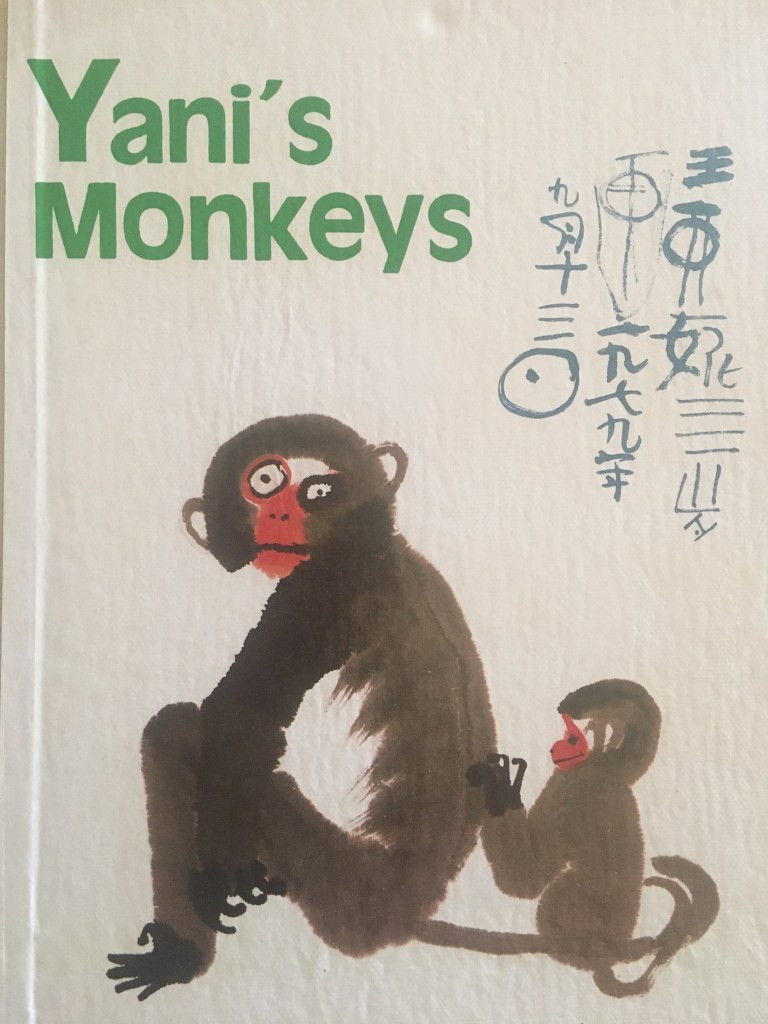
Wang, Yani. Yani’s Monkeys. Foreign Languages Press, 1984.

Someone once told me that China looked like a big chicken and someone else showed me how Taiwan look like a sweet potato.  To one who has always struggled with creating visual art, that worked for me. Although I have a vivid imagination, I’ve always found it virtually impossible for me to transfer my ideas into visual images. I have, however,  always loved looking at drawings, paintings, sculptures, photos – all kinds of art. I marvel at not only the art work I contemplate  in museums, but equally at that produced by my students and my daughters over the years and imagine the map in my poem looking like something Chinese artist Wang Yani might have drawn.
 
One of the most extraordinary artists and presenters I’ve had the fortune of seeing , fourteen year old Wang Yani stood very still on a dais in a small lecture hall at the Nelson-Atkins Museum of Art in Kansas City, Missouri in 1989. A large sheet of white paper was placed on the ground in front of her on the stage and for a few moments, Yani just stared at the paper. Then something happened. She reached down, picked up a brush, mixed some colors on a palette and began to lay blotches of black, brown and red onto the paper. Once she started, she could not be stopped. Each stroke was intentional and meaningful. Yani moved swiftly from one area of the painting to another with an intensity that entranced her audience. Truth be told, I can’t remember if Yani painted monkeys or cats or cranes that day, but I do remember that in the span of 20-odd minutes I was looking at a scene that would make any child smile. There were multiple animals playing on the page with trees and jungles and it all seemed to be moving. Yani’s animated art felt alive.
 
Wang Yani was certainly a child prodigy. First discovered before she was even three years old, Yani painted the picture on the cover of her book at age 4. Wang Yani hails from the Guangxi Zhuang Autonomous Region in southern China. In the area where she lived there were tall pine trees, groves of bamboo, coconut trees, and orchards filled with fruits of many shapes
and colors. Yani would walk among the trees with her artist father and describe sunsets in clouds and flames that “helped the sun cook its meals”. Yani would gather sticks and twigs and leaves and bark and pretend that they were animals. After a visit to the zoo at age three, Yani developed a fascination for monkeys, the ways that they played and screeched and cuddled.
 
Yani, for her part, didn’t really understand the fuss. “It’s simple,” she said. “I just paint what I see.” But I continued to be astounded at how that transfer took place. To Yani, every picture told a story. I was reminded of the artist/calligrapher Wang Fang Yu and his painting where he created a painting of Wang Wei’s saying, “In every picture there is a poem and in every poem there is a picture.” Yani’s art has be described as 写意 (xiĕ yì) “Idea writing” aka free lance or literati painting. Images and words appear to be spontaneous and simple but are, at the same time, incredibly detailed, accurate and bold.
 
Wang Yani’s artist father, Wang Shiqiang, painted in a more traditional, western style. Although he coached Yani on “concentration”, Wang Shiqiang really tried hard not to influence his daughter’s  style. In her early years, there were no art books in her home. When Yani’s talent began to really emerge, Wang Shiqiang put his own art tools away, so as not to influence Yani’s work.
 
I like to imagine that the map in the beginning of the poem was a map drawn in the style of Wang Yani. As a nine-year old boy, my imagination would have included mountains and rivers, bamboo and pandas, and the Great Wall of China. Even though I couldn’t paint like Wang Yani, I inhabited some of the worlds she created. I ran through the jungle bare footed, scurrying up tree trunks, jumping from one tree to another, always finding a branch to grab and a vine to carry me forward. Unlike Mowgli, I was not a “man child.” I’m not sure what I was, since I never focused on me. But like Mowgli, all of the animals, the monkeys, the lions, the elephants, the venomous snakes, and the giant crocodiles were my friends. The trees were my roads, and the pools and waterfalls were my resting places. All my body needed were the fruits and nuts which grew in abundance.
As an adult I see so many more parts of China – its deserts and plains, the Three Gorges river project, its modern cities, Maglev trains, and suspension bridges, and, of course its masses of people. I can’t help but wonder what Wang Yani’s paintings might look like if she had been born in Shanghai or in Hong Kong.

Gatekeepers

Chinese Odyssey 82

From Hai Kou to Hong Kong

the angels were sleeping

On board Hong Kong Air

no cell phones were beeping

I pondered our journey

the things we had shared

We’d seen most of China

But was I in error?

Beginnings are mostly about relationships. In the beginning of every trip with kids is excitement. We’re starting off on an adventure where we only have a rough idea of what awaits us. Instead of traveling with the familiar family and close friends, we are with people we barely know or don’t know at all – and we’re going to be together with these same folks 24/7 for the next 14 days. Combined with the excitement is the anxiety. Whenever we crossed the border into China, we knew we weren’t in Kansas anymore. In the 1980’s in Xiamen, that meant the only western item we could find was Coca-Cola in the Friendship store. In 2020, it means we can’t access Facebook or use Google unless we have a VPN.

Endings are easier than beginnings. I rarely slept on the plane rides back home. It was my time to reflect on the ”middle”. Did the kids have fun? What did they learn? Did we do everything we said we would do? What was the frosting on the cake?

Thomas Merton, in his interpretation of Zhuangzi cautions us “to be on our guard” in regards to what we think we understand. Merton expands by saying,  “. . . tasting is one thing and swallowing is another, especially when, having only tasted, one proceeds to identify the thing tasted with something else which it seems to resemble.”

We’d seen most of China

But was I in error?

What does it mean to “see” China and how can we best interpret what we see? Who are the guides, the docents, the ferrymen, and the gatekeepers? 

Oftentimes gatekeepers are ignored once one passes through the gate – never a thought that they may have been the ones who created the gate in the first place. Such a gatekeeper was Dr. Lin Yutang. Born in 1895, in the southern province of Fujian, son of a Presbyterian minister during the closing years of the Qing Dynasty, Lin Yu Tang was educated at St. John’s College in Shanghai and from there he studied for a Master’s Degree in Comparative Literature at Harvard University in Boston. Lin went on to earn his Doctorate in Linguistics from Leipzig University in Germany.

Lin Yutang was the first academic that I know of who, urged by author Pearl Buck, made a concerted attempt to explain China to the West in his book, My Country, My People, first published in 1935. At the time of its publication, most Westerners based their understanding of China and the Chinese on biased news reporting based on insufficient research and comprehension and misinterpretation of what they were seeing. Lin Yutang had lived almost half of his life in China. Few doubt his understanding of things Chinese. His book was well received in the USA, reprinted seven times in the first four months of its publication.

In My Country, My People, Lin divided his book into two main parts which he called Bases and Life. In “Bases”, Lin talked about Chinese people, the characteristics of the people, the Chinese mind and Ideals of Life. In reading this, one has to consider that it was published in 1935 and may not describe modern characteristics of Chinese people. Still Lin opens a window for us to look at Chinese characteristics circa 1935, In “Life”, Lin discussed ways women were perceived (Even though footbinding was outlawed in 1912, it was still being practiced in rural parts of China), social and political life, literature, art, and the art of living. In a particularly touching quote from the book, Lin Yutang said, “When one is in China, one is compelled to think about her, with compassion always, with despair sometimes, and with discrimination and understanding very rarely.” He concludes his last chapter by saying, China “enables us to see life steadily and see life whole, with no great distortions of values. It taught us some simple wisdom, like respect for old age and the joys of domestic life, acceptance of life, of sex, and of sorrow. It made us lay emphasis on certain common virtues like endurance, industry, thrift, moderation, and pacifism.” I have strong doubts that Chinese would characterize themselves by using the same words today, but would Westerners in the year 2020 use the same vocabulary and same expressions to characterize themselves as those that might have been used in 1935. Very unlikely.

We certainly had not seen most of China. We’d barely scratched the surface.

Was I in error? Probably, sometimes at least. But I like to consider myself at the autumn of my studies of China where Lin suggested “its leaves are a little yellow, its tones mellower, its colors richer, and it is tinged with a little sorrow . . . “  Fortunately, my friend and colleague was usually at my side when I was in China. She, like Lin, had spent her early life in China. Although I had some knowledge and opinions, I would almost always defer to her when it came to understanding the contexts of what we were seeing and experiencing.

The Tail of the Dragon

Chinese Odyssey 81

So different today

many fine roads and schools

and ferries to Hainan

and great swimming pools

The beaches of Sanya

crowned Miss Universe

The old revolution

seemed now in reverse.

OLYMPUS DIGITAL CAMERA

Hainan Dao is the smallest Chinese province and is an island only slightly smaller than Taiwan. Shaped like a fig, it sits in the South China Sea about 25 miles off the tamarind shaped Leizhou Peninsula (雷州半岛 Léizhōu Bàndǎo) off the southern tip of the Guangxi Zhuang Autonomous Region. 200 miles to the east of Hainan, across the Gulf of Tonkin lies Vietnam. Travel north and east along the China coast for 330 miles and you’ll arrive in Hong Kong. Although, China sometimes refers to Hainan Island as the “Hawaii of China”, it’s not quite there yet. It is about the same size as all of the Hawaiian islands combined, has beautiful white sand beaches and crystal clear waters and you can swim there all year round – but the infrastructure has a ways to go.

When we arrived at our 4 star hotel in Sanya in the early 2000’s, I was surprised to see a massive number of ‘Europeans’ everywhere. It didn’t take me long to realize that these ‘Europeans’ were really Russians. Signs in Russia were everywhere. There was Russian TV at the hotel. And I was addressed in Russian by vendors on the street. It turns out that huge numbers of Russians come to Hainan as much for the beaches and tropical sun, as for the medical tourism with Traditional Chinese Medicine being very popular (especially acupuncture, moxibustion, and cupping.)

Hainan first became a part of China in 110 BCE during the reign of Han Wu Di (漢武帝Hàn Wǔ Dì) in the Han Dynasty when a military garrison was set up there. The original inhabitants of the Island were the Li minority (黎族 Lízú) aka Hlai people, who were not happy about the invasion of their island by the Han Chinese and held onto control of the island well into the Tang Dyasty (618-907 CE.) Up to that time, Hainan Island was also a place where political and intellectual enemies of the ruling Chinese elite were banished. The Han Chinese who lived on Hainan were confined to the coastal areas. During the Song Dynasty (960−1279 CE), Hainan Island became a part of Guangxi Province and large numbers of Han Chinese moved there. Later on, during the Ming Dynasty (1368 to 1644 CE), Hainan was put under the administration of Guangdong Province.

Some of the early lures of Hainan Island were its northern bed of pearls as well as the precious gems and scented woods from the region’s rich interior. Two major groups of Li people occupied the island. The Sheng Li (生黎) were also known as the savage Li or the wild Li where the Shu Li (熟黎) were considered to be the tame or the civilized Li. The Shu Li accepted the supremacy of the ruling Chinese and intermarried with the Han, whereas the Sheng Li continued to rebel and separate themselves from the invading Han. Like Taiwan, Hainan Island was also a haven for pirates and buccaneers and was a haven for opium smugglers and merchants to ply their trade.  As regards legitimate trade, timber became a lucrative item, especially in the Five Finger Mountain region. Hakka traders dealt in Xin Hua Li (a type of scented rosewood), Sandal Wood, and Nan Mu, a precious wood unique to this region used for boat building, architectural woodwork, and furniture. Towards the end of the Qing Dynasty (1644-1911 CE), the British Navy put an end to much of the piracy in the area and foreign religious groups established churches, hospitals, schools, and orphanages.

Hainan Dao remained underdeveloped until well into the 20th century. It was not until Liberation in 1952 that a road was finally built intersecting the mountainous central part of the island. There is a legend from the area called Five Finger Mountain (五指山Wǔzhǐshān). The story is that a man and his wife met a stranger on the road one day. After walking and talking with the man, the man presented them with a magic knife. The knife, he claimed, would make them rich . . . and it did. When an evil demon found out, however, he decided to rob and kill the couple so he could have the knife for himself. The couple learned of the plot and told their five sons who came to their rescue. Unfortunately, the sons were unsuccessful and all five sons were killed and the devil ended up with the knife. When five immortals heard the story, they went after the devil, slew him, and buried the sons in five parallel mounds. The mounds grew into hills and the hills became the Five Finger Mountains. Other stories claim that the five fingers are the fossilized fingers of a dead Li minority Chief and still another story dedicates the five mountain peaks to five Li gods.

Two events occurred in the 2000’s which focused the eyes of the world – many for the first time – on this beautiful island.

The first was the mid-air collision of a U.S. Navy spy plane with an interceptor fighter from the PRC in April, 2001. According to the Chinese People’s Daily, two Chinese F-8 fighter pilots were following a larger American plane flying near the coast of China, when suddenly the larger plane veered, striking one of the Chinese planes. The pilot of the Chinese fighter was killed in the incident and the American pilot of the EP-3 and his 24 man crew were forced to “violate Chinese air space.” US officials claimed that the US plane was flying over international waters and that the Chinese planes swooped in twice before “clipping the leftmost propeller on the third pass.” Even though permission to land was denied by the Chinese authorities, the American aircraft was disabled and was forced to make an emergency landing on Hainan Island where they were detained and interrogated by Chinese authorities for 10 days. To free the American crew, a “Letter of two sorries” was issued which was, according to US authorities “not a letter of apology” since the US had nothing to apologize for.

Mao Zedong had banned all beauty pageants in China. He called them “bourgeois nonsense” and said that participants were “lacking in self-respect.” In the early 1980’s, there were calls to “allow women to be women.” (Dr. Louise Edwards, director of the Modern China Studies program at the University of Hong Kong). Edwards went on to say, “The contemporary idea of womanhood seems to be linked to the ‘right to be beautiful and to beautify’ in China.” Actually one of the first acknowledged beauty pageants in the PRC was the Goat City Youth Beauty Competition which happened in 1985 in Guangzhou. Even though, looks only accounted for 15% of the final decision (the other 85% relied on a knowledge of politics, literature, economics, chemistry, temperament, and Putonghua proficiency), there was still plenty of controversy. Wasn’t this bourgeois liberalism? In 1993, Beijing University women rejected beauty pageants because they “objectified women” and in 1994, the China Federation of Women declared that beauty pageants were “products of a male-dominated society.” It wasn’t until 2003 that the Chinese Communist Party officially lifted the ban on beauty pageants. This was just in time for the resort city of Sanya (三亚市 Sānyàshì), on southern tip of Hainan Island, to host the Miss World contest. One year later, a transgender model by the name of Chen Lili applied to the compete in the Chinese Miss Universe contest and was initially accepted, but that was overturned before the actual contest. According to the Shanghai Morning Post, Miss Li “seemed to outshine all the beauty queens onstage.”

Hanoi to Hainan – Haves and Have Nots

Chinese Odyssey 80

 From Xingyi to Nanning

and west to Hanoi,

a Friendship Pass opened

bringing sorrow and joy.

In the midst of the war,

a banana peel

discarded by Gonggong

became one family’s meal.

https://upload.wikimedia.org/wikipedia/commons/1/1d/Banana_peel.jpg

My father-in-law came from a family of traders and merchants. China was a scary place to live in the 1930’s and 40’s. By December of 1938, much of the province of Guangdong had been occupied by Japanese forces. All Chinese males between the ages of 15 and 60 were suspected by the Japanese to be enemies or “enemies pretending to be local people.” Survival in southern China meant a lot of out of the box thinking and creative problem solving.

Gonggong left his home village in the Nanhai district of Guangdong to seek his fortune and help support his family by traveling south and west eventually ending up in Vietnam. Like his forefathers who had made their ways to San Francisco and then south to El Salvador 100 years earlier, Gonggong was a keen observer and was able to connect dots between what was available in certain areas and what was sought after in others. He saw possible business opportunities opening up in French controlled Vietnam, so he sought out distant relatives in Hanoi. There, he learned the lay of the land and was able to consider his options. Sometimes he would take the southern route, staying on the coast to Beihai – even taking the slow boat to Hainan Dao.  I have no idea how many times Gonggong crossed the 500 odd miles between Hanoi and Jiujiang, but I do know that there were enough trips for him to develop a familiarity with the region. From Hanoi north and east to Nanning before traveling the remaining 350 miles north and east to Jiujiang.

There was the 530 mile narrow-gage (1,000 mm – 3 ft 3 3⁄8 in) railway line built by the French between Hanoi and Nanning (Yunnan–Haiphong railway (滇越铁路 Diānyuè Tiělù) that was completed in 1910. Goods were transported on that line to both the KMT and others in China in need of European goods in the early days of the war, but once Nanning was taken and the Japanese occupied Vietnam, this line too was severed (for the allies), making “the Hump” air route the only way of getting supplies into China.

During the Han Dynasty, Emperor Han Wu Di (漢武帝 Hàn Wǔ Dì) conquered Vietnam (then known as Nan Yue 南越 Nányuè) and for 1,000 years, Vietnam was effectively a part of China. Many Chinese migrated there, drawn by the rich farmland and fishing of the Red River Delta. Scholars and government officials also alighted and set up a Chinese centralized state. Like Korea and Japan, Viet Nam adopted the Chinese writing system – until they recognized it was inadequate for their own linguistic needs nearly 1,000 years later. Confucianism also seemed to be a good fit for the Vietnamese as did Buddhism and Daoism.

Barely two hundred years into Chinese occupation, there was a famous rebellion started by two sisters by the surname of Tru’ung. Tru’ung Trac and Tru-ung Nhi came from a military family where they learned the arts of war. After Tru’ung Trac’s husband was killed, and Tru’ung Trac raped by the Chinese for resisting Chinese rule, Tru’ung Nhi convinced Tru’ung Trac to avenge their treatment and liberate Vietnam from the Chinese.  In 43 CE, the Tru’ung sisters led an independence revolt against the Chinese government which nearly succeeded, but after three years of fierce fighting, their revolt was ultimately crushed by the Chinese forces and the Tru’ung sisters drowned themselves to avoid capture. To this day, the Tru’ung sisters are national heroes in Vietnam. Chinese Premier Zhou En Lai visited a temple dedicated to the Tru’ung sisters as a show of respect during his first state visit to Viet Nam in 1956.

Towards the end of the Tang  Dynasty in the 10th century CE, however, the Vietnamese took advantage of the weakened Chinese government and upon prevailing in the Battle of Bach Dang River declared Vietnam free of the Chinese yolk, and finally secured independence for Vietnam which they called Annam.

The Friendship Pass 友誼關 Yǒuyì Guān; older name Ải Nam Quan (隘南關) was actually first established between Viet Nam and China during the Ming Dynasty in the 17th century. Then, it was called South Suppressing Pass 鎮南關 Zhèn Nán Guān,  and the pass itself actually served as the border between Viet Nam and China. This pass was later used by China and Vietnam during the early 1970’s to help the Vietnamese fight “American Aggression” in Vietnam. During that period, the Friendship Pass was anything but friendly. All along the pass were land mines, bamboo spikes, and barbed wire meant to prevent disruptions to the flow of goods.

When the initial clashes between China and Vietnam began in 1977, the Vietnamese government put pressure on its ethnic Chinese population and many of them fled north across the border. In 1979 400,000 PLA troops suddenly appeared on that same border to teach the Vietnamese a lesson for their assistance in bringing down the Khmer Rouge regime in Cambodia, who had been a close ally of the PRC. That was the last “border war” between the two countries. Vietnam and China began patching things up in the 1990’s as they worked together for common economic interests. Today, there remains a love-hate relationship between Vietnam and China, not unlike the scars the still exist in many families as the results of unresolved family feuds.

The one story I remember Gonggong telling about his traveling over Friendship Pass was when he felt hungry while walking along the road near present day Lang Son. He reached into his travel bag and pulled out a banana. As soon as he did, he noticed a small group of people following him. As he walked, the number grew. When he finally finished his snack, he tossed his banana peel into the road. Before it even hit the ground it was snatched up and torn apart by people desperate for anything to eat. Such was southern China in the early 1940’s.

Guizhou Cornucopia

Chinese Odyssey 79

Yet the wonders of Guizhou

made up for them all,

the Dong town of Zhaoxing,

Huangguoshu waterfall.

In the gorges near Xingyi,

we kayaked white water.

Arriving in Guangxi,

heard Liu San Jie’s daughter.

Huangguoshu Waterfall 2

From the Dong Village of Zhaoxing in the far south-eastern corner of Guizhou, we travelled west to  Kaili. There, they have a fun Sunday market where Dong and Miao people ply their crafts, art, and household wares. Thirty years ago wooden buckets could be picked up at any rural  community in southern China. I remember friends riding bicycles through Guangdong and buying these buckets off farmers for a few pennies. I’m sure farmers were dismayed by anyone wanting to buy their night soil buckets, but at that time, the farmers could turn around and buy a couple of new buckets for those same pennies. Today, shop keepers laugh at me when I ask if they sell “木桶 mù tǒng.” Why would anyone want a wooden bucket, when plastic buckets are so much lighter and easier to take care of? A few years ago, I was still able to find those wooden buckets in the Kaili Sunday market.

From Kaili to Guiyang is only about one-half hour by high speed train or a couple of hours by car. Guiyang (贵阳, Guìyáng) is the capital of Guizhou and is mostly unpretentious. That said, Guiyang is making a name for itself in the area of “big data.”  In this city of 4.5 million people, there are over 20,000 surveillance cameras aimed at the people of Guiyang. Flashback to Tom Cruise in the futuristic Minority Report. The future is here. The claim is that marketing analysis can be obtained real time by using the appropriate tools at a grand scale. Big data is not as much about the amount of data gathered, but rather how that data is organized to discover patterns and trends related to human behavior. And China is sitting on big data’s cusp. Part of China’s advantage has to do with China’s 730 million internet users. Guizhou got the nod of storing big data for companies like Tencent Holdings Ltd. (腾讯 Téngxùn) largely because  of its isolation and its insulation.

Continuing southwest about 100 miles, we arrived in Anshun (安顺 Ānshùn) and from there it was another 25 miles south to Huangguoshu Waterfall(黄果树瀑布 Huángguǒshù Pùbù)the largest waterfall in China. It was late June or early July and it had been raining a lot so the falls were at their fullest and they were really impressive. We broke out our rain gear and thoroughly enjoyed splashing our way through natural shower geysers firing at us from all directions. I remember walking under the water curtain into a cave (水帘洞) reminiscent of the one where the monkey king was born. Other waterfalls seem to converge from several directions into what looked like a massive earthenware sink called the Rhinoceros Pool (犀牛潭 Xīniú Tán) where I imagined a giant stooping down to do his morning ablutions. Still other waterfalls seemed more like strands of vermicelli or glassy Thai bean noodles hanging over a ledge in the distance. For an hour or more, we wandered through this natural water wonderland. When we came out near where we began, we were tired, and soaked, and smiling.

Maling Gorge (马岭河峡谷) near Xingyi (兴义) has been called the “birthplace of whitewater kayaking in China.” I wish I could say that we actually got to test the waters there ourselves, but alas, this was something we had not planned for and our time was too short. Still, we got to look down on the white water from the concrete arch Maling Gorge Arch Bridge, the first high bridge over the gorge. From our vantage point at the scenic lookout next to the bridge we could see at least a dozen waterfalls tumbling more than 100 meters down sheer cliffs into the roiling waters below. When our host asked us if we’d like to go down to the water, we thought she was kidding. We found hiking paths and steps that led us down about 30 meters, but the big surprise was a 70 meter elevator which took us the rest of the way down (and back up – of course.) At the bottom of the gorge there were foot bridges that allowed us to feel the river up close and personal. In 1998, China’s first whitewater kayaking competition was held there and since the 2008 Beijing Olympics, Maling Gorge has been the “National Training Base of Whitewater Kayaking.”

The story of Liu San Jie (刘三姐) is a popular story in China. Liu is a family name. The term “San Jie” means the “third oldest sister.” I mentioned in an earlier CO story that Chinese are commonly called by their rank in the family.  I think of the girls in one family of close friends who, to this day, I only know as Da Jie (big sister), Er Jie (second oldest sister), and San Mei (third youngest  sister).

Liu San Jie belonged to the Zhuang Minority (壮族 Zhuàngzú) and lived in the Guangxi Autonomous Region due south of Guizhou. The story started with a haunting song being sung by a female voice coming from a boat going through what looked like the karst hills around Guilin. The voice itself was not appealing to my western trained ear, but I kept listening as the picture panned into an old man and a handsome young man fishing from a small covered wooden boat where they, too, were mesmerized by the voice. White egrets and small nesting birds shared the screen with seven men with ropes around their bodies pulling a boat laden with merchandise up the river. Suddenly in a distance, Liu San Jie appears and we see actress Huang Wanqiu (黃婉秋) on a small boat made of tree branches, still covered with leaves, singing as she steers her way down the river with nothing but a bamboo pole. The two men decide to check her out so they pole their way over to her small skiff. The old man asks who she is, and Liu San Jie responds to all of his questions in song. Suddenly the young man bursts forward and says, “I know who you are. You are Liu San Jie!” They invite her on board and she accepts their invitation. The old man bursts into song, and the young man then dives into the water and catches a fish and then bursts into song himself. Liu San Jie is renowned in the area for her beautiful voice, her intelligence, and her courage. She had been orphaned at a young age and had been raised by her elder brother. Singing was a natural way for the Zhuang people to communicate. Liu San Jie sang songs about freedom and justice and about the way that the peasants were abused by the wealthy landowners. The laobaixing 老百姓 (common people) loved Liu San Jie, but the upper crust did not. Early in the movie, Liu San Jie got into a singing duel with one of the ruling elite and he had a heart attack and died after hearing the harsh accusations that Liu San Jie made about him and his family. The man’s family accused Liu San Jie of killing the man and arranged for her to be arrested. There are many incidents during the story where Liu San Jie stands up against tyrants like the infamous Mo Huai Ren. When the young man she befriends early on in the movie, defeats Mo Huai Ren’s lacky in a fist fight, Mo Huai Ren informs them that he owns everything in the area and that Liu San Jie and her friends would no longer be able to fish or hunt there. Liu San Jie challenges Mo Huai Ren to a singing duel and Mo accepts. Mo then hires three scholars who know “all the songs in the world” as his backup. Like freestyle battles between rappers, Liu and Mo’s songs go one after one another until Mo finally challenges Liu with the lines: “Tell now now, young lady, without pause: How many nails are there on our boat? How much do those mountains over there weigh? AND How many grains are there in a basket of oats?” To which, Liu San Jie answers without hesitation. Liu then quietly disappears from the scene with her lover, Li Xiao Niu.

In 2004, acclaimed director Zhang Yi Mou decided to stage Liu San Jie as yet another grand spectacular on the Li River in Yangshuo near Guilin. As with the Tea Horse Road extravaganza in Lijiang, this show involves approximately 600 performers who have been hired mostly from the local Zhuang community. They included fishermen, merchants, farmers, and young people. The 70 minutes show portrays actors on bamboo rafts performing on the actual Li River. “San Jie Liu Impressions” claims to be performed on the world’s largest natural stage. If you don’t understand Putonghua (Mandarin), becoming familiar with the story beforehand really helps get the most out of the experience. Maybe you will be able to answer: How many nails are there on our boat? How much do those mountains over there weigh? AND How many grains are there in a basket of oats?”


Guizhou – Poverty, politics, and pulchritude

Chinese Odyssey 78

The province of Guizhou

was poor and remote.

It’s said there were three things

they all lived without;

no three feet of flatland,

three days without rain,

three pieces of silver

were in their domain.

IMG_1392

Xi Jinping, China’s Premier, has been getting a lot of bad press these days, especially in the USA. Most recently due to the Hong Kong national security legislation, but that runs neck-to-neck with the coronavirus. Before that it was unfair trade practices, cyberespionage, the treatment Uyghurs in Xinjiang, and a host of other issues. What we don’t hear about very often, however, are some of Xi’s positive initiatives.

In October 2015, Xi vowed to eradicate poverty among the remaining 70 million poor Chinese people by the year 2020. Actually, the poverty eradication initiative started in 1984 when Deng Xiaoping said in a meeting with foreign guests:  “Socialism must eradicate poverty, and poverty is not socialism.” Since the year 2000, 600 million poor people had already been lifted out of poverty. Xi relied on his own experience growing up in a small impoverished agricultural community in the north-western part of Shaanxi province in the 1950’s and 60’s. This year, Xi has reiterated his solemn pledge during the March 2020 18th National Congress of the CCP, that despite Covid-19, this goal shall be met.

Even though, the name Guizhou, could be translated as “rich land”, for most of its history, Guizhou has been one of the poorer provinces of China largely due to topography and isolation. Guizhou sits on an old eroding plateau called the Yunnan Guizhou (aka Yun Gui) Plateau. It’s steep slopes, poor drainage, and red and yellow soil  make it challenging for farming. Only about 3% of Guizhou’s land is suitable for any type other than terrace farming and terrace farming requires large numbers of people working for little pay. Imagine not a hill, not a mountain, but a range of mountains sculpted by hand into steps of various sizes and shapes that all need to be maintained by an intricate system of irrigation controlled by massive numbers of men, women, and children using the most basic of farming tools.

Topography also made trade difficult since there were very few roads and no navigable rivers in Guizhou. Guizhou’s does have natural wealth, however, in terms of forests and plant and animal diversity, it is a treasure land to practitioners of Chinese medicine.

To address Guizhou’s poverty, there have been major initiatives throughout the province. New crops have been introduced that are more nutritious and have higher yields, both in terms of production and health benefits. Over 4,000 miles of new roads, highways, and modern suspension bridges have been built reaching some of the more isolated areas in the province. A well known idiom in China is 要想富先修路 yāo xiǎng fù xiān xiū lù which translates to, “If you want to become prosperous, you must first build roads.” In 1978, there were 18 million people living in poverty in Guizhou. 40 years later, in 2018, that number had been reduced to 1.5 million.

In December of 1934, after trudging 320 miles from Ruijin, Jiangxi, the 34th Division of the Red Army was nearly destroyed by Nationalist Troops at the Battle of the Xiang River (血战湘江) in Guangxi province. By the end of that battle only about 30,000 of the original 130,000 Red Army troops remained and things were looking bleak. With their strong reduction in numbers, they knew they would have to jettison much of their equipment, like x-ray machines,  printing presses, and heavy artillery, so they dumped it into the Xiang River and carried on. Mao persuaded Zhu De, Lin Biao, Zhang Wentian aka Lo Fu, and others that they should change course and meet up in Zunyi in Guizhou instead of south-eastern Sichuan. By the time they reached Zunyi in Guizhou in early January, 1935, it was clear that tactics and leadership needed to change. Otto Braun, the German comintern commander of the 1st army alongside Zhou En Lai and Bo Gu aka Qin Bangxian were poised to step aside. By the end of the Zunyi Conference (遵義會議 Zūnyì huìyìn) January 15-17, 1935, it is fair to say that Mao Zedong was poised to take over as both military commander and acknowledged leader of the Chinese Communist Party. It’s probably no coincidence that China’s premiere “baijiu” (grain alcohol), Maotai (made from red sorghum), is distilled only minutes away from Zunyi.

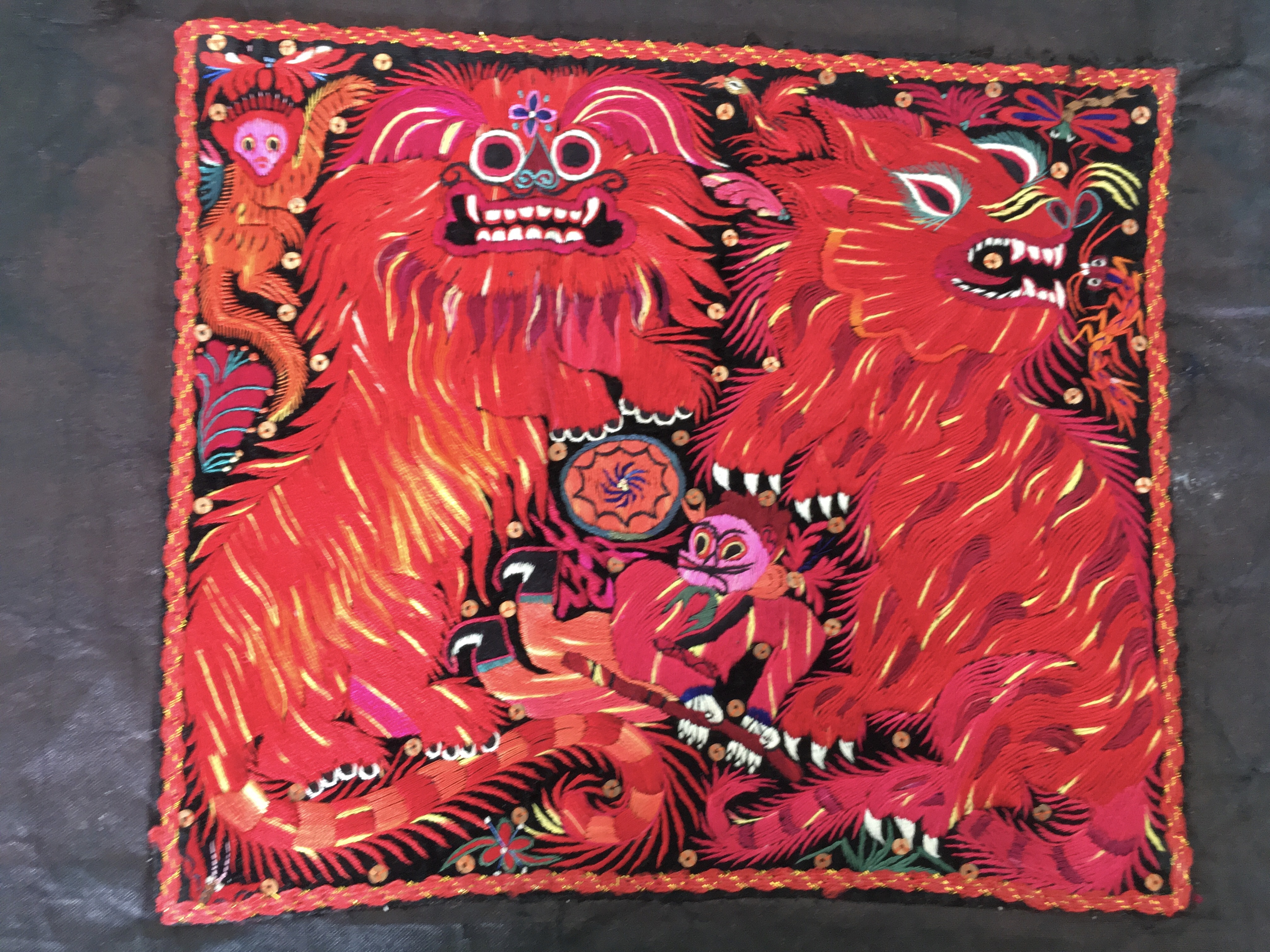
According to legend, the people from the Miao minority in Guizhou came from one of a dozen eggs laid by a butterfly mother who came from a Maple tree. Among the remaining eleven eggs there was hatched a dragon, an ox, an elephant, a tiger, a thunder god, a centipede, a snake, a boy and a girl. Miao religion is animistic in nature. Shamans communicate with spirits. Animals, stones, trees, water, lightening, and thunder all play important parts in traditional Miao religion. The embroidery of the Miao people is striking. The photo is of a portion of a sleeve which we discovered in a house outside of Kaili in western Guizhou. The two lions depicted represent the autumn harvest celebration and the deep red color symbolizes fortune and prosperity. The cotton fabric was made by the Miao people and dyed red to become “cow blood fabric.” The fabric is often coated with egg white to give it a kind of sheen or gloss and to make the fabric water resistant. Indigo is also prevalent in Guizhou. Blue indigo actually comes from green leaves. Indigo leaves are crushed and left in a vat of water to ferment. After a few months, quick lime is added and the result is indigo. Cotton fabric is soaked in the dye and then hung to dry. If the color is not dark enough, the fabric may be dipped again until it reaches the desired shade of blue. Indigo is still the primary dye used in making blue jeans. Sometimes hemp is used instead of cotton and similar techniques are used to preserve the hemp cloth. Hemp fibers, however, are much shorter than cotton and unsuitable for spinning.

Besides the beautiful embroidery, Miao people are also silver artisans. Miao women adorn themselves with an abundance of silver jewellery which typically includes necklaces, earrings, bracelets, rings, and even heavy silver tiaras and crowns. Sometimes these crowns are adorned with silver horns or head flowers. Women wear silver “vests” decorated with all kinds of bling. Silver is also used by the Miao to test the purity of water and to fight disease and misfortune. Like many arts in China, however, silver artisans are a dying breed. Like embroidery, this art is time consuming and takes patience and persistence. But the results are both delicate and elegant.

If you were to meander through Zhaoxing, the largest and most accessible Dong village, in far eastern Guizhou, you couldn’t  help but feel that you’ve entered a time warp. The village rests in an idyllic setting surrounded by jade colored hills with a river flowing through it. The houses are almost all constructed of wood with many built on stilts. There are five drum towers, one for each of five Confucian virtues: Ren 仁 (benevolence), Yi 义(righteousness), Li 礼 (ceremony),  Zhi 智(wisdom), and Xin 信 (integrity). Each is unique, both in style and design.

Imagine a covered bridge made of wood that was wide enough for a bus to go over, but was made for people, not vehicles. Held aloft by five rectangular pillars made of concrete and stone, it’s an open bridge which supports multi-level towers (one on top of each pillar). There are benches and railings along the entire distance of the bridge where old men are playing xiangqi (Chinese chess), young couples are courting, and people of all ages are playing and exercising. All along the bridge and on the walls of the towers are carved and painted works of art. Calligraphy and auspicious flowers, dragons, gourds, cranes are everywhere. And lest I forget, strong mortise and tenon joints alleviate the need for a single nail or screw. These are the Wind and Rain Bridges of the Dong minority.

Hello Dali

Chinese Odyssey 77

In Dali, we found

a lake shaped like an ear

biking beside it,

the water was clear.

The ancient walled city,

a backpacker’s dream

minority cultures

Bai, Hui, and Yi

MVC-006S (2) copy

Imagine a bamboo stalk 6” in diameter reaching up into the sky higher than 20 feet. Now imagine six of those bamboo poles strapped together with bamboo fibre and floating on a giant lake the shape of an ear. Standing on the boat, a single fisherman. The fisherman is barefoot and wears a wide hat with a cone on top which looks a little bit like an enormous semi-flattened chocolate drop. Around the fisherman’s shoulders there is a rain jacket made out of woven grass and on his shoulders rests a pole. Balanced at either end of the pole are two massive black with a greenish-blue sheen cormorants, each weighing approximately five pounds. Cormorants have long necks and a hook at the end of their strong bills, perfect for grabbing fish out of the water. Each cormorant sports a ring around his neck to keep them from swallowing their catch. On a signal from the fisherman, the pole is steadied and both cormorants take off, one right after the other.  These amazing birds have been known to dive to depths of more than 30 feet and capture fish well over three pounds. When the cormorant returns, the fishermen collect the fish which are disgorged into the boat.

Many of the fishermen on these boats are from the Bai minority. Descendants of the Qiang people who probably moved from the Himalayas in far western China, they founded the Nanzhao Empire more than a thousand years ago in the area around present day Dali. Other groups of Qiang people became the more powerful Yi clan who ultimately ruled the Bai. It is said that the Yi people dressed in black and that the people who served them, the Bai people, dressed in white. (Many Bai women continue to where white headgear, with colorful embroidered costumes and many Yi women continue to wear black headgear, combined with colorful, embroidered clothes, and silver jewelry.)

The Bai Kingdom of Nanzhao existed during the 8th and the 9th centuries followed by the Kingdom of Dali from 937-1253 CE. Towards the end of the Nanzhao Empire the Bai rebelled and took over the kingdom, but it didn’t last long. Towards the end of the 13th century, Kublai Khan and the Mongols invaded and the formerly  independent Nanzhao kingdom became a part of Yuan China.

Among the people accompanying Kublai Khan were members of the Hui minority, who are Muslim, but are ethnically Han Chinese. The Hui make up a part of the rich diversity of the people in Dali, a community of 650,000 residents situated in north-central Yunnan about halfway between Kunming and Lijiang. The Hui people have fully integrated with the local population, becoming shop owners, traders along the Tea-Horse road, farmers, mine-workers, and restaurant owners. Their path to integration, however was not always an easy one. During the 1860’s, there was a Muslim uprising in Dali, when, for a short period of time, Dali became an “independent city state” with a Sultan. Du Wenxiu (杜文秀 Dù Wénxiù), Chinese Muslim leader of the Panthay Rebellion became the “Sultan of Dali” for 16 years. In 1873, however, Qing troops under the command of Cen Yuying (岑毓英) laid waste to his “kingdom.” Cen Yuying, from neighboring Guangxi had risen quickly to power, and when he arrived in Dali, he supervised the decapitation of Du Wenxiu. Three days after Du’s decapitation, Du’s top generals were welcomed by Cen to a banquet, where 17 of the generals, on a signal from Cen, were beheaded at the table. The following day, a 3-day massacre began, with no Muslim man, woman, or child spared. Cen, himself, estimated that 4,000 Muslims were slaughtered and that number is considered by many as a conservative estimate. For three decades after that, a sign hung over the city gate stating that “traitorous Hui” were forbidden to enter Dali.

Dali was healing and just getting used to its new normal at the beginning of the 20th century. The Republic of China was established, and Yunnan pledged its loyalty to the fledgling republic. Cai E (蔡鍔 Cài È) was a Chinese revolutionary from Yunnan who challenged Yuan Shikai when Yuan attempted to dissolve the nascent Republic of China in 1916. Cai later became Governor of Yunnan and Governor of Sichuan, before becoming a very influential warlord who served as an inspiration to Zhu De, Mao Zedong’s staunchest ally from the beginning of the Communist revolution. Cai and other warlords managed to hold on to a fair amount of autonomy thanks to both trafficking in opium and the fact that Yunnan was geographically distant from most of the action happening in China during the Republican period.

Fast forward to the opening of the bamboo curtain and backpackers discovering Dali in the late 1980’s thanks to Lonely Planet’s China – a Survival Kit. Dali welcomed foreign newcomers at first, even renaming one of their main roads Yangren Jie (Foreigners Street) – aka Huguo Lu (护国路). Along that road there were restaurants which sold pizza and banana pancakes as well as regional cuisine at low prices. There was freshly baked bread, spicy potato and corn dishes and freshly brewed Yunnan coffee. Cafes like Marley’s, Jim’s Peace Café, and the Tibet Café (said to be the oldest western café in Dali – opened in 1984) were perfect places to read, write, and socialize with journeyers from around the world. Travel Writer, Bruce Connolly from China Daily called Dali his personal “Heaven on Earth” in the 1990’s when there were still horse-drawn taxis that would take local people up to their homes on the mountain slopes.

And the beat goes on. In March 2020, a researcher for Sixth Tone Fresh voices from today’s China, Xu Song wrote an article entitled “Why Dali’s Hippie Migrants are a Model for Chinese Communities” in which he introduces the Chinese public to artists, novelists, and musicians in Dali’s diverse migrant community. Dali has become a haven for people who want to break away from the hectic life of China’s megacities. They even have alternative schools there, which ameliorate the academic pressure ubiquitous in the vast majority of Chinese schools through an emphasis on creativity and self-motivated learning. Xu has personally met with other “alternative migrant communities” around the world and is running a long term study in hopes that they may learn from one another.

Within the newly restored city wall surrounding Dali’s eclectic Old Town, one can sip amazing coffee at the Shi ZiShu Café or drink beer at Baldy’s Belgian Beer Garden. In the mountain village of Nuodeng (诺邓古村) 100 miles to the northwest, Bai people still cover fresh pig legs with a half inch of salt from a thousand year old salt well and cure them in cool, dark rooms for about a week. After that, they are hung up to dry in the fresh mountain air for from one to three years. The results are a dark, fatty, flavorful prosciutto-like ham. This ham is often eaten as a solo dish, although it sometimes cooked with cabbage, or served in soups. It also can be thinly sliced and served with breakfast eggs or in a sandwich.

On one side of Dali is Erhai lake, a longish (about 25 miles by 4 miles) lake, about the size of Flathead Lake in Montana. It sits at the base of the Cangshan (苍山 Cāngshān) Mountain range with an altitude of about 6200’ in elevation. The Cangshan mountains are beautiful by their own right. Steps have been replaced by a cable car (actually 3 cable cars). There are mountain streams, a beautiful lake, and an 11-mile paved trail called the Jade Belt Road which you can easily hike in a day. Perhaps, the greatest wealth of Dali and all of Yunnan is its diversity. In addition to the Bai, the Hui, and the Yi people, at least 22 of the other 56 recognized minorities in China call Yunnan their home.


Stan Lai (賴聲川)

Chinese Odyssey 76

In a play by a friend

was a Peach Blossom land

where a cuckolded fisherman

discovered first hand

a place with no conflict —

where all lived in peace.

How could he walk away

knowing his calm would cease?

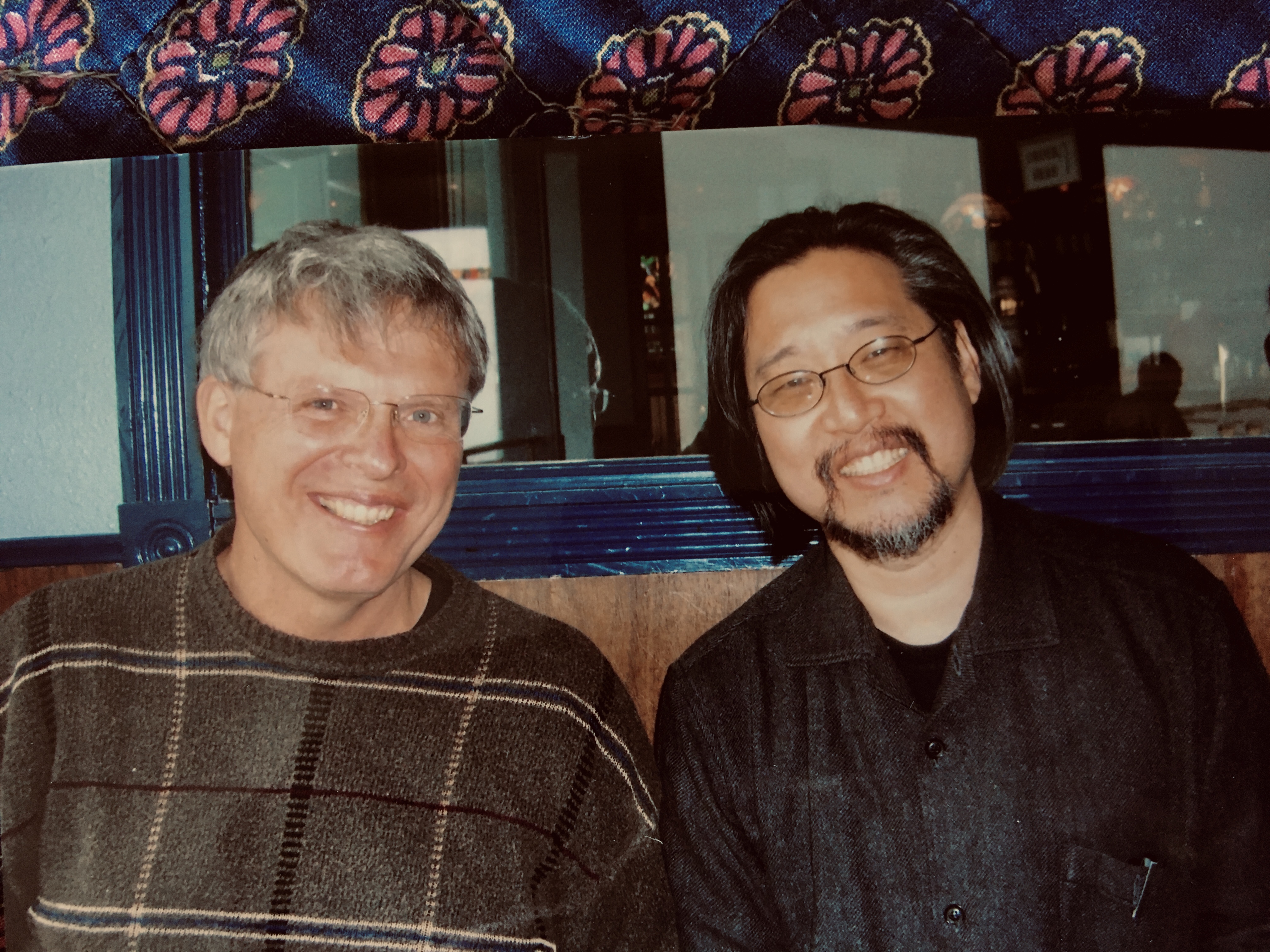
Peter & Stan

In CO 15, I wrote about a play my friend, Stan Lai (賴聲川 Lài Shēng Chuān) wrote called “Peach Blossom Land” (暗戀桃花源 Ànliàn Táohuāyuán). The English name of the play sometimes only translates the second part of the Chinese title, (桃花源 Táohuāyuán). The first part of the title  (Ànliàn 暗戀) “暗戀” means “unrequited love“ – and that was the story I told in CO 15. The original Peach Blossom Land, by Tao Yuan Ming (陶淵明), was written in the Six Dynasties Period (421 CE) and is one of the earliest “Shangri-la” stories on record. Stan took some wonderful liberties with Tao Yuan Ming’s story. The fisherman in Stan’s play was being cuckolded by his wife who was having an affair with her landlord. As the Peach Blossom story unfolds, it is being constantly interrupted by the “An Lian” story. “An Lian”, the tragedy, weaves its way over and around “Tao Hua Yuan” (which Stan tells as a slapstick comedy). The two plays perform a wild dance on the same stage as each play tries to complete rehearsals for their upcoming performances. A third story is, of course, the story of the two theatre companies preparing to perform. Somehow, although all three stories and even the dialogues overlap and intersect one another, in the end, there is resolution to each of the three stories. Audiences in Taiwan, Hong Kong, and China are all familiar with the loss that came with the KMT moving to Taiwan in 1949. Fathers, sons, brothers, and husbands had no idea when they landed in Taiwan that it would be 30 years before they could reconnect with their loved ones. Like the fisherman who left Peach Blossom Land, the mainlanders who came with the KMT must have yearned to return, but the door was sealed and the majority on both sides had only memories. Parents died. Husbands and wives remarried. Children grew up with no father or sometimes a new family when Dad failed to return. As China gradually reopened, searches were begun, contacts were made, and families began to reconnect. The KMT soldiers were my parents’ age. The generation who never got to know their mainland families were Stan’s age. Secret Love in Peach Blossom Land was performed for the entire summer at the Oregon Shakespeare Festival in 2015

Stan Lai was born in Washington D.C. His father was a diplomat at a time when Taiwan was the only “China” recognized by much of the world. Taiwan’s official name in English is still “The Republic of China.” When Stan arrived in Taiwan as an 11 year old, he could barely speak Chinese, but his parents were adamant that he and his brother learn their “mother tongue” and they were enrolled in local schools. By the time Stan graduated from Jianguo High School (臺北市立建國高級中學), his Chinese was almost as good as his English. Now Stan had one foot planted in the west and the other in Taiwan. After Jian Zhong, Stan received his BA in English literature from Taiwan’s Fu Jen Catholic University (輔仁大學). Following two years of mandatory military service in Taiwan, Stan decided to return to America for his graduate work. He earned his PhD. in Dramatic Arts from UC Berkeley in 1983.

Some of Stan’s works are not available in English and would, in fact, be hard to appreciate in languages other than Chinese. An example of this would be a series of plays in which Stan uses a Chinese comedy style called “crosstalk” (xiangsheng 相聲) where there is a straight man and a funny man. Stan’s crosstalk plays involved playing with words, language, and local politics.

Although most of Stan’s plays are written for Chinese audiences, he has opened several doors to western audiences who are truly interested in gaining a more personal understanding of 20th and 21st century China, Chinese people, and Chinese culture.  These works create a natural bridge between China and the English speaking west – starting with Secret Love in Peach Blossom Land. That’s the play I’ve already talked about. The DVD with English subtitles is not easily available but one can occasionally find a copy on E-Bay. I actually found a copy (without subtitles) on YouTube.

Another play which can be very much appreciated by people of different cultural backgrounds is The Village (寶島一村 Bǎo Dǎo Yī Cūn.)  First presented in 2008, The Village tells the story of a military dependent village (眷村 juàncūn) where KMT soldiers lived when they first arrived in Taiwan, and which many families continued to live in for generations. There were nearly 900 of these villages of which about 30 still remain. In these villages, former soldiers from all over China were thrown together. At first these villages were put together with whatever materials could be found. There were communal toilets and showers and electrical wires were strung randomly to provide power where needed. Houses were about 6-10 ping and a ping was the size of two regular tatamis (about 6’ square). In the play we peeked into the lives of families whose common language was Mandarin (國語 Guóyǔ) even though  many of the wives were Taiwanese. In the early scenes, the audience is privy to conversations about the soldiers’ own families and villages back home and what they planned to do when they returned. We experience children growing up in the “juancun” and – along with the villagers – mourn the death of Chiang Kai-Shek (蔣介石). The play begins in 1949 and then jumps to the interval from 1968-1975, before finishing up in the period of 1987-2007. At the end of the play, as the audience leaves the theatre, each person in the audience is given a paper bag with one of Grandma Qian’s warm pork buns (包子 bāozi) inside. Bāozi were a staple in the village throughout the generations. “The Village” was warmly received in Taiwan, the People’s Republic of China, Singapore, Hong Kong, and in the United States. I don’t know anyone who has seen The Village without being incredibly moved.

At the heart of Stan Lai’s theatre company is improvisation. I remember sitting in on one of Stan’s classes at Stanford University in Palo Alto as his class was brainstorming ideas for a play (in English) that started out with the name, Stories for the Dead. By the time I got to see the play in Beijing, the play’s name had been changed to Like Shadows (如影隨行 Rú Yǐng Suí Xíng.) Stan told me the most recent name for that same play is Bardo Blues.

In 2000, Stan Lai shook the theatre world with his seven and one-half hour long A Dream Like a Dream (如夢之夢 Rú Mèng Zhī Mèng.) When I first saw the play in 2002 in Hong Kong, I sat in the center of what would have been the stage in a normal show. The theatre was square with two levels of seating on all four sides. But with “Dreams”, each member of the audience was given our own rotating seat in the center of the “stage” and we watched the play performed in 8 spaces where the audience would normally sit.  Small “stages” were created on all four sides and on both levels. At about the 3:30 mark, the audience was given a dinner break, and then returned for the final four hours.  Dream Like a Dream was booked solid for every performance in Hong Kong. When it returned to Hong Kong in 2019, it was every bit as popular when performed at the new Freespace in West Kowloon. This time we watched it over a two day period. In addition to the Lotus Pond seats in the middle with the revolving chairs, there was now a seating area above the play where one can read surtitles in English and Chinese and watch some amazing stage effects on a giant screen while the play is happening.

Stan directed Dream of the Red Chamber for the San Francisco Opera (libretto by David Henry Hwang, music by Bright Sheng) in 2016 and created Nightwalk in the Chinese Garden, in which he wove elements from the 16th century Chinese classic, The Peony Pavilion, with early 20th century California history in a play created specifically for the Huntington Library’s Chinese Garden in 2018.

I haven’t seen the final play I want to mention, but I have read the script more than once. Ago (曾经如是  Céng Jīng Rú Shì) would be more literally translated as “Thus, therefore”, Ago is a journey involving a small community of Tibetans living in Yunnan, talking animals, basic elements, enlightened beings, spirits,  Wall Street tycoons, hookers, drug dealers, musicians, and cooks. Characters transform themselves seamlessly from life on the Tibetan high plateau to doing business on the 88th floor of the World Trade Center in Manhattan. All kept in check by “Time”, “Chance”, and “Space.”

In the June 2020 issue of the IATC journal/Revue de l’AICT, writer Yu Kuo-Hua said that “Ago is about migration.” He then suggests that in the play, “Lai poses the crucial question: What are people seeking when they undertake the journey of migration?”

Perhaps Stan is reminding us that we’re all migrants in the crazy world in which we inhabit. Whether we migrate physically, spiritually, or merely in our dreams, we all leave the mundane to inhabit worlds which we don’t control. In Stan Lai’s plays we can’t help but migrate through time and space, to take on new identities through his characters and sets. We yearn for that “Shangri-la” we might encounter around the next corner or over the next hill. As we walk through each new door, however, we leave something behind us and like Stan’s fisherman, and like Hilton’s Conway, those doors may have closed behind us.

Lost Horizon

Chinese Odyssey 75

The roads there were narrow

and sometimes we worried,

turned blind mountain curves

where June snow still flurried.

Descending at last

to a Yunnan plateau

like James Hilton’s hero

we, too, chose to go.

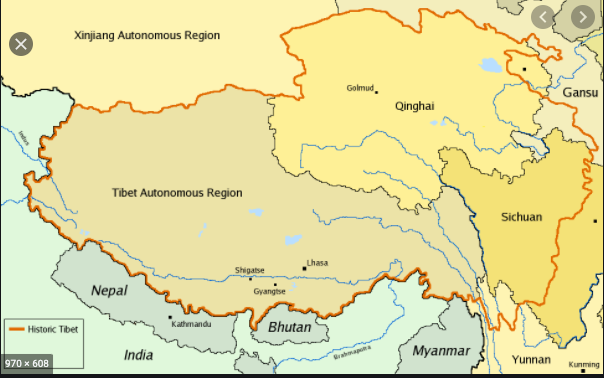
Historic Tibet“File:Historic Tibet Map.png.” Wikimedia Commons, the free media repository. 8 Jul 2019, 02:51 UTC. 26 Jun 2020, 01:00 <https://commons.wikimedia.org/w/index.php?title=File:Historic_Tibet_Map.png&oldid=357437409

Tibet Tidbits

  • Tibet is about the size of the entirety of western Europe. Tibet is larger in area than the states of Alaska and California combined.
  • Tibet exists on a plateau which averages 4,500 meters or a little under 15,000’. It would be safe to say that the 3.2 million people who inhabit Tibet all live their daily lives at an elevation that most people in the world have never experienced.
  • Tibet is the southern of the two autonomous regions which make up far western China.
  • Tibet is commonly referred to as the “Rooftop of the World.”
  • The highest mountain in the world, Qomolangma (Mount Everest) is called by many names: Sagarmatha सगरमाथा in Nepali; Chomolungma ཇོ་མོ་གླང་མ in Tibetan; and 珠穆朗玛 Zhūmùlǎngmǎ in Chinese. It sits on the border of Tibet and Nepal.
  • The name, Everest, comes from British surveyor Colonel George Everest since it was determined in 1865 to have “no name intelligible to civilised men.” It is said that Colonel Everest was somewhat embarrassed by the honor.

Deqin is as close as I have come to actually being in Tibet. Deqin and other parts of northern Yunnan, western Sichuan, Gansu and almost all of present day Qinghai used to be parts of Tibet.

Zipping around the turns on the single two lane road from Zhongdian to Deqin reminded me of mountain roads we used to take in Montana. I’m talking about those paved country roads that weave through mountain passes connecting one valley to another. The bus driver was a little crazy and we had to ask him to slow down several times. Looking out the window, the countryside appeared mostly wild and mostly untamed. Untamed, except for the red, pink and white azaleas popping up around what seemed like every corner as we approached Fēiláisì (飞来寺), a temple complex on the mountain road overlooking Deqin and the Beijiang River Gorge. The multi-colored prayer flags and bright white chortens set against the electric blue sky combined with a stunning view of Kawakarpo Peak (梅里雪山 Méi lǐ xǔe shān) in the distance made me stop in my tracks. It must have been what Hugh Conway experienced when he turned the corner in the tunnel leading from the harsh, bitter, and snowy winds where his plane had crash landed and stared into the idyllic and pastoral setting of Shangri-la. For the briefest moment, as our  bus turned the corner and came to a halt, I, too was awestruck and couldn’t help but utter, “Thank you, God.”

Curious about the mountains, I learned that Kawakarpo is the highest of 13 peaks in the range and that it has never been conquered although there have been attempts by Americans, Europeans, Japanese, and Chinese to summit this 6,740 meter peak. The loss of 17 lives of a joint Sino-Japanese expedition in 1991 combined with an increased sensitivity to both the religious and the cultural norms of the area caused the local government to ban further climbing attempts in the year 2000.

I remember Lord Gainsford’s lines from the 1937 film, “Lost Horizon”:  “They’ll never forget the devil-eyed stranger who six times tried to go over the mountain pass that no other human being dared to travel. And six times he was forced back by the severest storms. They’ll never forget the mad man who stole their food and clothing, who they locked up in their barracks, but who fought six guards to escape. Their soldiers are still talking about their pursuit to overtake him and shuddering at the memory. Oh, he led them on the wildest chase through their own country and finally he disappeared over that very mountain pass that they themselves dared not travel.”

Was Conway’s Shangri-la a place which could only be found by conquering Kawakarpo? Was Shangri-la a pure land which could only be found and only be entered by one who was pure of heart and was invited in.

“How pure are the mountain peaks

  Shining in the sunlight

  Such is the purity of my heart

  The purity I sing to you . . .

  How pure is the mountain air

  permeating the peaks and valleys

  Such is the purity of my heart

  The purity I sing to you. . .”

(Sonam Act 1, Scene 1 p.5 “Ago” by Stan Lai)

Tibet/China Timeline

  • China and Tibet were certainly well aware of one another’s existence as early as the Tang Dynasty when Tibet sent its first official diplomatic mission to China in 634 CE.
  • Mongol rulers first conquered Tibet for China during the Yuan Dynasty, but Tibet was granted a high degree of autonomy. According to the PRC, from that point until now, Tibet has been under Chinese suzerainty.
  • In 1912, the Dalai Lama proclaimed Tibet’s independence to the world, created its own national flag, printed its own stamps, and attempted to establish diplomatic relationships with neighbouring countries. The Republic of China’s government, however, did not recognize their claim for independence even after the death of the 13th Dalai Lama in 1933.
  • In 1951, Tibet was forced to sign a treaty known as the “17 point agreement” which guaranteed Tibetan autonomy but which allowed China to set up both civilian and a military headquarters in Lhasa.
  • In 1959 there was a large scale revolt in Lhasa where thousands of lives were lost; the current Dalai Lama, Tenzin Gyatso fled to Dharamsala, in northern India where he continues to reside as a political refugee.
  • Since 1974, the Dalai Lama has stated many times that Tibet does not demand independence, but does seek “meaningful autonomy.” In 2017, in a speech to the Chamber of Commerce in Kolkata, the Dalai Lama reiterated, “The past is the past. We will have to look into the future.” He went on to say, “We are not seeking independence… We want to stay with China. We want more development.”

I really do love the words and the attitude of the current Dalai Lama. He is amazingly humble and does not consider himself to be more special or significant than anyone else.  In an interview with Jörg Eigendorf for the German newspaper Die Welt, the Dalai Lama seemed optimistic about both Xi Jinping and the future of Tibet. Here a few of the Dalai Lama’s words from that 2014 interview which I believe should be mulled over:

  • “A few years ago when I met students, they were serious and reserved. Today they smile. Those are signs of change.”
  • “A new era has begun with the presidency of Xi Jinping. He wants to create a more harmonious society than the one under his predecessor”
  • “The leader of the Communist Party saying something positive about Buddhism is definitely new. He has Buddhists in the family; his mother even practices Tibetan Buddhism. And many Chinese people are fascinated by our religion.”
  • “He resolutely fights corruption. And corruption is the main source of mistrust. Xi Jinping is brave. He has alienated large parts of the old cadres. Some high-ranking Chinese officials have been arrested. The president seriously thinks about values.”
  • “It is good that China was integrated into the world economy. I’ve always said so. What matters now is that the modern world supports China becoming a democratic country — with rule of law, human rights and freedom of press. So integration is good, for Tibet as well.”