Chinese Odyssey 74
Zhongdian changed its name
to San Ga Li La,
a mythical city
in Himalaya.
On the bus to Deqin,
Azaleas ablaze.
Meili snowy mountains
in foggy grey haze.

Naxi people believe that God resides in north-western Yunnan. UNESCO World Heritage calls this area one of the most biologically diverse temperate regions on the planet. The Three Parallel River area of Yunnan (云南三江并流 Yúnnán Sānjiāng Bìngliú) contains lakes and meadows, steep gorges, luxuriant forests, snow-capped peaks 19,000’ high, and some of the most stunning vistas to be found anywhere in the world. The three rivers that run parallel are the Jinsha (金沙江, Jīnshājiāng), one of the headwaters of the Yangtze (长江 Chánɡ jiānɡ), the Lancang or Mekong (澜沧江 Láncāng Jiāng), and the Nu River aka Salween (怒江Nù Jiāng.)
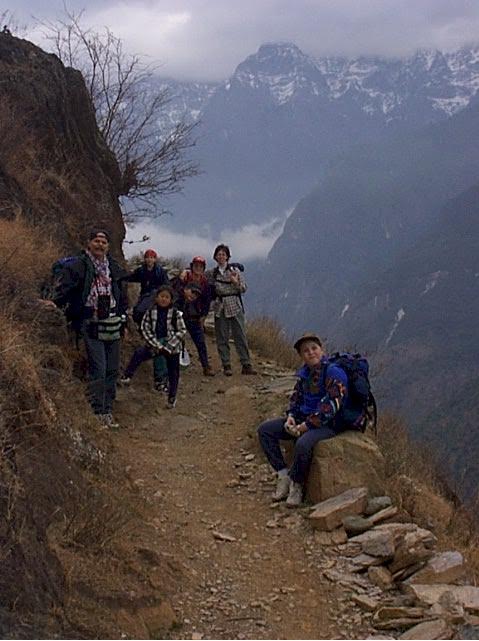
Deqin (德欽 Déqīn), a Tibetan town of 300,000 people sits between the Jinsha (Yangtze) River and the Lancang (Mekong) River. In this same part of northern Yunnan, the Nu River runs parallel to the Yangtze and the Mekong. Deqin lies in the Lancang River Valley 30 km east of the 6740 metres high Meili Snow Mountains (梅里雪山 Méilǐ Xuěshān.) In 2005, we had arranged a short pack trip up to the Mingyong Glacier with a dozen middle schoolers. The glacier is located at the base of the main peak in the Meili Snow Mountains. Unfortunately there was a landslide in the area where we were going to begin our journey, so we had to turn back to Deqin. That same road was part of the Ancient Tea Horse Road (茶马古道 Chámǎgǔdào.) It meandered through this spectacular region of China from Lhasa to Lijiang. In the 7th century, Tibetan horses were traded for Yunnan tea. Caravans consisting of up to 500 yaks would be driven up and over the Tea Horse Road from Lhasa to Lijiang and back.
The Nu River (怒江) aka Salween River
The Nu people live in the Gongshan area (贡山独龙族怒族自治县 Gòngshān Dúlóngzú Nùzú Zìzhìxiàn) of northwestern Yunnan, not far from Deqin. On the 15th day of the 3rd month, about the time when the azaleas first begin to bloom, there is a celebration called the Flower Fairy Festival (鲜花节) to celebrate and commemorate the amazing life of a young woman called Ah-Rong (阿茸 Ā Róng) A-rong’s ingenuity, strength, bravery, and beauty are celebrated by the drinking of “holy water” which comes from the caves. Nu people stay up all night dancing, drinking, and singing songs and prayers to fairies and mountain Gods in the hopes that their fields and families will be blessed for another year.
When A-Rong was a young girl, she loved to immerse herself in the nature that surrounded her. She was especially intrigued by birds, butterflies, and bugs. Her favorites, however, were the spiders. She loved their strength, their artistry, and especially their engineering. How could they create a single thread that was strong enough to form a bridge between the branches of two trees? How were spiders able to create geometric designs that were not only sturdy, but beautiful, and almost transparent?
Living next to the Nu River, A-Rong was well aware of both the dangers and the difficulties people had going from one side to the other. Certain times of the year navigating a boat across the river wasn’t only dangerous, it was impossible. One day A-Rong was watching a mosu spider on a tree near the river and finally understood how this spider was able to get his thread from where he was sitting on one branch to the branch of another tree. By “reading” the wind, the spider was able to control a single thread in the direction of a tree across a small stream. As A-Rong patiently watch the single thread eventually grew long enough to fasten itself to the branch of the other tree. Since the thread had a natural glue attached to it, the spider was then able to use the thread as a kind of bridge to transport herself to the other tree. Inspired by her discovery, A-Rong continued to watch spiders create thread and weave webs and it occurred to her that it might be possible to do something similar. She would weave a web across the river.
A-Rong must have tried and failed many times before she successfully created a rope made out of bamboo fiber which was light enough and strong enough to reach across the river. The story goes that an archer sent an arrow with the line attached to the other side and from this first bamboo filament, the people created a system of bamboo rope bridges and zip-lines where people and goods could be transported back and forth across the Nu River during any season of the year.
Impressed by both her ingenuity and her beauty an ‘old toad’ of a chief decided he wanted to make A-Rong his bride. Although stories differ, the general theme is that A-Rong escaped and was captured and contained in a cave where she died (or some say was burned to death) and where her body transformed into a stone statue. Other stories say that A-Rong’s body turned into fields of Azaleas which blanket the countryside every Spring.
The Jinsha River (金沙江, Jīnshājiāng), one of the headwaters of the Yangtze (长江 Chánɡ jiānɡ)
Although the headwaters of the Yangtze River are most certainly in the Tibetan Plateau in Qinghai, by the time it becomes the Jinsha river in northern Yunnan, it has already morphed into a powerful force of nature.
In 2004, the central government had almost completed plans for building a dam across Tiger Leaping Gorge. The dam would have risen approximately 200 meters high and would have displaced more than 100,000 mostly Naxi minority people. Since the beginning of the PRC, nature was looked at by Chairman Mao as something to conquer, not to nurture. One of the mantras of the Great Leap Forward was “Man can conquer nature” (人定胜天 rén dìng shèng tiān.) Millions of people were mobilized to defeat nature for the good of the people. When the central government made a decision, there was no room for dissent.
As fate would have it, however, the right mix of local farmers, activists, budding environmentalists, and journalists teamed up to see if they could halt this project in its tracks. The odds of a relatively small group of activists actually changing the course of the Chinese government were negligible, but a 57 year old farmer and “local leader” by the name of Ge Quanxiao (葛全孝 Gě Quánxiào) stepped in to save the day. Spurred by his success in the local villages, the word spread and before anyone knew, the dam at Tiger Leaping Gorge became the subject of a national debate. Like other projects, this one began before it had been officially approved by the central government. Surveyors had begun mapping and laying markers down where the construction was planned to take place. When Ge Quanxiao realized what was happening, he spent countless hours compiling information and educating the residents. Instead of blindly accepting their fate, the villagers decided to fight back. One of their first acts was to confront a group of seven surveyors and ask them for their official documents (which they did not have.). After being told that they were going to need to relocate, the villagers seized these officials and held them hostage in the field. Later they were joined by nearly 10,000 local people and the provincial government actually stepped in to support the villagers. The protesters were warned that armed police would be brought in if they didn’t disband, so they went home with a strong sense that victory was theirs. The next day, the government posted a flyer saying that no dams would be built without the support of the local population and a violent escalation was nipped in the bud.
The story is beautifully told in “Waking the Green Tiger”, a film by Gary Marcuse and produced by Betsy Carson. The second part of their title is “A Green Movement Rises in China.” Further information can be obtained through www.facetofacemedia.ca . Although not the only movement of its kind, this was one of the first incidents of environmental activism in China. In 2004, a movement called “The Green Camel Bell” was already looking at the sludge accumulating in the Yellow River near Lanzhou in the province of Gansu where it was said that breathing the factory air in Lanzhou was equivalent to smoking a pack of cigarettes a day.
Lancang (澜沧江 Láncāng Jiāng) aka the Mekong River
On the edge of Yanjing aka Yerkalo, there is a lovely Catholic Church founded by a group of 35 French missionaries in 1865. At one time, 90% of the residents of Yerkalo considered themselves to be Catholic. The architecture of the church is partly Gothic and partly Tibetan and there is a bell tower and a huge green cross prominently displayed high above the whitewashed front entrance. The Catholic church of Yerkalko is truly unique and continues to operate to this day. Babies are still baptized there, and there are masses on Christmas and Easter. During the first part of the 20th century conflicts arose between the church and Tibetan Buddhists, and by 1945, when Father Maurice Tornay assumed the position of parish priest at Yerkalo, there was a Tibetan lama leader called Gun-Akhio who had an intense hatred of the Catholics and demanded all the priests to leave or “apostatize and all their children wear lama’s robes.” In August of 1949, while journeying to Lhasa in hopes of meeting with the Dalai Lama, Father Tornay was killed by gunshot for the crime of “spreading the Catholic Religion in Yerkalo.” Like all foreign churches in China, this one suffered during the first years of communist rule and there was very little contact between remaining Catholics there with the outside world. In the 1980’s however, the church was allowed to reopen as a Chinese Catholic Church.
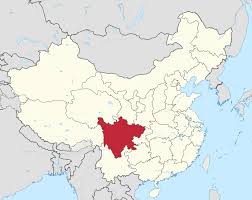
盐井镇 Yánjǐng Zhèn is a town on the Tea Horse Road (茶马古道) in the far south of Sichuan which borders northwestern Yunnan. It sits about 900 meters above the Lancang (Mekong) River and is about 110 km north of Deqin. Most of the 30,000 people in Yanjing are involved in the salt industry. The name of the town, Yanjing means, “salt well.” Adjacent to the town of Yanjing flows the Mekong River and it’s on the banks of this river there exists a unique process for collecting and processing salt. There are salt wells dotted along both sides of the Mekong, and when the salt brine is collected in wooden barrels from these river wells, it is poured into a multitude of salt ponds until it reaches a certain concentration. At that point, it is transferred into a system of salt pans scattered along the river. There, the intense sun and the wind do their work and in a few days the salt dries and is collected in bags to be taken to the market. Both men and women are involved in the processing and harvesting salt, but gender roles are obvious (although the reasons for the gender roles are not.) There are different prices for different qualities of salt obtained, but collecting salt is not seasonal, although due to rain and wind conditions, output varies throughout the year.
 On a
On a
 Rock, Joseph Francis. “Seeking the Mountains of Mystery.” The National Geographic Magazine, vol. LVII, no. 2, Feb. 1930, pp. 131-85

 The Panda in the Room PD
.svg)
