On the train to Gansu

Yellow River Hohhot to GansuShannon1 [CC BY-SA 4.0 (https://creativecommons.org/licenses/by-sa/4.0)]

In the early 2000s there were three types of tickets foreigners could buy for trains. Soft sleeper was the premier class. There were 4 beds to a coach and once situated, you could shut the door and keep the smoke out of your room. This worked best, of course, if you were traveling in a group of 4. Otherwise, there was no way of knowing who you might end up next to. An added benefit to many foreigners was that the soft sleeper cars usually had access to a sit-down toilet. For those not accustomed to squat type toilets, train toilets could create additional challenges.

Hard sleepers were actually more fun. There were two sets of three-layered bunks in each open doored section. Although you often had to scrounge for a place to store your bags, once you finally settled into your bunk, the ride was every bit as comfortable as the soft sleeper. For kids, it was like a giant sleepover and was a highlight of many of their China trips.

Seats were fine for short rides of a few hours and I believe there were different categories of seats as well. Tickets would also be sold with no seat number and during holidays, people would sit anywhere they could park their bums. Including inside the toilet (or so I’m told.)

(note: Trains like the ones we rode back in the early 2000s still exist in China, but China also has high-speed and bullet trains and smoking on trains is no longer allowed. Not long ago, I boarded a high-speed train in Beijing at 10:00 a.m. By 8:00 p.m., I was enjoying a meal with my family back on Hong Kong Island.)

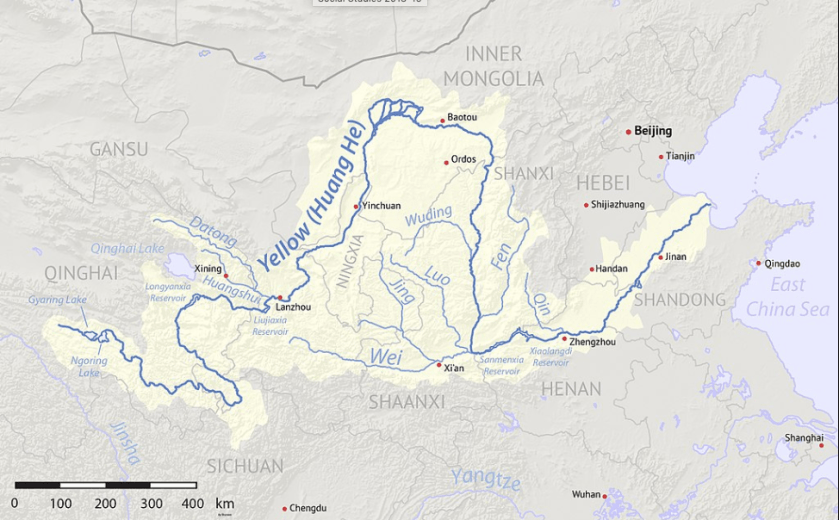
From Hohhot (呼和浩特 Hūhéhàotè) to Baotou (包头市 Bāotóu) is less than 100 miles, as the crow flies. We boarded the hard sleeper in Hohhot, following the northernmost plateau of Yellow River before it dipped down just north of the Ordos Desert (鄂爾多斯沙漠 È’ěrduōsī Shāmò in Inner Mongolia flowing towards Yinchuan (银川市Yín chuān shì) in the Ningxia Hui Autonomous Region (宁夏回族自治区 Níngxià Huízú Zìzhìqū) and ending in Lanzhou (兰州市Lánzhōu), Gansu 甘肃省 (Gānsù Shěng). For a little while starting in Yinchuan, we were close enough to the Great Wall to almost see it. Even if we didn’t see it, we knew it was there.

From Inner Mongolia down to Gansu, we saw monks in robes, Tibetan steles, and prayer flags, all indicators that Buddhism in this part of China was more similar to Tibetan Buddhism than the Buddhism we experienced in the southern and eastern parts of China. It was like traveling from America’s east coast megalopolis into the corn belt of the mid-west. The pace and the mannerisms seemed somehow different.

Chinese Odyssey 54

I was feeling complacent

on the train to Gansu,

reading Renmin Ribao,

eating Mapo Doufu.

Watched the Huang He meander

through loess plateau corn.

On a crumbling Great Wall,

heard a Tibetan horn.


The 3 “manly skills” of Inner Mongolia

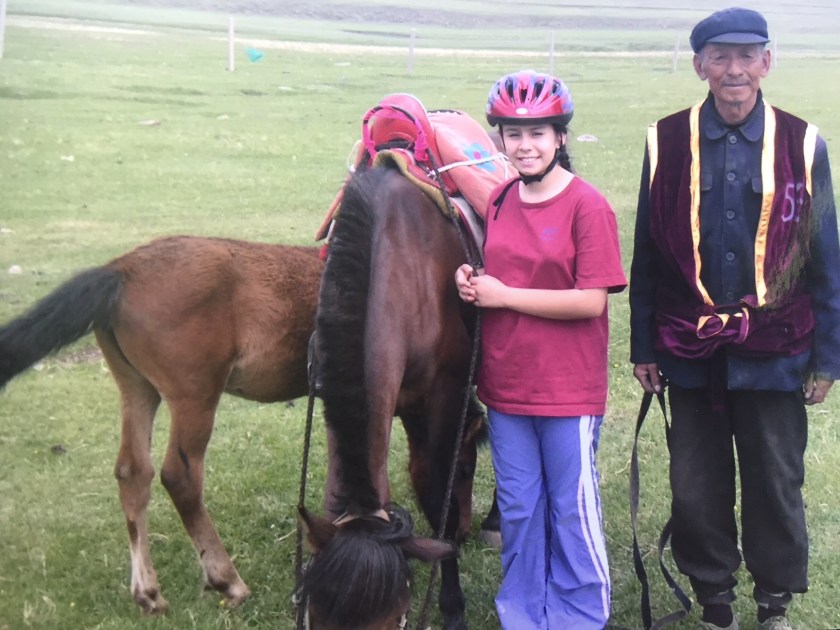
Ana and the Inner Mongolian Saddle

China was only “conquered” twice. First, by Mongolians during the Yuan Dynasty (1271-1368 A.D.) and then by Manchus in the Qing Dynasty (1644-1912 A.D.) Most of what we know today as Inner Mongolia was a part of Mongolia which defeated the Chinese during the Yuan Dynasty. At the fall of the Mongolians to the Ming armies, there were already divisions among the various tribes. At the end of the Qing Dynasty, the new Republic of China incorporated both Manchuria and a large segment of Mongolia into its new Republic. And it wasn’t until 1945 that most of the rest of the world recognized what we now know as Mongolia as an independent country. Inner Mongolia is an autonomous region of China. Mongolia remains an independent country.

Inner Mongolia reminds me of parts of Montana. It’s the 3rd largest political region of China and is a bit off the normal tourist track. Horseback riding and livestock are abundant on the lush grasslands. There are no really big cities. It also has the longest northern border in China, bordering both Mongolia and Russia. In Inner Mongolia, horse riding, archery, and wrestling used to be known as the “three manly skills.”  Rodeo is still big in Montana, but few Montanans wrestle, and guns trumped bows and arrows shortly after Crazy Horse and Sitting Bull defeated Custer at the Little Big Hole in 1876.

We rode horses on rolling grasslands a few hours from Hohhot. Colorful prayer flags like those in Tibet flew from mounds of stones topped with willow branches (敖包 áobāo) and a local family invited us into their house to have tea and sweet cheese. We spoke Putonghua with kids and asked what they would most like and they said “better schools” and asked us if we could stay and teach. After spending time in the schools and hills, it was time to trot back to our cement yurts complete with bathrooms, western sit-down toilets, air conditioners, and hot showers.

The salty butter tea we drank in the yurts we visited was probably made from cow’s milk and not yak. The “cheese” was sweet and chewy and more like candy than the cheese we were used to.

Inner Mongolia’s traditional musical claim to fame is throat singing – Khoomei (songs of eternity), as it is called in Mongolian, starts with a single pitch. As that pitch is being produced, a second, and sometimes a third pitch comes from the same throat and one is able to hear two and sometimes three sounds simultaneously. This happens by the singer tightening or loosening his throat and manipulating his tongue to produce multiple sounds at the same time.

I first heard Mongolian throat singers in Hong Kong in the 1990s and marveled how one person could produce several sounds simultaneously. Traditionally a male art, females are now becoming quite adept at the technique. Khoomei was once practiced only on the pastoral highlands of Mongolia, but has found its way into many parts of Inner Mongolia. “Khoomei” means “song of eternity” and dates back more than 1000 years. In Inner Mongolia, where the Heilongjiang (Amur River in Russia) forms the border between Russia and China, Mongolian hunters began settling in as nomadic farmers and it is in this environment Khoomei is said to have begun. If you’re curious to hear Khoomei, try listening to a youTube entitled “Huun-Huur-Tu – Live” at

https://www.youtube.com/watch?v=i0djHJBAP3U&feature=youtu.be&t=9m41s  In 1929, Arthur Miles tried his luck at Tuvan overtone singing in his rendition of “Lonely Cowboy” Parts 1 & 2 (Dallas, Texas, 1929) hillbilly https://www.youtube.com/watch?v=DpAFZnMyC7o

Chinese Odyssey 53

Our journey continued,

we too headed west

to the grasslands near Hohhot

Mongolian steppes.

Shared yak butter tea

with a family of peasants.

At night we retired

to our yurts, warm and pleasant.

Monkey King vs. the White-Boned Demon – 3 Strikes and You’re Out

Monkey King from Mei Zhong Kuai Bao孙悟空三打白骨精 Sūn Wù Kōng sān dǎ Bái Gǔ Jīng) from 西游記 Xīyóu Jì (Journey to the West)

In CO 30, I wrote about the birth of Sun Wu Kong, the Monkey King, and mentioned how that after he was freed from his internment under the mountain, he and his piggy friend, Zhu Ba Jie (猪八戒 Zhū Bājiè), helped the monk, Tripitaka (三藏經), aka Tang Sanzang (唐三藏) aka Tang Seng (唐僧) aka Táng Zhēn (唐甄), bring the Buddhist scriptures from India to China. This ancient trio of superheroes was often joined by another monk called  Sha Seng (沙僧) aka Shā Wùjìng (), and Tang Seng’s faithful white steed, Bai Long Ma (白龍馬).

“Sun Wu Kong and the 3 hits of the White-Boned Demon” is one of the most loved of the Monkey King stories.

Bái Gǔ Jīng 白骨精 (the White-Boned Demon) hunkered down and licked her lips when Tang Seng passed by.  She knew that if she tasted the flesh of Tang Seng, she would live forever.

In the White Tiger Mountain Range, there lived a young peasant girl who plowed the fields with her mother and father. Unseen by the innocent young girl and her family, Bai Gu Jing flew down and put deadly poison into their drinking water. The young girl took a ladle, and after first serving her parents, she then drank a ladle full of water herself. Within minutes, the entire family lay dead. Bai Gu Jing cackled softly as she moved the bodies to a safe place where they wouldn’t be found.

Soon after, Tang Seng and his followers walked into the clearing.  Sun Wu Kong’s skin began to tingle and he knew he was in the presence of pure evil. “Master”, Sun Wu Kong addressed Tang Seng, “Nearby there are many beings who would like nothing better than a taste of your flesh.” With his magic staff, Monkey drew a perfect circle around his friends and warned them. “Nothing can harm you within the confines of this magic ring. Stay inside while I search for food and water. If you step outside of the circle, you put yourself in great peril.”

As you might expect, Zhu Ba Jie felt his piggy tummy rumbling and soon began to complain. Where is that lazy monkey? I’m famished!” Unbeknownst to Zhu Ba Jie and the rest of the family, Bai Gu Jing had moved her spirit into the body of the young girl and walked on a path towards Tang Seng and Zhu Ba Jie.

“Handsome sir”, she addressed the pig. “Master” she bowed to Tang Seng. “It’s so nice to welcome you to our home.” Bai Gu Jing (disguised as the young girl) moved toward them and was surprised when she could not step into the invisible barrier which protected them.

“Where are you going with that delicious looking basket of food?” asked Piggy.

“I’m taking it to my elderly parents, but I would be happy to share it with you” the girl responded and spread a small cloth on the ground outside of the circle and carefully displayed the food.

“Oh, yes” cried Piggy. “We would love some.” Zhu Ba Jie jumped out of the magic circle and lumbered towards the feast. Bai Gu Jin could barely refrain herself from devouring the pig, but she knew the real prize was the monk.

Hunger finally got the best of Tang Seng, as the sun was setting. As soon as Tang Seng stepped out of the circle, Bai Gu Jing made her move, but Sun Wu Kong came out of nowhere and pummelled Bai Gu Jing with his red cudgel. Neither Tang Seng nor Zhu Ba Jie had seen Bai Gu Jing’s approaching attack, so they were both shocked that the Monkey King would murder this nice young girl.

“What have you done?” shouted Tang Seng. Only the monkey king could see the injured spirit separate from the young girl’s body and move to assuage her wounds.

“Didn’t you see?” cried Sun Wu Kong. That was Bai Gu Jing in disguise.” Tang Seng and Zhu Ba Jie approached the dead girl, but there was nothing to suggest that the girl was Bai Gu Jing. Piggy did notice that the food that he had found so appealing had turned into rocks and sticks, but he said nothing to Tang Seng.

Sun Wu Kong quickly pushed Tang Seng and Zhu Ba Jie back into the magic circle so they would be protected in the event Bai Gu Jing returned.

Tang Seng then began murmuring a Buddhist chant and each time he repeated the chant, the golden headband on the monkey king grew tighter. When Monkey finally cried out in pain, Tang Seng scolded him and reminded Sun Wu Kong about the preciousness of life.

As Sun Wu Kong was recovering from his headache, an old lady approached them. Hiding behind the old lady so only Sun Wu Kong could see her, was Bai Gu Jing.

Zhu Ba Jie cried out. “Master, master. The young girl’s mother is coming. What do we do?”

Tang Seng once again stepped out of the circle and approached the women. “Venerable lady, your daughter is dead. She was accidentally killed by my overprotective disciple. Please forgive us. Please forgive us.”

“My poor innocent daughter. How could anyone suspect her gentle soul to be a threat to anyone? How could you? How could you?” She rushed towards Tang Seng.

Again, neither Zhu Ba Jie nor Tang Seng saw the transition from an old lady to the White-Boned Demon.  What they did see was the lightning speed of Sun Wu Kong’s staff as it broke open the head of the old lady – unaware that Bai Gu Jing had already killed the old woman earlier that day. In the eyes of Tang Seng and Zhu Ba Jie, Sun Wu Kong had murdered yet another innocent woman whose only crime had been to react to the death of her daughter.

“Wu Kong”, yelled the master. “You’ve done it again. Another innocent person died due to your overreaction to an imaginary threat. You may no longer accompany me on my sacred journey. I cannot be protected by a murderer. Leave now, and never return.”

“But Master,” cried Sun Wu Kong. “The old lady was Bai Gu Jing as well. Didn’t you see her fangs as she came in to kill you? Did you not see the speed and power of her movements? Those were not the moves of an old lady. That was Bai Gu Jing!’

“Leave now, Monkey. I am no longer your Shifu (master).

“Shifu. Shifu.” Monkey pleaded as he watched Tang Seng and Zhu Ba Jie continue on.

But the Monkey King could not leave. Sun Wu Kong knew that his master and his friend were in grave peril and that the violence he had been guilty of committing was only to protect his master and the scriptures. So, he followed at a distance and when they were stopped by an old man, Sun Wu Kong’s hair once again stood on end.

“Nan wu a mi to fo, nan wu a mi to fo”  The old man was chanting a time-honored Buddhist prayer. Hiding behind him was Bai Gu Jing.

Zhu Ba Jie asked Tang Seng. “Master. May I go bless that old man and give him an offering.”

Tang Seng responded. “No, let me go. You’re too ugly. I’m afraid you would frighten him off.” Zhu Ba Jie stood pouting.

Tang Seng approached the old man and said. “Greetings, honorable gentleman.”

“Hello, kind sir.” said the old man. “Welcome to our countryside.”

“Do you have a family?” enquired Tang Seng

“I have a young daughter.” Responded the old man. She left this morning and has not yet returned. My wife went out looking for her, but she hasn’t come home either.”

“Master” whispered Zhu Ba Jie loudly. “Those were the two people that the monkey killed.”

As the old man reacted, Tang Zhen shouted out. “We are so sorry. Forgive us, please.”

“Forgive you?” Bai Gu Jin shouted as she threw down the husk of the old man and appeared in all of her ugliness and splendor. “Ha, ha, ha! Not only will I forgive you, I will consume you. I will eat you and then I will live forever. And since you banished Sun Wu Kong, no one will come to your rescue.”

Bai Gu Jin stepped forward to devour Tang Seng, but this time, Sun Wu Kong dealt the death blow and Bai Gu Jing ceased to exist.

“Wu Kong, you’re here! How?” asked Tang Seng.

“You are my shi fu, master. Wherever my master is, that is where I will be.” That was the only response the Monkey King had to give.

Chinese Odyssey 52

A monkey, a pig,

and a priest on a quest

set out on a journey

which took them out west.

Their harrowing stories

are known far and wide;

Tang Seng, Zhu Ba Jie,

Sun Wu Kong was their guide
The Road to Somewhere

Imprimir                            https://all-free-download.com/free-vector/download/china-political-map-vector_587825.html

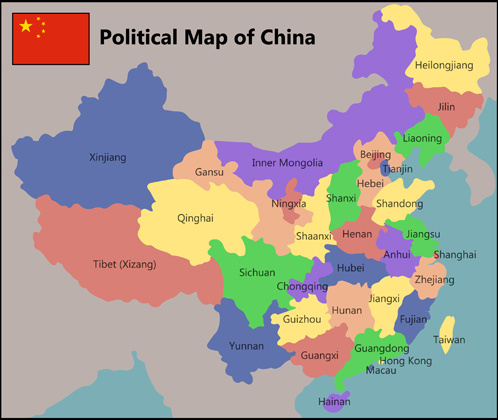
Look closely at the map. I started in Taiwan, then to Hong Kong. From Hong Kong almost due north to Beijing, mostly along the coast. I had skirted the eastern edge of China. Like visiting the east coast of America from Florida to Massachusetts and thinking I’d seen the USA.  The Gobi Desert, the Himalayas, Guilin, the Silk Road, the Terra Cotta Warriors. What else was I missing?

Politically, China has 23 provinces (省shěng) – if you count Taiwan as a province (which both China and Taiwan do.) Provinces are like states in the USA. In addition, China has 5 autonomous regions (自治区 zìzhìqū) which are similar to provinces, but each houses a major ethnic minority group which makes up much of its population. Autonomous Regions are supposed to have more freedom to make decisions;  4 municipalities (直辖市 zhíxiáshì) which are huge cities which have the same rights as provinces; and 2 Special Administrative Regions (特别行政区 Tèbié Xíngzhèngqū). The two SAR’s are Hong Kong and Macau. Both Hong Kong and Macau have “high degrees of autonomy” and enjoy the constitutional principle of “one country, two systems”. SAR’s are parts of China, but they get to have their own governments and can make their own laws for 50 years.

From where we left off after leaving the Great Wall, Inner Mongolia lay to my immediate north. From 1271 to 1368 AD, Kublai Khan (忽必烈 汗Hū bì liè hàn), grandson of Genghis Khan (成吉思汗 Chéng jí sī hàn) officially established the Yuan Dynasty (  Yuán Cháo) where he claimed all of China to be ruled by Mongolia.

The far western part of China is made up of only two regions: the Tibet (Xizang) Autonomous Region (西藏自治区 Xīzàng Zìzhìqū), and the Xinjiang Uyghur Autonomous Region (新疆维吾尔自治区 (Xīnjiāng Wéiwú’ěr Zìzhìqū).

Until recently, most people in the west had never heard of Xinjiang,  and Tibet was associated with esoteric Buddhism, Shang-ri-la, yak butter tea, the Dalai Lama, and to some, the Tibetan independence movement.

Tibet has an interesting history. Often referred to as the “rooftop of the world”, the average elevation of Tibet is 4,500 meters (nearly 15,000 feet). It was in 1271 AD, that China first claimed a portion of Tibet as its own during the Yuan Dynasty when Kublai Khan reigned. This claim of Chinese suzerainty over Tibet continued through the Ming and well into the Qing Dynasty. In 1912, the Republic of China stipulated Tibet as one of its 22 provinces, but in 1913, Tibet declared its independence from China. In 1951, however, China re-asserted its suzerainty over when the People’s Republic of China and Tibet signed a 17 point agreement officially reaffirming that Tibet was a part of China.

Tibet is the most sparsely populated region of China averaging about 2 people per square kilometre. In The Times of India on April 6, 2017, the Dalai Lama clearly stated “We are not seeking independence. We want China to give us meaningful autonomy. We want to remain with the People’s Republic of China.” He went on to say. “Tibet is materialistically backward, but spiritually advanced. We want to develop materialistically by remaining with China and it should also feel the same way for mutual benefit.”

About the same size as Iran, Xinjiang can be separated into two distinct regions by the Tianshan Mountains. To the north of the Tianshan Mountains, the people are composed of a variety of minorities including Kazakhs, Mongols, and Russians, and the predominant religion is Buddhism. South of the Tianshan Mountains in the Tarim Basin, live about 8 million Turkish speaking Uyghur people who practice Islam. The modern Uyghurs who look more Turkish than Han Chinese, descend from the Turkic Uyghurs. Occupying a huge portion of the Tarim basin is the  Taklamakan Desert (塔克拉玛干沙漠 Tǎkèlāmǎgān Shāmò). This massive desert has an area about the same size as Germany.

The Chinese first claimed a portion of Xinjiang nearly 2000 years ago during the Han Dynasty. The nomadic people from the far north-western part of Xinjiang supplied Chinese courts with their richest jade as early back as the Shang Dynasty. In the 1990s there were clashes between the 40% Han Chinese and the 47% Uyghurs and in 2009, a series of demonstrations led to 200 people losing their lives and nearly 2000 people suffering injuries in Urumqi. In March 2017, China established new “Regulations on De-extremification” and began arresting Uyghurs and sending them to “re-education camps.” It is estimated that at the time of this writing there are well over 1,000,000 Uyghurs being held against their will in an attempt to educate them on the pitfalls of extremist views on religion.

Chinese Odyssey 51

So we looked at a map

and saw she was right.

We’d just scratched the surface

on our line of sight.

We had to continue

this road to somewhere

so we took a step forward

and said a short prayer.


When the end is the beginning

Tiger Leaping Gorge Sea of Clouds blurry

The old lady on the road was right. I probably knew more about China than most foreigners, but I had still barely scratched the surface. But, I was discovering words and ideas on my “journey” that I kept bumping into, no matter where I was in China, and many of them led back to Lǎo zǐ  (老子) and the Dào Dé Jīng (道德经), that 5000 character, 81 chapter canon which forms the foundation of  Daoism a.k.a. Taoism. There is something compelling and homegrown about the character “道 dào”, which translates as “path” or “way”. Growing up in the West where the scientific method makes one search for answers. Paths and ways must have beginnings and end points. . . mustn’t they? Yet, according to the Dao De Jing, 有 “yǒu”(to have) and 無  “wú”  (to lack) are born from one another. Difficult and easy complement each other.  It is only because people accept certain ideas of beauty, that the concept of ugliness even exists. Does contrast define? Can there be a path with no beginning and no end point?

Laozi forced me to think differently. The lessons are often simple and profound which makes them even more difficult to translate into English. Take for example, wú wéi (無爲 ). Wu wei is often translated as “non-action”, but what is action? Is it movement? Can you be involved in “action” without instigating or influencing action? Wu wei does not mean non-doing or non-action, but rather not attempting to influence action.” Sort of a ‘go with the flow.’ Indeed, Laozi said that the highest good was like water. Water is content with wherever it is. But even when water moves, it is never the instigator of the move. Water is powerful like the Dao.

Laozi said that the space where there is nothing is the most important space. It is into the space of a cup where there is nothing that tea is poured. It is into the space where there is nothing that light flows into a building. And it is into the space where there is nothing that a wheel moves into. Just as we appreciate and take advantage of what is, we should also recognize the usefulness of what is not.

In the Dao De Jing, we are introduced to the simplicity and the power of the “uncarved block” and asked to question both wisdom and knowledge and to embrace selflessness and lessening of desire. Once the block is carved, there will be names. Like Zhuangzi’s “ugly tree” (see CO 2), Laozi believes that straight only manifested itself next to the crooked, that it was the hollow that could be made full, and that one can be defined without defining oneself. Laozi warns us that we should not tamper with Heaven and that those who tamper with it, lose it. One does not glorify nor boast about what one has done. One of my favorite passages is where Laozi said that when Dao was lost, only power remained. When power dissipated, there was human kindness; after human kindness left, there was morality; and then ritual. Laozi said that ritual was “the mere husk of loyalty and promise keeping” and eventually led to brawling which is “the beginning of folly.” (Laozi and Arthur Waley. The Way and Its Power: A Study of the Tao Tê Ching and Its Place in Chinese Thought. New York: Grove Press, 1958. Print.)

Laozi says that the loftiest power can appear as an abyss; the way into the light can seem dark;  the purist state can look faded and disheveled; and the loveliest music can have the subtlest notes. The Dao is often hidden in plain sight. One can therefore see without looking and by doing nothing can achieve everything.

I was on the edge of the precipice and staring into the west of China – the void. I knew how to float and to swim. It was time to leave that part of China where I could touch the bottom of the pool and move into the deep end.

Chinese Odyssey 50

“You think you know China,

you’ve been to the core.

Your journey’s just started,

Go west and see more”

How could she have known that

from “reading” my face?

Yet her message was clear,

no doubt. Not a trace.

Entering the Tiger’s Lair

Tiger_Cub

Keven Law [CC BY-SA 2.0 (https://creativecommons.org/licenses/by-sa/2.0)%5D

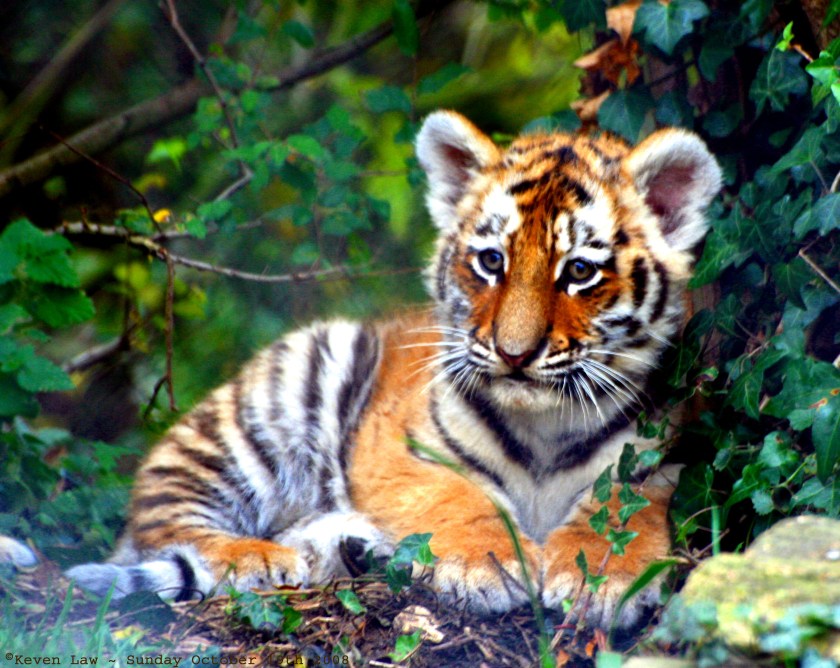
不入虎穴,焉得虎子 (bù rù hǔ xué, yān dé hǔ zǐ)  “To catch the tiger cub, one must enter the tiger’s lair.” Problem was, I found myself in the middle of the tiger’s lair, but I had no desire to catch a tiger cub. I was, however, enjoying my surroundings and was curious to know more. There’s another Chinese saying, 不到长城非好汉 (búdào chángchéng fēi hǎohàn).  “You can’t really call yourself a real man (hǎohàn) until you been to the Great Wall of China.” I’d been to the Great Wall, but I still didn’t feel that I’d earned my “hǎohàn” merit badge.

Not sure when the “tiger cub” idiom first appeared, but the best-known backstory centers on an historical figure by the name of Bān Chāo (班超) who hailed from Xianyang in the province of Shaanxi. He was both a military leader and a diplomat who lived in the Eastern Han dynasty during the first century A.D. The story goes that Bān Chāo, along with 36 subordinates, was on a diplomatic mission for the Eastern Han Emperor to visit the kingdom of Lóu Lán (楼兰) in the Tarim Basin, located in the present day Xinjiang Uygur Autonomous Region. He had been asked to cement a relationship with its king. When Bān Chāo arrived, he was given a warm reception and things were looking good. After a few days, however, things seemed to cool down. He learned that another delegation had arrived at about the same time as his. This much larger delegation were Xiongnu (匈奴), fierce warriors from northeastern China.  Bān Chāo knew the only real weapon he possessed at that moment was surprise. He sent 10 men to beat drums and start shouting. The rest of  Bān Chāo’s men lay in ambush and swiftly slew 30 of the Xiongnu soldiers, including the leader, whose head he severed. The remaining Xiongnu fled the kingdom erroneously believing that they had been attacked by a large Han force.  The next day, Bān Chāo presented the severed head of the Xiongnu leader to the King of Lóu Lán, and the Lóu Lán King decided to form an alliance with the Eastern Han. Bān Chāo had entered the tiger’s Lair and had successfully captured the tiger cub.

As I was writing this, a third idiom came to mind. Yue Guang(樂廣)invited a friend to a bar about a thousand years ago during the Jin Dynasty(晉朝). While tippling and staring into his cup, the friend appeared startled and suddenly left the bar. Wondering what had happened,  Yue Guang popped by his friend’s home later on to make sure he was OK.  “I thought I saw a snake swimming in my drink.” said his friend. “It really scared me so I came home.” Yue Guang was curious. He went back to the bar and sat at the same spot his friend had sat and drunk the same drink. Then he smiled. The snake his friend had seen, was, in fact, the reflection of a bow that was hanging on the wall. He quickly returned to his friend’s house and explained the illusion. . . and they went back to the bar and finished their drinks.

I knew I was no Bān Chāo. There have been a few times in China, however, when I have felt a little like Yue Guang’s friend,  where I may have possibly mistaken a snake for a bow  杯弓蛇影(bēi gōng shé yǐng.) The road back to Beijing reminded me of the snake in the cup, but my eyes closed and I drifted back into the tiger’s lair.

Chinese Odyssey 49

The road back to Beijing

was curvy and long

We spied an old lady,

but something seemed wrong.

She beckoned us over

and said that she knew

some secrets about me

and things I must do.


Fishing at the Great Wall

Fishing at the Great Wall

Walls in China pre-date the earliest historical dynasties. Built as enclosures, walls have been a part of every Chinese village and city for most of China’s history. Indeed the character chéng (城), depending on how it is used, can colloquially mean either wall or city. Beijing, Shanghai, and Nanjing all had walls surrounding them, long gone now. Today, you can rent a bicycle to ride the nearly 14 km perimeter on the top of the city wall of Xi’an, one of the few remaining city walls in China.

In his quest for immortality, Emperor Qin Shi Huang burned books and destroyed historical records so that Chinese history would recognize him as China’s first emperor. Some historians believe that the name “China” came from Qin (pronounced “chin”). It was this emperor who had over 6,000 life-sized terra cotta soldiers and horses made to protect him in the after-life. And, it was Emperor Qin, China’s most narcissistic ruler ever, who decided that he wanted to unite the already existing walls into a barrier wall that would protect all of China and keep the northern barbarian invaders from entering into his kingdom.

Stretching from Shanhaiguan (山海关区)  in Hebei Province, 270 km northeast of Tianjin, the Great Wall stretches about 2,250 km (1400 miles) across northern China to the final resting post, Jiayuguan (嘉峪关) in Gansu province. It varies in dimensions, but is nearly 10 meters tall (over 30 feet) in some places and is as wide as a single lane road on the top. It crosses deserts, steep mountain passes, and plains. Combining the lengths of all the tributary walls with that of the northern wall, it is estimated that the Great Wall stretches for nearly 8,000 km (5,000 miles) in length.

Only a fraction of the current Great Wall was initially connected together by Emperor Qin. Most of the Great Wall was built during the Ming Dynasty (1368-1644). The Ming Dynasty overthrew the Yuan Dynasty which had been ruled by the Mongolian people to the north. A large portion of the Great Wall was built to prevent another invasion from the Mongolian steppes. There is no way of ascertaining the human cost of building the wall. Historians believe that the number of people who died constructing the wall exceeds 1,000,000. Scientists all agree that there’s no way that a person could make out the Great Wall or any other man-made construction from the moon. And most military minds agree that a wall is an ineffective way of protecting a border.

That said, the Great Wall is impressive. And it’s crowded. Remember my formula for visiting Chinese sites. Walk for 10 minutes and the crowd diminishes by half; another 10 and it can be quiet; 30 minutes and you can be by yourself. Definitely the case for the Great Wall. All the sites are impressive. That’s why they were chosen in the first place. I think my favorite – so far – is the 10 km stretch of the ‘wild’ wall starting at Jinshanling (金山岭) and ending at Simatai (司马台). One used to be able to walk the entire stretch pretty much hassle free. In recent years, certain parts have been closed off for a variety of reasons. At the Simatai end, there used to be an amazing zip-line that would take you from the wall itself over a reservoir onto a platform right outside the tourist area of Simatai. Probably not the safest of Chinese tourist attractions, but maybe they’ve upped the standards. Sure was fun!

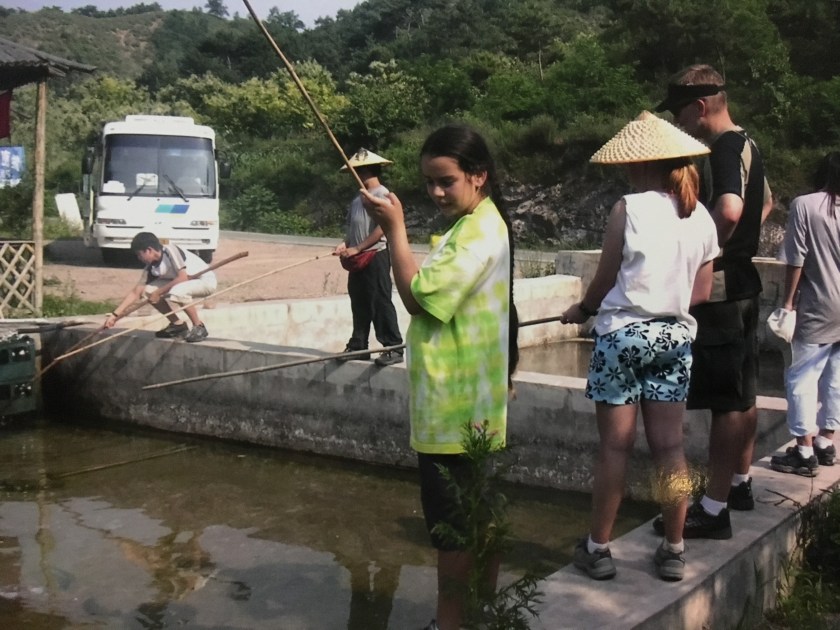
Outside the walls at Badaling (八达岭), Simatai (司马台),  and Mutianyu (慕田峪), there were fishing ponds where you could rent cane poles with hooks covered in balls of dough which you cast into small concrete fishing pools teaming with rainbow trout and salmon. After catching a trout, it would then be barbequed on a wood fire and served with local greens and a kind of cornbread. My Montana fly-fishing father is probably turning in his grave reading this, and it wasn’t much of a fishing experience, but the local people did know how to barbeque the fish and they were delicious.

Chinese Odyssey 48

Outside of Beijing

at the Jinshanling wall,

we scrambled and trekked

trying hard not to fall.

We slid down the zip line

into Si-Ma-Tai,

went fishing for trout

on the 4th of July.


Summer Palace 2.0 and other Beijing stories

Temple of Heaven

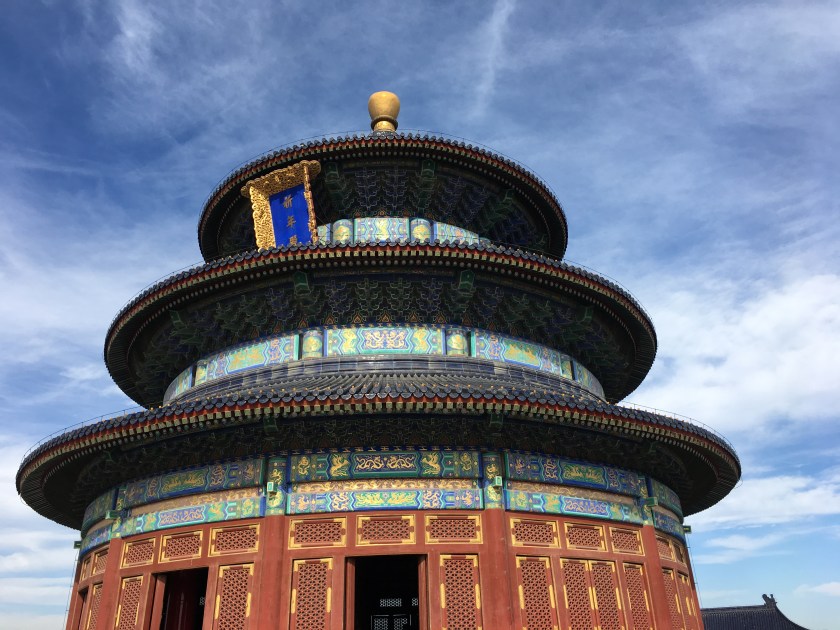
Built in the early 15th century during the rule of Emperor Yong Le (永樂帝 Yǒnglè Dì), 3rd Emperor of the Ming Dynasty, the Temple of Heaven (天壇 Tiāntán) is internationally recognized as the symbol of Beijing.  The cobalt blue tiles which make up the roof of the Hall of Prayer for Good Harvests are earthly manifestations of heaven and the sky. The nail-less structure of the wooden building, supported by “dougong brackets” https://multimedia.scmp.com/culture/article/forbidden-city/architecture/chapter_02.html) further compel anyone who visits to celebrate this monument, and to wonder and to smile at its magnificence. Like beautiful mosques, amazing cathedrals, and temples of faith around the world, the Temple of Heaven aspires to be a conduit between heaven and earth. Emperors of both the Ming and the Qing Dynasty would visit the Temple of Heaven at least once a year to pray for good harvests. After briefly wresting power from Sun Yat-sen in 1913, the last imperial wannabe, Yuan Shi Kai visited the Temple of Heaven in 1914, in hopes of moving from provisional President of the newly established Republic of China to Emperor of a new Hongxian ( 洪憲) dynasty. He actually declared himself Emperor of China on January 1, 1916. Unfortunately for Yuan Shi Kai, neither heaven nor the masses smiled at this usurpation of power. 83 days into his rule, he abandoned his emperorship, and by June 1916, Yuan Shi-Kai succumbed to a natural death from uremia at age 56.

20 kilometers to the west of the Temple of Heaven lies another famous landmark in Beijing, the Summer Palace. Only about 3 kilometers square, once you’re inside the park it seems much larger than that. About three-quarters of the park is occupied by Kunming Lake.

During the reign of the Qing Dynasty Emperor Qianlong, the original natural lake was dredged and sculpted like the park itself. When I go to the Temple of Heaven, I like to walk around the lake. Like so many places in China, if you walk away from the center of the action, the crowd diminishes by about one half after ten minutes. Continue for another 10 minutes and it starts to feel quiet. 30 minutes out from the focus of main tourist areas in China, you can be by yourself. At the Summer Palace, there is the Long Corridor stretching along one side of Kunming Lake, hand painted from top to bottom with landscapes, temples, flowers, birds, musicians, and figures from China’s history, Suzhou Street with its Qing Dynasty like shops, the pagodas on Longevity Hill, and the Marble Boat that could never float. A connection that not everyone makes, however, is between the Summer Palace and the Dowager Empress Cixi. It was Cixi who actually renovated the already existing marble party boat using funds embezzled from the Chinese navy.

A “dowager” is a widow who assumes a title from her deceased husband. Although never technically China’s “empress”, the “Empress Dowager” aka 慈禧太后 Cíxǐ Tàihòu, assumed the mantle of leadership for nearly 50 years in China during the waning years of the Qing Dynasty (late 19th and early 20th centuries) as the “Empress Dowager Cixi.” Cixi was actually one of the many young imperial concubines of the Xianfeng Emperor (咸豐帝 Xiánfēngdì). Her son, Zaichun (載淳 Zǎichún) became the Tong Zhi Emperor (同治帝 Tóngzhìdì) from 1861-1875. Zaichun died of smallpox (or possibly syphilis) in 1875 leaving no male heir. Cixi then appointed his three-year-old cousin as successor in the new Guangxu (光緒) era and so, was able to continue her rule. The new emperor’s mother mysteriously died soon after, thus securing Cixi’s rule and continued dominance. As the Guangxu emperor grew up, although he was emperor by name, the Empress Dowager Cixi was the de facto ruler of China. In 1898, Cixi actually had the Emperor removed from power and imprisoned in the Hall of Jade Ripple (玉澜堂) in the Summer Palace, where he remained until his death at age 37, just one day before the death of Cixi in 1908. Cixi had already named Puyi, her two-year-old nephew, as the new (turned out to be “the last”) emperor of China.

A final note on the Summer Palace. The Summer Palace was where the Imperial Family would move to as a respite from the summer heat, and the walls of the Forbidden City. Even though the current “Summer Palace” was built in the early Qing Dynasty, until 1860, the real summer palace, Yuan Ming Yuan (圓 明 園; Yuánmíng Yuán), was a complex of a much grander scale and was only a short distance away from the current Summer Palace. It was actually known in Chinese as the “Imperial Garden” (御 園 Yù Yuán).  It contained extensive gardens and was replete with beautiful buildings as well as historical and artistic treasures. When I first visited the “old Summer Palace”, I erroneously assumed that the smashed up statues and destroyed buildings had fallen victim to the Cultural Revolution. That idea was quickly put to rest when our guide told us that this park had been destroyed by the French and the British. In 1860, after the 2nd Opium War, a small delegation made up of British and Indian troops was sent to meet and discuss the Qing surrender with Prince Yi (怡親王). While negotiations were going on, British and French troops took it upon themselves to do a little pillaging and plundering of the old Summer Palace. After it was learned that 20 members of that delegation had been tortured and killed by the Chinese, all hell broke loose. Lord Elgin, British High Commissioner to China, ordered the complete destruction of the Summer Palace. After three days, nearly 4,000 French and British soldiers had turned the summer palace into a war zone. Looted pieces of art that were not destroyed can still be seen in museums and in private collections around the world today.

A Chinese Odyssey 47

The Temple of Heaven’s

dome shone cobalt blue.

We stared at the sky

where dragon kites flew.

Sailed round Kunming Lake

In a grand marble boat

which the dowager empress

could never make float.


Cutting Edge Science ca. 1600

Beijing Astronomy

In today’s world, it’s difficult to imagine Catholic Jesuit priests introducing scientific principles and laws into China that would merge with China’s mathematics and engineering to transform Chinese understanding of astronomy. But hang on to your hats. These guys did just that! At the beginning of the 17th century, Matteo Ricci and other priests who followed in his footsteps were convinced that science would open wide the doors to Christianity in China.

The Board of Astronomy became an official part of the Chinese government during the Han Dynasty (right around the time of Christ). Even before that, there are records of Chinese noting celestial phenomena like solar and lunar eclipses and comets. But by the end of the Ming Dynasty, the study of astronomy was definitely on the decline in China. Enter the Jesuits.

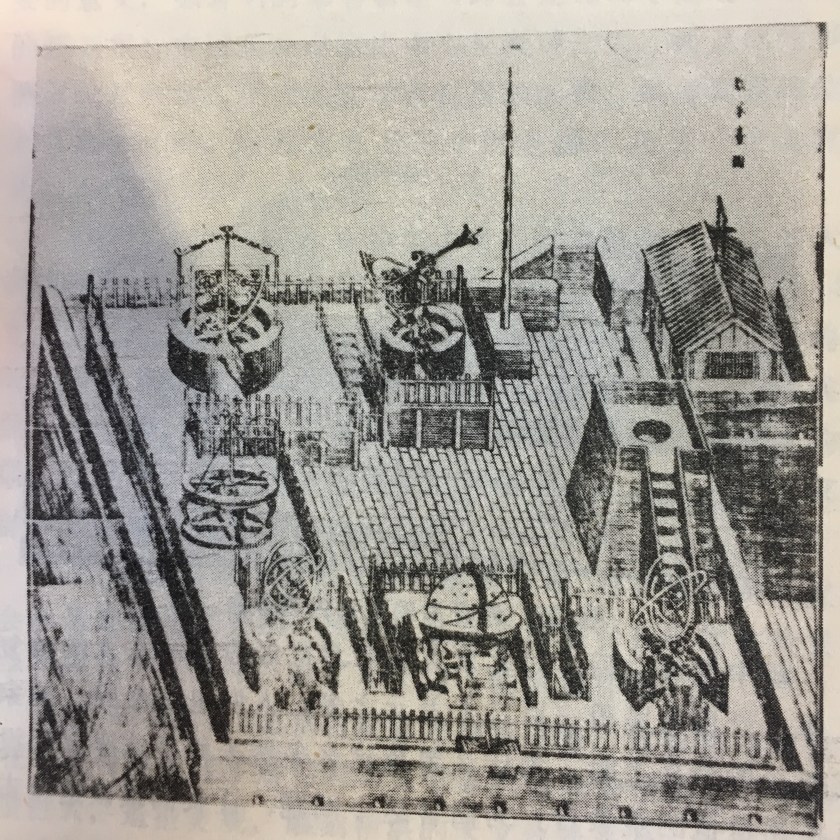
Matteo Ricci was not only a priest, but he was also a professor of mathematics whose own professor had been held in high esteem by Galileo. In 1601, upon arriving in Beijing, Ricci was granted an audience with the Emperor Wan Li and he offered his services to the Emperor. During a trip to Nanjing, he had discovered several large antique bronze astronomical instruments which nobody really understood, that had been created by the Chinese astronomer, mathematician, inventor, and engineer, Guo Shoujing (郭守敬) during the reign of Kublai Kahn in the Yuan Dynasty (13th century).

The very cool thing is that these instruments still can be found on the top of a small square building in Dongcheng Qu on Jian Wai Da Jie in Beijing. It’s called the Beijing Ancient Observatory (北京古象台 Běijīng Gǔ Guānxiàngtái.) The photo above is from an observatory pamphlet I picked up there in the ’90s.  I still don’t understand how any of these instruments work.

Not far from the observatory, there are hundreds of hutongs (胡同 hútòng). Hutongs are narrow alleys that have flowed through neighborhoods in Beijing since the Yuan Dynasty (13th century). Like so much of China, what was once a normal way of life has turned into quaint neighborhoods where tourists can rent airbnbs.  All the homes and shops are low-rise in the hutong neighborhoods. The houses have courtyards where families sit on stools and lounge chairs made out of bamboo slats. Birds sleep in wooden cages covered to keep them dark and crickets chirp in tiny bamboo cages being fed and trained for cricket fighting. Most people who live in hutong’s live where their parents lived and their parents before them. It’s said that the term, Hutong, actually comes from a Mongolian word meaning “water well”.

Not far from the hutongs is the Forbidden City, across the street from Tiananmen Square, and only a few blocks from Beijing’s first ever McDonalds. Through a contact in Hong Kong, a former student of mine from Australia managed to get an “internship” slinging burgers and running a cash register at what was once touted as the biggest McDonalds in the world. It could seat over 700 people. I wish I could have witnessed this tall white kid joking with his customers there. By the end of the summer, his Putonghua was better than mine. In 1996, this piece of Wangfujing real estate was determined to be too valuable for McD’s and is now the home of the Oriental Plaza.

Chinese Odyssey 46

We ate food from McDonald’s

near Tian An Men Square,

bicycled through hutongs

climbed Drum Tower stairs.

Saw celestial globes

made by Jesuit priests

for the Emperor Kangxi’s

astronomical feasts.


Beijing, Peking, Peiping, Yanjing, Dadu – what’s in a name?

Beijing_Old_Railway_Station

Gene Zhang [CC BY 2.0 (https://creativecommons.org/licenses/by/2.0)]

My first trip from Beijing to Tianjin took over three hours on a slow-moving passenger train. Today, one can get from Beijing South Railway Station to Tianjin Railway Station on the Beijing-Tianjin High-Speed Train in 30 minutes.

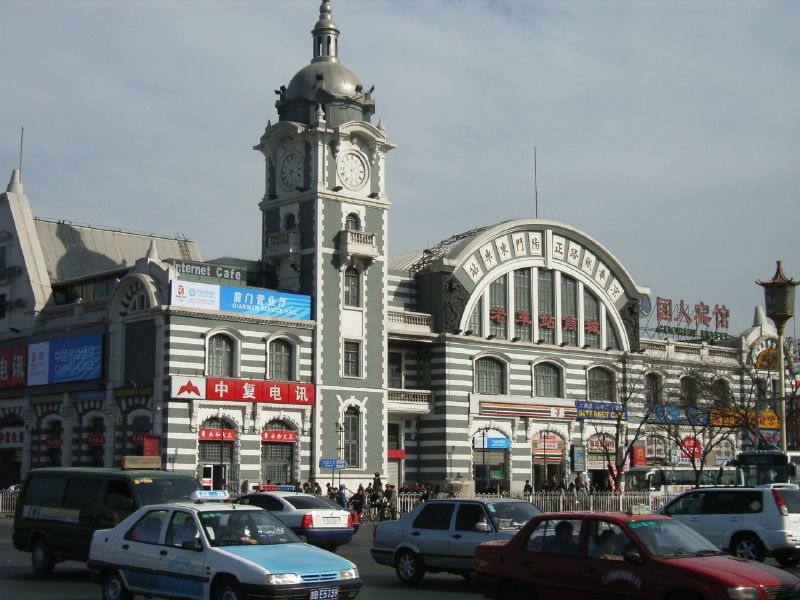
There was a vibrancy in the air when we stepped off of the train at the Beijing Station 北京站 Běijīngzhàn on a hot July day in 1982. The grey, blue, and green colors of day faded softly into the concrete and stone buildings and bridges and the air of China’s capital city. Moving like a snail in a Didi Chuxing car (China’s Uber), it’s hard to imagine many of these same streets packed chock-a-block with bicycles. There still seem to be bunches (not billions) of bikes in Beijing, but most of them are shared bikes. And an increasing number of shared bikes are broken bikes. Bikes no longer own the road, cars do.

So many things taken for granted a few decades ago are a shadow of what they used to be. Barbers had spots on the street and at sidewalk intersections in the parks. It’s said that one can still find old men at Yùyuāntán Park 玉渊潭公园 who will trim your hair for a few yuan. And in the early morning, men walking their birds and Taiqi “boxers” have been joined by practioners of Qigong, a variety of wǔ shù (武术) martial arts, badminton players, gymnasts, and ballroom dancers.

Beijing lawmakers banned bāozi (包子) and jettisoned jiānbǐng (煎饼) when they made the Haidian hawkers close down shop. Baozi is the quintessential northern comfort food. It’s a fist-sized wheat flour pastry filled with meat and/or vegetables and then steamed. Jianbing is more difficult to describe. It’s made with flour (millet or wheat), thickness somewhere between a crepe and a dosa. After the flour mixture is poured and spread onto the large, round cast iron pan, it becomes the “bing”. Add an egg (or two) by spooning or brushing it onto the bing. Then a generous sprinkling of green onions and a pinch of salt; some sweet bean paste; a shake or two of sugar; maybe a little baste of hot pepper sauce aka là jiāo jiàng (辣椒酱).  On top of all of that spread a few shards of guǒ bì (馃箅), that crispy fried dough that goes on top of everything else. Then roll it up like a big burrito, fold it in two, cut it in half, and put into a paper or plastic bag. Beijing breakfast.

I heard the street food’s also gone in Xidan and Sanlitun. Is there still someone selling green onion cakes aka cōng yóubǐng 葱油饼 outside of the Temple of the Azure Clouds in Xiangshan? Thank God for Wangfujing. Rumor has it, the night market is still going strong. I’m sure they still have the amazing Xinjiang kebabs (串儿Chuànr) and sugar coated haw fruit aka tánghúlu 糖葫芦 . It’s been a few years, but I’m heading up to Beijing next week. Guess I get to see for myself.

Chinese Odyssey 45

Three hours from Tianjin

to the heart of Beijing.

There were vendors on bikes

hawking fresh congyoubing.

Haircuts on the corners,

men walking their birds,

Sword Taiqi at daybreak

not saying a word.