A Belt and Road Primer

2000px-One-belt-one-road.svg.png        wikimedia.org/wiki/File:One-belt-one-road.svg

The late 19th and early 20th centuries were not China’s finest hour. From one of the most powerful nations in the world, it had become a decaying relic of its former greatness. Europeans, Japanese, and Americans tried hard to make places like Tianjin reflect their own cultures. Sometimes I wonder as I stroll along the Bund in Shanghai or Yingkou Road in the former British Concession in Tianjin where Harry Liu lived, how Chinese feel about these relics of the past. Do they mourn the loss of iconic foreign architecture from the Concession Era, or do they welcome the distinctly modern creations by Chinese architects?

For many foreigners looking at China, it’s easy to get stuck in the past, be it 15 years ago leading students up China’s east coast, or 2,500 years ago, when Confucius, Laozi, and Gautama Buddha (OK Gautama Buddha was India) walked this Earth at the same time. Or to remember the Ancient Silk road which spread not only goods but Chinese culture across western Asia into Europe.

But most people in today’s China don’t live in the past. They live in a very future driven present.

Tianjin is the closest port to Beijing.  Located on the Bohai Sea, it has been a northern center for foreign trade in China since the Qing Dynasty, and today stands as the opening northern port of China’s 21st Century Maritime Silk Road, meeting up near Tianjin with the Eastern Land Silk Road, both a part of the “Belt and Road”, which is probably the most important 21st century economic initiative in the world today.

The “Belt and Road Initiative” aka “One Belt, One Road 一路 aka the “Silk Road Economic Belt and the 21st-century Maritime Silk Road 丝绸之路经济带和21海上丝绸之路was first unveiled to the world by President Xi Jinping in October 2013 in Kazakhstan. A few weeks later, Premier Li Keqiang promulgated China’s vision to  “help promote the economic prosperity of the countries along the Belt and Road and regional economic cooperation, strengthen exchanges and mutual learning between different civilizations, and promote world peace and development.”

We would be very naïve to think that altruism plays much of a role at all in the multi-trillion dollar Belt and Road Initiative. It’s designed to make it easier for the world to trade with China. At a national level, China would like to lessen gaps between the underdeveloped hinterlands and rust belt with the wealthier coast of China, and, by upscaling China’s status as a global leader, further enhance pride and love for the Mother Country.  At an international level, they would like to create new markets for China; to allow easier access to raw materials which China will continue to need; to find ways to reuse and repurpose surplus goods, equipment, and factories as China repositions itself as a more eco-friendly producer and manufacturer of goods; to create future customers for some of its new technological innovations AND to further develop its posture and position as a global economic leader.

The Belt is not a single path; it is actually six land corridors all starting in China:

1) The first corridor extends into Mongolia and Russia.

2) The second from China through to Europe. It’s now possible to go from China to London by railroad. In mid-March 2019, Italy announced that it would join the Belt and Road Initiative, becoming the first European country to sign on.

3) China-Central & West Asia Corridor make up the third corridor; the Central Asia-China gas pipeline, linking China with the Caspian Sea is up and running.

4) In the Pakistan Corridor China has helped build seaports, highways and high-speed railways.

5) There is a China-Bangladesh-India-Myanmar Corridor.

6) The final corridor is the China-Indochina Corridor. In Cambodia, between 65 and 80% of all the energy projects across the board are Chinese invested, built, or owned.

The Road refers to a maritime sea route extending from China through Indonesia, India, East Africa,  Egypt, into the Mediterranean – and which might very well extend west to South America in the not-too-distant future.

Some things to think about

  1. China has a unique requirement that it must be involved in all of the building of the projects it supports.
  2. Seven of the top ten global contractors are Chinese.
  3. The “Belt and Road” has been a big hit with the less democratic countries; In recent history, countries have often had to meet strict ethical standards when setting up global partnerships, but China, for the most part, does not require those kinds of ethical conditions be met:
    1. China has already signed agreements with Belarus, Azerbaijan, Saudi Arabia, and Thailand.
    2. China has been quietly developing economic connections with Afghanistan, Ukraine, Yemen, and Iraq.
  4. BRI is a risky plan involving several countries who may have a difficult time paying China back. In 2017, China signed a 99 year deal with Sri Lanka giving China control of the port they helped build. China also has a 40-year lease on the strategic Gwadar Port in Pakistan.
  5. There is a theory that China is trying to establish a chain of naval bases (“a string of pearls”) that will allow it to guard shipping routes where China has interests, thus giving it some strategic benefits.

For more in-depth reading, check out the Lowy Foundation “Understanding China’s Belt and Road Initiative” by Peter Cai https://www.lowyinstitute.org/publications/understanding-belt-and-road-initiative

Chinese Odyssey 44

Before Liberation,

Tianjin had “Concessions”

Europeans, US, Japanese

claimed possessions

The Astor Hotel 

housed the Emperor Pu Yi

There was Keisslings for borscht

for baozi, Gou Bu Li
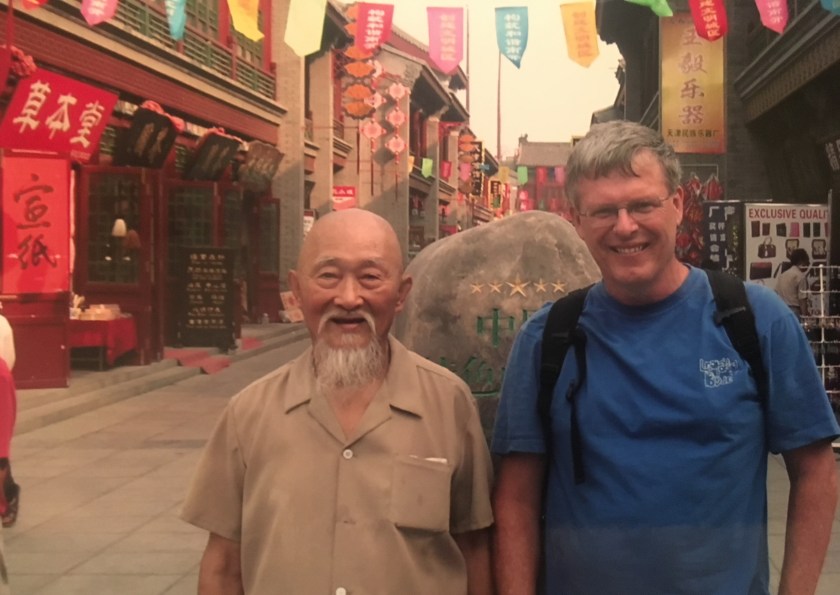
 

“They called me Harry Jeep”

Harry Liu and Peter 2

I first went to Tianjin to see an old friend from Taiwan who was teaching there. Jeff took me to meet a buddy of his who sold paintings and porcelain on Ancient Culture Street. Enter, Harry Liu. Originally from Shanghai, Harry Liu studied at Tientsin Anglo-Chinese College in the early 1940s with Eric Liddell (remember “Chariots of Fire”?) After graduating, Harry went on to study and complete his medical degree in the Japanese and German program at Beijing University. But largely because of a part-time post-war job, Harry never got to practice medicine. Somehow, he had been co-opted by the American Marines in Tianjin where his Scottish accented English changed into that kind of hybrid English found among English speakers today who live between America and the UK.  In addition to speaking Putonghua, German, and Japanese, Harry also spoke Cantonese, Shanghainese, and a smattering of European Romance languages. Harry loved America – or, at least the idea of it. Two things I would often take Harry were Whitman’s Chocolate Samplers and American 20th-century non-fiction books about China. Harry’s work as a Jeep driver and general lackey for the American marines post-WW2 earned him both his nickname, “Harry Jeep”, and a protracted period of reeducation from the “real teachers” in China during the early days of the revolution – the workers and the peasants. Harry loved Kiessling’s Café  (起士林饭店 Qǐshìlín Fàndiàn) a German-Austrian bakery and restaurant renowned for its fine European cuisine. I remember taking Harry there in the late 1990s and treating him to a couple of his favorite dishes that he hadn’t eaten since the 1940s. For years after that,  whenever I would lead a group to Beijing, we would invariably detour to Tianjin where Harry would walk us through the European concessions and regale us with stories of his life in Tianjin.  We would often take kids to 狗不理包子(Gǒubulǐ Bāozi), a 200-year-old local favorite whose name defies translation, but it’s something like “Dogs don’t pay attention steamed buns.” Harry Liu passed away in 2010 at the age of 86, never having fulfilled his lifelong dream to visit America.

Although it is one of 4 municipalities in China (the other three being Beijing, Shanghai, and Chongqing), and has been a prominent trading port in China since the 13th century, most  people outside of China know very little about this “Shanghai of the North.” After the French and British gunboats attacked Tianjin and forced the Treaty of Tianjin in 1858, opium was made legal, and foreign trade was opened wide.  Following the British and the French into Tianjin were the Germans, the Japanese, the Austrians, the Italians, the Belgians, and the Russians.  There was also a sizable American population there.  The “Concessions” (公共租界 Gōnggòng Zūjiè) were physical “settlements” in Tianjin, Shanghai and several other cities which were ceded by the Chinese to European countries, the USA, and Japan. Tianjin had eight foreign concessions. Each concession had its own schools, hospitals, stores, prisons, and restaurants.

The flower of the British Concession was the Astor Hotel (利顺德大饭店), located next door to British built Victoria Park. It was the prime address for diplomats and social functions among the international upper crust in Tianjin in the late 19th and early 20th centuries. Ulysses S. Grant stayed there in the 1870s. The American consulate in Tianjin was located in the Astor until 1929, and Herbert Hoover stayed there numerous times before he became 31st President of the United States. Pu Yi, China’s last emperor called the Astor his home for many years after abdicating in 1910 and before becoming the puppet ruler of Manchuria during the Japanese occupation. Starting as a single level hotel, by 1924 it had built up to three levels and later added an eight-story wing with one of China’s first American Otis elevators. Today, the newer portion has been refurbished while portions of the old Astor retain their former Old World décor, memorabilia, and furnishings. The Astor remains one of Tianjin’s finest luxury hotels.

I ran across this interesting description of Tianjin in Isabelle Maynard’s book,  China Dreams: Growing up Jewish in Tientsin: She wrote “Not until I was living in the safety of America did I realize that the land where I was born and raised would now be as inaccessible to me as Russia was to my father. It was then that the dreams began. Tientsin dreams of growing up; of joys and sorrows; of boyfriends and girlfriends; of blood red mimosas in Victoria Park, cerulean blue quilted rickshaw covers, yellow soft-as-powder sands of Pei-tai-ho Beach; of the silvery bridge joining the French and Italian concessions; of murky green water of the Hai-Ho Canal; of white signs that said, ‘No dogs or Chinese allowed’; and of the blackness into which war had plunged us.”

Now, less than an hour from cosmopolitan Beijing by fast train, Tianjin retains both the charm and a feeling of “renqingwei” (warmth and hospitality) that I had not encountered since leaving Taiwan.

Chinese Odyssey 43

Ending up in Tianjin

with my friend, “Harry Jeep”.

An amazing old man

selling art on the street.

Eric Liddell, his teacher

M.D. from Bei Da

worked for US Marines,

unforgivable flaw.

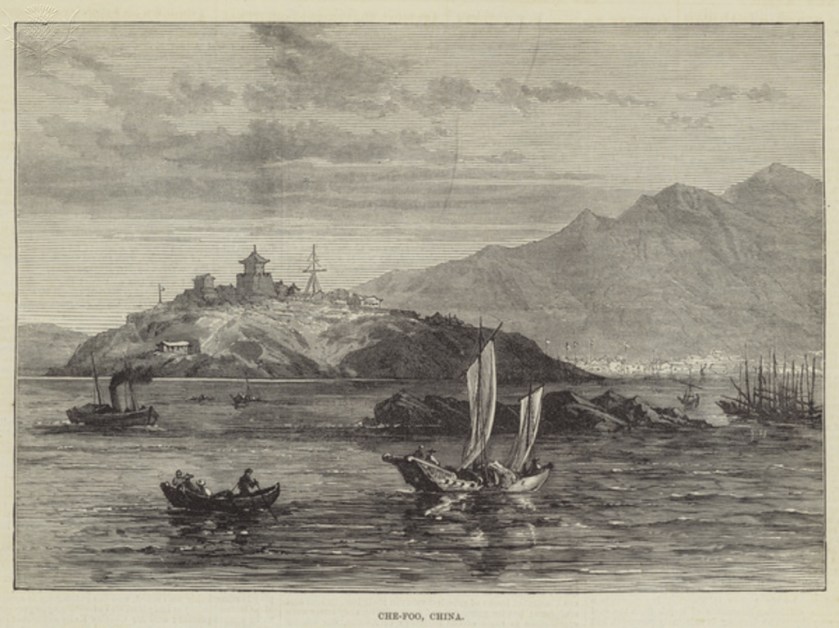
Yantai is Chefoo

Yantai (Chefoo) ChinaChe-Foo, China (engraving). Illustration. Britannica ImageQuest, Encyclopædia Britannica, 26 Mar 2018.  quest.eb.com/search/108_2472893/1/108_2472893/cite. Accessed 16 Mar 2019.

In 1997, the plan was to travel by train from Taishan to Yantai. Yantai (烟台市 Yāntái shì) is located on the southern shore of the Bohai Sea which turns into  Korea Bay and then becomes the Yellow Sea and then the East China Sea and finally the Pacific Ocean. It is nearly due south of Dalian (formerly known by non-Chinese speakers as “Port Arthur”), and it looked to be a straight shot by boat to Tianjin. Twice I tried and twice my plan was foiled. But I’d still like to ride that boat.

Chefoo 芝罘  Zhīfú was the name most Westerners used when they referred to the city we now know as Yantai. Although it is a city of nearly 7 million people, my guess is that many people reading this have never heard of it. There was a Christian school that opened there in 1881 called the Protestant Collegiate School or Chefoo China Inland Mission School 芝罘学校  Zhīfú Xuéxiào, and it served as a Christian boarding school for the China Inland Mission. I find the accounts of Christians living in China fascinating. More came to teach than to learn. The ways they lived and dressed and considered their missions were multifold and multi-layered. Many provided the first solid connections between China and the West. Some men and women would dedicate their entire lives to the service of the church in China. I found this account of the life of missionary children at the Chefoo School by Larry Clinton Thompson, an interesting window into how the children of these missionaries lived their lives:          https://www.academia.edu/8994079/Missionary_Children_in_China_The_Chefoo_School_and_a_Japanese_Prison

In 1941, the children and staff who had not managed to leave before the Japanese invaders arrived were first interned in the Temple Hill Internment Camp in Chefoo before being transferred to the larger Weihsien Internment Camp 潍县集中营 Wéixiàn Jízhōngyíng, a Japanese operated “Civilian Assembly Center” about 260 km southwest of Chefoo. Among the residents of the camp was Eric Liddell, the famous Scottish gold medal runner turned missionary who was featured in the 1982 Oscar best picture film, “Chariots of Fire.” When he was finally taken prisoner by the Japanese, he was sent to Weihsien where he continued his ministry, setting up sports events, teaching science to children, and running a Sunday school every week. While there, he was diagnosed with a brain tumor but was inspirational to the end. The title track from “Chariots of Fire” is often used in sporting events today and is still one of the most recognizable instrumental movie themes ever written.

A fun story connecting Yantai to the West involved an American sailor by the name of Jimmy James. Most people don’t know that Jimmy’s actual last name was Skalicky. After dropping out of college in Minnesota in 1902, Jimmy joined the army and ended up in Tianjin (then known by Westerners as Tientsin) where he was discharged from the 15th Infantry in 1922. At that town, there were naval ships that would dock at Yantai, and Jimmy had the bright idea of opening up a hamburger stand there. It was such a big hit, people begged him to do something similar in Shanghai, so Jimmy decided to give it a go. In 1924, he opened up a diner on Broadway Road (now Da Ming Lu) in Shanghai, called The Broadway Lunch. In 1927, he changed the name to Jimmy’s Kitchen, and the rest is history. And for those who don’t know that history . . . the restaurant is an icon in Hong Kong from the Colonial era. You can still get the same Steak Diane and Baked Alaska that were favorites of John Wayne and Cary Grant. Still dishing up great grub on Wyndham Street in Central and at the Jinjiang Hotel in Shanghai.

 Chinese Odyssey 42

 On the map it appeared

to be one easy sail

from Yantai to Tianjin;

there was no way to fail.

No boats in the Bohai,

so an overnight bus

where the seats turned to beds

was a hotel for us.

“Tyranny is More Ferocious than Tigers” Tai Shan

MINOLTA DIGITAL CAMERA

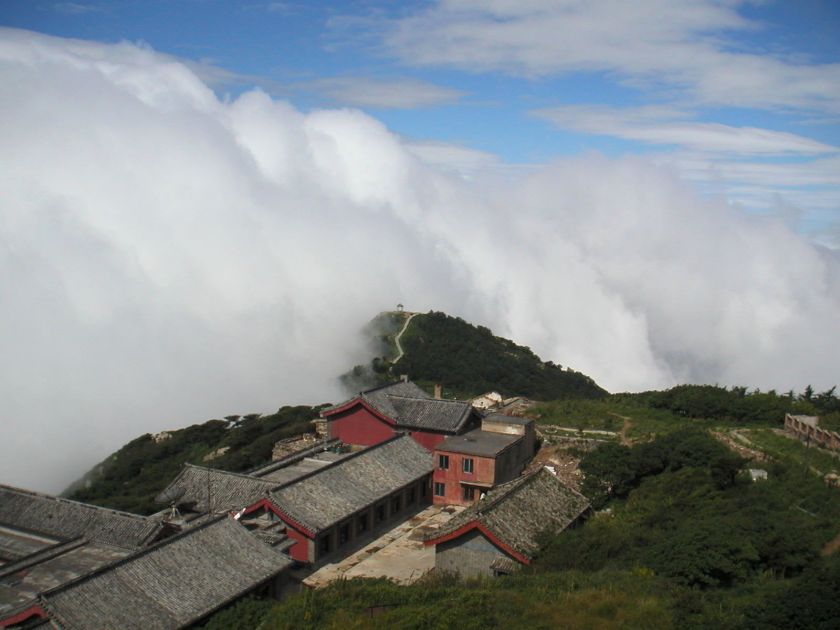
During his travels, Confucius was approaching the foot of Mount Tai (Taishan) when he encountered a lone woman weeping and obviously distraught. When he asked why she was sad, she told him that her son had recently been devoured by a tiger. She went on to say that her husband and her father-in-law had also been killed by tigers in the same area. Confucius invited her to join his retinue and asked why she remained in this place. The woman politely declined his offer and said that in this place, she felt free and was not subject to the tyranny of the government. His words, “Tyranny is more ferocious than tigers” (苛政猛于虎 kē zhèng měng yú hǔ) are still used today to describe how some people believe that the benefits of living in isolation or in isolated communities outweigh the benefits of living near a repressive government.

Buddhism, Daoism, and Confucianism all have long histories in Shandong Province. Mount Tai (泰山 Tài Shān) is located near the city of Tai ‘an in the middle of Shandong, and is, perhaps, the most revered of all China’s “sacred mountains”. It is said that 72 emperors from China’s ancient past journeyed to Taishan to pay homage and make sacrifices to Heaven and Earth and pray for peace and prosperity Fengshan Ceremony (封禅仪式 fēng shàn yí shì). There are over 6,000 steps one needs to climb in order to summit the east peak of Mount Tai, but these days, most people opt for the combination bus and cable car ascent. Expedience does, however, have its costs. Many of the hundreds of stone tablets and engravings, numerous temples and ruins, and a scattering of archways, gates, pavilions, and kiosks line the steps up the mountain.

Some of the earliest artifacts of Chinese history come from the province of Shandong. During the Neolithic period (4100 to 2600 BCE), the Dawenkou culture (大汶口文化  Dàwènkǒu wénhuà) existed alongside the Yangshao culture (仰韶文化 Yǎngsháo wénhuà) and there is strong evidence that there was strong interaction between the two cultures. There is also interesting research going on which suggests links between Dawenkou culture and Austronesian languages and culture. The Dawenkou culture was also believed to have been the first to practice trepanation (boring a hole in the skull to relieve pressure) in prehistoric China.

But it’s the ceramics that I find most fascinating. Some of the pottery was made on pottery wheels and was colorfully decorated with geometric patterns similar to those found in indigenous pottery throughout the world. Black “egg-shell” Longshan pottery from the Neolithic Age has been discovered which was both delicate and amazingly strong. Sophisticated tools and ornaments were made out of jade and bone.

登泰山而小天下  Dēng Tàishān ér xiǎo tiānxià

If you want to see how small the world is, climb Tai Shan.

Chinese Odyssey 41

 Once tigers roamed foothills

surrounding Mount Tai

but now tourists ride,

they don’t climb to the sky.

Gondolas replaced

six thousand stone stairs.

So, welcome back tigers.

return to your lairs!

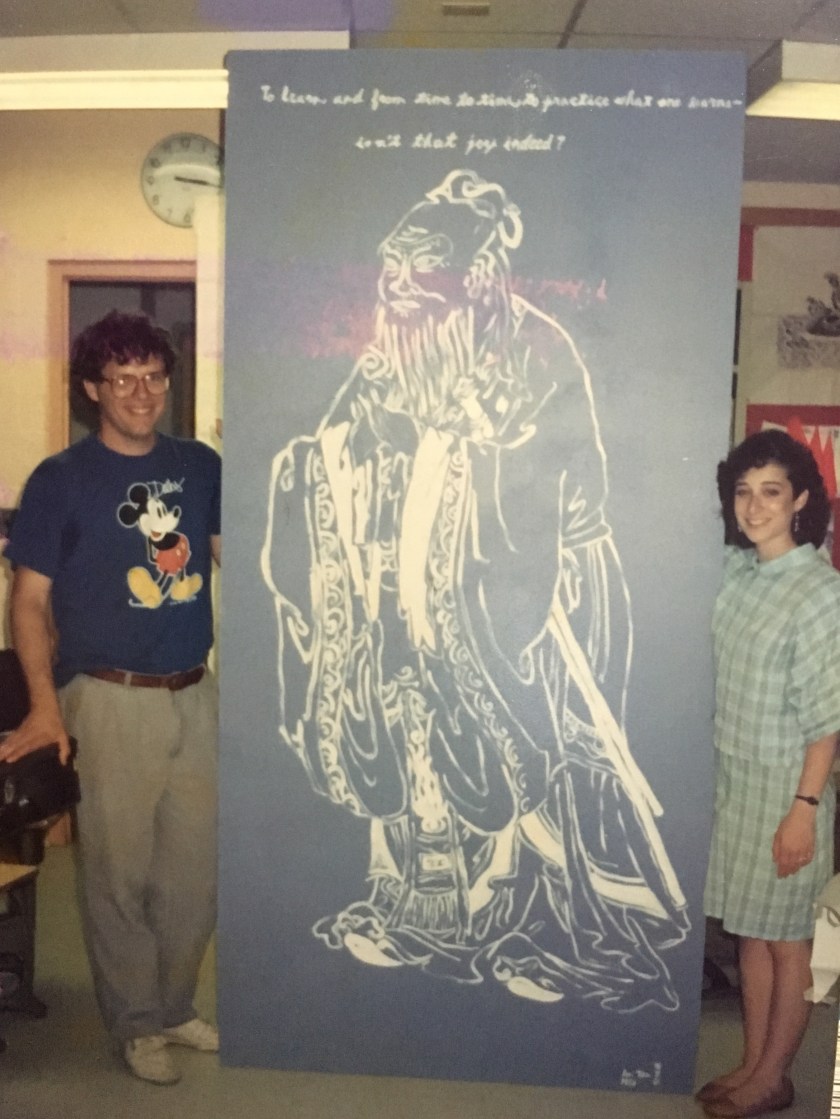
Confucius – 子曰:学而时习之,不亦说乎

ConfuciusThe Master said:  “To learn, and from time to time, to practice what you learn, isn’t that joy indeed?”

My first introduction to Confucius was in primary school, where we would share “Confucius says” pearls of wisdom that, I’m pretty sure, Confucius never said. Still, even as nine-year-olds, we all knew the name, Confucius. I can’t think of any other Chinese historical figure that has that kind of name recognition.

The writings and teachings of Confucius are one of the “3 pillars of Chinese Culture”. The impact of Confucius on, not only China, but on Japan, Korea, and much of south-east Asia, is immense. In much the same way as teachings from the Bible, the Quran, and the Torah continue to influence the way people behave today, Confucianism continues to inform both behavior and relationships in China. Yet, Confucius was not a religious teacher.

The man we call Confucius is known by most Chinese as Kongzi (孔子 Kǒngzi), or Kong Fu Zi (孔夫子 Kǒng fū zǐ.)  Born in B.C.E, 551, Confucius lived in the “Spring and Autumn Period” during the Eastern Zhou Dynasty (東周  Dōngzhōu), about 500 years before the birth of Christ. He was born in the town of Qufu ( Qǔ fù) in the province of Shandong.

Confucius believed that the sages of old truly understood social harmony and had, through the Book of History (書經 Shū Jīng) and the Book of Odes, (詩經 Shī Jīng), made that wisdom available to people living during the time of Confucius. By studying both Zhou and Shang societies, religion, and political institutions, the chaotic state of affairs which existed during the Spring and Autumn period could be rectified. In addition to the classics, there was also a rich oral history that surrounded Confucius. He loved hearing stories of the legendary Kings preceding the Zhou Dynasty. He recounted many of these stories and lessons of life in the Analects (論語 Lúnyǔ), a collection of his thoughts and dialogues with his disciples. The Confucian Analects is one of the Four Books and the Five Classics (四書五經 Sìshū Wǔjīng), which are the classical texts compiled after Confucius’ death, and which make up the core of Confucianism.

Confucius felt it was his mission to instruct rulers at high levels of government in order to revitalize learnings that had been around for centuries. He believed that the rites, rituals, and ceremonies  (礼 lǐ) had been developed over generations of human wisdom and that they both represented core social values and helped create social order. Confucius also stressed virtues like ren (  rén), sometimes translated as “righteousness” or “humanity” or even “love” or “kindness.” How do human beings live together in harmony? Only by continuing to nurture our own inner character through education and reflection.

One of the ways that people could begin to live in harmony was to adhere to the three fundamental bonds ( 三纲 Sān Gāng),  which are the basis for the most important of human relationships. Although one cannot discount a hierarchy, there is equally a sense of reciprocity and definition of roles in these relationships. The ruler not only mentors the ministers but takes care of them (君臣 jūn chén); the father teaches, encourages, and protects the son (父 子 fù zǐ); the husband respects, supports and nurtures the wife (夫 婦 fū fù). They all have obligations to one another.

Confucius was the ultimate idealist. He believed that people could improve themselves and their interactions among their families and their states through love, respect, understanding, and consideration of the needs of others. But core to those requirements was honesty. And that meant being able to criticize unjust rulers and refusing to serve corrupt officials.

The Master said: Water that floats a boat can also capsize it.  子曰:“水可載舟,亦能覆舟”

 Good government demanded stellar officials who had mastered the five virtues: 

  • Li (礼 lǐ), propriety, ritual etiquette, manners, duty, and respect. Confucius clearly identified roles between rulers and ministers, fathers and sons, husbands and wives, elder brothers and younger brothers and even friends.
  • Ren (仁 rén), benevolence, or kindness to one’s fellow man. Confucius believed that there should be no limit to benevolence, even if it means laying down one’s life for another.
  • Xin (信 xìn), honesty, truthfulness, faithfulness, and sincerity. One’s word is one’s bond.
  • Yi (义 yì), righteousness, honesty, integrity; strongly associated with justice
  • Zhi (智 zhì), wisdom, knowledge of right and wrong; a strong moral compass

The Master said:   One cannot be an outstanding teacher, without continuing to acquire new knowledge. 

子曰:“溫故而知新,可以爲師矣。Zǐ yuē: Wēn gù ér zhī xīn, kě yǐ wéi shī yǐ.”

Chinese Odyssey 40

We continued our journey, 

in a hard sleeper car, 

to the land of Confucius,

a bright rising star.

Now children can learn

about filial piety,

Will little emperors dance

to odes of propriety?

Shandong – Robin Hood on Steroids

BaDaGuan in Qingdao copyBadaguan ()

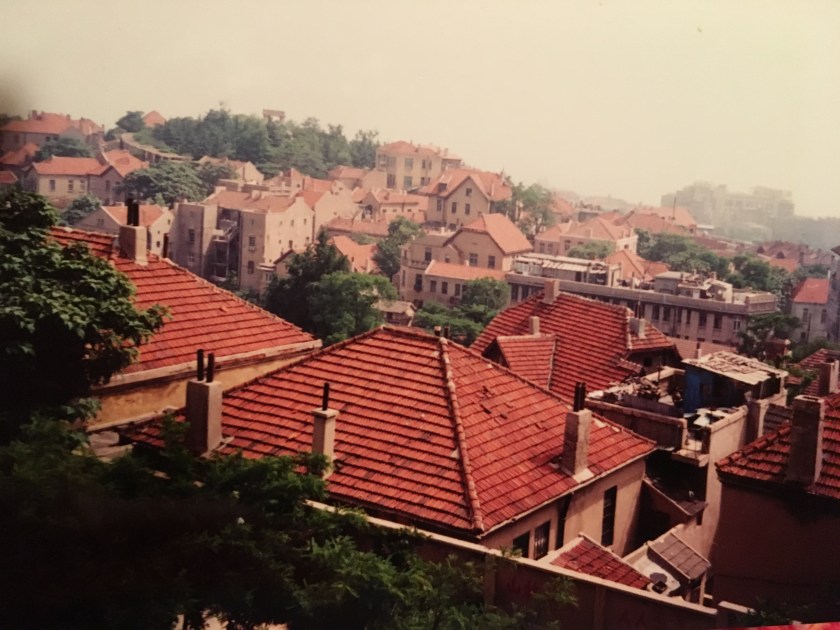
Most people know Qingdao (青岛) as Tsingtao . . . like the beer. Today, quite a few are pronouncing the name of this city of nine million people as “ching dow” which is fairly close to the correct pronunciation. Located on the coast, in the province of Shandong (山东), Qingdao is about 500 km due north of Shanghai. In 1897 during an observation of the Chinese coast, the German high command decided that Qingdao would be the perfect place for a German naval base. They had been eying this sleepy little fishing village since the early 1890s and gradually transformed Qingdao into a modern port. The weak Qing government was bullied by Germany to cede a portion of Qingdao (about 200 square miles) to the Germans as a “concession”. The Germania-Brauerei was established in 1903 as a joint venture between German and British investors.  This was the birth of Tsingtao Beer. In addition to outstanding beer, Germans in Qingdao had developed amazing schools and established several  Protestant and Roman Catholic missions. The Germans also based their Far East Squadron in Qingdao. The Japanese, with the aid of 1500 British troops, wrested Qingdao from the Germans in 1914, but the Republic of China reasserted its control in 1922. The bombing of German ships in the harbor by a Japanese Farman seaplane is said to have been the first air to sea battle in history. The Japanese then re-occupied Qingdao in 1938 and remained there until their surrender at the Tientsin racecourse in October of 1945. The US Navy, at the invitation of the KMT, was then allowed to station its Western Pacific Fleet in Qingdao until the Red Army, under the leadership of the Chinese Communist Party, finally took control in 1949.

One of China’s most beloved novels has several different titles in English. In 1948, Pearl Buck named it “All Men are Brothers”. “Outlaws of the Marsh” and variations of that theme are also popular English titles for translations. The Chinese title, however, Shuǐhǔ Zhuàn 水滸傳, translates to “The Water Margin Story”. It is about a band of outlaws and is based on an actual historical figure, Sòng Jiāng 宋江, the charismatic leader, and his followers, who roamed the hills and marshes of Shandong and Henan during the Song Dynasty. Song Jiang led attacks and started a rebellion against the government who initially felt powerless against this Chinese style Robin Hood, the “Protector of Justice (呼保義 Hū Bǎoyì)”. 

The authorship of “Shui Hu Zhuan” is unclear. Stories have circulated about Song Jiang and his band of outlaws since they were active in the 12th century. There were early manuscripts of the book in the 14th century, but the first full-on 100 chapter version doesn’t appear until the Ming Dynasty in the 16th century.

In the “Water Margin Story”, Song Jiang commands 108 “Stars of Destiny” (宿星 sù xīng),  former “demonic overlords” who had been accidentally redeemed. These erstwhile bad guys then took it upon themselves to turn over new leaves and became heroes who dedicated themselves to fighting for justice.

Kind of like Clark Kent, “mild man and reporter for a great metropolitan newspaper”, Song Jiang, by day, serves as a clerk for a county magistrate, but this identity underlies the complexity of who he really is, both a trained scholar and a martial arts warrior. He is a handsome, dark complexioned man with “phoenix eyes”.  There’s a little bit of everything in the Water Margin – love, lust, loss, betrayal, violence, death, flight, and secret hideouts in the Liangshan Marsh ( Shuǐ Pō Liáng Shān).

In the book, Song Jiang is eventually caught, his face branded with a prisoner tattoo, and he is exiled to a prison camp in Jiangzhou (江州), in present-day Jiangxi. Considered by the people as a great patriot, who first and foremost loved China, Song Jiang was given a chance to prove his loyalty to the Emperor by commanding his band of outlaws against Liao rebel forces invading the Song. Song Jiang survives these campaigns, but at a terrible price. Two-thirds of the “108 Stars of Destiny” perish.

In the end, Song Jiang is rewarded by the Emperor Huizong (宋徽宗 Sòng Huīzōng), by being named as Governor of Chuzhou. Not long after, he is poisoned by corrupt officials. But after his spirit visits the Emperor in his sleep, he is once again redeemed by the Emperor and rewarded posthumously for his loyalty and courage.

It was a breath of fresh air when we stepped out of the train and began to explore the hills and tunnels of Qingdao with our three young daughters in the mid-’90s. The area called Badaguan () still had many of the old German style mansions and villas and an underground passage Chiang Kai-shek used to get from his villa to the beach.   I also remember the Laoshan hills (山 Láo Shān), to the northeast of Qingdao, where the local folks told us the Qingdao Beer was too pricey for them. They preferred the local Laoshan Pijiu, anyway. No arguments from us. It was perfect.

Chinese Odyssey 39

Shanghai to Qingdao

the train chugged along,

played xiangqi, ate noodles

sang Chinese folk songs.

Walked under a mountain

to a German cathedral.

Shared a walk on the beach

with seagulls and people.

Lion’s Head, Trotters, and 1,000 Year Old Eggs

800px-Xiao_Long_Bao_at_Shanghai_Wind,_VancouverKent Wang from Richmond, Vancouver (https://creativecommons.org/licenses/by-sa/2.0)%5D, via Wikimedia Commons

Shanghai’s history is rich, but, as a cosmopolitan city,  relatively short. Before the 1842 Treaty of Nanjing,  following the 1st  Opium War, Shanghai was little more than a fishing village. All that changed when the British named Shanghai as a treaty port. As Shanghai grew,  it was not as a single entity, but rather as a conglomeration of “concessions” to foreign powers. The French, British, and Americans along with the Germans, Dutch, Japanese, Portuguese, and Russians all had “concessions” in Shanghai, and they all demanded the right of “extraterritoriality.” They would be bound only by the laws of their own countries, not by the laws of China.  What emerged was an interesting mixture of architecture and industry, Chinese and European cultures that both blended and clashed. By 1943, the Japanese were largely in control, and by the end of the 1940’s most foreigners had cut and run, leaving Shanghai as the heart of the new guard, from whence the Cultural Revolution received guidance from Mao’s wife Jiang Qing, ¼ of the Gang of 4.

Aside from its proximity to the ocean (“Shanghai” 上海 actually means “on the sea”), it is also within a few hours of a large number of some of China’s more popular (and populous) places. The Yangtze River Delta (長江三角洲) is a bulging Megalopolis, 88 million strong. Hangzhou (杭州) is 100 km to the southwest. Suzhou () is 100 km due west. And Wuxi () and Tai Lake (太湖) are 100 km northwest. Larger cities of Ningpo (宁波) and Nanjing (南京) are 160 km south and 240 km west respectively.  River towns like Tongli (铜陵) and Wuzhen (乌镇), and hillside resort villages like Moganshan (莫干山are all only a few hours from Shanghai. Shanghai was at the right place at the right time for its rapid emergence in the new China.

Maybe because of its patchwork history and it’s spider web like delta geography, it’s hard to associate a particular cuisine with Shanghai. That said, there are certainly dishes which connoisseurs of Chinese food associate with Shanghai.

Foremost among these has got to be Xiǎolóngbāo (). Like other Chinese dishes, the English translation, “steamed dumplings” just doesn’t do this tasty treat justice. A thin flour pastry is wrapped around a filling of pork, sesame oil, ginger, soy sauce and shaoxing wine. Handling these floppy balls of steamy soup and ‘filling’ with chopsticks so that they don’t burst between the bamboo steamer, the small ceramic dipping plate filled with Zhenjiang vinegar (镇江) and slivers of fresh ginger, and your mouth, takes practice, but it’s well worth the effort.

I’ll never forget the first time I tried Pídàn Dòufu 皮蛋豆腐.  When it came to my plate, it was already minced up and I didn’t really pay attention to the black and brown specks stirred with a white, cold, almost cheesy mass. All I knew was that I really liked it. When I was then shown my first pidan (usually translated as “thousand year old egg” or “century egg”),  my first thought was “no way am I going to eat this”. Think of peeling a hard boiled egg, but instead of the outside of the egg being white, it is amber black. When cut open, the yolk is greenish blue grey. It’s actually an egg that has been preserved by being treated with ash and alkaline, wrapped in clay and buried for 6-8 weeks. It is not, nor was it ever, soaked in horse urine – as I was first lead to believe. Pidan can be made with a duck egg or a chicken egg, but it’s not something one usually eats solo. My favorite way to eat it is in the Shanghai style cold dish, Pidan Doufu. Combined with fresh silky doufu, finely chopped cilantro, diced fresh ginger, soy sauce, sesame oil, and often accompanied by pork floss, its pleasing taste is second only to it’s presentation. Really a delightful way to start a Shanghainese meal.

Another largely unknown dish outside of China is, Típáng (红烧蹄膀 Hóngshāo Típáng). Appearing like a pork roast covered in fat with a thin layer of skin covering the entire thing, in actuality, it is a pork trotter or a pork shoulder that is stewed for hours on the top of a stove in a combination of soy sauce, water, garlic, shaoxing wine, green onions, rock sugar, and star anise until it emerges from the wok ready to eat. Cooked well, it is unbelievably tender and is easily picked off the bone with chopsticks. Not only is the meat delicious, many people believe that the fat and the rind are really the tastiest portions of Tipang. Not sure where it had its beginning, but it’s a popular winter dish in Shanghai and surrounding areas.

Another fun winter food with Zhejiang origins is called “Lion’s Head” or Shīzitóu 狮子头.  It can be described as a stewed pork and cabbage meatball. It’s large size and it’s shape are probably the reasons for the name. Like most dishes, there are variations of Shīzitóu. Color varies from white to red (soy sauce). Usually made with pork (can be beef or even vegetarian).  Chinese cabbage, diced mushrooms, doufu, and diced bamboo shoots can all be found in Shizitou.

Last, but not least, is 炒年糕 Chǎo Niángāo –  The name means fried (new) years cake.  I always associated the name niangao with a sweet fried treat we eat during the Chinese New Year. In Shanghai, however, chao niangao is eaten all year round and it often takes the form of a wide, thick noodle. Sometimes, it takes other shapes. Rectangles, ovals, and circles (representing coins) are all common. During CNY, another common form one sees is that of a pair of fish. The New Years saying “年年有餘 nián nián yǒu yú” means that you should have surplus at the end of every year. The word yú “surplus” is a homonym for another word yú which means “fish”. Two years, two fish.

Like so many other things Chinese, I’ve introduced only the tip of the iceberg, with a few well known Shanghainese foods. Hairy Crab, Beggar’s Chicken, and Drunken Shrimp are all fun and tasty as well. And the modern cuisine, both Chinese and International, which one can find in areas like Xintiandi (新天地), is some of the best in all of China.

Chinese Odyssey 38

Peace Hotel, Peoples Park

to the west, old Shanghai

Pudong, growing out

building up to the sky.

Xiaolongbao at Nan Xiang

fusion food Xintiandi

Bicycles replaced

by the new MRT


Shanghai

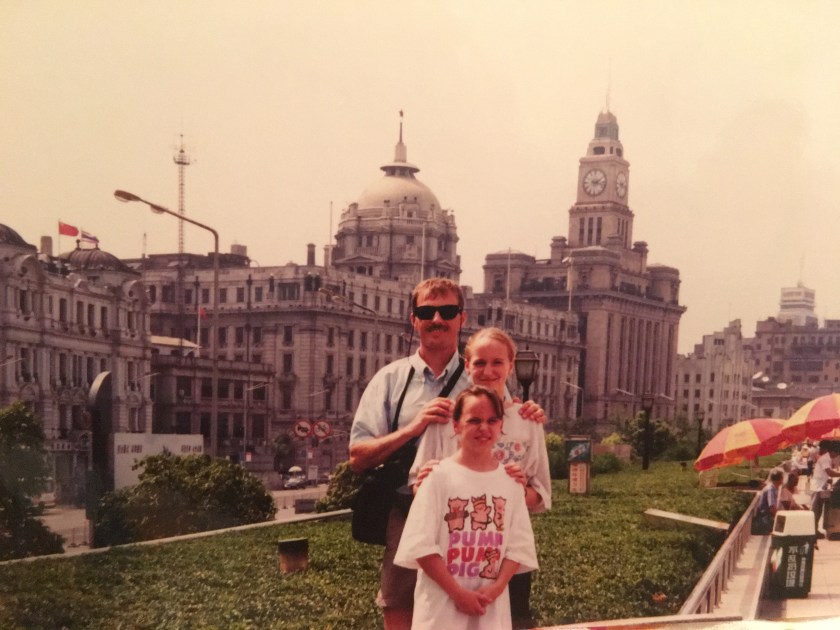
Brockberg, Bund, Pump Pump Pig

One of my favorite Stephen Spielberg movies is “Empire of the Sun.” I love seeing the young Christian Bale playing the role of J. G. Ballard, the author of the book by the same name. I also marvel at the access Speilberg got to Shanghai as it was transitioning from the ravages of the Cultural Revolution to the boom of the 1990s. The opening shots of the film remind me of a quote from J.G. Ballard’s novel:

“Every night in Shanghai those Chinese too poor to pay for the burial of their relatives would launch the bodies from the funeral piers at Nantao, decking the coffins with paper flowers. Carried away on the tide, they came back on the next, returning to the waterfront of Shanghai with all the other debris abandoned by the city. Meadows of paper flowers drifted on running tide and clumped in miniature floating gardens around the old men and women, the young mothers and small children, whose swollen bodies seemed to have been fed during the night by the patient Yangtze.” 

With its current population of 24 million plus (nearly 3 times that of New York City), Shanghai is the most populous city in the world (within a single administrative region.) Although Shanghai displays some of the world’s most modern architectural structures,  it has also decided – at least for the moment – to preserve one of the richest collections of art deco architecture of any city in the world. The Bund  (外滩 Wàitān) remains the image which comes to the minds of many Westerners when they hear the name, Shanghai.  The word, “bund” is a hybrid Persian, Hindi, English, and German word with the original meaning “embankment”. The traditional Bund is a mile-long stretch along the river in Puxi. Pu is short for Huángpǔ (), the river which divides Shanghai into Pǔxī 西 (west of the Huangpu) and 浦东 Pǔdōng (east of the Huangpu). Along the two sides of the Huangpu now  stands the 2017, 128 story, energy efficient, typhoon resistant Shanghai Tower上海中心大厦, the 2008, 101 story Shanghai World Financial Center上海环球金融中心, and the hybrid modern/art deco 88 story Jin Mao Tower金茂大厦 (1999), alongside the 10 story Fairmont Peace Hotel上海费尔蒙和平酒店(1926), the 17 story Bank of China Building 中国银行大厦 (1937), and the iconic Cathay Theater 国泰电影院 (1932). Shanghai is definitely worth visiting for its architecture alone.

The city of Shanghai is one of four Municipalities (直辖市 Zhíxiáshì) in China. The other three are Beijing, Tianjin, and Chongqing. A municipality in China operates in a similar way to the District of Columbia in the USA. Municipalities are not considered to be part of any province. Municipalities are under the direct administration of the Chinese central government.

In the 1920s, Shanghai was known as the “Paris of the Orient”, and was China’s most international city. There was opulence sitting next door to abject poverty. Whitey Smith played jazz in the Astor House, the Paramount, and the Fairmont. The Green Gang lead by Big Eared Du (杜月生 Dù Yuèshēng) controlled the lucrative opium and heroin trade. The latest Hollywood films showed at the Cathay Theater, and flappers wore the same outfits and hairstyles as their counterparts did in New York, London, and Tokyo.

Shanghai was also a city of politics. The first congress of the Communist Party was held in Shanghai in July 1921. It’s formal name, Zhōngguó Gòngchǎn Dǎng 中國共産黨 was also established at that time. Just two years prior to that, the May 4th movement (五四运动 Wǔsì Yùndòng) had erupted in Beijing partially due to the granting of European concessions to the Japanese in Shanghai and partly to protest against the 21 demands made by the Japanese directed at China. In 1927, a youthful Chiang Kai-Shek, recognizing the imminent threat of the Communists to his Guomintang (KMT) Party, conducted what became known as the Shanghai Massacre, when he sent in his troops and conscripts from the infamous Green Gang to wipe out the Communist scourge from Shanghai. By 1934, the Communists were pretty much gone from Shanghai, with most following Mao on the Long March.

Another classic 1920’s mansion, Shanghai’s Jinjiang Hotel (锦江大酒店), formerly the Cathay Mansion, was the site of the historic 1972 meeting between US President Richard Nixon, and Premier Zhou Enlai where the Joint Communique of the USA and the PRC aka the Shanghai Communique, reopened the relationship between the US and China.

Like its “sister city”, Hong Kong, 1200 km to the south, Shanghai has always prided itself as an international city. And there is definitely a friendly rivalry which exists between these two behemoths. Although Shanghai’s population is three times that of Hong Kong, Hong Kong’s population density is nearly twice that of Shanghai. At age 32, Shanghai’s median age is 10 years younger than Hong Kong. Rent in HK is roughly double that of rent in Shanghai. Transportation is twice as expensive in Hong Kong, but ease of transportation has Hong Kong far exceeding Shanghai. That is one of the main reasons that Hong Kong is easier for families than Shanghai. Getting a Hong Kong drivers license is fairly simple and many ex-pats have cars. More would if parking was less expensive and more accessible. The internet is reasonably fast in Hong Kong and there are no firewalls preventing communication of controversial topics. Both private and public medical care are easily accessed in Hong Kong and there are always competent English speakers for those who don’t speak Chinese. Restaurant food’s cheaper in Shanghai, but both places sport some amazing eateries. I think if I was young and single, I might choose Shanghai over Hong Kong just because of its potential. Being neither young nor single, however, Hong Kong’s definitely the place for me.

Chinese Odyssey 37

Our leisurely train went

northeast to Shanghai.

The Bund was amazing!

We all wondered why,

in the middle of China

the majestic Huangpu

mirrored art deco skylines —

split Shanghai in two.


Joseph Needham & the Grand Canal

emperor yang di and the grand canalCHINA: EMPEROR AND BOATS. – Yang Ti, Sui emperor of China (604-618), and his fleet of sailing craft, including a dragon boat being pulled along the Grand Canal. Painted silk scroll, 17th century.. Fine Art. Britannica ImageQuest, Encyclopædia Britannica, 25 May 2016.
quest.eb.com/search/140_1707542/1/140_1707542/cite. Accessed 29 Jan 2019.

Most people don’t spend a lot of time thinking about canals. We’re all familiar with the Panama Canal and the Suez Canal. If you studied elementary school music when I did, you learned the American folk song, “The Erie Canal.” It does seem strange to me, however, that  I had never even heard of the longest man-made canal in the world. Stretching well over 1,000 miles (think NYC to Miami) from Hangzhou to Tianjin, construction started nearly 2,500 years ago during the Spring and Autumn period. It didn’t really become the “Grand Canal” 京杭大運河 Jīng-Háng Dà Yùnhé  though until the short lived Sui Dynasty, about a thousand years later. When completed, it connected the Yellow River 黄河 Huáng Hé, the Qiantang River 钱塘江 Qiántáng Jiāng, and the Huai River 淮河 Huái Hé, with the Yangtze River 长江 Cháng Jiāng and, through a series of tributaries extended west all the way to the ancient capital of Chang’An 長安  (near present day Xi’An 西安).

Sui Emperor Yang Di (帝 Suí Yángdì) conscripted upwards of 5 million people to build the section of the Grand Canal from Luoyang to Beijing during the Sui Dynasty. Nearly one of three of these laborers died.  It was created to transport grain from southern China to Beijing and was also used to supply and reenforce military operations. When finished, Emperor Yangdi traveled on a huge boat pulled by hundreds  of men. The canal was 40 metres wide, large enough to transport boats which could carry over 100 people. In many ways, the Grand Canal is reminiscent of the Great Wall. It was a labor intensive project which took many centuries to complete.

Some of the most amazing parts of the Grand Canal, however, are the locks. These are the parts of a canal used for raising and lowering boats, enabling them to navigate in significantly lower or higher terrain. The way a “pound lock” works is by using the gates at either end of a chamber to “lock” water in where the boat is positioned. The gates control the amount of water let in, thus raising and lowering the level of water in the chamber allowing the boats to float up or lower down. Pound locks were first created by the Chinese on the Grand Canal during the 10th  century. Altogether, there were 24 locks on the Grand Canal.

To my knowledge, Joseph Needham (Lǐ Yuē sè), never made it to the Grand Canal. He did, however, recognize both the significance of the “pound lock” and the magnificence of the Grand Canal in Science and Civilization in China, his epic compendium of scientific discoveries and inventions in China.

According to Arthur Toynbee in the London Observer, Joseph Needham was able “. . . to interpret the Chinese mind in Western terms, and he is perhaps unique among living scholars in possessing the necessary combinations of qualifications for this formidable undertaking. The practical importance of Dr. Needham’s work is as great as its intellectual interest. It is a Western act of ‘recognition’ on a higher plane than the diplomatic one.“

Joseph Needham, like the Grand Canal, was quite remarkable. In his early 20’s, already an esteemed scholar and biochemist at Cambridge, Needham knew very little about China until 1937, when he became infatuated with both the Chinese language and a young female biochemist from China by the name of Lu Gui Zhen. Already fluent in seven languages, at the age of 37, Needham decided to learn Chinese. Within 2 years, he could read nearly 5000 Chinese characters and was able  to read authentic Chinese classical texts. He made his first trip to China in 1943, towards the end of WW2, when the Japanese occupied vast portions of China.  By flying “over the hump” (the Himalayas) to Kunming in the province of Yunnan, he was able to set up and office and lab at a university in Chongqing, Sichuan. As the result of several chance encounters during the course of his research, Needham became aware of the magnitude of China’s scientific acheivements and contributions to the world and was appalled that most of the world outside of China was ignorant of those contributions. So, Needham started a quest which was to be continued throughout the rest of his life. He would enlighten the West about China’s genius through a series of books he was prepared to write. By the time of his death in 1995, 17 volumes of Science and Civilization in China had gone to print and they rocked the world of science as the West had come to know it. In a strange twist, it rocked the world of many Chinese as well.

If you’re not quite ready to jump into Science and Civilization in China, but are curious about Joseph Needham, I strongly recommend listening to Lazslo Montgomery’s 2-part podcast, #’s 155 & 156 from his amazing China History podcast:

https://www.teacup.media/2015/06/24/chp-155-joseph-needham-part-1/

https://www.teacup.media/2015/07/14/chp-156-joseph-needham-part-2/

A fantastic book about Joseph Needham, published in 2009,  is the New York Times best-seller,  The Man Who Loved China by Simon Winchester. Also, strongly recommended by moi.

Chinese Odyssey 36

In the Sui (before Tang)

a long, long time ago,

China built a canal

from Beijing to Hangzhou.

A million men worked

so that Emperor Yang Di

could inspect his kingdom

in pompous luxury.

Tales from Hangzhou

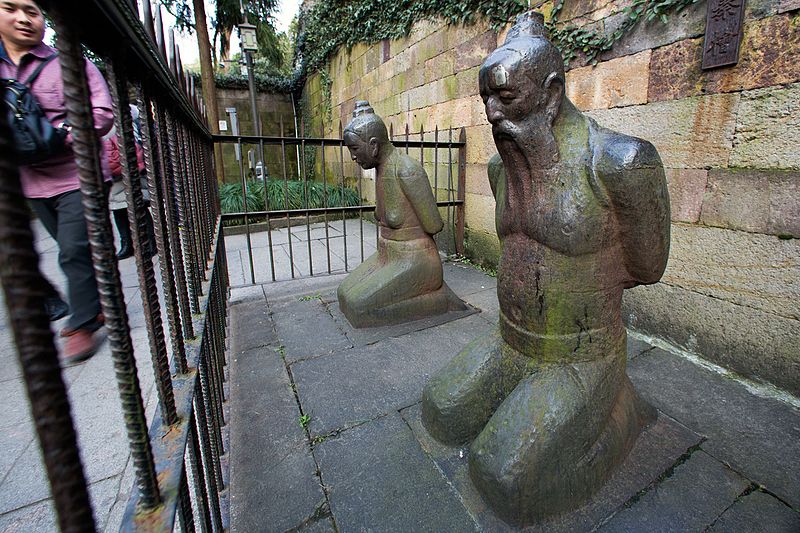
qin hui and lady wangQin Hui and Lady Wang  –  Morio [CC BY-SA 4.0 (https://creativecommons.org/licenses/by-sa/4.0)%5D, from Wikimedia Commons

My introduction to Hangzhou was poetry. When I first gazed on West Lake, I couldn’t wait to search out Ping Hu Qiu Yue aka Placid Lake Autumn Moon (平湖秋月 Pínghú Qiūyuè). It was the nexus of West Lake, where one could watch clouds flying and the reflection of distant hills, while sipping the perfect cup of Long Jing Green Tea under a full Autumn moon. Visually, it was all I had hoped for. I knew the tea house would look and feel old and weather-worn, but that was OK. Pen and notepad in hand, I sat down to compose a poem. Unfortunately, a very loud and excited member of our China tour named Bill, from the Bronx, saw me sitting alone and thought I wanted company. I never did get my poem written. Thankfully, I can borrow and share one from Tang Dynasty poet, Su Shi (aka Su Dongpo 苏东坡.)

 曲:

盘。

看?

 Yang Guan Qu: Zhong Qiu Zuo by 苏轼 Su Shi

Mu yun shou jin yi qing han

Yin han wu sheng zhuan yu pan.

Ci sheng ci ye lou chang hao,

Ming yue ming nian he chu kan ?

Mid-Autumn Composition by Su Shi

Sunset clouds together and then dissipate, air clear and cold

Milky Way without a sound, moon moves across the sky。

This life, like this evening, not always so good

Next year, where will I be living to see this moonlight?

I did, however, get to see much of the West Lake the poets wrote about. There was the mountain crag called the “Peak Who Flew in from Afar” (飞来峰 Fēilái Fēng), that legend claims transported itself from India, the Six Harmonies Pagoda (六和塔 Liùhé Tǎ), which, for centuries served as a lighthouse on the Qiantang River, and the Broken Bridge (断桥duàn qiáo), backdrop for the Legend of the White Snake, where a young boy innocently consumed immortality pills, thinking he was eating sweet dumplings. The sweets seller,  actually one of the eight immortals, seeing what had happened, made the boy regurgitate the pills into the water by Broken Bridge where they were consumed by a small white snake swimming by. As you might imagine, there is a lot more to that story.

My favorite tale, however, is about the patriot, Yue Fei (岳飛 Yuè Fēi). He was born into a poor, but very patriotic family. When he was young, his own mother engraved the tatoo, 盡忠報國 jìn zhōng bào guó  “serve the country with the utmost loyalty”, on his back, and that message served as Yue Fei’s driving force. Yue Fei later managed to become both educated and a respected general in the Jin military. While fighting to recover Kaifeng, the Northern Song capital,  Yue Fei was called back to Hangzhou by the Emperor Gaozong (宋高宗Sòng Gāozōng), but he failed to heed that call initially. Qin Hui (秦桧) falsely accused Yue Fei of being a traitor to his country on some trumped up charges and Yue Fei was put to death. Although later history points much of the finger of guilt at Emperor Gaozong, it was Qin Hui and his wife, Lady Wang, who were to ultimately be remembered – in a very unique manner – as traitors to China.

One of the most popular pastries in China is called You Tiao (油條). Some people liken You Tiao to a donut without sugar, but it’s shape is a bit like that of two foot-long hotdogs glued together. In Taiwan, we used to eat youtiao with steaming hot doujiang (soybean milk) for breakfast. In Hong Kong, people will often eat these alongside their morning jok, aka congee (粥 zhōu).

The story goes that a doughmaker and his friend were sitting around at the end of the day, reeling about the unjust death of Yuefei and the dispicable nature of Qin Hui and his wife, and the doughmaker picked up a couple of pieces of remaining dough and said. “This is what I’d really like to do with those two. He stuck two long pieces of dough together, fashioned faces for each, and dropped them into boiling oil. Take that, you traitors, you “deep-fried devils” (油炸鬼 yóuzháguǐ). The Cantonese term, yàuhjagwái, is still popularly used for youtiao.

I would be remiss, however, if I didn’t update my story to the year 2018. As my Chinese friends would say, “bian hua hen da” (變化很大  biànhuà hĕn dà) – the change is enormous. I really didn’t recognize Hangzhou the last time I went there. I flew into a small, but very modern, airport.  My friend, Stan, said its faster for him to fly from the old Songshan airport in Taipei to Hangzhou than it is to go from his home in Taipei to the main Taipei airport. Streets once crowded with bicycles are now jammed pack with cars, and the air is a constant grey from the accompanying smog. Although many of the low-rise places along West Lake itself have been preserved, high rise, modern architecture abounds. There is a Starbucks now not far from Ping He Qiu Yue. Maybe great poems are being written there now over Caramel Macchiatos.

Chinese Odyssey 35

Our next stop, Hangzhou,

placid lake, autumn moon

broken Bridge, riding bikes—

took a break around noon.

Paid respects to Yue Fei,

ate some zongzi for free.

Like the Emperor Qian Long,

sipped Dragon Well tea