The Yellow Mountains

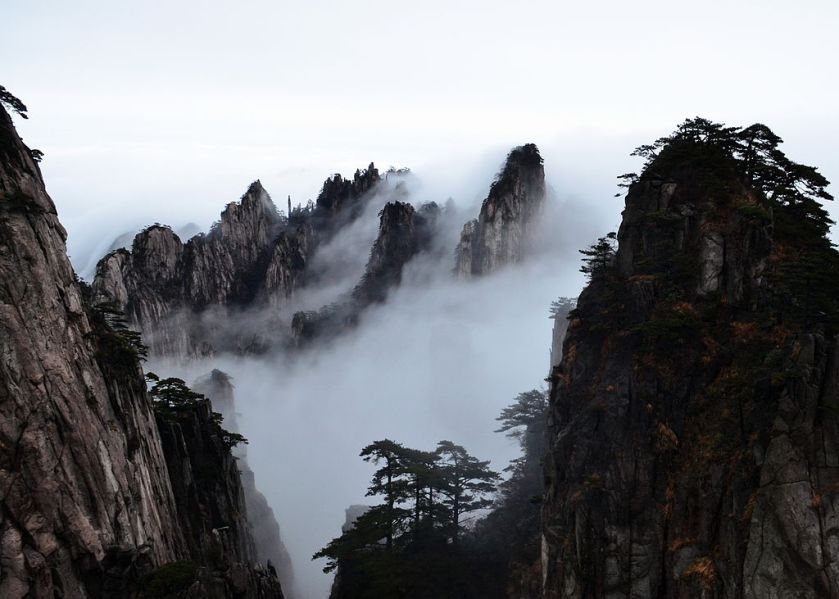
the yellow mountains颐园新居[CC BY-SA 4.0 (https://creativecommons.org/licenses/by-sa/4.0)%5D, from Wikimedia Commons

Huangshan is a range of mountains located in the southern part of Anhui province. Photos like this one illustrate the types of natural features that greet those who find their way here. Sunrises, sunsets, peaks, crags, promontories into seas of clouds, pine trees and natural springs abound. Huang Shan is latticed with trails and steps. On these paths, one finds hikers, and artists, painters, and poets. After one visits Huang Shan, the landscapes on the scrolls that formerly appeared magical, finally make sense. They’re real.

More than a thousand years ago, there was a poet and a painter by the name of Wang Wei (維 Wáng Wéi).  Although Wang Wei is acclaimed as one of the great painters of the Tang Dynasty, none of his original paintings have survived. His poetry, however, continues to live.

In 1980, Fred Fang-Yu Wang (王方宇 Wáng Fāngyǔ), a professor of Chinese at both Yale and Seton Hall Universities, published a a book of his own calligraphy called “Walking to Where the River Ends”,  where he connected his calligraphy to the poetry of Wang Wei.  Although nowhere in this volume is Huangshan mentioned, I can’t help but connect Wang Fangyu’s calligraphy and Wang Wei’s poetry to this amazing range of mountains. Wang Fang-Yu starts off the book with a poem by Su Shih (軾 Sū Shì), an eleventh  century poet who wrote of Wang Wei, “in every poem, there is a painting. In every painting, there is a poem.” (Wang, Fred Fang-Yu. Walking to Where the River Ends. Compiled by Suzanne Graham Storer and Mary De G. White, Hamden, Archon Books, 1980.)

In his book, not only does the author introduce us to the poetry of a beloved Chinese poet, but he opens doors to appreciating Chinese calligraphy through his own calligrahic interpretations. In the index, he then gives both figurative and literal interpretations in English which encourage the reader to conjure up their own images and wonder how they might create a poem in English which would begin to do justice to the images created by the Chinese characters. Here’s an example from the poem used as the title for this book. The English words were the literal translations provided by Professor Wang.  Mary de G. White then took Professor Wang’s literal translation and created a poem which works in English:

Walking to Where the River Ends     (行到水窮處)

 行到水窮處,(walk, to, water, end, place)

xíng dào shuǐ qióng chǔ,

坐看雲起時(sit, watch, clouds, end, time)

zuò kàn yún qǐ shí。

偶然林叟 (accidentally, meet, forest, old man)

ǒu rán zhí lín sǒu ,

談笑無還期 (chat, laugh, have not, return, time)

tán xiào wú huán qī

Walking to Where the River Ends  by Wang Wei

“Walking to where the river ends

I sat and watched the clouds rise

By chance I met an old man in the forest

We talked and laughed

and forgot when it was time to go home.”


Chinese Odyssey 34

Trails wove through mountains

Running narrow and steep

hiding treasures which paintings —

and poetry — keep

reminding us how

little time has affected

the clouds and the cliffs

which the pools reflected.


Crouching Tiger, Hidden Dragon

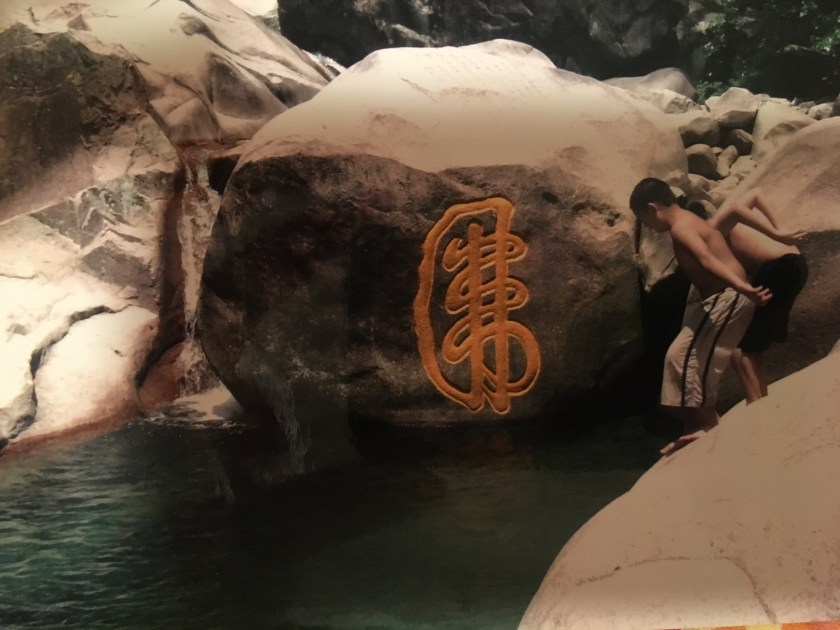
fei cui pool

There are only a handful of Chinese films which have enjoyed even moderate success in the West. In 2000, Ang Lee gathered together an all-star cast including Chow Yun-fat, Michelle Yeou, and Zhang Zi Yi. In the USA, “Crouching Tiger, Hidden Dragon” was the highest grossing foreign-language film produced overseas, and it won the Academy Award for the Best Foreign Language Film in 2001.

About 40 km from the Yellow Mountains (黄山 Huángshān) sits the village of Hongcun  (宏村 Hóngcūn). When we walked through it 10 years ago, it was a quiet step back into a past where a village was built around a pond. I remember the amazing wood carvings surrounding the doors and windows opening into homes where villagers would invite strangers in to share a cup of tea.

It was in this village that Chow Yun-fat’s character journeyed to rid himself of the Green Destiny sword which he had wielded as a hero and master of martial arts. The sword, meant as a gift to an old friend, was stolen, and once again found itself to be a weapon. Chow Yun-Fat’s character tries to rid himself of the sword by throwing it into the Fei Cui pool (翡翠池 Fěicuì chí) , but Zhang Zi Yi’s character recovers it. It emerges once more  in a struggle to the death with his old nemesis, Jade Fox. Michele Yeoh and Zhang Ziyi personify both the beauty and the strength of female martial arts heroes as they beguile and subdue anyone standing in their way. Sword fights, acrobatics, and a variety of martial arts find our heroes running on the tops of the swaying leaves and forests of bamboo which cover the hills of southern Anhui, and flying on the back of wild horses dashing through the the wild valleys and crevasses of Xinjiang chasing down a robber who becomes a lover.

Hongcun village was the village where many of the characters first came into contact. The pond in real life is just as it was in the movie and it was easy to imagine the story when walking through the village. We were told by the local people that the village was in the shape of an Ox with a nearby hill and trees forming the head and the horns. The upturned roofs on the houses of Hongcun are known as horses heads for the way the edges of the roof flow down in rivulets like the mane of a horse.

The real magic happened for us, however, when we accidentally found our way to Fei Cui pool in Huang Shan. This was the pool, we were told, where the Green Destiny sword was flung. When we arrived, there was no one there. Our kids were in shorts. There were no signs that said “no swimming”. So for about two hours, we got to play in a crystal clear water pool at the base of Huang Shan. When a man did come by and told us that we weren’t supposed to be swimming there, I let him know that I was a lifeguard in a former life and the kids were perfectly safe. I was probably playing the “ask forgiveness” card once again, but it all worked out in the end. We had a beautiful afternoon frolicking in the waters at Fei Cui pool.

Chinese Odyssey 33

They say Hongcun village

is shaped like an Ox.

Reflections are magic —

jade eyes of a fox.

Green Destiny’s message

was crystalline clear

in the pool at Fei Cui

its message, ‘no fear’.


Cold Mountain (寒山 Hán Shān)

Hanshan and Shide

This stone rubbing is from an engraved stone stele in the Han Shan Temple in Suzhou.

from Gary Snyder’s translation:

“White clouds gather and billow.
Thin grass does for a mattress,
The blue sky makes a good quilt.
Happy with a stone under head
Let heaven and earth go about their changes.”

Snyder, Gary, Gary Snyder, and Hanshan. Riprap & Cold Mountain Poems. San Francisco: Four Seasons Foundation, 1965. Print.

One of my all time favorite poets is thought to have lived more than 1000 years ago in Tang Dynasty China. No one knows what Han Shan’s real name was nor where he was from, but the cave called Cold Mountain, where he is said to have lived, is in the province of  Zhejiang, about a day’s foot journey from the sacred range of mountains called Tian Tai (天台).

One commonly held story is that an official by the name of Lu Jiuyin 閭丘胤 Lǘqiū yìn went to Mount Tiantai in order to meet Han Shan.  He was told that there were actually two Bodhisattvas living there, Han Shan 寒山 and Shi De  拾得.  Asked how he might know them, he was told, “If you see them, you won’t recognize them; if you recognize them, you won’t see them.” He didn’t see them, but they saw him.  And when they did, they laughed out loud and ran away, obviously having no desire to meet him.

When I first read Gary Snyder’s translation of 24 of Han Shan’s 300 poems, the translations and interpretations – by the young 24 year old budding poet – of the words and antics of Han Shan, spoke to me, and now, nearly 50 years later, I’m still listening.

Patrick Murphy noted in his preface of Snyder’s book, Riprap & Cold Mountain Poems: “These poems are something more than translations precisely because Snyder renders them as a melding of Han Shan’s Chinese Ch’an Buddhist mountain spirit trickster mentality and Snyder’s own mountain wilderness meditation and labor activities. The suite of 24 poems was published in the 1958 issue of The Evergreen Review, and the career of one of America’s greatest poets was launched.”

It was partly the sacrilege of Han Shan’s poetry that appealed to me. I loved that I never knew whether Han Shan and Shi De were Zen (Ch’an) Buddhists or Daoists or neither or both. Neither did religion own them, nor did they necessarily embrace a religion. I loved that they worked hard at menial tasks and were true to their own natures. They knew then that the answers were not to be found in the gadgets and the glitz and the glamour that so defined success in the eyes of so many. In years past, they may have been “boomers” who worked the buck rakes and beaver slides on the large cattle ranches in Montana, or the “old uncles” in American Chinatowns sipping Po-lay and reading the China Times, after the Chinese exclusion act insured that these men would remain bachelors until the act was repealed in 1943. Today, these old people might be homeless street sleepers in any large metropolitan area in the world. These men and women lived and live largely solitary lives where they had/have a fair amount of down time to  contemplate the secrets of the universe. If you see them, you won’t recognize them; if you recognize them, you won’t see them.

To learn more about Han Shan, check out: https://terebess.hu/zen/chang/hshan.html#a

Chinese Odyssey 32

Once again there were pictures

emblazoned on sails;

not Han Zi, not words.

More like fish without scales

swimming into the night.

Through menacing clouds

the mountains were yellow.

There were no more crowds.

Fujian Farewell

Tulou in Fujian

Wuyi Shan was like a mini-Guilin with karst mountains and a river called the Nine Bend Stream  (九曲溪 Jiǔ qū xī) winding through it. We floated on 4” diameter bamboo pole rafts and fell off into the cooling waters which we weren’t supposed to swim in. I found out early in my travels in China that it was a lot easier to ask for forgiveness than for permission. There are very few natural water areas in China where swimming is actually permitted.

I would be remiss to leave Wuyi Shan without mentioning Da Hong Pao, one of the world’s most renowned and expensive teas. Nearly a thousand years ago, it was leaves from these  tea plants growing under Tianxin Rock which were highly coveted by the emperor. I never thought that tea grew on trees until I visited Xishuangbanna, in southeastern China, home of Pu Er tea and saw tea trees that reminded me of the apple and cherry trees growing in my grandparents orchard in Missoula. Prior to that experience, I thought all tea grew on bushes like the wonderful green tea plants around Hangzhou and Moganshan. What I discovered was that tea plants let to grow wild, grew into trees. Da Hong Pao (大红袍 dàhóngpáo), a very dark Oolong tea, grows in the heavily oxidized soil of Wuyi Shan where, in 2002, 20 grams of a very high grade Da Hong Pao sold for around US$28,000. By 2016, there were only six of the Ming Dynasty Da Hong Pao trees left.

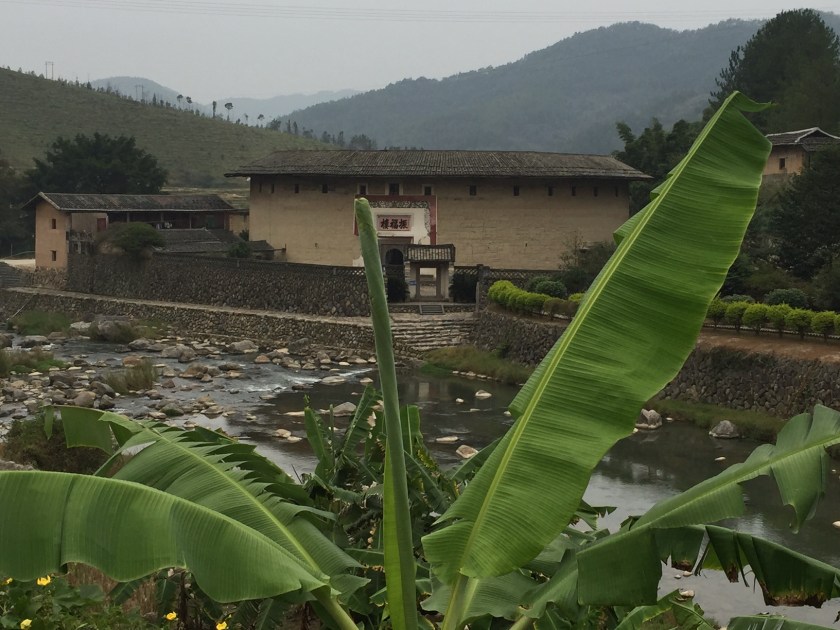
Before leaving Fujian, I also need to direct you south from Wuyi Shan to some amazing homes called “tulous” (土楼 tǔlóu)which have graced southeastern China for almost a millennia. Appearing like natural outgrowths among the terraced fields and persimmon trees in southern Fujian, these massive bagel shaped homes were built by the Hakka people aka 客家 Kèjiā (lit. translation – “guest families”– sometimes referred to as the “Gypsies of China”). These multi-story units, some over 70 metres in diameter with six foot thick walls, could house hundreds of people.  One wonders how a building made out of mud could withstand the weather until one actually approaches the structure and feels the walls. The rammed earth has hardened like cement and these homes have proven to be remarkably resistent to wind, rain, and even earthquakes.

Several of the tulous, which served as family homes for centuries, have now opened up to accommodate tourists – complete with flush toilets, showers, and breakfasts. Fall is a beautiful time to bicycle through the low hills of southern Fujian and experience these magnificent structures from a distant past.

Chinese Odyssey 31

As we coasted downstream

on a long bamboo raft,

Sliding into the river

and feeling quite daft.

The clouds up above

formed a quizzical cast

like a sail held high

overhead on a mast.

Monkey King – The Origin Story

Sun Wu Kong - Yoshitoshi

Tsukioka Yoshitoshi [Public domain or Public domain], via Wikimedia Commons

Every Chinese child knows about Sun Wu Kong (孫悟空 Sūn Wùkōng), the Monkey King. Hatched from a magical rock, he grew up on Flower Fruit mountain. At the base of the mountain flowed a stream, where one day the young monkey convinced his friends to follow the stream to its source, and there they discovered a beautiful waterfall. The young monkey, on a dare, jumped into the waterfall to see what would happen. To his surprise, he found himself inside a giant cave. He quickly jumped back through the water curtain and goaded his friends in. Monkey and his friends had found their new home in the magical Water Curtain Cave. To reward him for his resourcefulness, the other monkeys and his many animal friends decided that the monkey born from stone would be their king.

For a while, the Monkey king was happy in his new role, and romped and frolicked and ate and drank and played. After many years of this kind of living, however, the Monkey King became despondent. He had concluded that he was mortal and was going to turn old and die. He went looking for a master who could teach him how to live forever. After spending years on the road looking for immortals, sages, and Buddhas, he finally happened upon an enlightened master who was impressed by the stone monkey’s cleverness and agreed to take him on as a student. He then gave him a new name, Sun Wu Kong, which means “Sun, who knows emptiness.”

Sun Wu Kong happily took to the life of a disciple and years passed by. When the master delivered his teachings though, Sun Wu Kong found it very difficult to sit and listen. He explained to his master that he found the teachings so exciting he could not contain himself and needed to jump about. Sun Wu Kong was clever and very quickly learned spells and transformations which amazed his teachers. He also acquired his only weapon. It looked like a walking stick with gold bands on either end and he could vary the size to his wishes. It was perfect. He could somersault 60,000 miles in one full loop, and by taking one hair out of his body and blowing on it, he could create an army of monkeys just like him. All in all, Sun Wu Kong acquired the ability to make 72 transformations. So, he decided to return to his kingdom at Flower Fruit Mountain.

As his powers increased, however, so did his ego. With every victory, Sun became more aggressive and proud and he was beginning to upset the immortals who wondered how he had ever achieved such great powers. To appease him, the immortals finally awarded him the title, “Great Sage, Equal to Heaven.” Sun Wu Kong loved his new name and he aspired to sit on the throne of Heaven. Finally, the Buddha challenged the Monkey to jump off the palm of his hand. If he succeeded, he would indeed, be awarded the title he so desired. Monkey laughed as he accepted the challenge and leapt off the hand somersaulting many times before landing at the base of five pink pillars. Thinking this was the end of the world, Sun Wu Kong peed on a pillar after writing “Great Sage, Equal to None” on one of the pillars as proof that he had made it there. The Buddha then showed Sun Wu Kong his hand, and held Sun’s nose close to the base of one finger where Sun not only smelled his own urine, but saw the words he had written there. With that, Sun Wu Kong was sealed under the Mountain of the Five Elements where he would serve out a long penance.

And that is only the beginning of the story. After centuries of penance, trapped under the weight of the mountain and his ego, Sun Wu Kong was released and became an heroic disciple of the Buddha. Along with a pig, a horse, and the monk,Tang Zhen (Tripitaka), Sun Wu Kong undertook the perilous journey of transporting the teachings of Buddha from India to China.

In 1981, transportation options were limited in Fujian. There were trains, but they were like something out of the 19thcentury. Riding on narrow gauge tracks, their coal fire engjnes belched out black billowing smoke. We were warned not to wear anything light colored because the windows were wide open the whole way from Quanzhou to Wu Yi Shan (武夷山 Wǔyí Shān).

Wu Yi Shan are mountains where immortal beings lived during the Sung Dynasty. There are steep crags and demon shaped rocks said to have been placed there by the Gods. In the past there were hundreds of temples and “boat coffins” on the faces of the cliffs which  was home to a large Daoist community. We hiked along a trail to a water fall they had named the Water Curtain Cave (水帘洞 Shuǐ lián Dòng) and were told that some people believe it to be the Water Curtain Cave. But the cave we saw behind the water did not have quite the splendor or the drama I would have expected.

The name of the book about the monkey king is actually “Journey to the West” (西游记 Xī Yóu Jì). It was most probably written by Wu Cheng’en(吳承恩 WúChéng’ēn), a Chinese writer and poet who lived in 17th century late Ming and early Qing Dynasties. The translation I’m most familiar with is one simply called “Monkey” by Arthur Waley. Although not the complete work, it does offer a fantastic first look at the Monkey King. (Wu, Cheng’en, and Arthur Waley. Monkey. , 1958. Print.)

 Chinese Odyssey 30

We traveled up north

to a place called Quanzhou.

Climbed a statue of Laozi

in a green bamboo grove.

Took a smoky black steam train

through hills of Wuyi.

Saw the king’s water curtain

Sun Wu Kong, the monkey.

The Pirate of Piano Island

Koxinga Museum in Gulangyu

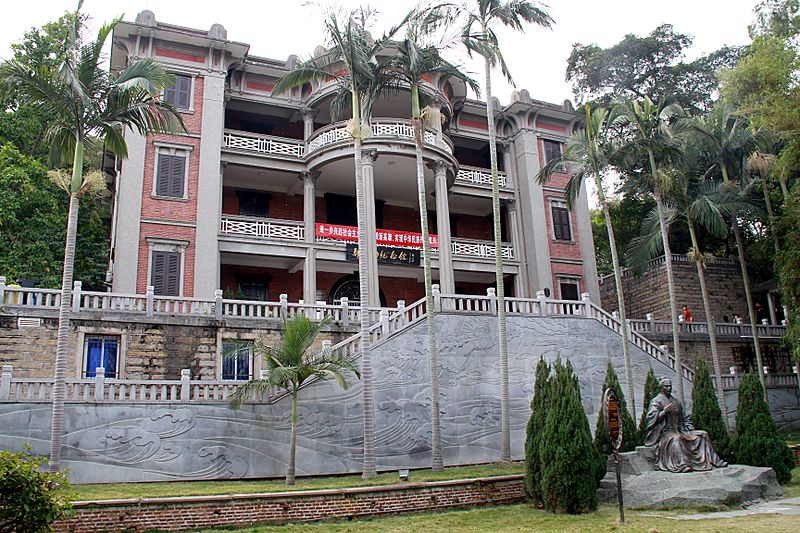
Koxinga Museum in Gulangyu – Rolfmueller [CC BY-SA 3.0 (https://creativecommons.org/licenses/by-sa/3.0)%5D, from Wikimedia Commons

When I first visited the island of Gulangyu in 1981, it was truly a magical place. Anyone could step up to the ferry terminal in front of the Lujiang Harbourview Hotel in Xiamen, and enjoy a five minute hop over to “Piano Island.” There were no cars or other motorized vehicles and one could walk the 3 mile circumference of the island in a couple of hours. As we walked around 1981 Gulangyu, we were awed by the architecture. Crowded stalls were gateways to 1930’s art deco mansions which used to be consulates, banks, and homes to the wealthy foreign and Chinese elite. During the Cultural Revolution the mansions had been subdivided and many families occupied what had once been the lavish get aways for Chinese Jay Gatsby’s. Wandering through the rolling hills on this tiny island, it was easy to imagine grand parties with alcohol flowing, dapper multinational sheiks, beautiful shebas in cocktail dresses, and Whitey Smith jazz wannabes drifting south from Shanghai. One could stand on the balconies, stroll in the beautifully kept gardens, and listen to the natural drum beat from the waves pounding on the shores.

A lot can change in 30 years, however. The quiet island of 1981 Gulangyu made famous for its classical music, its churches, tunnels where people escaped the summer heat, and laid back locals has been transformed into an island of Airbnb’s for young lovers. The five minute ferry is still there, but since it became so popular, only local people are allowed to use it. Foreigners must take a 25 minute taxi to a ferry station where an advanced booking has been made for them and a passport is required. The island’s still beautiful and many of the old mansions have been restored. The former Christ the King Catholic Cathedral (now a UNESCO World Heritage site) has been newly painted and you can visit the Trinity Church (三一堂 Sān Yī Táng) there. The former US Consulate and the former HSBC mansion are both privately owned, but both have survived nicely.

Zheng Chenggong (Zhèng Chénggōng 鄭成功) aka Koxinga 國姓爺 Guóxìngyé  (man given an imperial surname by the government) was the only Chinese commander ever to win a decisive battle against a major Western power, when he forcibly ejected the Dutch from Taiwan 350 years ago. He was a Ming Loyalist who fought against the newly established Qing Dynasty.

Zheng Chenggong was born in Japan. His father was the head of a large merchant group based in Japan and Taiwan. His mother was Japanese. When he was young, he went by the name of Fukumatsu. He often traveled with his father and went to live and study in Fujian, his father’s ancestral home, when he was only 8 years old. He was well schooled in Confucianism and studied at the imperial university in Nanjing and was given his imperial name when he was 21.  When the invading Qing army from Manchuria conquered the Ming, Zheng Chenggong’s father (who had become a general in the Ming army) was executed by the Qing, and Zheng Chenggong dedicated himself to rebellion against the Qing Dynasty and the restoration of the Ming. It was in Xiamen, that Zheng first set up his base. But when the Ming army pushed south, Zheng sailed east across the Taiwan Strait where he founded Dōngníng Wángguó 國 (the Kingdom of Dongning). It was from this base that he, along with 25,000 Chinese troops and the infamous Black Guard, “made up of ex-African slaves brought to Asia by the Portuguese” (https://www.scmp.com/article/993666/idol-worship)defeated the 10,000 strong private army of ‘red-haired barbarians’ stationed at Fort Zeelandia aka Rèlánzhē Chéng 熱蘭遮城, near the current city of Tainan, and routed the Dutch East India Company and the Dutch from Taiwan.

From Xiamen to Taiwan to Japan to Beijing, stories of Zheng Chenggong abound. Britannica calls him the “pirate leader of the Ming Court”. Taiwan sees him as a champion of the struggle for independence, where Beijing points to his reclaiming Taiwan for China, and Japan used him as a way to connect during their 50 year occupation of Taiwan during the first half of the 20thcentury. Was he a selfless patriot or a self serving entrepreneurial pirate? Probably more than a little bit of all of the above.

Chinese Odyssey 29

Commander Koxinga

really didn’t do much —

just resisted the Manchus,

defeated the Dutch.

On the island stood mansions

like F. Scott’s Gatsby

might have owned on West Egg

old now, and drafty.


Lu Xun – China’s Greatest early 20th Century Author

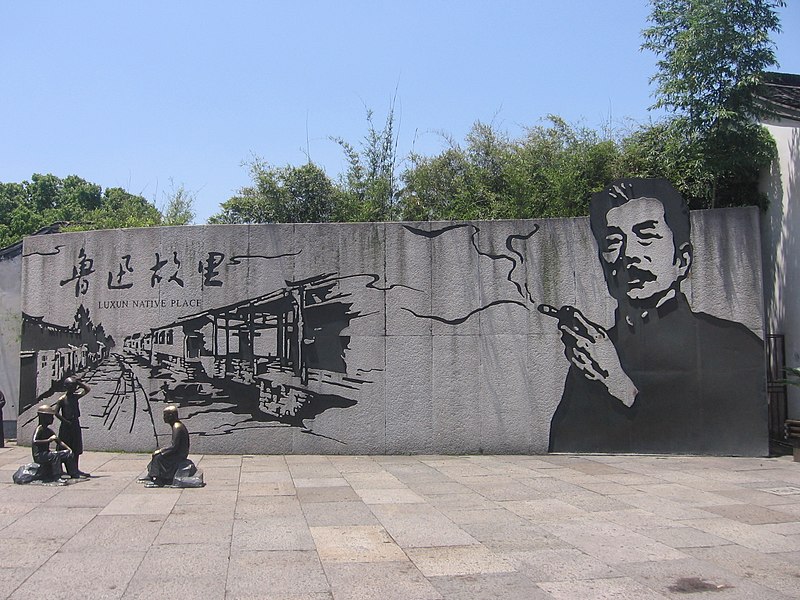
Lu Xun Native PlaceZhou Guanhuai [CC BY-SA 4.0 (https://creativecommons.org/licenses/by-sa/4.0)%5D, from Wikimedia Commons

What was it about Lu Xun’s writing that led Mao Ze Dong to call him the “commander of China’s Cultural Revolution“?

Although Lu Xun  (迅 Lǔ Xùn) aka Lu Hsun – had a formal education, he was much more interested in the stories he heard from uneducated peasants than in the great works of literature. Born in 1881, he was 38 when the 1919 May 4th movement championed writing in the vernacular “白话” instead of in classical Chinese (文言文). Lu Xun opened windows into the lives of uneducated peasants, of women who were branded by superstitions and beliefs which relegated them to roles of shame and dishonor they could never hope to climb out of. His writings were not hopeful. They were often dark and desperate and were an honest reflection of the lives of vast numbers of Chinese lǎo bǎi xìng 老百姓 (common people) during the early part of the 20th century. His most popular works were his short stories. Many are available on-line and I’ll mention three which I have read and believe would be a good introduction to Lu Xun.

Probably, the most iconic Lu Xun story is “The True Story of Ah-Q”.  Nobody knew what Ah-Q’s name really was or where he came from. It is evident from the beginning though, that Ah-Q is a loser – in everything he tries. He has no family. His only claim to fame is that the handi-work he does around town to pay for his food and drink seems to be acceptable. He is a blowhard, a braggart and a drunk, all of which bring on more ridicule and bullying from the townspeople. Ah Q represented much of China’s peasant population in the tragedy of his life, and the reader can’t help but feel that his lot was not his fault.

In the story, “Medicine”, a peasant couple whose son is dying of tuberculosis spend their last penny on steamed bread soaked in the blood of an executed criminal. The story was a powerful scream aimed directly at the ignorance which was burdening the masses. Ironic that Lu Xun himself would die at the age of 55 from the same disease.

“New Years Sacrifice” was one of the saddest stories I read. It was an almost voyeuristic glimpse at the lives of widows who were blamed for their own bad fortune both in this life and in the next. After being forced to remarry, Xiang Lin’s wife found herself pregnant and for the briefest of moments was happy with the son she bore until tragedy visited her again in the form of a wolf.

So much of what Lu Xun wrote was a commentary on the superstitions that enveloped China during the chaos of China’s Republican period. Maybe the reason that Lu Xun became Mao’s revolutionary poster boy was that he died in 1936. Mao Zedong, along with 4,000 stalwarts had completed the two year, 6,000 mile Long March which cemented his position as the undisputed leader of the revolution only one year earlier. The revolution was still young and those who died in its name were heroes. Although Lu Xun never joined the Communist Party, Mao understood Lu Xun to be someone who appreciated the plight of the peasants and was trying through his writing to help them rise up.

“The True Story of Ah-Q” (阿Q正传) and “The New Year’s Sacrifice”(祝福)  are both available in the Public Domain to read in English.

Chinese Odyssey 28

Xiamen had been open

for less than a year.

The colors were drab

but the air was quite clear.

Lu Xun used to write

in the Nan Putuo temple

and the Gulangyu

musical island felt gentle.

Slow Boat to China

Project China Mark Nicks

Hong Kong is located in the southeastern part of China. It is surrounded by the province of Guangdong. Adjacent to Hong Kong to the northeast is the province of Fujian. Located in the southeastern part of Fujian is the city of Xiamen. The distance from Hong Kong to Xiamen is only about 300 miles, as the crow flies. Fujian is the Chinese province directly across from Taiwan, separated by the Taiwan Strait. Taiwan is about twice the distance from Fujian as Cuba is from the state of Florida. Today, if we want to travel from Hong Kong to Xiamen, we can choose to take a 40 minute flight or a 5 hour high speed train.

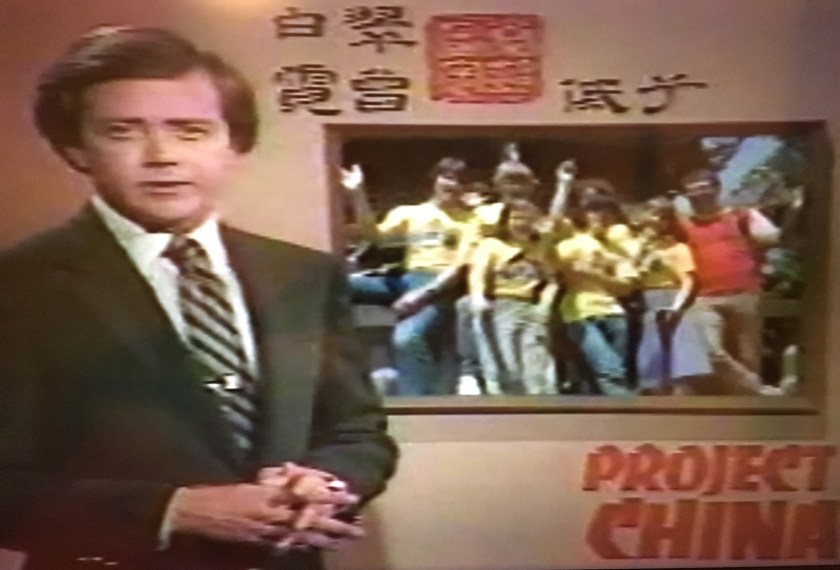
In June 1981, our only travel option was the Jimei passenger ship, the proverbial slow boat to China. From Hong Kong to Xiamen would take us 22 hours plus some change. Our six Tulsa high schoolers joined a rather odd assortment of 20+ individuals from all over the USA. Our kids were the youngest of the bunch. At 80 plus, Abe Gurvitz, a dentist from Boston shared the senior mantle with Frankie Wu from Prairie City, Kansas. We also had a smattering of missionaries, college students, and recent graduates along for the adventure. Accompanying us all was a news crew from Tulsa’s KJRH TV station. Reporter, Mark Nicks and cinematographer, John Ross were never far from our sides.

In earlier posts, we established that names for people, places, and things Chinese often have very different names, depending on their context.  China is called Zhongguo in Chinese; Taiwan is also known as Formosa; Hong Kong is Xianggang in Mandarin (aka Putonghua); Macau is known by most Chinese as Aomen; Canton can refer to either the province of Guangdong or city of Guangzhou; Kongzi is the Chinese way of saying Confucius; Zheng Chenggong is what most Chinese call Koxinga; just to name a few. In today’s post, there are some really different names. Xiamen is still called Amoy by many and Quemoy is most often referred to as Jinmen (or sometimes Kinmen.) Both Amoy and Quemoy are names which sound closer to the names used by local inhabitants in their dialects.

Just before arriving in Xiamen, we passed by the island of Quemoy (Jinmen) which sits less than 2 miles off the coast of mainland China, where we were awed by a Taiwan (ROC) flag the size of a football field waving in the breeze (much to the chagrin of the PRC I’m sure.) Just a few years earlier, Quemoy and Amoy had traded progaganda laden missiles every other day. Landmines were strewn along the beaches to stop an invasion from the mainland. The island is latticed with tunnels. Nearly 100,000 KMT troops were stationed in Quemoy during the Cold War with over 500,000 missiles lobbed in 1958 alone. Intermittent shelling went on until 1978, just three years prior to our arrival. When we lived in Taiwan, I used to hear stories of Taiwanese soldiers swimming over to Xiamen on a dare to watch a movie in a local theatre and come back with a movie ticket stub. Friends of ours who served in the Taiwan military told us that was crazy. Still, it makes for a good story and I can’t help but wonder.

At the time we arrived, Xiamen had only been opened to foreigners for one year. The only other non-Chinese we saw there were an American teaching couple who had been living in Xiamen for 8 months. Our food was very local. Much of the produce was grown on campus. Fruits and vegetables were smallish and very unlike the perfectly shaped and equally sized produce that we were used to in American supermarkets. The good stuff got shipped to Hong Kong where it commanded a much higher price. Even Coca-Cola had yet to reach these hinterlands. It was water, tea, a sickly sweet orange soda, or . . . local beer. I had met with parents before leaving and had told them that beer was not illegal for their kids to consume in Xiamen and it might be safer and healthier than some of the other alternatives. Some parents signed off on that, so beer began to be served with our evening meal.

Today, things are a little different. Anyone can board a plane in Taiwan and fly to Jinmen. It’s even easier in China. In  Xiamen, there is an hourly “Cross-Strait Ferry” from Xiamen to Jinmen which takes about one-half hour. You can only buy one-way tickets because tickets in Xiamen are sold in ¥RMB (Renminbi) and tickets sold in Jinmen are in $NT (new Taiwan dollars.)

Chinese Odyssey 27

Accompanying us

was a Tulsa news crew;

Oklahoma to Xiamen

turned into a coup.

On a boat called the Jimei —

Hong Kong to Amoy —

passed flags of two Chinas,

drank milk made of soy.

The British Colony of Hong Kong

600px-Flag_of_Hong_Kong_(1959–1997).svg

No one who ever landed at Hong Kong’s Kai Tak airport in the heart of Kowloon ever forgot the experience. There are tons of photos from planes landing that captured clothes hanging outside windows and on balconies of Kowloon high rises and some passengers claimed they could watch TV shows through the doors open behind the balconies. There was only one short runway built on “reclaimed land” in Victoria Harbour just south of Kwun Tung.  Some say that the reason there were never any serious mishaps were that pilots were just too scared coming in.

June is a muggy month in Hong Kong. Coming off a 15 hour flight from Los Angeles, we stepped into a steam bath of exhaustion and energy. A part of all of us just wanted a shower and a bed, but another part wanted to drop our stuff off and explore. Air conditioning wasn’t as ubiquitous then as it is now in Hong Kong so heat and jet-lag won out and it was on to the New World Hotel. For many of our kids, jet lag was a new experience. After all, it was sixteen hours earlier in Tulsa than it was in Hong Kong and none of our bodies or minds knew quite what to make of that.

In the early 1980’s, Hong Kong harbour was wider. Kellett Island, home of the Hong Kong Yacht Club, was not yet a part of Hong Kong Island. There was no peninsula where the Hong Kong Convention Center now resides. The first cross harbor tunnel had only opened 10 years earlier. The Fleet Club at Fenwick Pier had a McDonalds sitting right on the harbour where American sailors passing by could stop off and have a draft beer. The Star Ferry terminal sat next door to the main post office in Central. And one could have tea on the first floor of the Peninsula Hotel with and unobstructed view of Hong Kong harbour. They call what’s happened in Hong Kong harbour “land reclammation,” but I always wondered how land that was never land before could have been reclaimed.

Those were the days of really cheap public transportation. Double decker trams cost 10 cents for an hour long ride from Shaukeiwan to Western District. The Peak Tram was still going strong ever since opening up in the 1890’s. Taxi’s dropped their flags at $2. The Star Ferry cost 10 cents for the lower deck and 20 cents for the upper and there were always rickshaw drivers standing right outside to run you in, around, and through Central. For some reason, Morning Star was the ferry every kid wanted to ride. Anybody smoked whenever and wherever they wanted, and that included on all forms of transportation.

Hong Kong has always had the best Dim Sum in the world and it didn’t disappoint. Our kids from Tulsa had their first taste of Cha Shao Bao 叉烧包, Siu Mai 燒賣, Har Gao 蝦餃, Chicken Feet 鳯爪, Spring Rolls 春捲, Turnip Cakes 蘿蔔糕, Spareribs with Black Beans 豉汁蒸排骨 – which were just the tip of the iceberg. And all washed down with Jasmine 茉莉花茶 or Pu-Erh aka Polay 普洱 tea. And they did it the old fashioned way.  Food carts weaving among tables, stopping whenever anyone asked, placing the saucer sized plates and mini-bamboo baskets filled with Ma Lai Gao 馬來糕 or the steel plates with covers heaped with Changfen 腸粉 (shrimp, beef, or barbeque pork). At the end of the meal, the cost was tabulated by the number of plates on the table (most plates costing less than one US dollar). The literal translation of “dim sum” is “a little bit of heart”. Whenever and wherever I eat dim sum today it always takes me back to Hong Kong. Maybe it really is a  little bit of heart.

Chinese Odyssey 26

Thirty-one hours later,

touched down in Hong Kong

stepped into a steam bath

but moved right along.

We rode the Star Ferry

looked dapper and chic

ate dim sum, drank Po-lay

and trammed to the Peak.

When Oklahoma said “Ni hao”

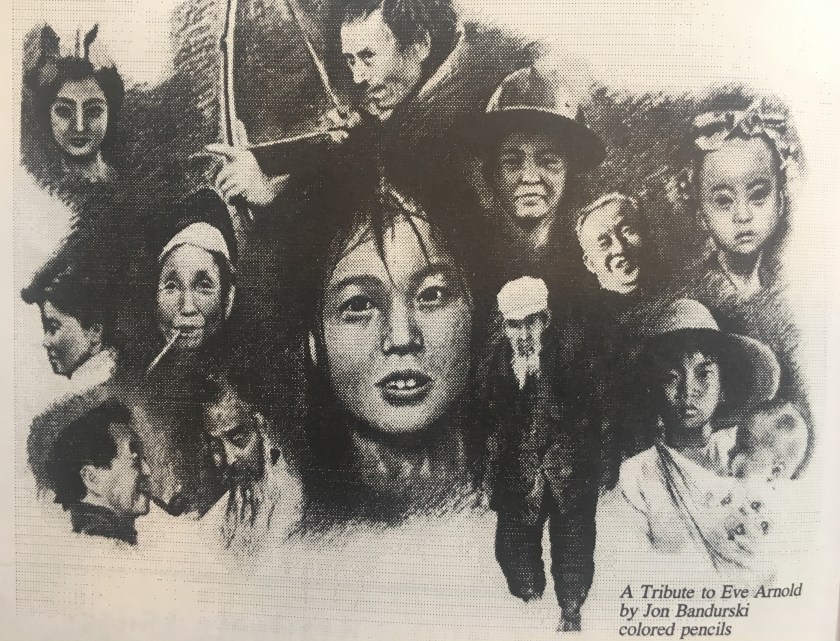
Jon Bandurski Drawing copyAccording the The Oklahoma Historical Society, the Chinese were the first Asians to settle in Oklahoma. Soon after the 1889 Land Run, a Chinese entrepreneur set up the Tom Sing Laundry in Guthrie (near Oklahoma City). Other laundries and restaurants followed. The 1940 census showed only 110 Chinese living in Oklahoma. By 1980 that number had increased to 2,461. (https://www.okhistory.org/publications/enc/entry.php?entry=AS006).

The 1980’s was a good decade for improved connections between Oklahoma and China.

  • In 1980, Tulsa established a “Sister City” agreement with Kaohsiung in Taiwan.
  • In 1980, Booker T. Washington High School and G.W. Carver Middle School offered Mandarin Chinese as a part of our foreign language curriculum in Tulsa.  At B.T. Washington, we published the “American Express” 美國快報, which later became the “Chinese American Express” 美中快報, a student newsletter which invited  young students of Chinese from all over America to contribute their experiences and perspectives regarding the learning of Chinese.
  • In 1981, I accompanied six high school students and a news crew from KJRH in Tulsa to Xiamen University, in southern Fujian Province where we spent 8 weeks studying Chinese. Xiamen had only been open to foreigners for one year at that time. KJRH won a Peabody Award (along with Hill Street Blues) for their documentary, “Project China.”
  • In 1985, Oklahoma and Gansu Province became “Sister States.”
  • In 1987, Tulsa established a “Sister City” agreement with Beihai in the Guangxi Zhuang Autonomous Region in China.
  • Later, that year, the Tulsa Global Alliance put together “Operation Breakthrough: China’s Middle America Initiative” in Tulsa where former President Gerald Ford was a Keynote speaker and Chinese scholar and interpreter, Perry Link, exposed Oklahomans to Chinese comedy in the form of Cross Talks. 100 Chinese governors, mayors and business leaders from 14 provinces and cities met and set up business deals with entrepreneurs from Oklahoma and middle America.
  • In 1989, 15 year old Booker T. Washington high school sophomore, Jon Bandurski became the first Tulsa Public School student ever to live for six months with a Chinese family in Shekou, near Shenzhen in southeastern China (near Hong Kong) where he studied Chinese and art for six months at Yucai School. Jon was the best unofficial ambassador the United States ever sent to China. When he wasn’t studying, he played soccer for the school team and even DJ’d for a school radio program.

Chinese Odyssey 25

It was in Oklahoma,

kids learning Chinese

thought they should go, too.

They even said, “Please!”

From a high school in Tulsa

six students departed

on a life-changing trip

destinations, uncharted