Character Confusions and other Stumbling Blocks

IMG_1628

Reading and writing Chinese is difficult. The US based Foreign Service Institute classifies Chinese as a Category 5 language (along with Arabic, Japanese, and Korean) for speakers of English. French and Spanish are classified as Category 1 because of the large number of cognates they share with English. There is very little that is intuitive about learning Chinese for a person growing up outside of a Chinese language environment. There is no phonetic alphabet which helps readers and writers of many languages to “sound out” words and spell them phonetically. Of course, Chinese parents and siblings read children’s books to children so kids learn to recognize characters before they learn to write them. And when they do start learning to write characters, close attention is paid to how they hold the writing instrument and how to write each stroke. Even though it is labor intensive work that requires a huge investment of time and effort, the 2018 CIA Factbook claims a literacy rate in Taiwan of 98.5%; in mainland China, 96.4%.

That said, few people educated outside of a Chinese education system have ever become truly literate in Chinese. The number of people who have studied and are studying Chinese outside of China has grown by leaps and bounds, yet the number of people who can pick up a Chinese newspaper, magazine, or book and easily read them is still relatively small, and of that number, those who can write and publish in Chinese is miniscule.

With all that in mind, here are some “organic” lessons I stumbled upon during my own journey.

Single character confusions

  • Car license plates – During my travels in Guangdong, I grew curious when I saw the character 粵 Yuè at the beginning of every license plate. I was told that 粵 Yuè was an abbreviation for Guangdong. It came from the historical kingdom of Yue of which Guangdong was a part; The character 京 Jīng on license plates in Beijing made more sense since I knew that 京 Jīng meant capital and Beijing is the capital of China; 闽  Mǐn for the province of Fujian also confused me. I knew that Taiwanese was also called the Minnan dialect. The word Min comes from the Min river in northern Fujian and is an abbreviation for Fujian.
  • Numbers – The numbers 1-10 are some of the easiest characters to learn in Chinese. Because they’re so easy, when writing a check and in other financial transactions, numbers are easy to alter. To address this, there is another way of writing numbers. A zero in Chinese is often written like this, “0”. The word for zero and the character used in finance, however, is 零 líng. The number one requires only a single stroke 一 yī. The number one used in finance, however looks like this, 壹y ī; two (二èr) becomes 贰 èr, five (五wǔ) becomes 伍, ten (十shí) becomes 拾, etc.
  • Others – I used to get really confused when I went to the market and saw a sign saying 7折 (qī zhé). In the market place, Chinese often use Arabic numerals for convenience sake. It turns out that the character 折 (zhé) means “discount”. But 7 折 doesn’t mean 7% or 70% off. It means 30% off or 70% of the original cost.

Abbreviating names of institutions – In the same way Americans refer to Oklahoma University as OU and Brits refer to Manchester United as Man Utd, China has similar abbreviations.

  • National Taiwan University (Táiwān Dàxué 台灣大學) →台大 Tái Dà
  • Communist Party of China (Zhōngguó Gòngchǎndǎng 中國共產黨) → 中共 Zhōng Gòng
  • One Belt One Road 一带一路 refers to the Silk Road Economic Belt and 21st Century’s Oceanic Silk Road (丝绸之路经济带和21世纪海上丝绸之路)。The 带 (belt) refers to multiple “Silk” roads and the 路 (road) refers to the oceanic trade route .
  • Chinese-American 中美 Zhōng Měi, as in Chinese American friendship 中美友谊Zhōng Měi yǒuyì and Chinese American relations 中美关系 Zhōng Měi guānxì

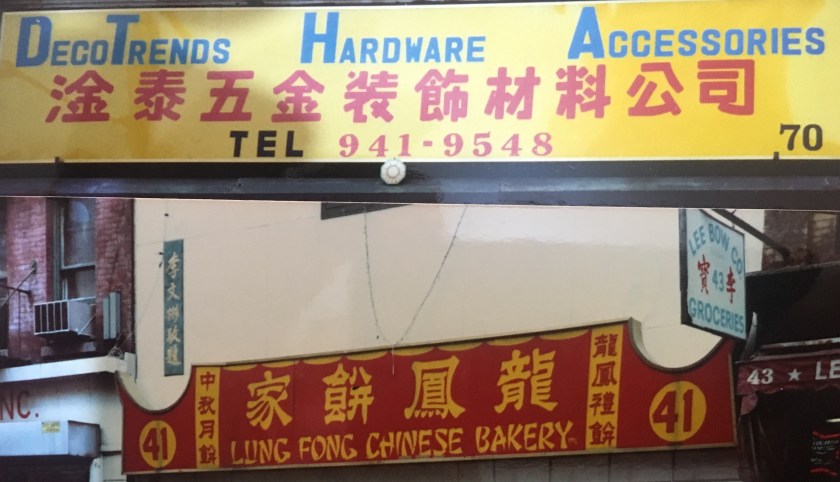
Up down, right left, and left right – In the old days Chinese sentences and phrases were always written from top to bottom and from right to left. Books in Chinese seemed to be read “from back to front”. It wasn’t until the mid-20thcentury that writing horizontally started appearing on the scene in China. A big part of the reason for doing this had to do with making the learning of Chinese easier. If Pinyin is included in the text, it is much easier to input words horizontally than vertically. Today, it is still common to see Chinese phrases and sentences written both vertically and horizontally. What can be confusing to the newcomer is when a horizontal sentence or phrase is written from right to left. Occasionally there are signs where both right to left and left to right are used. Then, one has to rely on context.

Fonts and styles– There have always been different styles of writing in Chinese. The style of Chinese writing beginners start with could be compared to printing letters in English. Although we don’t think of it now, most of us learned how to hold a pencil and the correct order for writing our letters. After printing, came cursive, and after cursive came calligraphy. There are probably at least as many fonts and styles of written Chinese as there are of written English. To illustrate this, I used to write “The United States of America” on the white board as fast as I could and purposely tried to make it illegible. Although I made it so hurried that not one letter could be distinguished, invariably a student would see “The United States of America”. In some of the most beautiful calligraphy in Chinese, individual strokes are impossible to pick out, but due to the rules of stroke order, it is obvious what the character is.

Cantonese expressions– When I first arrived in Hong Kong, I thought picking up Cantonese would be a breeze. Not so. I have all sorts of excuses. More tones. Too colloquial. No standard form of Romanization. Characters like 冇 (meaning “not have”) don’t even exist in Mandarin. Nor do expressions like the word for store, si6 do1 (士多) and taxi – dīk-síh (的士) which are transliterations from English. Still, I think my basic flaw was laziness. So many people spoke English when I arrived in Hong Kong that I wasn’t forced to learn Cantonese. Now, more people in Hong Kong speak Mandarin than English, so that has become my goto language. Still, I don’t see Cantonese on its way out. It is an incredibly rich dialect of Chinese with a long history. Many scholars say that Tang Dynasty poetry read in Cantonese is much closer to what the poems sounded like when they were written. Then, there’s Canto-pop!

Chinese Odyssey 14

Street signs were my textbooks,

bus stops, bills, and menus;

quizzes and tests

were all about venues.

Thrown into the water

I’d learned how to swim

and the jar with the map

was a memory dim.
 

Grinding an Iron Bar into a Needle

OLYMPUS DIGITAL CAMERA

磨杵成針,  磨杵成针 mó chǔ chéng zhēn

China’s golden age for art and literature occurred over 1,000 years ago during the Tang Dynasty (618 – 907 CE).  The form of literature which reached its zenith during that time was poetry. From the tens of thousands of poems written during the Tang Dynasty, 300 poems were selected in the mid-18thcentury, which Chinese school kids continue to memorize and recite to this day.

Of those Tang Dynasty poems, several were written by one man from Sichuan by the name of Li Bai (Lǐ Bái 李白). When I first started reading Chinese literature in translation, I was immediately drawn to Li Bai. He loved to drink alcohol and some people thought that he wrote some of his best poetry when he was “in his cups”. He seemed to be much more fun-loving than many of his contemporaries. One of those poets was a man from Henan by the name of Du Fu (杜甫 Dù Fǔ). Du Fu had a more serious outlook on life, and was not nearly as carefree as Li Bai. He was sometimes referred to as a poet saint (詩圣 shī shèng). They only really met a few times, but during those meetings forged a strong friendship. There are several poems in which each poet reflects the depth of their relationship.

I mention Li Bai because the idiom, “Grinding an iron bar into a needle” starts with him. When Li Bai was young, he was not a very diligent student. He was much more interested in watching birdies and eating fruit he found on the ground, than he was in studying. One day on his way to school, he happened upon an old woman filing an iron bar. Curiosity got the best of him and he asked, “Old woman, what are you doing?” (Calling a person “old lady” or “old gentleman” in Chinese is a respectful way of addressing an elderly person.) The old woman responded. “I’m making a needle out of this iron bar.” To which Li Bai responded, “That’s going to take forever. Let me try.” Li Bai took up the file and filed really hard for what seemed like a long time. Finally, he gave up. “I quit”, he said. To which the old lady responded, “That’s OK. I’m going to keep on filing, because I know that eventually this iron bar will become an excellent needle.” Li Bai never forgot the old lady’s words. Eventually he understood that his studies were like filing the iron bar. He became an accomplished scholar and one of the most famous poets of all time.

I can’t write about a poet and not include a poem. “Thoughts on a Quiet Night” 静夜思 (Jìng yè sī ) was memorized by most Chinese of my generation if they were educated in Chinese schools. As a Confucian scholar, Li Bai spent many years on the road in the service of the emperor. When Li Bai wrote “Thoughts on a Quiet Night”, the mid-Autum festival (the 15thday of the 8thmonth according to the Lunar calendar) was approaching and he was yearning to be home.

床前明月光
疑是地上霜
举头望明月
低头思故乡

Chuáng qián míngyuè guāng
Yí shì dìshang shuāng
Jǔtóu wàng míngyuè
Dītóu sī gùxiāng

At the foot of my bed

the moonlight is shining,

or is that frost on the ground?

I raise my head,

and see the moon in the sky.

I lower my head,

thinking of home.


Chinese Odyssey 13

One step at a time

the pieces connected

I struggled sometimes

and was often corrected.

And then I discovered,

much to my dismay,

I had spoken no English

for an entire day.

Let’s Get Radical

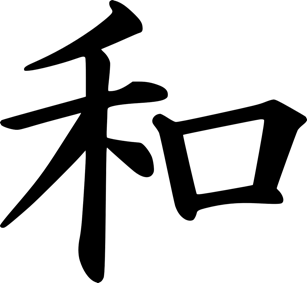
He Peace

Many years ago, when I was still teaching Chinese in Tulsa, I mentioned to Cristy that half way through the year, some of my kids were still having problems with radicals. She then asked me, “What are you talking about?” (Cristy had studied Chinese with me at Fu Jen Catholic University in Taiwan). Said I, “You know, Chinese radicals.” To which Cristy responded, “I really don’t have any idea what you mean.” I then tried explaining by example. “You remember the ‘tree’ radical, the ‘word’ radical, the ‘hand’ radical and the ‘three drops of water’ radical.” Cristy really was clueless.

When I then showed her several characters that had the “water” radical, the “tree” radical, the “word” radical, and the “hand” radical, Cristy said, “I never learned about radicals. They would have really helped me remember characters.”

The Chinese word for “radical” is “部首 bùshǒu”. In traditional Chinese, there are 214 radicals. Radicals are components or parts of characters. Sometimes radicals ARE also “stand alone” characters, and the character form is often different from it’s radical form.

Here are some examples of Chinese pictographs (characters which were originally pictures of what they represent) which also function as radicals. All of these characters remain the same in both their simplified and traditional forms:

  • The character for “female” is 女 nǚ. It is an ancient pictograph representing a woman kneeling.
  • The character for “tree” or “wood” is 木 mù. One can easily see how this pictograph represents a tree.
  • The character for “mouth” or “opening” is 口 kǒu. Again, an obvious picture.

A few Chinese pictographs changed the way they were written when Chinese characters were simplified in the mid-20thcentury. The traditional character for “horse” is 馬 mǎ. The simplified form is 马 mǎ. In traditional characters, 馬 mǎ retains its full form when it acts as a radical; in simplified characters, it also retains its simplified form as a radical. (e.g. mom = mā 媽, 妈)·  The character for “gate or door” is 門 mén. The simplified form is 门 mén. In traditional characters, it retains its traditional form as a radical; in simplified characters, it also retains its simplified form as a radical. (e.g. to ask – wèn 問, 问) Many characters change their forms when they go from being a character to being a radical.

  • The character for “hand” is 手 shǒu in both traditional and simplified forms.  When hand is used as a radical, it looks like 扌in both traditional and simplified forms.
  • The character for “person” is 人 rén. When “person” is used as a radical, it looks like 亻in both traditional and simplified forms.
  • The character for the word, “word” in both simplified and traditional charactersis 言 yán. More often it is written like this 言. The radical form of the word, “word” in traditional form is exactly the same as the character. However in it’s simplified form, it looks like this .

So, why should you be curious about radicals? The short answer is that knowing radicals makes learning to recognize, remember, and write Chinese characters easier. If, when you see the word for “trust” 信 xìn, you can see it as two radicals, instead of 9 strokes, it becomes easier to remember. It’s easier to decipher the word for “thank” 謝xiè if you recognize three radicals than it is to break it into 17 strokes. It’s a little like remembering a word in syllables instead of by its spelling. I’ll never forget Kurt Vonnegut’s wonderful made up word from “The Sirens of Titan”.  When I tried to spell “Chrono-Synclastic Infundibulum”, I blew it. But since I could remember how to say the word, it was easy to Google and find the correct spelling. In Chinese, if you can remember the main radical, that can help you find the character. After you learn the proper stroke order for writing down radicals, it will make it easier for you to jot down characters that arouse your curiousity.

 Here are 20 common radicals to look for where ever you see written Chinese.

  1. = knife
  2. = water
  3. = earth
  4. = son
  5. = roof
  6. or = heart
  7. = spear
  8. = sun or day
  9. = moon or month
  10. = fire
  11. = bamboo
  12.   or 絲 = silk
  13. = grass
  14. = clothing
  15. = foot
  16. = walk 
  17. = rain
  18. or = eat
  19. or 魚 = fish
  20. or龍 = dragon    

Chinese Odyssey 12

I discovered one symbol’s

not always a word,

that having no alphabet

wasn’t absurd.

Every stroke of the brush

was placed with precision.

Each line, dot, and hook

was there for a reason.


Speaking Chinese – its all in the tone

MVC-002S_3_JPG (2) copy

When I Googled “National language of China”, I got “standard Chinese”, “Mandarin”, and “Putonghua”. Putonghua is what Chinese in China call the standard spoken dialect of Chinese. Putonghua actually means, “the common language”.

There is no alphabet in written Chinese. There are, however, phonetic “alphabets” which have been created to help people pronounce Chinese correctly. That is one of the reasons why you see so many different spellings for names in Chinese history and literature. The most common phonetic alphabet today is called Pinyin (Lit. “spell sound”).

In Pinyin there are 21 initial sounds and 37 final sounds. An “initial sound is a consonant or a combination of consonants” at the beginning of most syllables. Some syllables don’t start with a consonant sound so those words have no initials. “Finals” are the end sounds of syllables. They are composed of either vowels, combinations of vowels, or vowels ending with a consonant or consonants. In the word “tang”, “t” would be the initial and “ang” would be the final. Most of the sounds are pretty easy to pronounce, but a few need a fair amount of practice to get right.

The hardest part in learning to speak Chinese, however,  has got to be the “tones”.  Tones are the way you change the pitch of your voice to alter the word you are saying. We do this in English sometimes to show emphasis. If I told Cristy I was planning to bring Xi Jin Ping home for dinner tonight, she would probably say the word “who” in the equivalent of a second tone in Chinese. In English, a “2ndtone”  indicates surprise or disbelief.  If I asked her if she wanted to eat dog tonight, she would probably answer with an emphatic “no” which is similar to a 4thtone in Chinese; a “4thtone in English” often suggests anger.  In Mandarin Chinese, tones are not used like this.

Every Chinese syllable has a tone.  Most syllables can be pronounced in a variety of tones, In Chinese, there are lots of homynyms. Many people know that in Mandarin, there are 4 tones. In Cantonese, there is a saying, “9 sounds, 6 tones”  ( gau2 seng1 luk6 diu6 九聲六調) which is used to explain sounds in Cantonese. Since I don’t speak Cantonese, however, I’ll fall back on the 4 tones of Mandarin.

Although there are 4 basic tones, there are also half 3rd tones, half 4th tones, and neutral tones. Not to mention tones which change (for a variety of reasons). After teaching Chinese for more than 20 years, I came to believe that the best way to learn tones is not through memorization, but rather through mimicry. It’s great if you can find a native speaker of Mandarin with standard pronunciation who you can attempt to mimic. It’s even better if they will agree to correct your pronunciation and your tones until you get it right.

Using the wrong tone can totally change the meaning of what you are attempting to say.  If, for example, I see you after being away from you during the summer and notice that you’ve been working out and are looking healthy and strong, I might say to you, “Wow, you’re looking fit.” You would probably smile and say “thanks.” If on the other hand, I misspoke and instead of saying “fit”, I said “fat”. (“Wow, you’re looking fat.”), you would probably be upset. All I did was miss one vowel. A missed tone on a Chinese word can mean the difference between a “mother” (mā) and “horse” (mǎ).

Try repeating this with a Putonghua speaker:

ma,      (Mom rides a horse)

mǎ, màn   (The horse is slow)

ma,     (Mom curses the horse)  (mom 媽 Mā)   (horse 馬 Mǎ)

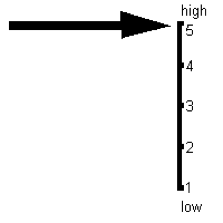
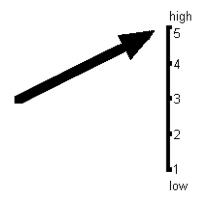
Finding your own range: Try singing and sustaining the syllable “ma” on as low a musical note as you can sing it. We will call that the lowest point on your range and will label that level 1. Now take the same syllable and speak and sustain it this time at your highest comfortable range.   We will call the highest point on your voice range level 5. Your normal level of speech would be level 3.

1st tone

The 1sttone begins at level and ends at level 5. Try saying ma and tang,  in first tone.

The  1sttone is indicated by a level line over a vowel (usually first vowel)  ( ― )

2nd Tone

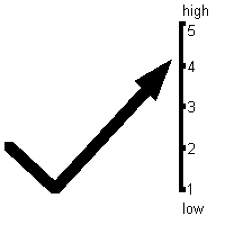
The 2nd tone begins at level and ends at level 5. Say ma and tang in second tone.

The  2nd tone is indicated by an ascending line (bottom left to top right) over a vowel ( / )

3rd Tone

The 3rd tone begins at level 2, goes down to level and ends at level 4. Say ma and tang in the third tone. The  3rd tone is indicated by a over a vowel (usually first vowel)   ( )

4th Tone

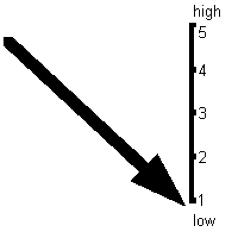
The 4th tone begins at level and ends at level 1. Say ma and tang in fourth tone.

The  4th tone is indicated by a descending line (top left to bottom right) over a vowel  ( )

I once went into a restaurant in Taiwan in the winter time hoping for a bowl of hot soup. I asked the waitress, “Ni you mei you tang?” (Do you have soup?) She replied, “Women zheli mei you tang. (No we do not have candy here.) I pointed to the menu, and and proudly said “Zhe shi bu shi tang?” (Isn’t this soup?). She laughed and said, “You didn’t say Tāng (soup), you said Táng (candy). We don’t sell candy at our restaurant.”

Chinese Odyssey 11

So where were the rickshaws?

There were taxis and busses.

Clothes looked just like mine

There were no thems or us’s.

I learned 1,2,3,4

now as “yi, er, san, si”

And those things I called “chopsticks”

were really “kuaizi.”


Stinky Bean Curd and other fine foods

Soy Molk doujiang

Chinese food in Taiwan was the best Chinese food in the world in the 1970’s. Nearly two million people from all over China descended on Taiwan in 1949, bringing with them a plethora of delicious delicacies to combine with the great Taiwan food already on the island.  And the best of the best was the cheap street food. I discovered Sour Plum Juice (酸梅汤 Sūan Méi Tāng) near the New City Park, to be a great thirst quencher in the summer and Star Fruit Juice (Yángtáo Zhī) was a natural soother for a sore throat. Boiled and Fried Dumplings (餃子 jiǎozi) and  鍋貼 guō tiē) cost 2 NT$ – 5 cents US, each. When I went out with my friends, I would always order at least 20 for myself. Cristy’s favorite snack just outside of the front gate of Fujen University – you guessed it, “Run, run, fast as you can, you can’t get away from the Stinky Bean Curd man .” Stinky Bean Curd (臭豆腐 chòu dòufu). Still a popular treat in Taiwan, Hong Kong and all over China, it is an acquired smell and taste, I suppose. Sort of like limburger cheese in Germany and durian fruit in southeast Asia.

And then there were the amazing noodles. In the winter time, it had to be beef noodles (牛肉面 niúròu miàn) at a cost of about 20 NT – 50 cents US – a bowl.  In the summer, it was cool noodles ( 涼麵 liáng miàn), made with shredded chicken, julienned carrots, green onions, cucumber, fresh ginger, and sesame sauce). Another popular noodle in the Ximending (西門町) area of Taiwan was pork chop noodles (排骨麵 páigŭ miàn). I once told Cristy that they were called pìgu miàn 屁股麵 (lit. “butt noodles”). She never could remember which one was correct – and never forgave me for that.  My favorite noodles, however, were Lao Deng’s Dan Dan Mian ( 擔擔麵 dàn dàn miàn). Hot, spicy, sesame noodles, perfect any time of the year. I liked to pair them with sliced pig ear, dried bean curd, and sea weed. Later, I learned that Dan Dan Noodles were not originally from Taiwan. They were from Sichuan, but to this day, I prefer Taipei’s version to the ones I get in Chengdu.

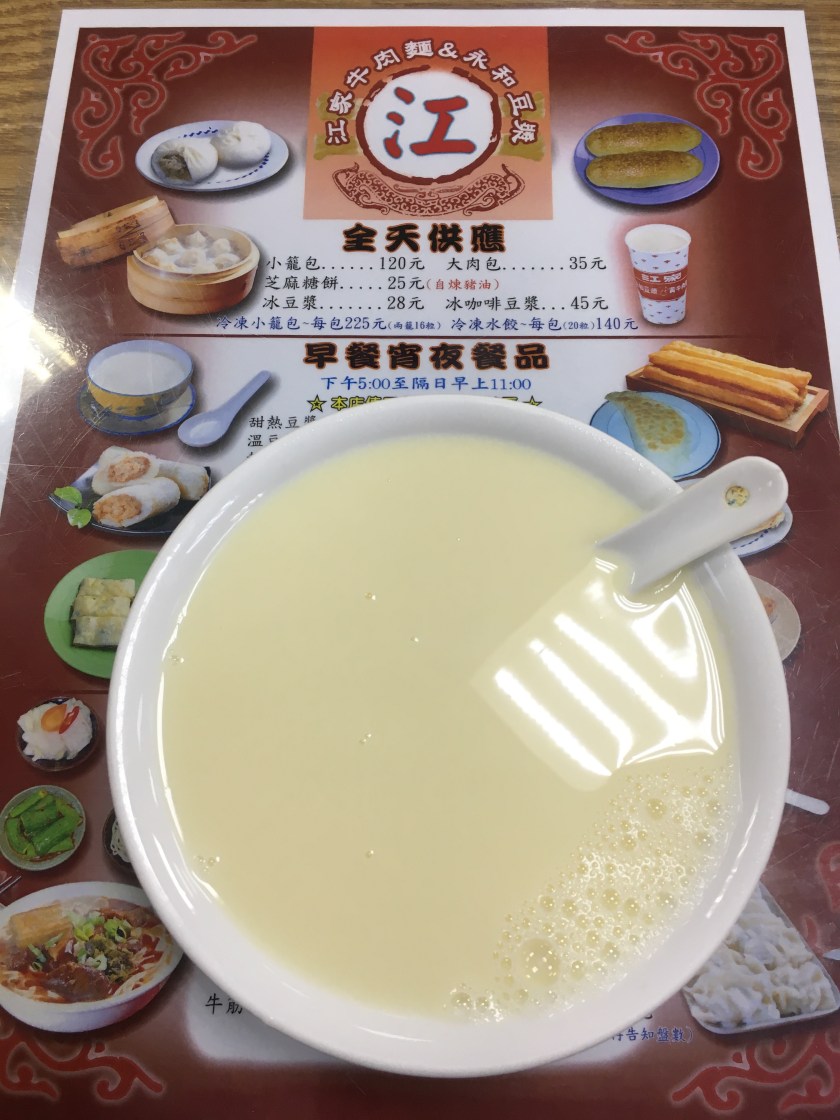
When I landed in Taiwan, I was clueless. I had studied Mandarin in Missoula, Montana for only one year. My professor had helped find a room for me with an elderly female judge who had come over from Shanghai with the KMT in 1949. I had an appointment the day after I arrived to enroll at Fujen University’s Mandarin Language Center which was over an hour away by bus. I left home at 7:00 every morning. On my way to school, I would pass the Recover the Mainland Café (復國餐廳 Fùguó Cāntīng) where smiling people would be enjoying their Chinese breakfasts. I really wanted to try the food, but I had no idea what they were eating or how to ask about it. One day as I stood there drooling at the steaming hot milk and the long pieces of deep fried dough, the cook came up to me and asked me in perfect English, “Do you want some of this?” I said, “Sure, what is it?” He said, “The white stuff is soy bean milk” (豆漿 dòu jiāng). You can get it salty or sweet. And that (he pointed at the fried long donut in a sesame bun concoction and struggled for a translation) is kind of like a Chinese hot dog without the meat.” I later found out this was called Shāobing Yóutiáo 燒餅油條. “OK”, said I, “I’ll give it a try.” It was love at first bite. I became a regular.  It turns out that the cook had picked up his English when he served with the US military in Vietnam for five years.

I supported my studies at FuJen University by teaching English in tutorial centers (補習班 bǔ xí bān) and by singing and playing at the Idea Coffee House – about a mile from the old airport. Almost all of my students had English names as well as Chinese names. Sometimes students chose their own English names so I had quite a few with names like “Brave”, “Loyal”, “Swallow”,  but my personal favorite was “Sweet Potato”. As hard as I tried, I could not convince “Sweet Potato” to change his name. Later I learned that the sweet potato has a special significance to the Taiwanese. Indeed, the shape of the island of Taiwan is the shape of a giant sweet potato.

Chinese Odyssey  10

The island was shaped like

a big purple yam.

For my first dinner there

I had fried rice with ham.

Next morning early,

I went for a walk

Ate youtiao and shaobing

but still couldn’t talk.


Republicans in China

800px-Flag_of_the_Republic_of_China.svg

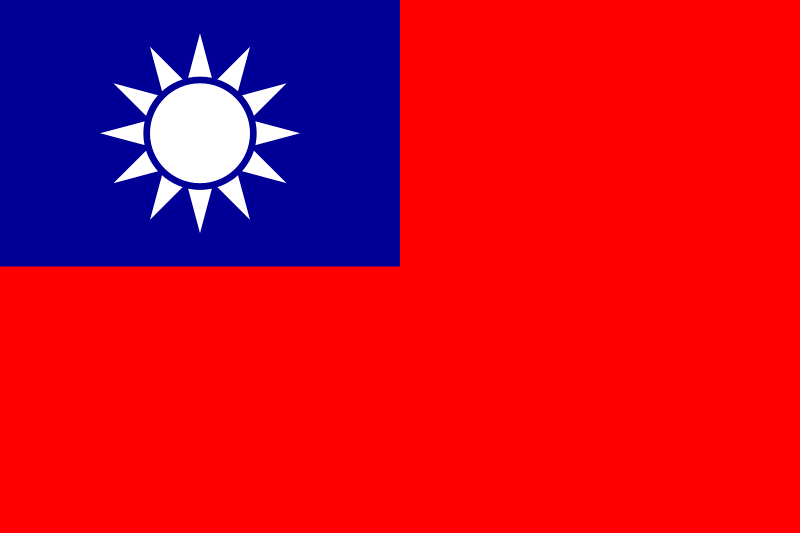
When Americans see the word, “Republican”, we immediately think of a political party. There are Republicans, Democrats, and Independents. In this post, the term “Republicans” refers to the people who wanted to change China from a system ruled by emperors and their families to a “republican system” where elected representatives of the people controlled the government. Many historians call the period between 1911-1949 in China, the “Republican Period” since the official English name of China at that time was “The Republic of China”.

Before the Republican Period, China was ruled by a succession of dynasties.  Some dynasties, like the Han lasted for centuries. Others, like the Qin, only a few years.  What all dynasties had in common was that they were lead by emperors who ruled with a “mandate from Heaven”. In Chinese, the word for revolution (革命 gé mìng) literally means “removing the mandate”. When an emperor no longer had the” mandate from Heaven,” the dynasty was toppled and a new dynasty began.

The Qing 清 (aka Ch’ing or Manchu) Dynasty was the last imperial dynasty in China. A coalition of anti-Qing forces from both inside and outside of China culminated with the Wuchang Uprising in Hubei on October 10,1911, forcing Puyi (溥儀 Pǔ yí), the last emperor of China to abdicate his throne on February 12, 1912 at the ripe old age of six.

The Qing Dynasty began when the Manchurians defeated the Chinese Ming armies in 1644. At that time, Manchuria was not considered a part of China, so China felt that it had been occupied by a foreign power. Early emperors of the Qing were strong, but by the beginning of the 19th century, the Qing had begun to decline. The Opium Wars lead to an ever increasing European presence and the British acquiring a foothold in Hong Kong. Movements to resist the Qing included the Taiping Rebellion where a deluded failed scholar who thought he was the younger brother of Jesus Christ lead a rebellion where upwards of 20 million people died. The Boxer Rebellion, at the beginning of the 20th century, promised followers that China could rid itself of the scourge of foreign invaders who seemed to be dividing China up like a pie, and the infamous Empress Dowager built a marble party boat with money promised to the Chinese navy, all set the stage for revolution.

Dr. Sun Yat-sen 孫逸仙 SūnYìxiān (aka 孫中山 Sūn Zhōngshān) has often been referred to as the father of modern China. He is one of a small number of “modern” Chinese to still be revered in both Taiwan and in the People’s Republic of China.  Dr. Sun had a vision of a constitutional republic based on three principles: Democracy 民權 (mín quán), Nationalism 民族 (mín zú), and Welfare of the People 民生 (mín shēng). When the Qing forces were defeated, Sun Yat-sen became the provisional President of the new republic. Although Sun ruled for less than a year, his “3 principles of the people” continued to be the political backbone of the Republic of China.

The Republican period in China was a time of turmoil. In the beginning, “Warlords” with their own militaries both divided and controlled large portions of China. The Nationalist Party (國民黨 Guómíndǎng, aka Kuomintang or KMT) was made legitimate by Sun and ultimately recognized by his followers in 1919, and a young Generalissimo Chiang Kai Shek (aka 蔣介石 Jiǎng Jièshí, aka 蔣中正 Jiǎng Zhōngzhèng) was rapidly establishing himself as Sun Yat Sen’s successor and as the emerging leader of the KMT.

At the same time, a former librarian at Beijing University and primary school history teacher in Changsha, by the name of Mao Ze Dong (毛澤東 Máo Zé Dōng), joined the fledgling Chinese Communist Party. At the time of Sun’s death in 1925, the communists and nationalists seemed to be coexisting amicably, but in 1927, with the help of the infamous Green Gang, Chiang Kai-shek ordered a campaign in Shanghai where more than 5,000 Communists were killed. This and other similar communist purges continued until 1934 when tens of thousands of communist troops followed Mao and other communist leaders nearly 4,000 miles in the “Long March” from Fujian to Shaanxi, with Chiang Kai Shek and the KMT in hot pursuit.

Besides the ongoing civil war between the Communists and the Nationalists, China was also being invaded and occupied during this period of time by the Japanese. An incident in 1937 at the Marco Polo bridge just south of Beijing was the spark which would lead to the Japanese domination of much of eastern China, the Rape of Nanjing, and the eventual occupation of Hong Kong by the Japanese on Christmas day, 1941. Although the Allied troops in WW2 tried to get the Communists and the Nationalists to team up against the Japanese, this idea met with very little success. In one incident in Xi’An in 1936, the Communists actually kidnapped Chiang Kai Shek to force him to team up and fight against the Japanese.

With the retreat of the KMT to Taiwan in 1949, and the establishment of the People’s Republic of China, the Republic of China ceased to exist in mainland China.  The Republic of China is NOT the official name in English for China. The official name for China is The People’s Republic of China. However, the Republic of China remains the official name in English for Taiwan. To the rest of the world, it remains a conundrum.

Chinese Odyssey  9

I packed up my suitcase

and jumped on a plane.

It was off to Taiwan

and an ocean of rain.

Some called it “free China”

where KMT landed

soldiers from China

that Chiang had commanded


When Taiwan was China

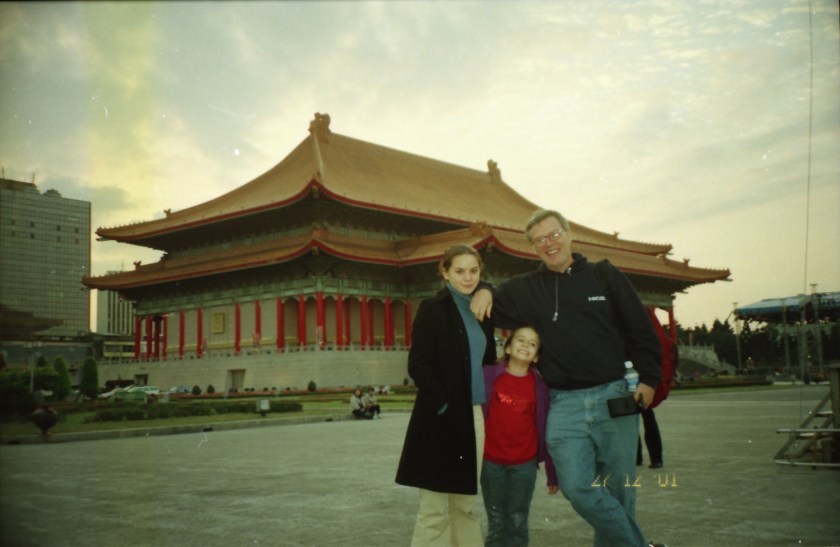
Peter, Katie, Ana Sun Yat Sen - I played this venue copy

I began my studies of Chinese at the University of Montana – on a whim. As a student of the 60’s, the James Legge translation of The I Ching: The Book of Changes and translations of the Tang dynasty poets Li Bai, Tu Fu, and Han Shan by Arthur Waley, Kenneth Rexroth, and Gary Snyder were on my reading list. Chinese was cool. My first Chinese language teacher was Father John Wang, a Catholic Priest from Shandong province who was also head of the U of M Spanish department. We studied a chapter of John DeFrancis’ Beginning Chinese every week, and we finished the year by reading “The Lady in the Painting”(畫兒上的美人). By the end of my first year, I was hooked. I wanted to go to China. Unfortunately, for an American in the mid-1970’s, mainland China was not an option. Father Wang said, “No problem. Go to Taiwan.”

At that time I was working on a ranch on Horse Prairie, near Dillon, Montana to support my university studies and was thinking about picking up my first horse, a dun mare.  I checked prices on tickets to Taiwan and the cost of the horse, and the cost of a round trip ticket to Taiwan were about the same. So I did what any red-blooded American would have done. I flipped a coin. Taiwan won. Father Wang assured me that his brother (also a Catholic priest) would find me a job teaching English for 60 NT$ an hour (about $1.50 US) and living in Taiwan was cheap, so I said OK. I cut my hair, borrowed a corduroy coat from a friend, and was on my way.

America, at that time, recognized Taiwan as the “real” China. Chiang Kai-Shek was still President and Mandarin was called Guoyu (the national language). The Kuomintang (Nationalists or KMT) ruled with an iron fist – and the people in Taiwan seemed to really like Americans. One of my first impressions of the Chinese in Taiwan was how gracious and welcoming the people  were. Later, I found out that most Chinese had a similar opinion of people from Taiwan. An oft heard expression among Chinese was “台灣人的 人情味很濃 “ (Táiwān rén de rénqíngwèi hěn nóng) which literally means “the hospitality of the people from Taiwan is really thick.” It really meant, “People from Taiwan are really nice.”

The first people in Taiwan were, most likely, not Chinese. The indigenous people in Taiwan were Austronesian. Chinese have been settling in Taiwan for centuries, however. Most came from Fujian and the dialect of Chinese which was most common in Taiwan before the KMT came in 1949 was the southern Min dialect (also called Taiwanese), the same dialect which is spoken in Xiamen (Amoy), Fujian.  The Dutch occupied Taiwan for about 20 years in the mid-17th century. The Dutch called Taiwan “Ilha Formosa” (beautiful island). Taiwan is still referred to by many as “Formosa”.  China ceded Taiwan to the Japanese in the Treaty of Shimonoseki after losing the first Sino-Japanese War in 1895 during the waning years of the Qing Dynasty. Taiwan remained a part of Japan for 50 years until the end of WW2 when it was reunited with China. When I first went to Taiwan, I encountered quite a few old people who did not speak Guoyu. They only spoke the Taiwanese dialect of Chinese and Japanese.

On January 1, 1979, America joined a majority of nations by formally recognizing the People’s Republic of China as the legitimate government of China. The USA acknowledged that there was only one China and that Taiwan was a part of China. At the writing of this post, there are currently 17 countries (out of 193 member states of the United Nations) – plus the Holy See in the Vatican – who continue to have diplomatic relations with Taiwan.

Chinese Odyssey 8

I read something new

in those dots, strokes, and lines.

Gates will soon open,

just look for the signs

An island awaits you

with jungles and snakes.

Fly over the pole

then put on your brakes.

鄭和 Zhèng Hé –Explorer Extraodinaire

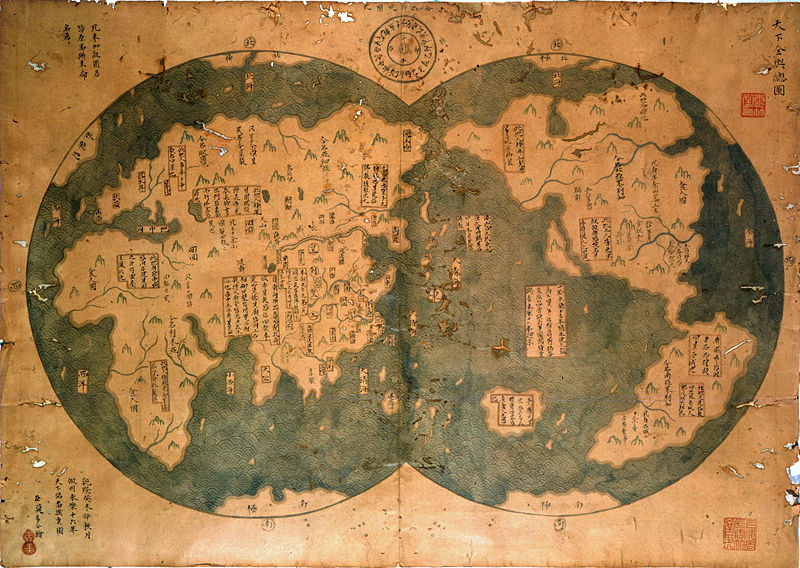
Zheng He Maphttps://commons.wikimedia.org/wiki/File:Zhenghemap.jpg

Growing up in the West, I learned that the 15th century was the “age of exploration”. I marvelled at the stories of Christopher Columbus, Fernando Magellan, and Vasco de Gama and imagined myself as a member of their crews. I devoured Robinson Crusoe, Gulliver’s Travels, and Homer’s Odyssey. It wasn’t until adulthood that I first discovered Zheng He (pronounced Jung Huh). When I began learning about him, the word “marvel” took on a whole new dimension.  It was like jumping from little leagues into the majors. Zheng He didn’t explore with a small fleet of ships like European explorers. He commanded an armada of over 200 ships and more than 25,000 men. His largest ship about the size of a  professional football pitch. The Santa Maria (Columbus’ flagship) on the other hand, was a mere 36 metres in length. I wonder what maps and other information about the rest the world Zheng He used when he and other explorers from different parts of the world explored their world during the “age of exploration”.

Born near Kunming, Yunnan in southwestern China into a Muslim family, Zheng He’s original name was Ma He. As a young boy, he was captured by soldiers of the Ming Dynasty. Like many boys of a similar age who were captured, Zheng He was castrated so he could serve the Ming Court and not pose a threat to the women of the imperial court. Not only did Zheng He became a loyal member of the Ming court, his outstanding service was rewarded by his being sent to Beijing  (then known as Beiping), where he gained favor with Zhu Di, the 4th son of the founder of the Ming Dynasty. Zhu Di later went on to become the Yong Le emperor. Ma He proved to be a great warrior and respected commander, and after fighting fiercely in several military campaigns for the Ming, he became a favorite of Yong Le. Emperor Yong Le showed him great honor by bestowing upon him the surname of Zheng. There are several stories as to the origin of the name, but my favorite is that “Zheng” was the name of Yong Le’s beloved horse who had been killed during a seige in Nanjing. Maybe since the “Ma” in Ma He’s name meant “horse”, Emperor Yong Le was honoring him by giving him the name of his favorite horse. At any rate, his new name, “Zheng He” was the name that stuck.

In his sea voyages, Admiral Zheng He, traveled south through what is now Indonesia, Malaysia, and the Philippines and west to India continuing south down the eastern coast of Africa. Five of Zheng He’s seven long voyages occurred during the reign of the Emperor, Yong Le. Some writers and historians believe that Zheng He could have sailed even well beyond Africa but evidence for that is a bit sketchy.

Chinese Odyssey  7

Years later while rummaging

through some old boxes

I heard a soft clink

amongst shorts, shirts, and soxes.

The jar, I remembered.

Inside was a map —

still cryptic, yet clearly

a beckoning trap.

Chop Suey and Chow Mein

SAMSUNG CSC
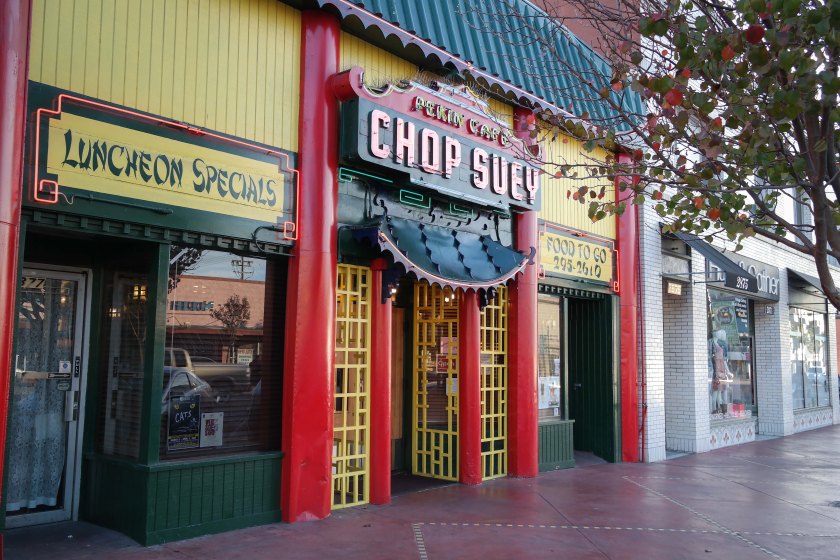
By Visitor7 [CC BY-SA 3.0 (https://creativecommons.org/licenses/by-sa/3.0)%5D, from Wikimedia Commons
As a child growing up in Tulsa, Oklahoma in the early 60’s, I had no access to “real” Chinese food. My Mom used to make Chinese food by opening up a can of “Chun King Chicken Chow Mein” or “La Choy Chop Suey” and heating up the mixture in a pot on the stove. We would put crispy “chow mein noodles” on our plates and slop the chop suey on top of the noodles. “Chinese vegetables” were a mixture of celery, carrots, snow peas, bamboo shoots, and bean sprouts. We always had a bottle of soy sauce on the table to sprinkle generously on the top. Our favorite Chinese restaurant, the Pagoda, had fancier dishes. There we could get shrimp fried rice (my favorite), pressed duck, egg rolls, and sweet and sour pork. Pots of tea were free. At the end of the meal, the check came on a small platter with enough fortune cookies for everyone at the table to have one of their own. In the middle of each sweet, bland cookie shaped like a Chinese ignot, there were words of wisdom like, “Your dreams will all come true.” and “Wealth awaits you very soon.”

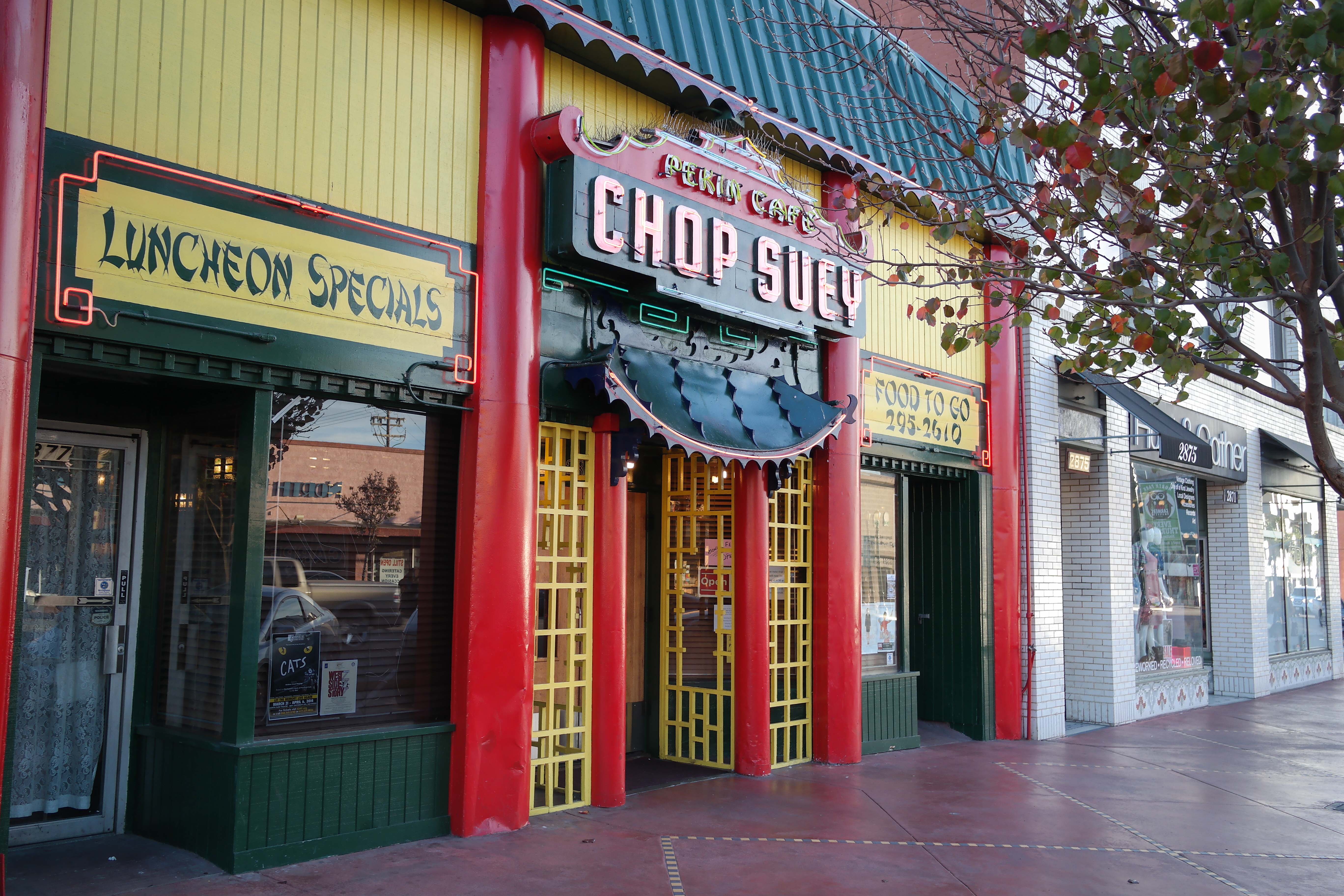
In all my years in China, I’ve never once seen Chop Suey on a Chinese menu, nor have I been given a fortune cookie at the end of a meal. Chinese food in middle America was a combination of real Chinese food, American ingredients, and cooks who did their best to modify Chinese flavors to suit their perceptions of American tastes. To a young boy in middle America, eating fried rice off a plate with chopsticks was not only exotic but challenging. My low point was a restaurant in Oklahoma City called The Chopstick. When we asked the blond haired teeny bopper waitress what she would recommend from the menu, she told us she’d never tried the Chinese food, but said the cheeseburgers were pretty good. Ignoring her advise, we ordered Chinese shrimp.  Unable to find the shrimp in the breading, we all wished we had taken her advice.

Chinese Odyssey 6

Life got in the way then

the next umpteen years

were devoted to learning

and follies and fears.

My first Chinese fare

was the Mandarin Café

I loved their fried rice

my first taste of Cathay.


Red China


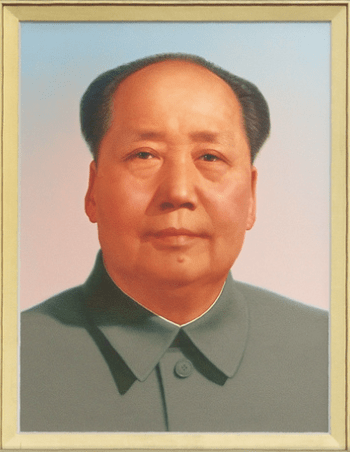
Screen Shot 2018-07-31 at 1.28.45 PM

WW2 ended in 1945, but the civil war in China continued to rage. Although America and its allies supported Chiang Kai-Shek and the KMT (aka the “Nationalists”), Mao Zedong was definitely gaining headway among the Chinese masses. There were attempts made to broker a peace between the Communists and the Nationalists in 1945 Chongqing, but neither the Communists nor the KMT were willing to lay down their arms. By 1948, the Communists were clearly in control of the majority of China and in 1949, Chiang Kai-Shek asked America, the UK, France, and the USSR to intercede. But by then it was too late. On October 1, 1949, Mao Zedong declared the birth of the People’s Republic of China and two months later, on December 8, 1949, the KMT officially moved its government and nearly 2 million troops and support personnel from Chongqing in Sichuan, to Taipei, Taiwan. The purpose of this move was to regroup and the plan was to recapture the Chinese mainland from the communists with the help of America and other supportive allies. Of course, that never happened. There was never a peace treaty or an armistice signed between the Communists and the KMT. Taiwan continues to officially call itself the Republic of China  (https://www.taiwan.gov.tw/index.php).

In 1951, the USA became involved in the Korean conflict and fought against both the North Koreans and the Chinese in Korea. But aside from stationing US troops on the island of Taiwan, the US did little to assist the Republic of China (the English name for the “official government” of China) now hunkered down in Taiwan, in its goal to recover the mainland.

America, in the 1950’s was in the throes of the Cold War. Communists were our sworn enemies. The USSR (The Union of Soviet Socialist Republics) and the Peoples Republic of China were considered to be huge threats to the American way of life. The United States was also the biggest financial supporter of the French and the South Vietnamese during their struggle against Ho Chi Minh and the communist North Vietnamese. When the French decided to call it quits in 1954, the USA was left holding not only the financial weight of that war, but the belief was that Vietnam was a communist domino which America could not allow to fall. If Vietnam became communist, the commonly held idea was that Cambodia, Laos, and Burma would be quick to follow.

In actuality, the Peoples Republic of China was having a tough go of it in the 1950’s.  Their vision was of a communist China but what would that mean? For one thing, Mao declared that  women would hold up half of the sky (女人撑起半边天- Nǚrén chēng qǐ bànbiāntiān) Men and women would be equals. There would also be serious land reform. Large chunks of land were taken from the wealthy landlords and given to the peasants and many land owners were killed in the process. In the beginning, China tried to model itself after the USSR, but relations between these two huge communist superpowers began to deteriorate. Both human caused and natural disasters (sometimes a combination of the two) lead to the deaths of millions of  Chinese during the late 1950’s, but China had shut itself off to most of the rest of the world at that time, so the west knew very little of the suffering that was happening in Red China.

Although the color red is usually associated with good fortune in Chinese, during the 1950’s, the red in Red China referred to “Communist China” (the Peoples Republic of China) as opposed to “Free China” (the Republic of China aka Taiwan.)  In the same way that the USSR was separated from western Europe by the metaphorical “Iron Curtain”, Red China was separated from the free parts of Southeast Asia by a “Bamboo Curtain” which prevented the free world from seeing what was really happening in China.

Chinese Odyssey 5

The world was huge.

China could have been Mars.

Confucius and communists

chopsticks and stars

Chow mein and chop suey

both came from Chun King.

Fortune cookies were made

in a place called Peking.