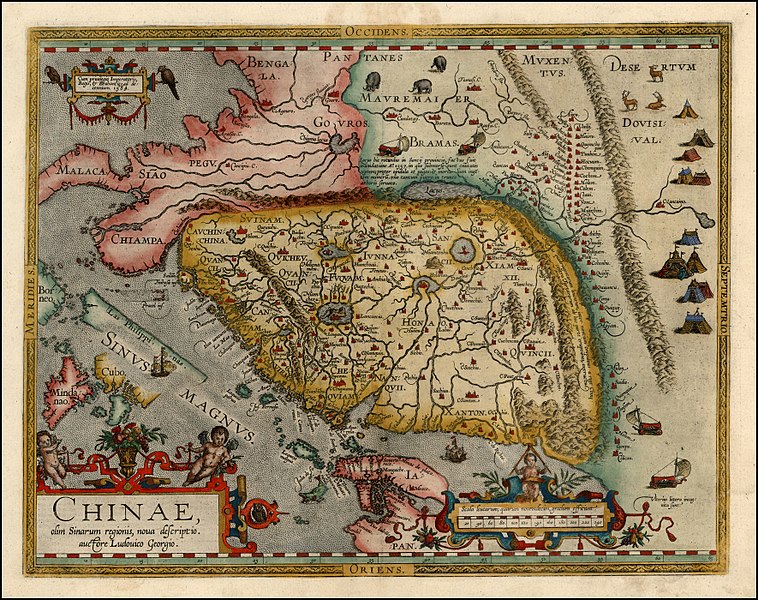
By Abraham Ortelius (1527-1598), Luis Jorge de Barbuda (also known as Ludovicus Georgius, fl. 1575-99) [Public domain], via Wikimedia CommonsIf you said the word “China” to a Chinese speaking person who did not speak English, he would have no idea what you were saying. To the Chinese, China has always been 中國(Zhong Guo) – the “Middle Kingdom”.
I grew up learning that the word China was derived from the Qin (pronounced ‘Chin’) Dynasty, the first imperial dynasty of China (221-207 B.C.E.) Many scholars believe the word China to have Sanskrit origins which predate the Qin Dynasty.
The official name of China is the People’s Republic of China (中华人民共和国) Zhōnghuá Rénmín Gònghéguó.
Taiwan also continues to lay claim to the title, the Republic of China (中華民國) Zhōnghuá Mínguó).
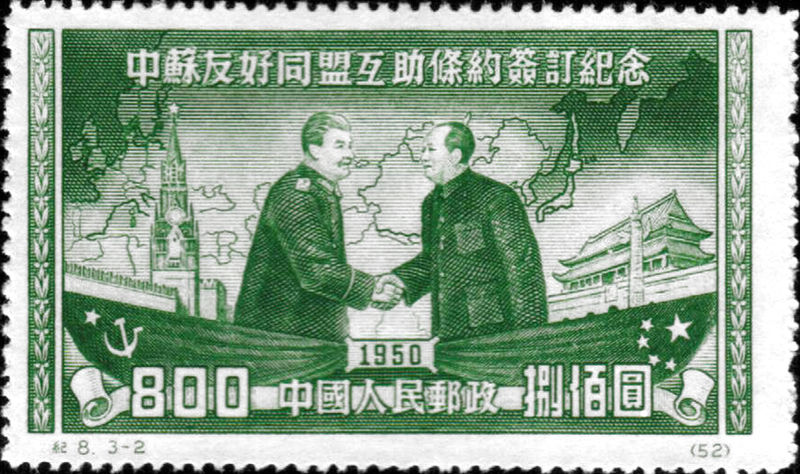
By Post of the People’s Republic of China [Public domain], from Wikimedia CommonsThere are no letters in Chinese characters. With languages like English, letters help us sound words out. Even if we don’t know what a word means in English, we can usually make a pretty good guess as to how it should be pronounced. Chinese words don’t usually have components that tell you how the word is pronounced. Sometimes there are parts of characters that give you a hint as to how a character might be pronounced, but not always. Depending on the Chinese dialect, the same character can be pronounced in very different ways depending on the dialect. Some characters can even be pronounced in different ways in the same dialect depending on how the character is being used.
For over 2000 years, people all over China wrote Chinese characters in the same way. There were different styles, of course, sort of like different character fonts in English. Even if you couldn’t speak the same Chinese dialect with someone, at least you could write notes. In the first two decades after the founding of the People’s Republic of China in 1949, the Chinese government decided to simplify many of the characters to make the Chinese language more accessible to the masses.
Every Chinese character occupies the same amount of space when characters are used together. Whether a chinese character has one stroke like the number one(一)or17 strokes like the traditional character for dragon(龍), it occupies the same sized imaginary square. Even though each character represents only one sound syllable, sometimes “words” in Chinese are made of two or more characters. The word for “almost” (chàbuduō) 差不多 is made of of the three separate characters. When writing a sentence in Chinese, there is no spacing between words, only between characters.
Traditionally, Chinese was written vertically, from up to down and from right to left and there were no punctuation marks. Today, much of written Chinese is written horizontally from left to right. Western style punctuation is also very commonly used.
Chinese characters are made up of strokes. There are 6 basic strokes:
Héng (橫) –horizontal line
Shù, (竪) – vertical line
Diǎn (點/点) –a dot; sometimes a dab
Tí (提) – a rising stroke from bottom left to top right
Piě (撇) – slanted line from top right to bottom left
Nà (捺) – slanted line from top left to bottom right
There are also many modifications and combinations of basic strokes and there are rules for the order of writing strokes. Here are 3 common examples:
Horiontal trokes are always written from left to right
Vertical strokes are always written from top to bottom
Horizontal strokes are written before vertical strokes
A journey of a thousand miles begins with a first step
More than two thousand years ago, a man known by the name of 老子(Lǎozǐ), wrote those words. My hope is that many people outside of China today stand poised ready to take their first steps in the understanding of China.
Laozi lived around the same time as Confucius. Daoism (Taoism) is looked upon in China both as a philosophy and as a religion. The canon (written text) of Daoism is called the Dàodéjīng(道德经) Arthur Waley translated this title as The Way and Its Power. The word Dao ( 道) is often translated as the “path” or the “way”. In the first of the 81 passages that make up the original text of Daoism, we learn that “dào” and the word “míng (名 )” meaning “name”, cannot really be defined by words. In other passages, we learn that water is one of the softest and pliable of all substances while being one of the strongest and most powerful forces in the universe. And we learn that opposites define one another (there would be no “ugliness” if there were no “beauty”). One of Laozi’s followers, Zhuangzi, wrote some amazing parables based on passages from the Dàodéjīng.
The Worthless Tree
One day, a man by the name of Hui Zu struck up a conversation with the philosopher, Zhuangzi. “See that big ugly old tree. It’s called a Stinky Tree. Butt ugly. Trunk twisted. The entire tree is riddled with knots and knotholes. There’s no way anyway could even make one good board from it. Check out the branches. Different sizes and shapes going this way and that. Not one thing about this tree makes any sense. Kind of like school. Big and worthless.
Zhuangzi thought for a minute and then responded. “Have you ever seen a wild cat crouching and waiting for its prey? The cat sits immobile while the mouse scurries around. In the end, the mouse always ends up in the trap. Water Buffalos are massive, almost as big as clouds. They’re really big and strong, but they can’t catch mice.”
“You’re telling me that tree is worthless. Uproot it then, and plant it where there is nothing else – in empty space. After it’s taken root, walk around it. Sit under it and enjoy its shade. No one’s ever going to cut it down.”
“Worthless? We should all be so worthless.”
(based on Thomas Merton, The Way of Chuang Tzu, Abbey of Gethsemani, 1965)
One day a turtle walked up to a circle of rocks and peered down into a well. “Hullo-o-o-o” he shouted down. But instead of the echo he was expecting to come back he was met with a perky “Hello!”
The turtle looked down and saw that at the bottom of the well, the sun was shining on a small frog lounging on a sand bank.
“What are you doing down there?” shouted the turtle. “Want to come up here and play?”
“Why should I?” asked the frog. “I’ve got everything I need down here. I have sunshine and my own private beach. There are dozens of bugs I can reach with my tongue whenever I’m hungry. Giant leaves protect me from the rain. I’ve got it all”
The turtle thought for a while and then asked. “Don’t you ever miss walking through the forest or sliding down sand dunes or seeing the waves crash on rocks. How about butterflies and birds and amazing flowers I get to see every day on my walks?”
At that, the frog paused. He really didn’t have a response.
In Chinese, this idiom 成語 (chéngyǔ) is called 井底之蛙 (Jǐng Dǐ Zhī Wā) – “The Frog at the Bottom of the Well”)
I grew up with Aesop’s fables. I knew that the fox really did covet the grapes that he dismissed as probably being sour anyway. Sort of like the frog in the well who came to the realization that he might not have it all but was too proud to admit it. One of my great surprises when I started to learn Chinese was the wealth of fables and idioms that are woven throughout the fabric of Chinese history and literature.
I was born in Montana and grew up in Oklahoma. About the closest I ever came to China was eating sweet and sour pork at the Pagoda restaurant at the corner of 51st and Peoria in Tulsa. As life would have it, a few twists and turns set me on a course which would cause me to spend more than half of my life in China. I became fascinated by much of what I learned about China and Chinese – almost none of it through formal education.
The more I learned about China, the more “treasures” I uncovered. Poetry, philosophy, and language study opened doors into worlds I never knew existed. A few years ago, I wrote a poem about my journey through China I called “China Odyssey”, where I cracked a few doors opened, but not quite wide enough. With China being an ever more dominant player in the world we live in, I decided to revisit my poem and open a few of those doors just a little bit wider. So join me, if you’d like and explore China – one stanza at a time.

 The Panda in the Room PD