Emperor with an Ego

Chinese Odyssey 65

We followed the footsteps

of men made from clay

who travelled the Silk Road

in Chang An by day

At night in their chariots

they served their Huang Di

He died, they died too

far away from the sea.Qin_Shi_Huang_(Chinese_characters).svg

https://upload.wikimedia.org/wikipedia/commons/8/8d/Qin_Shi_Huang_%28Chinese_characters%29.svg

As far as dynasties go, the First Emperor of China’s was really short. During his reign of only eleven years (221-210 BCE),  Emperor Qin Shi Huang (秦始皇帝 Qín Shǐ Huáng Dì) left a legacy that continues to this day. Indeed, the very name “China” probably has its origins in this first imperial dynasty. Qin is actually pronounced very similar to the English word “chin”. Emperor Qin Shi Huang standardized Chinese writing, weights and measures, established a common currency and connected the various walls at the northern border of China to create the Great Wall of China (万里长城 wàn lǐ cháng chéng.)

The Qin Dynasty was pivotal in the standardization of the Chinese written language. Emperor Qin did that by making the script that he was most familiar with – the Qin script, the official script of China. Other styles once popular in different parts of China eventually disappeared. The Qin script was simpler than most. In the picture above, the first row of characters and the second row are the same. The top script, known as zhuànshū 篆書 is usually translated as “seal script”, because it was used in “chops” or “seals” that appeared on documents and works of art. The second form of writing was called  lìshū 隸書, “clerical script” and was the traditional Qin form of writing – a simplified form of the seal script. A side note here. While Emperor Qin was very intent on unifying the Chinese written language, he also sought to unify Chinese thought. What better way to make history begin with him, than to kill scholars and destroy documents of recorded history? And so, he tried – with some success.

Emperor Qin also felt the need to simplify and standardize weights and measures. When he became emperor, China was a mishmash of different measuring systems. Qin Shi Huang started by going decimal and dividing a day by 10’s. A day was actually made up of one hundred kès (刻). Emperor Qin also had a special affinity for the number 6. Six chǐ (尺) = one bu (一步 yī bù ). A chǐ was roughly equivalent to a foot (the approximate length of the space between the joints of a standard stalk of bamboo.) 300 bù was equal to one lí 厘(sometimes called a ‘Chinese mile’ – actually about 1/3 of an English mile.)  Finally 1 jīn 市 equalled about 1.1 pounds or 500 gm. A jīn is also referred to as a “catty”. A liǎng was also known as a “Chinese ounce” or a “tael” and was how foreigners weighed silver. In the past a jīn was equal to 16 liǎng, but nowadays there are 10 liǎng 两 in one jīn.

Contrary to popular belief, Qin Shi Huang did not build the Great Wall of China. Early portions of the wall built to protect kingdoms began to appear in the Spring and Autumn Period (771–476 BCE) and were followed by more sections of walls in the Warring States Period (475–221 BCE). What Emperor Qin did was to connect those east-west walls in northern China from Gansu all the way to Manchuria, just to the north of Korea.

Emperor Qin was a brilliant military strategist who ruled with an iron fist. One by one, the kingdoms of the Warring States fell. He killed, castrated, or enslaved those who stood in his  way. He was a megalomaniac who was obsessed with the after-life and was tenacious in is search for immortality. To that end, Qin Shi Huang decided to make his tomb a mini-kingdom of Qin where he would take an entire life-size army with him (as well as real life servants, concubines and craftsmen.) While Qin Shi Huang was building his tomb, he sent Xu Fu 徐福 XúFú , a Chinese alchemist and explorer from Guangdong, off on a sea voyage with 3000 virgin boys and girls to search for the pill of eternal life (長生不老藥 chángshēngbùlǎo yào.) Legend has it Xu Fu and his entourage ended up in Japan, and some scholars credit him with helping to develop farming techniques and introduce new plants and agricultural advances there. In some parts of Japan people still worship Xu Fu as the God of farming. And Marvel features him as a Chinese character in some of their comic books.

Since the uncovering of a terracotta head and bronze arrowhead by peasant farmer, Yang Zhifa (杨志发) and his five brothers while digging a well during a drought in the village of Xiyang (西杨乡), about 35 kilometers east of Xi’an in 1974, only a small portion of the entire tomb of Qin Shi Huangdi has been unearthed. The parts which have not been removed are rumoured to have rivers flowing with mercury, gem encrusted ceilings and treasures galore. Legend says that the tomb was shaped like a miniature map of China at the time of his rule (I’m thinking Shenzhen’s “Miniature China” – 小人国) complete with the kind of crossbow booby traps which likely inspired some of the special effects in the Indiana Jones and National Treasure films. So far, only about 2,000 life size terra-cotta soldiers, horses, and chariots have been uncovered and about 1,000 restored. On average, it takes almost six  months for a team of three experts to restore one soldier. The work is painstaking and made more difficult by the fact that the clay quickly loses its color when it is exposed to air. Estimates suggest there may be upwards of 8,000 more terra cotta figures to unearth. Sima Qian (the most famous Han Dynasty historian) said that 700,000 laborers worked to create what I think of as ‘a macabre monument to narcissism.’

Qin Shi Huang Di arranged for a plethora of steles (碑石 bēi shí)  (stone slabs with intricately inscribed words created to memorialize individuals and events) to be prominently displayed all over “the middle kingdom” with accolades dedicated to Qin’s accomplishments. Of those, seven still remain. Nothing says “ego” better than the words from one of four of the 2200 year old still intact steles memorializing Qin Shi Huang. Before it was carved, it would have most certainly have been approved by the emperor himself:

“According to the season of mid-spring,

The mildness of Yang had just arisen.

The August Emperor travelled to the east,

On His tour He ascended (Mt.) Zhifu,

Looked down on and illuminated (the lands by) the sea.

The attending officials gazed in admiration,

Traced back and contemplated (His) excellence and brilliant

accomplishments,

Recalled and recited the fundamental beginning:

The great Sage created His order,

Established and fixed the rules and measures,

Made manifest and visible the line and net (of order).

Abroad He instructed the feudal lords;

Brilliantly He spread culture and grace,

Enlightening them through rightness and principle.

The six kingdoms had been restive and perverse,

Greedy and criminal, insatiable –

The August Emperor felt pity for the multitudes,

And consequently sent out His punitive troops,

Vehemently displaying His martial power.

Just was He in punishment, trustworthy was He in acting,

His awesome influence radiated to all directions,

And there was none who was not respectful and submissive.

He boiled alive and exterminated the violent and cruel,

Succored and saved the black-haired people,

And all around consolidated the four extremities.

He universally promulgated the shining laws,

Gave warp and woof to All-under-heaven –

Forever to serve as ritual norm and guideline.

Great, indeed, was […]

Within the universe and realm

One followed receptively His sage intent.

The multitude of officials recited His merits,

Asked to carve (this text) into stone,

To express and transmit the constant model.”

Source: Ouellette, P. (2010, February 1). Power in the Qin Dynasty: Legalism and External Influence over the Decisions and Legacy of the First Emperor of China. Retrieved October 10, 2014, from Haverford College: http://thesis.haverford.edu/dspace/bitstream/handle/10066/5251/2010OuelletteP.pdf?sequence=1
The Yellow Mountains

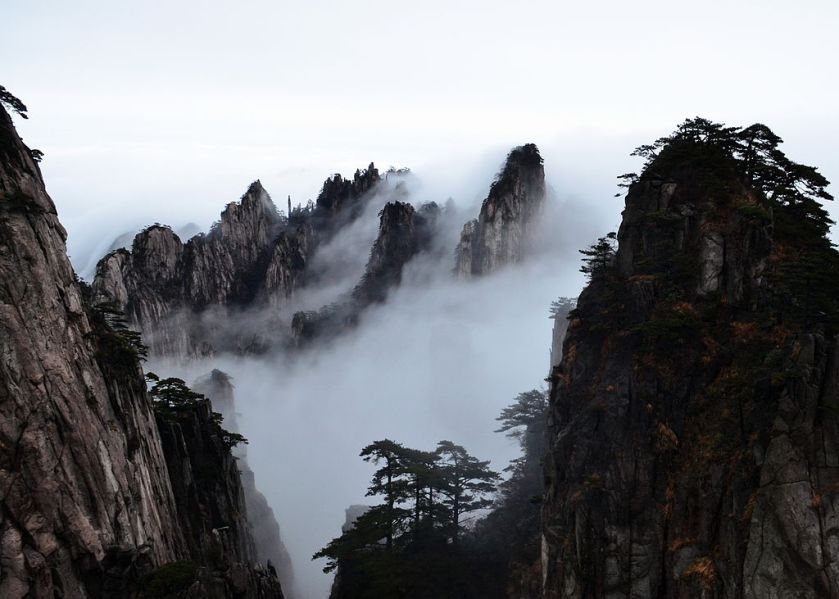
the yellow mountains颐园新居[CC BY-SA 4.0 (https://creativecommons.org/licenses/by-sa/4.0)%5D, from Wikimedia Commons

Huangshan is a range of mountains located in the southern part of Anhui province. Photos like this one illustrate the types of natural features that greet those who find their way here. Sunrises, sunsets, peaks, crags, promontories into seas of clouds, pine trees and natural springs abound. Huang Shan is latticed with trails and steps. On these paths, one finds hikers, and artists, painters, and poets. After one visits Huang Shan, the landscapes on the scrolls that formerly appeared magical, finally make sense. They’re real.

More than a thousand years ago, there was a poet and a painter by the name of Wang Wei (維 Wáng Wéi).  Although Wang Wei is acclaimed as one of the great painters of the Tang Dynasty, none of his original paintings have survived. His poetry, however, continues to live.

In 1980, Fred Fang-Yu Wang (王方宇 Wáng Fāngyǔ), a professor of Chinese at both Yale and Seton Hall Universities, published a a book of his own calligraphy called “Walking to Where the River Ends”,  where he connected his calligraphy to the poetry of Wang Wei.  Although nowhere in this volume is Huangshan mentioned, I can’t help but connect Wang Fangyu’s calligraphy and Wang Wei’s poetry to this amazing range of mountains. Wang Fang-Yu starts off the book with a poem by Su Shih (軾 Sū Shì), an eleventh  century poet who wrote of Wang Wei, “in every poem, there is a painting. In every painting, there is a poem.” (Wang, Fred Fang-Yu. Walking to Where the River Ends. Compiled by Suzanne Graham Storer and Mary De G. White, Hamden, Archon Books, 1980.)

In his book, not only does the author introduce us to the poetry of a beloved Chinese poet, but he opens doors to appreciating Chinese calligraphy through his own calligrahic interpretations. In the index, he then gives both figurative and literal interpretations in English which encourage the reader to conjure up their own images and wonder how they might create a poem in English which would begin to do justice to the images created by the Chinese characters. Here’s an example from the poem used as the title for this book. The English words were the literal translations provided by Professor Wang.  Mary de G. White then took Professor Wang’s literal translation and created a poem which works in English:

Walking to Where the River Ends     (行到水窮處)

 行到水窮處,(walk, to, water, end, place)

xíng dào shuǐ qióng chǔ,

坐看雲起時(sit, watch, clouds, end, time)

zuò kàn yún qǐ shí。

偶然林叟 (accidentally, meet, forest, old man)

ǒu rán zhí lín sǒu ,

談笑無還期 (chat, laugh, have not, return, time)

tán xiào wú huán qī

Walking to Where the River Ends  by Wang Wei

“Walking to where the river ends

I sat and watched the clouds rise

By chance I met an old man in the forest

We talked and laughed

and forgot when it was time to go home.”


Chinese Odyssey 34

Trails wove through mountains

Running narrow and steep

hiding treasures which paintings —

and poetry — keep

reminding us how

little time has affected

the clouds and the cliffs

which the pools reflected.


Slow Boat to China

Project China Mark Nicks

Hong Kong is located in the southeastern part of China. It is surrounded by the province of Guangdong. Adjacent to Hong Kong to the northeast is the province of Fujian. Located in the southeastern part of Fujian is the city of Xiamen. The distance from Hong Kong to Xiamen is only about 300 miles, as the crow flies. Fujian is the Chinese province directly across from Taiwan, separated by the Taiwan Strait. Taiwan is about twice the distance from Fujian as Cuba is from the state of Florida. Today, if we want to travel from Hong Kong to Xiamen, we can choose to take a 40 minute flight or a 5 hour high speed train.

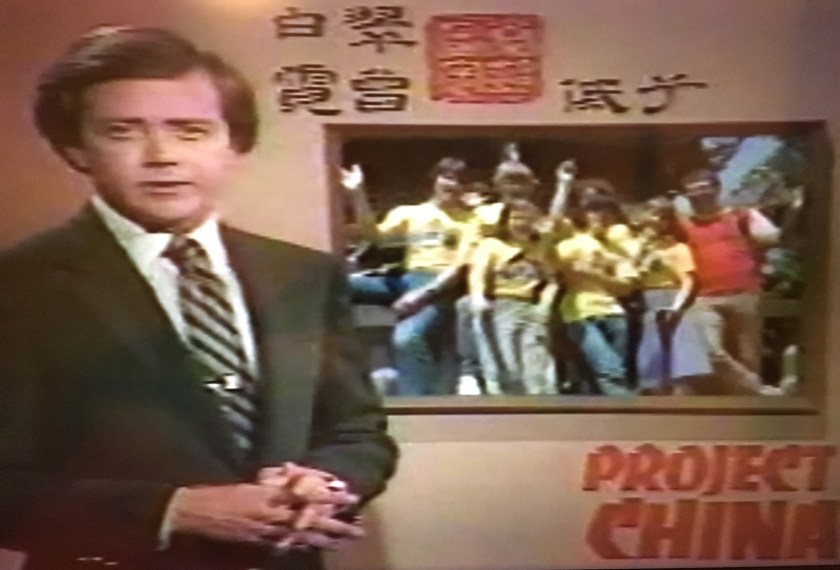
In June 1981, our only travel option was the Jimei passenger ship, the proverbial slow boat to China. From Hong Kong to Xiamen would take us 22 hours plus some change. Our six Tulsa high schoolers joined a rather odd assortment of 20+ individuals from all over the USA. Our kids were the youngest of the bunch. At 80 plus, Abe Gurvitz, a dentist from Boston shared the senior mantle with Frankie Wu from Prairie City, Kansas. We also had a smattering of missionaries, college students, and recent graduates along for the adventure. Accompanying us all was a news crew from Tulsa’s KJRH TV station. Reporter, Mark Nicks and cinematographer, John Ross were never far from our sides.

In earlier posts, we established that names for people, places, and things Chinese often have very different names, depending on their context.  China is called Zhongguo in Chinese; Taiwan is also known as Formosa; Hong Kong is Xianggang in Mandarin (aka Putonghua); Macau is known by most Chinese as Aomen; Canton can refer to either the province of Guangdong or city of Guangzhou; Kongzi is the Chinese way of saying Confucius; Zheng Chenggong is what most Chinese call Koxinga; just to name a few. In today’s post, there are some really different names. Xiamen is still called Amoy by many and Quemoy is most often referred to as Jinmen (or sometimes Kinmen.) Both Amoy and Quemoy are names which sound closer to the names used by local inhabitants in their dialects.

Just before arriving in Xiamen, we passed by the island of Quemoy (Jinmen) which sits less than 2 miles off the coast of mainland China, where we were awed by a Taiwan (ROC) flag the size of a football field waving in the breeze (much to the chagrin of the PRC I’m sure.) Just a few years earlier, Quemoy and Amoy had traded progaganda laden missiles every other day. Landmines were strewn along the beaches to stop an invasion from the mainland. The island is latticed with tunnels. Nearly 100,000 KMT troops were stationed in Quemoy during the Cold War with over 500,000 missiles lobbed in 1958 alone. Intermittent shelling went on until 1978, just three years prior to our arrival. When we lived in Taiwan, I used to hear stories of Taiwanese soldiers swimming over to Xiamen on a dare to watch a movie in a local theatre and come back with a movie ticket stub. Friends of ours who served in the Taiwan military told us that was crazy. Still, it makes for a good story and I can’t help but wonder.

At the time we arrived, Xiamen had only been opened to foreigners for one year. The only other non-Chinese we saw there were an American teaching couple who had been living in Xiamen for 8 months. Our food was very local. Much of the produce was grown on campus. Fruits and vegetables were smallish and very unlike the perfectly shaped and equally sized produce that we were used to in American supermarkets. The good stuff got shipped to Hong Kong where it commanded a much higher price. Even Coca-Cola had yet to reach these hinterlands. It was water, tea, a sickly sweet orange soda, or . . . local beer. I had met with parents before leaving and had told them that beer was not illegal for their kids to consume in Xiamen and it might be safer and healthier than some of the other alternatives. Some parents signed off on that, so beer began to be served with our evening meal.

Today, things are a little different. Anyone can board a plane in Taiwan and fly to Jinmen. It’s even easier in China. In  Xiamen, there is an hourly “Cross-Strait Ferry” from Xiamen to Jinmen which takes about one-half hour. You can only buy one-way tickets because tickets in Xiamen are sold in ¥RMB (Renminbi) and tickets sold in Jinmen are in $NT (new Taiwan dollars.)

Chinese Odyssey 27

Accompanying us

was a Tulsa news crew;

Oklahoma to Xiamen

turned into a coup.

On a boat called the Jimei —

Hong Kong to Amoy —

passed flags of two Chinas,

drank milk made of soy.

Learning Chinese in America

Dodge Foundation 1984

You can take the cowboy out of China, but you can’t take China out of the cowboy. In Spring, 1979, I needed to go back to Oklahoma. My sister’s kidneys were failing from Type 1 diabetes. She needed a kidney transplant. After prelimary tests at Taipei’s Veteran’s Hospital 臺北榮民總醫院,  Táiběi Róngmín Zǒngyīyuàn, and a follow up consultation with the head of the Nephrology department at UCLA, I was good to go. No kidneying.

Everything worked out well. During my recuperation, I received a note from H.J. Green, the Principal of Booker T. Washington High School, in Tulsa. BTW was a magnet school located in the heart of north Tulsa. Even before it became an official “magnet” for the Tulsa Public Schools, Booker T. had been a magnet for Tulsa’s Black community. When it opened its doors to students from all over Tulsa, to purposely promote racial integration, it did so with the promise of combining a stellar athletic program with an academic curriculum which was second to none. We were home to Tulsa’s 1stever International Bacculaureate program and students from all over Tulsa wanted in. HJ Green was a visionary and he really wanted a Chinese language program at Booker T. Even after I confessed that I had never taught Chinese before, HJ was willing to give me a try.

Before the 1980’s, there weren’t a lot of Chinese Language programs in the USA. Two of the early intensive programs were the Defense Language Institute Foreign Language Center at the Presidio in Monterey, California, and the LDS Missionary Training Center in Utah, but they both had pretty specific agendas and clientele. Universities like Harvard, Stanford, and Yale had developed Chinese language programs in the US, and also had well established programs in China, Taiwan, and Hong Kong. But all of these programs were for adults who had graduated from high school.

The earliest initiative in secondary school education that I’m aware of in the US was from the Carnegie Foundation in the early 1960’s. There were 230 high schools involved. But by the end of the 1960’s, when the funding stopped, so did most of the programs. By the 1980’s few of the programs which had been seeded by the Carnegie Foundation were still in existence. The second wave came with the Geraldine R. Dodge Foundation. From 1982, the Dodge foundation helped start and fund 60 high school programs in the US.

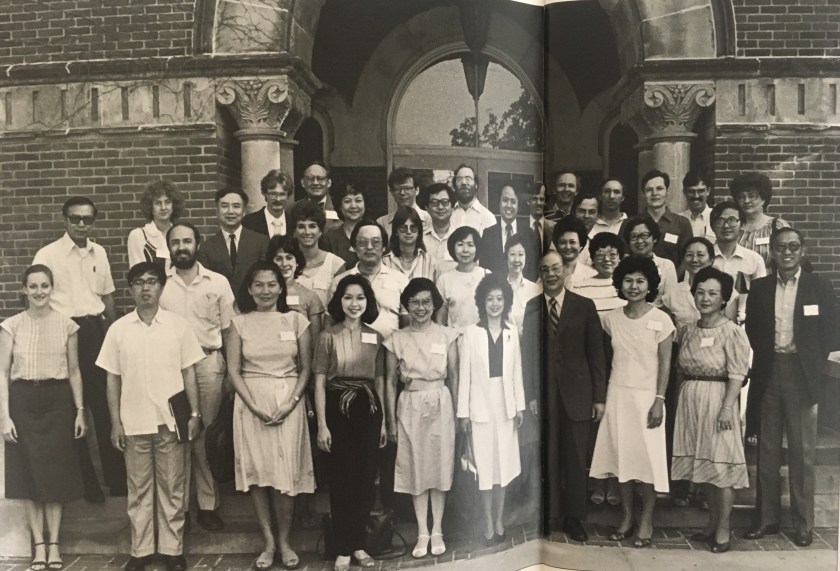
In 1982, I was at the right place at the right time. In Tulsa, Nancy McDonald wrote a grant proposal to the Geraldine R. Dodge Foundation and Timothy Light from Ohio State University was sent to check us out. I was fortunate to meet and to learn from amazing people like Dr. Light, T.T. Ch’en and Zhou Zhi Ping from Princeton, Perry Link from UCLA, Ron Walton from the University of Maryland, and John Berninghausen from Middlebury College. Nearly every summer in the 1980’s, secondary school Chinese language teachers from all over America met and helped one another become better teachers of Chinese. One summer 20 of us converged at the Beijing Language and Culture University (at that time called 北京语言学院 Běijīng Yǔyán Xuéyuàn) to learn together with 20 Chinese language teachers from all over China.

Chinese Odyssey 21

So I boarded the plane

and headed due west.

I had more great teachers.

My Chinese progressed

Then one day while watching

my clothes tumble dry

a voice called out softly

“Get ready to fly.”


Character Confusions and other Stumbling Blocks

IMG_1628

Reading and writing Chinese is difficult. The US based Foreign Service Institute classifies Chinese as a Category 5 language (along with Arabic, Japanese, and Korean) for speakers of English. French and Spanish are classified as Category 1 because of the large number of cognates they share with English. There is very little that is intuitive about learning Chinese for a person growing up outside of a Chinese language environment. There is no phonetic alphabet which helps readers and writers of many languages to “sound out” words and spell them phonetically. Of course, Chinese parents and siblings read children’s books to children so kids learn to recognize characters before they learn to write them. And when they do start learning to write characters, close attention is paid to how they hold the writing instrument and how to write each stroke. Even though it is labor intensive work that requires a huge investment of time and effort, the 2018 CIA Factbook claims a literacy rate in Taiwan of 98.5%; in mainland China, 96.4%.

That said, few people educated outside of a Chinese education system have ever become truly literate in Chinese. The number of people who have studied and are studying Chinese outside of China has grown by leaps and bounds, yet the number of people who can pick up a Chinese newspaper, magazine, or book and easily read them is still relatively small, and of that number, those who can write and publish in Chinese is miniscule.

With all that in mind, here are some “organic” lessons I stumbled upon during my own journey.

Single character confusions

  • Car license plates – During my travels in Guangdong, I grew curious when I saw the character 粵 Yuè at the beginning of every license plate. I was told that 粵 Yuè was an abbreviation for Guangdong. It came from the historical kingdom of Yue of which Guangdong was a part; The character 京 Jīng on license plates in Beijing made more sense since I knew that 京 Jīng meant capital and Beijing is the capital of China; 闽  Mǐn for the province of Fujian also confused me. I knew that Taiwanese was also called the Minnan dialect. The word Min comes from the Min river in northern Fujian and is an abbreviation for Fujian.
  • Numbers – The numbers 1-10 are some of the easiest characters to learn in Chinese. Because they’re so easy, when writing a check and in other financial transactions, numbers are easy to alter. To address this, there is another way of writing numbers. A zero in Chinese is often written like this, “0”. The word for zero and the character used in finance, however, is 零 líng. The number one requires only a single stroke 一 yī. The number one used in finance, however looks like this, 壹y ī; two (二èr) becomes 贰 èr, five (五wǔ) becomes 伍, ten (十shí) becomes 拾, etc.
  • Others – I used to get really confused when I went to the market and saw a sign saying 7折 (qī zhé). In the market place, Chinese often use Arabic numerals for convenience sake. It turns out that the character 折 (zhé) means “discount”. But 7 折 doesn’t mean 7% or 70% off. It means 30% off or 70% of the original cost.

Abbreviating names of institutions – In the same way Americans refer to Oklahoma University as OU and Brits refer to Manchester United as Man Utd, China has similar abbreviations.

  • National Taiwan University (Táiwān Dàxué 台灣大學) →台大 Tái Dà
  • Communist Party of China (Zhōngguó Gòngchǎndǎng 中國共產黨) → 中共 Zhōng Gòng
  • One Belt One Road 一带一路 refers to the Silk Road Economic Belt and 21st Century’s Oceanic Silk Road (丝绸之路经济带和21世纪海上丝绸之路)。The 带 (belt) refers to multiple “Silk” roads and the 路 (road) refers to the oceanic trade route .
  • Chinese-American 中美 Zhōng Měi, as in Chinese American friendship 中美友谊Zhōng Měi yǒuyì and Chinese American relations 中美关系 Zhōng Měi guānxì

Up down, right left, and left right – In the old days Chinese sentences and phrases were always written from top to bottom and from right to left. Books in Chinese seemed to be read “from back to front”. It wasn’t until the mid-20thcentury that writing horizontally started appearing on the scene in China. A big part of the reason for doing this had to do with making the learning of Chinese easier. If Pinyin is included in the text, it is much easier to input words horizontally than vertically. Today, it is still common to see Chinese phrases and sentences written both vertically and horizontally. What can be confusing to the newcomer is when a horizontal sentence or phrase is written from right to left. Occasionally there are signs where both right to left and left to right are used. Then, one has to rely on context.

Fonts and styles– There have always been different styles of writing in Chinese. The style of Chinese writing beginners start with could be compared to printing letters in English. Although we don’t think of it now, most of us learned how to hold a pencil and the correct order for writing our letters. After printing, came cursive, and after cursive came calligraphy. There are probably at least as many fonts and styles of written Chinese as there are of written English. To illustrate this, I used to write “The United States of America” on the white board as fast as I could and purposely tried to make it illegible. Although I made it so hurried that not one letter could be distinguished, invariably a student would see “The United States of America”. In some of the most beautiful calligraphy in Chinese, individual strokes are impossible to pick out, but due to the rules of stroke order, it is obvious what the character is.

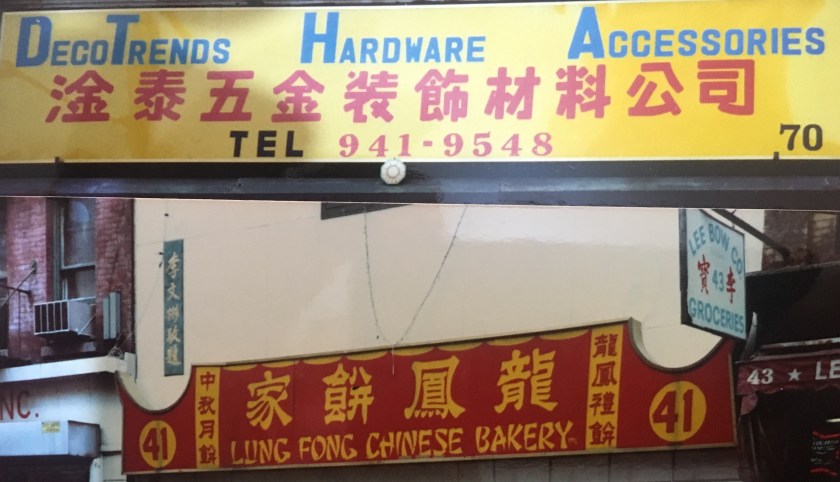
Cantonese expressions– When I first arrived in Hong Kong, I thought picking up Cantonese would be a breeze. Not so. I have all sorts of excuses. More tones. Too colloquial. No standard form of Romanization. Characters like 冇 (meaning “not have”) don’t even exist in Mandarin. Nor do expressions like the word for store, si6 do1 (士多) and taxi – dīk-síh (的士) which are transliterations from English. Still, I think my basic flaw was laziness. So many people spoke English when I arrived in Hong Kong that I wasn’t forced to learn Cantonese. Now, more people in Hong Kong speak Mandarin than English, so that has become my goto language. Still, I don’t see Cantonese on its way out. It is an incredibly rich dialect of Chinese with a long history. Many scholars say that Tang Dynasty poetry read in Cantonese is much closer to what the poems sounded like when they were written. Then, there’s Canto-pop!

Chinese Odyssey 14

Street signs were my textbooks,

bus stops, bills, and menus;

quizzes and tests

were all about venues.

Thrown into the water

I’d learned how to swim

and the jar with the map

was a memory dim.


Let’s Get Radical

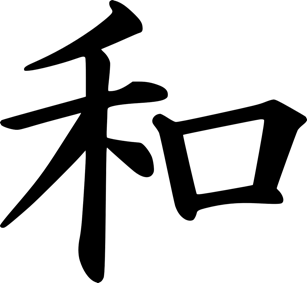
He Peace

Many years ago, when I was still teaching Chinese in Tulsa, I mentioned to Cristy that half way through the year, some of my kids were still having problems with radicals. She then asked me, “What are you talking about?” (Cristy had studied Chinese with me at Fu Jen Catholic University in Taiwan). Said I, “You know, Chinese radicals.” To which Cristy responded, “I really don’t have any idea what you mean.” I then tried explaining by example. “You remember the ‘tree’ radical, the ‘word’ radical, the ‘hand’ radical and the ‘three drops of water’ radical.” Cristy really was clueless.

When I then showed her several characters that had the “water” radical, the “tree” radical, the “word” radical, and the “hand” radical, Cristy said, “I never learned about radicals. They would have really helped me remember characters.”

The Chinese word for “radical” is “部首 bùshǒu”. In traditional Chinese, there are 214 radicals. Radicals are components or parts of characters. Sometimes radicals ARE also “stand alone” characters, and the character form is often different from it’s radical form.

Here are some examples of Chinese pictographs (characters which were originally pictures of what they represent) which also function as radicals. All of these characters remain the same in both their simplified and traditional forms:

  • The character for “female” is 女 nǚ. It is an ancient pictograph representing a woman kneeling.
  • The character for “tree” or “wood” is 木 mù. One can easily see how this pictograph represents a tree.
  • The character for “mouth” or “opening” is 口 kǒu. Again, an obvious picture.

A few Chinese pictographs changed the way they were written when Chinese characters were simplified in the mid-20thcentury. The traditional character for “horse” is 馬 mǎ. The simplified form is 马 mǎ. In traditional characters, 馬 mǎ retains its full form when it acts as a radical; in simplified characters, it also retains its simplified form as a radical. (e.g. mom = mā 媽, 妈)·  The character for “gate or door” is 門 mén. The simplified form is 门 mén. In traditional characters, it retains its traditional form as a radical; in simplified characters, it also retains its simplified form as a radical. (e.g. to ask – wèn 問, 问) Many characters change their forms when they go from being a character to being a radical.

  • The character for “hand” is 手 shǒu in both traditional and simplified forms.  When hand is used as a radical, it looks like 扌in both traditional and simplified forms.
  • The character for “person” is 人 rén. When “person” is used as a radical, it looks like 亻in both traditional and simplified forms.
  • The character for the word, “word” in both simplified and traditional charactersis 言 yán. More often it is written like this 言. The radical form of the word, “word” in traditional form is exactly the same as the character. However in it’s simplified form, it looks like this .

So, why should you be curious about radicals? The short answer is that knowing radicals makes learning to recognize, remember, and write Chinese characters easier. If, when you see the word for “trust” 信 xìn, you can see it as two radicals, instead of 9 strokes, it becomes easier to remember. It’s easier to decipher the word for “thank” 謝xiè if you recognize three radicals than it is to break it into 17 strokes. It’s a little like remembering a word in syllables instead of by its spelling. I’ll never forget Kurt Vonnegut’s wonderful made up word from “The Sirens of Titan”.  When I tried to spell “Chrono-Synclastic Infundibulum”, I blew it. But since I could remember how to say the word, it was easy to Google and find the correct spelling. In Chinese, if you can remember the main radical, that can help you find the character. After you learn the proper stroke order for writing down radicals, it will make it easier for you to jot down characters that arouse your curiousity.

 Here are 20 common radicals to look for where ever you see written Chinese.

  1. = knife
  2. = water
  3. = earth
  4. = son
  5. = roof
  6. or = heart
  7. = spear
  8. = sun or day
  9. = moon or month
  10. = fire
  11. = bamboo
  12.   or 絲 = silk
  13. = grass
  14. = clothing
  15. = foot
  16. = walk 
  17. = rain
  18. or = eat
  19. or 魚 = fish
  20. or龍 = dragon    

Chinese Odyssey 12

I discovered one symbol’s

not always a word,

that having no alphabet

wasn’t absurd.

Every stroke of the brush

was placed with precision.

Each line, dot, and hook

was there for a reason.


Speaking Chinese – its all in the tone

MVC-002S_3_JPG (2) copy

When I Googled “National language of China”, I got “standard Chinese”, “Mandarin”, and “Putonghua”. Putonghua is what Chinese in China call the standard spoken dialect of Chinese. Putonghua actually means, “the common language”.

There is no alphabet in written Chinese. There are, however, phonetic “alphabets” which have been created to help people pronounce Chinese correctly. That is one of the reasons why you see so many different spellings for names in Chinese history and literature. The most common phonetic alphabet today is called Pinyin (Lit. “spell sound”).

In Pinyin there are 21 initial sounds and 37 final sounds. An “initial sound is a consonant or a combination of consonants” at the beginning of most syllables. Some syllables don’t start with a consonant sound so those words have no initials. “Finals” are the end sounds of syllables. They are composed of either vowels, combinations of vowels, or vowels ending with a consonant or consonants. In the word “tang”, “t” would be the initial and “ang” would be the final. Most of the sounds are pretty easy to pronounce, but a few need a fair amount of practice to get right.

The hardest part in learning to speak Chinese, however,  has got to be the “tones”.  Tones are the way you change the pitch of your voice to alter the word you are saying. We do this in English sometimes to show emphasis. If I told Cristy I was planning to bring Xi Jin Ping home for dinner tonight, she would probably say the word “who” in the equivalent of a second tone in Chinese. In English, a “2ndtone”  indicates surprise or disbelief.  If I asked her if she wanted to eat dog tonight, she would probably answer with an emphatic “no” which is similar to a 4thtone in Chinese; a “4thtone in English” often suggests anger.  In Mandarin Chinese, tones are not used like this.

Every Chinese syllable has a tone.  Most syllables can be pronounced in a variety of tones, In Chinese, there are lots of homynyms. Many people know that in Mandarin, there are 4 tones. In Cantonese, there is a saying, “9 sounds, 6 tones”  ( gau2 seng1 luk6 diu6 九聲六調) which is used to explain sounds in Cantonese. Since I don’t speak Cantonese, however, I’ll fall back on the 4 tones of Mandarin.

Although there are 4 basic tones, there are also half 3rd tones, half 4th tones, and neutral tones. Not to mention tones which change (for a variety of reasons). After teaching Chinese for more than 20 years, I came to believe that the best way to learn tones is not through memorization, but rather through mimicry. It’s great if you can find a native speaker of Mandarin with standard pronunciation who you can attempt to mimic. It’s even better if they will agree to correct your pronunciation and your tones until you get it right.

Using the wrong tone can totally change the meaning of what you are attempting to say.  If, for example, I see you after being away from you during the summer and notice that you’ve been working out and are looking healthy and strong, I might say to you, “Wow, you’re looking fit.” You would probably smile and say “thanks.” If on the other hand, I misspoke and instead of saying “fit”, I said “fat”. (“Wow, you’re looking fat.”), you would probably be upset. All I did was miss one vowel. A missed tone on a Chinese word can mean the difference between a “mother” (mā) and “horse” (mǎ).

Try repeating this with a Putonghua speaker:

ma,      (Mom rides a horse)

mǎ, màn   (The horse is slow)

ma,     (Mom curses the horse)  (mom 媽 Mā)   (horse 馬 Mǎ)

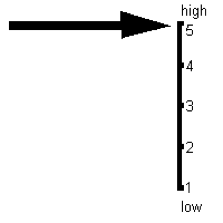
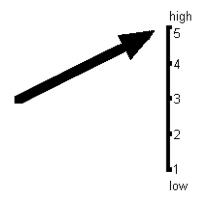
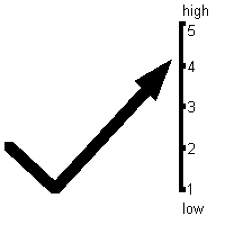
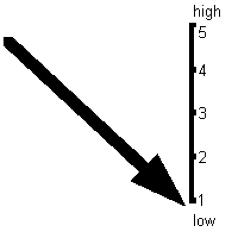
Finding your own range: Try singing and sustaining the syllable “ma” on as low a musical note as you can sing it. We will call that the lowest point on your range and will label that level 1. Now take the same syllable and speak and sustain it this time at your highest comfortable range.   We will call the highest point on your voice range level 5. Your normal level of speech would be level 3.

1st tone

The 1sttone begins at level and ends at level 5. Try saying ma and tang,  in first tone.

The  1sttone is indicated by a level line over a vowel (usually first vowel)  ( ― )

2nd Tone

The 2nd tone begins at level and ends at level 5. Say ma and tang in second tone.

The  2nd tone is indicated by an ascending line (bottom left to top right) over a vowel ( / )

3rd Tone

The 3rd tone begins at level 2, goes down to level and ends at level 4. Say ma and tang in the third tone. The  3rd tone is indicated by a over a vowel (usually first vowel)   ( )

4th Tone

The 4th tone begins at level and ends at level 1. Say ma and tang in fourth tone.

The  4th tone is indicated by a descending line (top left to bottom right) over a vowel  ( )

I once went into a restaurant in Taiwan in the winter time hoping for a bowl of hot soup. I asked the waitress, “Ni you mei you tang?” (Do you have soup?) She replied, “Women zheli mei you tang. (No we do not have candy here.) I pointed to the menu, and and proudly said “Zhe shi bu shi tang?” (Isn’t this soup?). She laughed and said, “You didn’t say Tāng (soup), you said Táng (candy). We don’t sell candy at our restaurant.”

Chinese Odyssey 11

So where were the rickshaws?

There were taxis and busses.

Clothes looked just like mine

There were no thems or us’s.

I learned 1,2,3,4

now as “yi, er, san, si”

And those things I called “chopsticks”

were really “kuaizi.”


Character Development

800px-Stamp_China_Stalin_Mao_1950_800
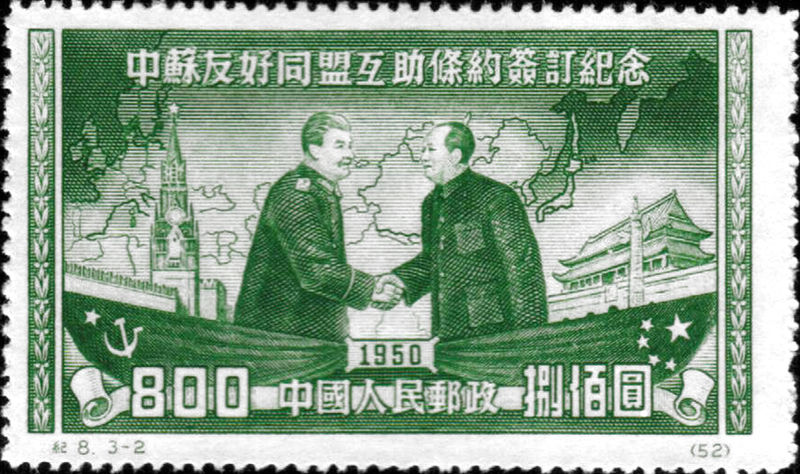
By Post of the People’s Republic of China [Public domain], from Wikimedia Commons
There are no letters in Chinese characters. With languages like English, letters help us sound words out. Even if we don’t know what a word means in English, we can usually make a pretty good guess as to how it should be pronounced. Chinese words don’t usually have components that tell you how the word is pronounced. Sometimes there are parts of characters that give you a hint as to how a character might be pronounced, but not always. Depending on the Chinese dialect, the same character can be pronounced in very different ways depending on the dialect. Some characters can even be pronounced in different ways in the same dialect depending on how the character is being used.

For over 2000 years, people all over China wrote Chinese characters in the same way. There were different styles, of course, sort of like different character fonts in English.  Even if you couldn’t speak the same Chinese dialect with someone, at least you could write notes. In the first two decades after the founding of the People’s Republic of China in 1949, the Chinese government decided to simplify many of the characters to make the Chinese language more accessible to the masses.

Every Chinese character occupies the same amount of space when characters are used together. Whether a chinese character has one stroke like the number one(一)or 17 strokes like the traditional character for dragon(龍), it occupies the same sized imaginary square. Even though each character represents only one sound syllable, sometimes “words” in Chinese are made of two or more characters. The word for “almost” (chàbuduō) 差不多 is made of of the three separate characters. When writing a sentence in Chinese, there is no spacing between words, only between characters.

Traditionally, Chinese was written vertically, from up to down and from right to left and there were no punctuation marks. Today, much of written Chinese is written horizontally from left to right. Western style punctuation is also very commonly used.

Chinese characters are made up of strokes. There are 6 basic strokes:

Héng (橫) –horizontal line

Shù, (竪) – vertical line

Diǎn (點/点) –a dot; sometimes a dab

Tí (提) – a rising stroke from bottom left to top right

Piě (撇) – slanted line from top right to bottom left

Nà (捺) – slanted line from top left to bottom right

There are also many modifications and combinations of basic strokes and there are rules for the order of writing strokes. Here are 3 common examples:

Horiontal trokes are always written from left to right

Vertical strokes are always written from top to bottom

Horizontal strokes are written before vertical strokes

Chinese Odyssey 3

Yet I knew right away

that the note was for me

It made perfect sense

with no A, B, or C

It said, “You’ll never find me

by digging through ground

The only way here is

straight up and around”