The Long March

Chinese Odyssey 71

On a bridge near Shi Gu

was a plaque on an arch —

told how red army soldiers

crossed here in their march.

A six thousand mile trek

lead by Zhu, Zhou, and Mao

through the heartland of China

such contrast to now.

Long March BridgeOn a

In the 1920’s the Chinese government was in turmoil. For a short period of time in 1924, the KMT aka the Nationalists  (國民黨 Guómíndǎng) and the CCP ( 中国共产党 Zhōnɡɡuó ɡònɡchǎndǎnɡ – the Chinese Communist Party) closed ranks in an attempt to rid China of the warlords. Together, they formed the KMT-CPC Alliance (聯俄容共 Lián É Róng Gòng) a.k.a. the “First United Front”, and they created the National Revolutionary Army.

But this was not what the leader of the KMT, Generalissimo Chiang Kai-shek ( Jiǎng Jiè shí), had in mind. He decided to end this alliance by purging all communists from the ranks starting with the 1926 Canton Coup (中山事件 Zhōng shān jiàn shì jiàn). On April 12, 1927 Chiang then ordered the Shanghai Massacre (四一二反革命政變 sì yī èr fǎn gé mìng zhèng biàn).  The Generalissimo ordered his troops to purge all Communists from the ranks of the KMT. With the help of Big Eared Tu (杜月生 Dù Yuèshēng), leader of the Green Gang (青幫 Qīng Bāng), a ‘criminal organization and secret society’,  1000 Communists were arrested, 300 were executed and 5,000+ “went missing.” In the “White Terror” that followed, more than 10,000 Communists in Changsha, Hangzhou, Ningbo, Nanjing, Guangzhou, and Xiamen were executed. This series of events were the spark that ignited the Chinese civil war between the Communists and the KMT. It was a war that never officially ended. To this day, no peace treaty or armistice between these two warring parties has ever been signed.

In 1931, the Chinese Soviet Republic (中華蘇維埃共和國 Zhōnghuá Sūwéi’āi Gònghéguó) a.k.a. “the Jiangxi Soviet” was established by Mao Zedong, Zhu De, and others in the city of Ruijing (瑞金), in Jiangxi (江西省 (Jiāngxī Shěng), a land-locked province north of Guangdong and west of Fujian. It was sort of a country within a country. Máo Zédōng was elected as Chairman. Zhū Dé was his second in command. Deng Xiaoping and Zhou En Lai also joined Mao in Ruijin. Mao, Zhu, and Zhou enjoyed a long and complementary relationships throughout the revolution.

By 1934, Chiang Kai-shek’s five “Encirclement Campaigns” planned on dealing the death blow to the Communists in Ruijin, but spies informed the Communists, and Zhou En Lai (周恩来 Zhōu Ēnlái) came up with a plan. In the late afternoon of October 16, 1934, amidst a confusion caused by a strong rear guard, the main body of 84,000 soldiers of the Red Army under the command of Bó Gǔ (博古) and German Communist Otto Braun (Chinese name 李德 Lǐ Dé) began its strategic retreat from Jiangxi. Several thousand troops stayed behind to serve as the rear guard for the retreating forces. Among them, 29 year old Máo Zétán (毛泽覃), younger brother of Mao Ze Dong, was executed by the KMT. Chiang’s annihilation campaigns had taken their toll on the communists, and they decided that their only play was to abandon their southern bases and regroup in Shaanxi, Gansu, and Ningxia in northern China.

Author, Sun Shu Yun, started her book “The Long March” by saying, “Every nation has its founding myth. For communist China, it is the Long March, . . .” (红军长征 Hóngjūn Chángzhēng.)  The Long March is truly an amazing story of perseverance, commitment, and resilience replete with stories of heroism, self-sacrifice, and suffering which has been told to generations of Chinese children.

Mao, himself, was in terrible shape from a bad bout of malaria and had to be carried on a litter by two soldiers at the beginning of the Long March. A very pregnant, He Zizhen (贺子珍), Mao’s 3rd wife, accompanied him. The child she bore during those early days of the Long March was given away to a family in Fujian. He Zizhen was one of only about 35 women who started out on the Long March.

For a guerrilla army, the Red Army, was way too laden with “stuff.” Besides printing presses and an x-ray machine that required 20 people to carry, this retreating military carried a library of books and documents, food, weapons, ammunition, and gold so they could pay their way.

New recruits were expected to always abide by the 8 primary rules:

1) Speak politely and help people whenever you can;

2) Return doors and straw matting to their owners [doors were used as beds];

3) Pay for any damage caused;

4) Pay a fair price for all goods;

5) Be sanitary; build a latrine away from houses;

6) Don’t take liberties with the women;

7) Don’t ill-treat prisoners;

8) Don’t damage the crops.

Bo, Braun, and Zhou took their retreat south and then due west, where the crossing of the Xiang River (湘江 Xiānɡ Jiānɡ) in Hunan proved to be a major obstacle. The Red Army lost over half of its forces by January of 1935 –  many due to the fighting, but probably just as many to desertion. The original 84,000 soldiers were soon whittled down to around 30,000.

In late January, in the province of Guizhou, there was a famous meeting of the Chinese Communist Party called the Zunyi Conference (遵义会议 Zūnyì huìyì.) Those in attendance were definitely among the Who’s who of the early Chinese communists including Mao Zedong, Zhou Enlai, Liu Shaoqi, Zhu De, Lin Biao, and Deng Xiao Ping. It was as a result of this meeting at Zunyi that Mao Zedong soon after emerged as the unequivocal leader of the Chinese Communist Revolution.

From Zunyi, Mao and the Red Army took a surprising turn south and crossed the Jīnshājiāng (金沙江), an upstream branch of the Yangtze River in Yunnan in May of 1935, much to the surprise of Chiang Kai-shek. Mao’s capture of the Luding suspension bridge over the Dadu River on the border of Tibet is legendary, although Deng Xiaoping once told Zbigniew Brzezinski, former National Security Advisor to President Carter, that  capturing the bridge at Dadu was really no big deal, but it did make for some great propaganda.

From Dadu, Mao lead the Red Army through the “Snowy Mountains” (Yùlóng Xuěshān 玉龙雪山), in Yunnan in early June of 1935.  His troops struggled and many died as a result of the thin air, exposure, and frostbite while crossing  a snowy pass of about 14,000 feet with heavy packs. The Snowy Mountains were just the first of several mountain passes the Red Army troops traversed. These mountains were followed by the Zoigê Marsh (湿  Ruòěrgài Shī) “Great Morass”, a 10,000 foot high swampy plateau in northern Sichuan where it rained every day. This wet grassland proved incredibly difficult to navigate and thousands of troops were lost.

Long Marcha poem written by Mao Zedong October 1935

Red Army unafraid of the journey

Torrents of water, jagged mountains abound

Five ridges flow like rippling water

Wu Meng mountains roll, mounds of clay

Jinsha water sprays cloud cliffs,

Freezing cables of Dadu Bridge

Thousand li snow in Minshan,

Faces of the three armies illuminate

红军不怕远征难

万水千山只等闲。

五岭逶迤腾细浪,

乌蒙磅礴走泥丸。

金沙水拍云崖暖,

大渡桥横铁索寒。

更喜岷山千里雪,.

三军过后尽开颜

Local people in China’s far west were sometimes openly hostile to the Red Army and other times Mao’s army was met with incredible hospitality and open arms. As much as Mao would have wanted, the soldiers did not always abide by the eight primary rules and occasionally had to resort to theft and threats in order to survive.

In October 1935, 8,000 people, about 10% of the original 84,000 marchers arrived in Shaanxi Province. Even though, at its roots, the 6,000 kilometer “L” shaped Long March was a retreat, it was quickly rebranded as a regrouping and reforming against unsurmountable odds. Mao, Zhou, Deng and company were somehow able to transform a retreat into an epic victory over the hearts and minds of the Chinese people.

In his book, Red Star Over China , Edgar Snow added to the story of the Long March. Snow traveled many months with Red Army troops in 1936 and was able to spend ten days almost exclusively with Mao as he narrated his autobiography. Snow used his conversations with Mao and other leaders to write the first detailed account of the Long March from the perspective of a westerner. Through Snow’s account, both Chinese and foreigners alike, began to take a serious look at the Chinese communist movement.


Lijiang and the Naxi

Chinese Odyssey 70

In the old town of Lijiang,

the streets were confusing.

At night on Square Street

we found dancers amusing.

In the middle of town

ran a clear crystal stream

where paper boats carried

our hopes and our dreams.

Screen Shot 2020-04-10 at 9.10.43 AM

The province of Yunnan has it all. Of the 55 recognized minorities in China, 25 of them can be found in Yunnan. The city of Jinghong in southeastern Yunnan makes you wonder if you may be in Burma. The capital, Kunming, located on the banks of Dianchi Lake (滇池 Diānchí) has a climate more like that of San Francisco. The further north one travels from Lijiang into the foothills of the Hengduan Mountains (横断山脉 Héngduàn Shānmài), the more it seems to morph into Tibet.

It was not long after a New York Times article, In China, Rock’s Kingdom by Bruce Chatwin, in 1986, that Lijiang became a ‘must visit’ place for backpackers with their sights on China. A slight segue off of the “Hippie Trail” that already had backpackers camping out in Yangshuo and Dalian, Lijiang had some even cooler draws. First off was the town itself . . . well the old town that is. The old part of Lijiang was a maze. Lanes and alleys broke out in funny angles. There was a crystal clear canal running through the middle of the town where people would float paper boats with wishes. The backpacker hotels were usually two story rustic wooden houses surrounded by small stores selling clothes, curios, tea, ice cream, and other necessities. In the middle of old town is Square Street where dancers, singers, and other performers entertained at night. But that was then, and now is now. Like so many “destination” spots, Lijiang is no longer ‘off the beaten path.’

Forty kilometres due north of Lijiang is the 18,360’ high Jade Dragon Snow Mountain 玉龙雪山 Yùlóng Xuěshān. The Naxi people know it as Mt. Satseto and nearby lived the famed Austrian-American botanist Joseph Rock. I’m sure the area at the base of the mountain looks very different now than it did when Rock was there in the early to mid-20th century. At the foot of Mt. Satseto is a visitor center where stores sell containers of oxygen for the high elevation, and where I bought a fine cup of Hump coffee years ago. From the same building, one can board a cableway to a viewing platform nearly 15,000 feet in elevation.

It was back at the base of Jade Dragon Snow mountain that in 2006, film director Zhang Yimou first presented a spectacular outdoor extravaganza employing more than 500 Naxi, Bai, and Yi people called “Impression Lijiang.” The performance takes its audience along the ancient Tea Horse Road before introducing you to the lives and the cultures of the people who inhabit this amazing region. There are three shows a day (during peak season) packed with singing, dancing, drumming , and story telling all in beautiful local costumes with the majestic Jade Dragon Snow Mountain as the back drop. Perhaps best know for his ground breaking movies such as Red Sorghum (1987), Raise the Red Lantern (1991), and Hero (2002), “Impressions Lijiang” is one of seven live shows that Zhang Yimou has created scattered throughout China.

One shouldn’t leave Lijiang without learning something about the Nakhi or Naxi (纳西族 Nàxī zú) people and culture. Two foreigners who were fascinated with the Naxi and wrote prolifically about them were Joseph Rock and Peter Goullart. Between these two friends, they explored the Naxi language, lives, and beliefs of the Naxi people. The religion of the Naxi is called Dongba (东巴 dōngbā) and is related to the Tibetan Bon religion. The Dongba religion appreciates and celebrates man’s relationship with nature and the spiritual world. The Naxi people have their own music and their own distinct language and literature. Dongba is also the name of the pictographic script that the Naxi developed in the 7th century CE. Joseph Rock actually wrote the first Naxi-English Encyclopedic Dictionary, which is now preserved in Harvard University Library. In addition to his dictionary, Rock wrote 18 journals and books related to the Naxi culture.

Like so many indigenous cultures and languages, both the language and the religion of the Naxi people is fading. The Cultural Revolution from 1966-76 didn’t help things out. Very few young people after that period of time were really interested in preserving the Naxi culture. In 2004, only about 20 Dongba masters were still active and many of them were old.  At that time, almost 80% of the people in the area around Lijiang were Naxi, but only about 30% of the school-aged children there spoke their native language and even fewer could read their hieroglyphs.

In 2017, D.J. Poupard from the University of Hong Kong wrote a postgraduate thesis entitled “Rescued into extinction?: the case of the Naxi texts in translation” Poupard asks the question, “Can translation go beyond the text and rescue a culture?” He suggests that “It may be the case that the uniquely semi-oral nature of the Naxi traditions needs to be re-evaluated and recreated in translation, for the Naxi ritual texts are at once written and oral; they can be read, but not in any fixed form.” But it was the question in the first part of his title is what I found most compelling. Can a language like that of the Naxi be, “Rescued into Extinction?”  https://hub.hku.hk/handle/10722/241397


Joseph Rock and Shangri-la

Chinese Odyssey 69 

There, a ceramic basin

reflected no crowds

just a river, a tiger,

an ocean of clouds.

I saw snow on green jade

and a dragon above

Joseph Rock’s photographs

geographical love.

Amnyi Machen Joseph RockRock, Joseph Francis. “Seeking the Mountains of Mystery.” The National Geographic       Magazine, vol. LVII, no. 2, Feb. 1930, pp. 131-85
“Before leaving for China, he purchased tents, a folding canvas bathtub, aneroid barometers, cameras, guns and ammunitions. Other items essential to his expedition were furs, warm bedding, trunks, photographic supplies, paper made from bamboo for drying specimens, medicines and for transportation mules and, sometimes, yaks. He revealed a distinct preference for such luxuries as canned foods and collapsible bathtubs. Edgar Snow, who traveled with him a time or two, wrote, “During the march, his tribal retainers divided into a vanguard and a rearguard. The advance party, led by a cook, an assistant cook, and a butler would spot a sheltered place with a good view, unfold table and chairs on a leopard-skin rug and lay out a clean linen cloth, silver and napkins. By the time we arrived our meal would be almost ready. At night, it was several courses ending with tea and liqueurs.” Rock kept the same cooks with him on most of his expeditions and even taught them Austrian recipes.” (from: THE STORY OF JOSEPH ROCK by Gwen Bell, Seattle, WA – presentation at the National Rhododendron Convention in Portland, OR).    https://scholar.lib.vt.edu/ejournals/JARS/v37n4/v37n4-bell.htm

I first “met” Joseph Rock in the old copies of National Geographic that my grandparents used to keep in the side table next to the bed where my uncle slept growing up in Missoula, Montana during the 30’s and 40’s. Somehow, they had never been thrown out. To leaf through an old copy of National Geographic was to pretend to be in advertisements for Ethyl gasoline, Chris-Craft boat builders, Great Northern Railroads – The Empire Builders, Chrysler sedans, Campbells Soup, Whitman’s Chocolate, the new World Book Encyclopedia, American Express Travelers Cheques, and to see risqué photographs of scantily clad native people from all over the world. I loved National Geographic and I managed to scavenge one copy of a National Geographic from that night table  which remains with me to this day. I remember laughing at pictures of early 20th century western explorers like Joseph Rock in Asia, Africa, and South America all decked out in their tropical tweeds, starched white shirts, ties, thick woollen knee high stockings with leather garters, and pith helmets.

It may also have been at Black Acre (my grandparent’s home – named after a legal kadigan – a placeholder name – for parcels of real property) that I picked up James Hilton’s Lost Horizon for the first time. To say I was intrigued would have been an understatement! Was Shangri-la real? Since my initial read, I’ve found several stories which support that possibility. The lost kingdom of Shambala has existed in esoteric Tibetan Buddhist doctrines for centuries. In the Nyingma tradition, there existed hidden treasures and teachings which could only be discovered by tertons (people who had the powers or ability to discover terma (religious texts and treasures). There are also hidden places, sometimes expansive called Beyul which serve as refuges to the blessed ones. These holy places are protected by deities who are assigned by Padmasambhava (8th century Guru Rinpoche – considered by some as the “second Buddha”). Beyul are “secret lands” that somehow transcend physical and conceptual boundaries. Even though they may have specific geographic coordinates, that in no way guarantees that you will be able to find them. Their actual locations are hidden and only those who seek them with the proper spiritual keys will be allowed entrance. According to the stories, the physical beauty of these beyuls is stunning. Rivers, valleys, and hills shrouded in clouds and flowers and huge biodiversity are as important as the spiritual quiet which can most easily be described as harmonious and peaceful.

Amnyi Machen aka Amne Machin (阿尼瑪卿山  Ānímǎqīng Shān) is the name of both a mountain range and the highest peak of that range (6,282 m (20,610 ft). It is located in the province of Qinghai in central China.  Getting to Amne Machin was fraught with peril. In nearby Gansu, Labrang was held by  a Moslems.

“My own visit, what from extraordinary hardship and the perils of bandits, was so brief that I could make only limited observations. So as yet, the world knows only from the hearsay of all the Amnyi Machen’s mysterious valleys, its lawless Ngokok tribes, and the queen who was supposed to ride over them.” (from Joseph Rock in the February, 1930 National Geographic article “Seeking the Mountains of Mystery)

“The nearby Hetso  (合作  Hézuò) monastery was plundered and a Living Buddha was slain.” Rock continues.  “One hundred fifty-four Tibetan heads were strung about the walls of the Moslem garrison like a garland of flowers. Heads of young girls and children decorated the posts in front of the barracks.” “Among this carnage,” Rock concludes, “we were forced to give up, for the time being, any hopes of marching on to our difficult goal.”

A year later, he tried again. After spending some time in Labrang in fascinating conversations with the Abbot of Labrang who believed that the Earth was flat and assured Joseph Rock that there were people in the world “with heads of dogs, sheep, and cattle”,  Rock and his mile-long entourage comprised of 60 yaks, 34 mules, “20 armed and mounted men of the nomad Sokwu Arik tribe of Mongol origin”, and American missionary, William Ekvall Simpson who he engaged as a Tibetan interpreter, but whom he came to dislike because he felt that Simpson was too much of a “do-gooder” who “lacked firmness with the natives.” As they travelled, they were constantly under the watch of by robber tribes who were somehow held at bay by his Sokwu Arik protectors.

 They continued “Uphill and down, through canyons and over passes with odd, gurgling names, we pushed our toiling way through an empty world. Not a human being appeared anywhere in that forsaken region.”  As they approached the Gur Zhung Valley, Rock was told “You had better not go, for all the Ngoloks are aroused are awaiting you to rob and perhaps murder you.” Rock persevered.

Until finally “I shouted for joy as I beheld the majestic peaks of one of the grandest mountain ranges of all Asia. . . ”  . . atop the Mokhur Nira (Pass), at an elevation of 12,800 feet.

“With difficulty, I tore myself from that sublime view – a view of the eastern massif of the mountain from west of the Yellow River which no other foreigners had ever had. I remained for some time on that isolated summit, lost in reverie and easily comprehending why the Tibetans should worship these snowy peaks as emblems of purity.

Joseph Rock was an Austrian born American botanist, explorer, author and photographer, who was, quite literally National Geographic’s “man in China” during the 1920’s and 30’s. A product of his times, like so many of the characters I’ve discovered in my Chinese Odyssey, Joseph Rock was unique. While fascinated by so much of what he discovered, I would not consider Joseph Rock to have been a sinophile, but he did love living in China and spoke Chinese fluently. He seemed to have been a very solitary man in many ways, and appeared to milk his journey of explorations and adventure for all it was worth. When I visited the small Joseph Rock museum in 玉湖村 Yù Hú Cūn aka 雪嵩村 Xúe Sōng Cūn in the early 2000’s, I found a two story modest home outside of Lijiang near the town of Bai Sha where Joseph Rock lived for 27 years and where he did much of his writing and botanical research. He was fascinated by the Nakyi aka Naxi 納西族  Nàxī minority people who lived in and around Lijiang. His Nahki-English Dictionary Encylopedia, was both a dictionary of the Dongba script and an encyclopedia of Naxi culture.

For those who are curious to know more about Joseph Rock, check out “in the Footsteps of Joseph Rock” This amazing photo blog by Australian journalist Michael Woodhead has extensive links to both Rock’s photos and his journeys. http://www.josephrock.net/2004/


Chinese Detective Stories

Chinese Odyssey 68

Ate juicy tomatoes

which monkeys all wanted

Monasteries at Emei

Van Gulikly haunted

Slurped Chong Qing hot pot

at Laozao in Cheng Du

The Dandan Mian

made me run to the loo

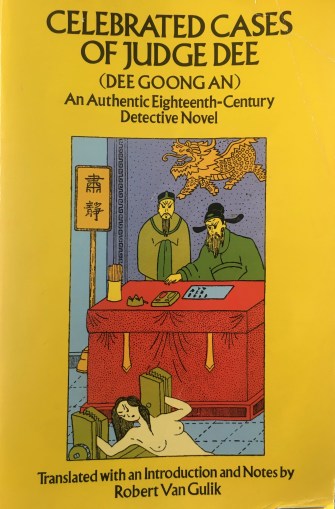
Celebrated Cases of Judge Dee

“He can have anyone arrested, he can put the question to suspects under torture, have recalcitrant witnesses beaten up on the spot, use hearsay evidence, bully a defendant to tell a lie, and then trip him up with relish, . . .” (Gulik, Robert Hans van. Celebrated Cases of Judge Dee = Dee Goong An: an Authentic Eighteenth-Century Chinese Detective Novel. Dover Publications, 1976)

Robert Hans van Gulik (髙羅佩Gāo Luópèi) , Dutch diplomat, correspondent, amateur primatologist, musician, calligrapher, and “Orientalist” will probably be best remembered as a mystery writer. Van Gulik wrote seventeen mysteries about a Tang Dynasty judicial super star by the name of Judge Dee aka 狄公案 Dí Gōng’àn . Fashioned after a real-life judge who lived in the Tang Dynasty during the reign of China’s only female emperor, Wu Zetian (武則天Wǔ Zétiān.) Judge Dee’s real name was Dí Rén jié (607-700), and he was a Tang dynasty prime minister under Empress Wu Zetian.

Born in the Netherlands, van Gulik’s family moved to Jakarta in 1913 when he was only three. His father was a physician and medical officer in the Dutch army corps. At that time, Jakarta was called Batvia and Indonesia went under the name of the Dutch East Indies. It was during his childhood there that van Gulik first began his studies of Chinese, something he continued throughout his life. His university studies focused on East Indian law and culture and he joined the Dutch foreign service in 1935. He served in various capacities in Japan, China, Lebanon, India, and in the USA. While stationed in Chongqing during WW2, he fell in love with and married Shui Shifang and they had four children.

In late 1940’s post-war Japan, while stationed in Tokyo , van Gulik picked up a book called  武則天四大奇案  (Four Great Strange Cases of Empress Wu’s Reign) in a used book store in the back alleys of Tokyo.  This was van Gulik’s first translation. He called it Celebrated Cases of Judge Dee. Since he was living in Japan at the time, his first editions were in Japanese and in Chinese. In 1949, he first self-published 1200 signed English copies.

What’s amazing about the van Gulik books though is the window they provide us to look into a legal system very far removed from ones that most of us are used to. The judge is not only the person who decides the outcome of a case, he also directs the investigations and with the proper mixture of intelligent questioning and irrefutable evidence compels even the most resistant to eventually confess. Torture, beratement, discomfort, humiliation, and even communication with spirits are all legitimate tools for the judge to apply with full compliance of the public. The judge is fully in charge from the initial arraignment through the public executions (of which he has a variety to select from depending on the nature of the crime.)

Starting at a trail near the base of Mt. Emei (峨眉山 Éméi shān), one of the “4 sacred Buddhist mountains” of China, we walked on a trail alongside a crystal clear stream. Bought fresh tomatoes and watermelon slices from local vendors and were surprised by monkeys (actually Tibetan macaques) who demanded their fair share. I wish I could say we walked the “10,000 steps to Heaven” to summit Emei, but I can say that we walked many a step before we arrived at a Buddhist temple (Baoguo Temple报国寺 Bàoguó Sì) which also served as our accommodation for the night. As soon as I set my back pack down in my room, I imagined myself smack in the middle of the Chinese Bell Murders. I was immediately transported to the “Buddhist Temple of Boundless Mercy” and imagined Judge Dee prowling its halls.


American Indians and Chinese

Chinese Odyssey 66

In the Banpo museum

at the edge of Xi’An

There was “Hopi” clayware

and ancient floor plans

In 4000 BC

were the same stories told

in Pueblo kivas and

Shaanxi bungalows?

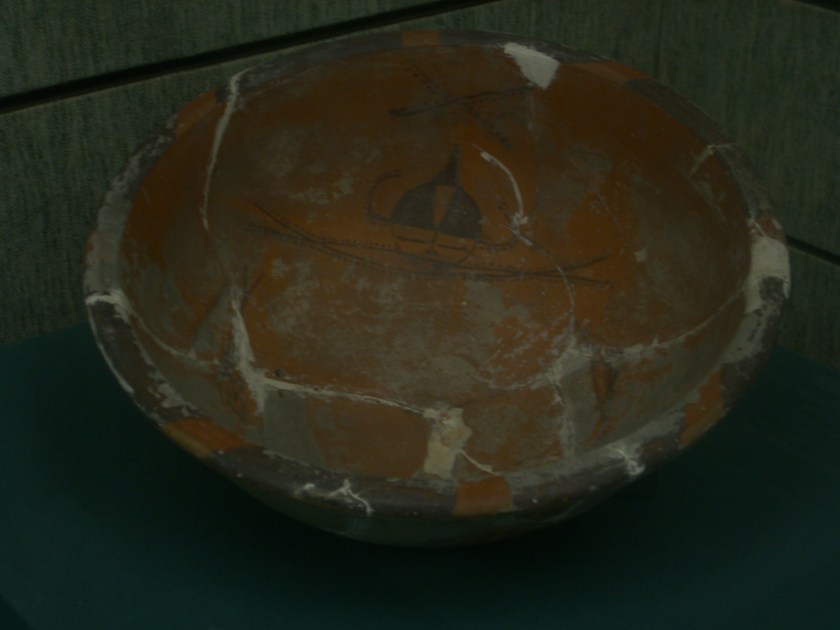
Ban Po Basin 5-7 thousand years old

Growing up in Montana and Oklahoma, both states with large indigenous populations, I learned from my history classes that Indians walked across a land bridge from Asia over to Alaska across the Bering Strait  during the last ice age and that the first documented site of an Indian settlement was in Clovis, New Mexico around 13,000 years ago. Lots of pieces were missing, but still, that worked for me . . . at least until I was exposed for the first time to American Indian creation stories in Roger Dunsmore’s Humanities class at the University of Montana. It was also during university, that I finally realized that the study of history was not necessarily static and that new discoveries meant different hypotheses which included the peopling of the America’s. National Geographic articles showing the Olmec stone heads discovered near La Venta, Mexico left me without a shadow of a doubt that not all pre-Colombian Americans were of Asian heritage. In the early 80’s, I took a group of public high school students from Oklahoma to Shanghai for a six week study course. One of the members of our group was a Native American who was constantly being addressed in Mandarin. Mainland Chinese were not only convinced she was Chinese, some insisted that she was Cantonese. She was, in fact, Creek, Seminole, and Cherokee.

There have been many connections made between North America and Asia. I don’t have any doubts that there were people who crossed the Beringia Land Bridge and filtered down through the Americas over the course of thousands of years. I also have little doubt that America was peopled from other parts of the world as well. Some tribes and nations have stories and songs that suggest that they have always been in a particular region of America and I have no proof that they were not.

But it was the bowl above that really caught my eye when I walked into the small building that housed the Xi’An Banpo Museum (西安半坡博物馆) in 1982. The clay and the designs were similar to bowls I had seen at the Gilcrease Museum in Tulsa, Oklahoma growing up. But these bowls were Neolithic Chinese, from about 4,000 BCE and they represented what is called Yangshao Culture (仰韶文化 Yǎngsháo wénhuà). Besides Yangshao culture having a presence in the loess plateaus along the Yellow River near Xi’an, remnants and artefacts from Yangshao Culture reach beyond Shaanxi into Henan and Shanxi (note: There is a Shaanxi and a Shanxi). Relatively little is known about the Yangshao people who lived at Banpo other than they were farmers who grew millet, wheat, and sorghum. They understood water and built terraces to prevent flooding. They also built pens for domesticated sheep, pigs, dogs, cattle, and goats.

Banpo was a community of small houses, each 10-16 feet across partially sunk into the ground. This was done to keep the homes cooler in the summer. The houses appeared to be of a wattle and daub variety similar to those of American Indians who lived in Louisiana, Mississippi, Alabama and Kentucky. Wattle and daub used wooden strips and/or branches woven into a lattice design and coated generously (daubed) with a mixture of mud, clay, animal poop, and straw. The roofs were conical and made of grass bundled together (thatch) which allowed the rain to run off.

It was the frog, pig, and bird faces, the deer and fish figures, and the geometric designs that really hooked me though. They were made with strong black lines, circles, rings, triangles. Some were etched while others appeared to be pressings of fabric or rope. On some of the pots were cuttings and lines that could have been an elementary form of writing or merely identification symbols. Among the nearly 10,000 artefacts and stone tools that have been uncovered were sickles and plows, bone and stone beads, ceramic bowls, basins, water jars, and urns (both for cooking and for burial). There were also fishhooks, bone needles, arrowheads, stone axes, and knives found in Banpo.

The fact that a cemetery was found very near the village suggested that there were defined burial rites and religion. Near the ancestral bones were found some of the best preserved artefacts of the Banpo people indicating the belief in an afterlife. Of the 130 adults buried there, all were buried face-up with their heads pointed towards the setting sun. Infants and young children were buried differently. They were placed in clay urns with a hole on the top.

In my search for other American Indian/Chinese Connections, I found very little. I did, however, discover two stories that were amazingly similar.

“Smearing the Bell”, was a story that first appeared in Song Dynasty China (960-1279 CE.) After a robbery, a group of thieves was assembled and confronted with a temple bell that had a magical power. If a real thief touched the bell, it would ring. If an innocent person touched the bell, it would remain silent. So the Magistrate placed the bell behind a curtain after ordering his constables to paint the bell. The thieves were then instructed to reach behind the curtain and strike the bell. Each of the men reached in and “touched” the bell, but the bell did not chime. Then, the Magistrate noticed that one of the men who claimed to have struck the bell had clean hands.  When the Magistrate confronted the thief, the thief confessed.

‘Children of the Frost’, a story by American, Jack London, author of “The Call of the Wild” (1903),  told of an Indian woman in the Klondike who reported to a local ‘Shaman that she had lost a blanket. The Shaman took a raven and placed the raven in a black soot covered pot in a dark room. He then commanded every villager to put their hand into the pot and touch the raven. If a thief touched the raven, the raven would cry out. All the villagers went in, but the raven never cried out. Then the shaman noticed one man with clean hands and confronted the thief, whereupon, the thief confessed. The blanket was found in the thief’s house and was returned to the woman.1”

 1Ting, Nai-tung. “A Comparative Study of Three Chinese and North-American Indian Folktale Types.” Asian Folklore Studies, vol. 44, no. 1, 1985, pp. 39–50. JSTOR.

I found two studies of American Indians and Chinese in America during the 19th century which I also found interesting just in case anyone might be interested:

“They Looked Askance”: American Indians and Chinese in the Nineteenth Century U.S. West by Jordan Hua, Honors Thesis, Professor Townsend, April 20, 2012

Horizontal Inter-Ethnic Relations: Chinese and American Indians in the Nineteenth Century American West Author(s): Daniel Liestman Source: Western Historical Quarterly, Vol. 30, No. 3 (Autumn, 1999), pp. 327-349 Published by: Oxford University Press Stable URL: https://www.jstor.org/stable/971376 Accessed: 22-02-2020 01:03 UTC


Emperor with an Ego

Chinese Odyssey 65

We followed the footsteps

of men made from clay

who travelled the Silk Road

in Chang An by day

At night in their chariots

they served their Huang Di

He died, they died too

far away from the sea.Qin_Shi_Huang_(Chinese_characters).svg

https://upload.wikimedia.org/wikipedia/commons/8/8d/Qin_Shi_Huang_%28Chinese_characters%29.svg

As far as dynasties go, the First Emperor of China’s was really short. During his reign of only eleven years (221-210 BCE),  Emperor Qin Shi Huang (秦始皇帝 Qín Shǐ Huáng Dì) left a legacy that continues to this day. Indeed, the very name “China” probably has its origins in this first imperial dynasty. Qin is actually pronounced very similar to the English word “chin”. Emperor Qin Shi Huang standardized Chinese writing, weights and measures, established a common currency and connected the various walls at the northern border of China to create the Great Wall of China (万里长城 wàn lǐ cháng chéng.)

The Qin Dynasty was pivotal in the standardization of the Chinese written language. Emperor Qin did that by making the script that he was most familiar with – the Qin script, the official script of China. Other styles once popular in different parts of China eventually disappeared. The Qin script was simpler than most. In the picture above, the first row of characters and the second row are the same. The top script, known as zhuànshū 篆書 is usually translated as “seal script”, because it was used in “chops” or “seals” that appeared on documents and works of art. The second form of writing was called  lìshū 隸書, “clerical script” and was the traditional Qin form of writing – a simplified form of the seal script. A side note here. While Emperor Qin was very intent on unifying the Chinese written language, he also sought to unify Chinese thought. What better way to make history begin with him, than to kill scholars and destroy documents of recorded history? And so, he tried – with some success.

Emperor Qin also felt the need to simplify and standardize weights and measures. When he became emperor, China was a mishmash of different measuring systems. Qin Shi Huang started by going decimal and dividing a day by 10’s. A day was actually made up of one hundred kès (刻). Emperor Qin also had a special affinity for the number 6. Six chǐ (尺) = one bu (一步 yī bù ). A chǐ was roughly equivalent to a foot (the approximate length of the space between the joints of a standard stalk of bamboo.) 300 bù was equal to one lí 厘(sometimes called a ‘Chinese mile’ – actually about 1/3 of an English mile.)  Finally 1 jīn 市 equalled about 1.1 pounds or 500 gm. A jīn is also referred to as a “catty”. A liǎng was also known as a “Chinese ounce” or a “tael” and was how foreigners weighed silver. In the past a jīn was equal to 16 liǎng, but nowadays there are 10 liǎng 两 in one jīn.

Contrary to popular belief, Qin Shi Huang did not build the Great Wall of China. Early portions of the wall built to protect kingdoms began to appear in the Spring and Autumn Period (771–476 BCE) and were followed by more sections of walls in the Warring States Period (475–221 BCE). What Emperor Qin did was to connect those east-west walls in northern China from Gansu all the way to Manchuria, just to the north of Korea.

Emperor Qin was a brilliant military strategist who ruled with an iron fist. One by one, the kingdoms of the Warring States fell. He killed, castrated, or enslaved those who stood in his  way. He was a megalomaniac who was obsessed with the after-life and was tenacious in is search for immortality. To that end, Qin Shi Huang decided to make his tomb a mini-kingdom of Qin where he would take an entire life-size army with him (as well as real life servants, concubines and craftsmen.) While Qin Shi Huang was building his tomb, he sent Xu Fu 徐福 XúFú , a Chinese alchemist and explorer from Guangdong, off on a sea voyage with 3000 virgin boys and girls to search for the pill of eternal life (長生不老藥 chángshēngbùlǎo yào.) Legend has it Xu Fu and his entourage ended up in Japan, and some scholars credit him with helping to develop farming techniques and introduce new plants and agricultural advances there. In some parts of Japan people still worship Xu Fu as the God of farming. And Marvel features him as a Chinese character in some of their comic books.

Since the uncovering of a terracotta head and bronze arrowhead by peasant farmer, Yang Zhifa (杨志发) and his five brothers while digging a well during a drought in the village of Xiyang (西杨乡), about 35 kilometers east of Xi’an in 1974, only a small portion of the entire tomb of Qin Shi Huangdi has been unearthed. The parts which have not been removed are rumoured to have rivers flowing with mercury, gem encrusted ceilings and treasures galore. Legend says that the tomb was shaped like a miniature map of China at the time of his rule (I’m thinking Shenzhen’s “Miniature China” – 小人国) complete with the kind of crossbow booby traps which likely inspired some of the special effects in the Indiana Jones and National Treasure films. So far, only about 2,000 life size terra-cotta soldiers, horses, and chariots have been uncovered and about 1,000 restored. On average, it takes almost six  months for a team of three experts to restore one soldier. The work is painstaking and made more difficult by the fact that the clay quickly loses its color when it is exposed to air. Estimates suggest there may be upwards of 8,000 more terra cotta figures to unearth. Sima Qian (the most famous Han Dynasty historian) said that 700,000 laborers worked to create what I think of as ‘a macabre monument to narcissism.’

Qin Shi Huang Di arranged for a plethora of steles (碑石 bēi shí)  (stone slabs with intricately inscribed words created to memorialize individuals and events) to be prominently displayed all over “the middle kingdom” with accolades dedicated to Qin’s accomplishments. Of those, seven still remain. Nothing says “ego” better than the words from one of four of the 2200 year old still intact steles memorializing Qin Shi Huang. Before it was carved, it would have most certainly have been approved by the emperor himself:

“According to the season of mid-spring,

The mildness of Yang had just arisen.

The August Emperor travelled to the east,

On His tour He ascended (Mt.) Zhifu,

Looked down on and illuminated (the lands by) the sea.

The attending officials gazed in admiration,

Traced back and contemplated (His) excellence and brilliant

accomplishments,

Recalled and recited the fundamental beginning:

The great Sage created His order,

Established and fixed the rules and measures,

Made manifest and visible the line and net (of order).

Abroad He instructed the feudal lords;

Brilliantly He spread culture and grace,

Enlightening them through rightness and principle.

The six kingdoms had been restive and perverse,

Greedy and criminal, insatiable –

The August Emperor felt pity for the multitudes,

And consequently sent out His punitive troops,

Vehemently displaying His martial power.

Just was He in punishment, trustworthy was He in acting,

His awesome influence radiated to all directions,

And there was none who was not respectful and submissive.

He boiled alive and exterminated the violent and cruel,

Succored and saved the black-haired people,

And all around consolidated the four extremities.

He universally promulgated the shining laws,

Gave warp and woof to All-under-heaven –

Forever to serve as ritual norm and guideline.

Great, indeed, was […]

Within the universe and realm

One followed receptively His sage intent.

The multitude of officials recited His merits,

Asked to carve (this text) into stone,

To express and transmit the constant model.”

Source: Ouellette, P. (2010, February 1). Power in the Qin Dynasty: Legalism and External Influence over the Decisions and Legacy of the First Emperor of China. Retrieved October 10, 2014, from Haverford College: http://thesis.haverford.edu/dspace/bitstream/handle/10066/5251/2010OuelletteP.pdf?sequence=1

Guanyin, the God(dess) of Mercy

Chinese Odyssey 64

Saw my favorite Guanyin

and we stopped for a soda

Remembered Xuanzang

at the Wild Goose Pagoda

Rode bikes on a wall

which encircled Xi An

Inside the Great Mosque

we could hear the Qur’an.Guanyin

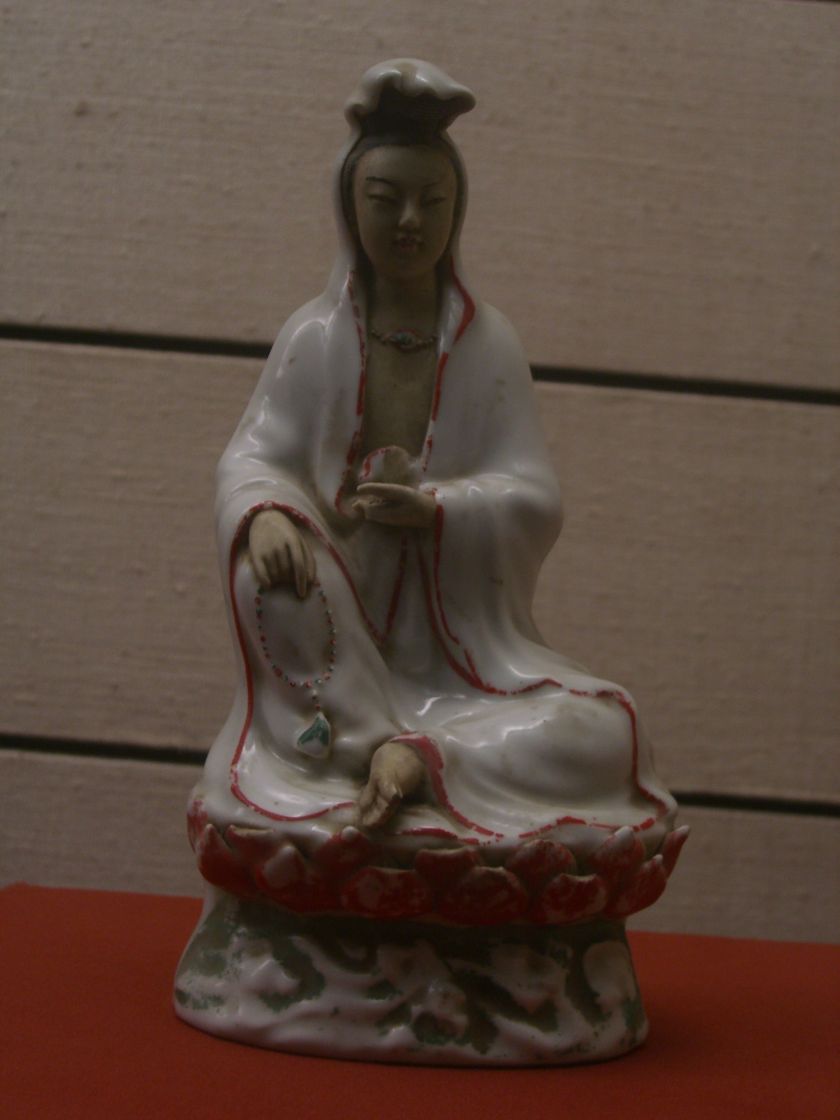
Guanyin has always been my favorite Bodhisattva. (Does anyone else have a favorite Bodhisattva?) Not sure whether it was the amazing 11th or 12th century “Guanyin of the Southern Sea” residing at the Nelson-Atkins Museum of Art in Kansas City or the Qing Dynasty Guanyin (Avalokitesvara) ceramic figure at the Shaanxi Historical Museum that made me fall in love with Guanyin. Having seen thousands of Guanyins in temples,  museums, street markets, and antique shops throughout the world, these two are still my favorites. I loved that Guanyin was the God/Goddess of Compassion and that he/she could have been male or female in origin. The Lotus Sutra says that “Guanyin travels throughout the world guiding beings towards freedom from suffering.” The word, “Guanyin” in Chinese means “pays attention to all sounds” which may also be interpreted as “hearing all prayers and pleas for help.”

“There is no place where s/he will not manifest her/himself.

The suffering of those in troubled states of being;

Hell-dwellers, hungry ghosts and animals;

And the suffering of birth, old age, illness, and death

Will gradually be extinguished”

The Lotus Sutra, trans. Tsugunari Kubo and Akira Yuyama, Bukkyō Dendō Kyōkai 2007.

Guanyin, (Avalokiteshvara in India), was almost certainly a male figure when s/he first appeared in Chinese Buddhist temples during the early centuries of the Common Era. It wasn’t until the Song Dynasty (960-1279 CE) that Guanyin transmogrified fully into her current female form. The Ming Dynasty Buddhist, Miaoshan (妙善 miào shàn) is often portrayed as a human manifestation of Guanyin. Miaoshan was the youngest of three daughters. At an early age, she had wanted to be a follower of Buddha, but her father had other ideas and insisted that she marry. When she adamantly refused, her furious father punished her by sending her to a nunnery, which he later tried to burn down. Legend has it that he tried again to have his daughter killed. Two soldiers took Miaoshan out to an open space in the forest and drew their swords. But a tiger appeared and the soldiers dropped their swords and fled whereupon the tiger took Miaoshan to a cave on a mountain and left her there. Some time later, Miaoshan’s father became very sick. He was told that the only way he could be cured was by a compassionate person gouging out an eye and cutting off an arm. Miaoshan’s father did not believe that someone would actually step forward and make that kind of a sacrifice. In the end, it was Miaoshan who gouged out her eye and cut off an arm to cure him. When her father gazed upon his mutilated daughter, and realized that she was the compassionate person,  he immediately realized what a selfish and heartless person he was, and begged her to forgive him. Some people believe that that thousand eyed, thousand armed Guanyin statues came into being as a result of the story about Miaoshan.

Guanyin statues and stories abound. One incarnation of the Guanyin statue which has always intrigued me is the one where she is carrying a baby (usually thought to be a baby boy.) I’ve often wondered whether that manifestation of Guanyin might have been influenced by Madonna statues brought in by Catholic priests when they first arrived China in the 14th century.

About 7 km (4.5 miles) due north of the Shaanxi History Museum, located in the heart of the old city of Xi’an, stands the best preserved and maintained city wall in all of China – with the possible exception of the wall around the Forbidden City in Beijing. Started in the Tang Dynasty (618-907 CE) and refurbished to its present state in the Ming Dynasty (1368-1644 CE), the total perimeter of the city wall is 13.7 km (8.5 miles). It is 15-18 meters (50-60 ‘) wide at the bottom and approximately 12-14 meters (40-45’) across on the top. The wall is approximately 12 meters (40 ‘) tall. Of the 6,000 cities in China which used to have walls, only about ten continue to exist today. A city within a city lies within these walls complete with schools, mosques, temples, commercial areas, museums, and anything else which makes up a city in China. One fun thing to do is to rent a bike on top of the wall. If you want, you can bike the entire perimeter of the wall.

One of my favorite places to visit within the wall is the Great Mosque. I actually lived in Xi’an for nearly a month in the early 2000’s. Every time I visited the mosque, it was quiet and serene. When I first went there in the early 80’s, I met a young English speaking Muslim student who lived and studied at the mosque. I wrote down his name and when I went back nearly twenty years later and asked about him, he was still there. I’m not sure he remembered me but we had a nice reunion .

The Muslim Quarter surrounding the Great Mosque has some of the best street food in Xi’an. A local Xi’an favorite is the Paomo Lamb & Pita Soup (羊肉泡馍 Yáng Roù Pào Mó). At its core, Paomo is a potage, a delicious thick broth filled with lamb and shredded flat bread.  Dumplings are also  nice in Xi’an. Unlike traditional jiaozi or xiaolongbao, dumplings here often contain spices like cumin, chives, and sweet garlic. Try the 灌汤饺子 Guàntāng Jiǎo which are translated as the Steamed Dumplings from Heaven.

You may remember Xuanzang (玄奘Xuán zàng) from the Monkey stories. He lived from 602-664 CE in the Tang Dynasty and was the real life Buddhist monk who took a pilgrimage to India to visit the sources of Buddhism in areas we now call India, Pakistan, Bangladesh, and Nepal. He was aware of an earlier Buddhist monk  by the name of Fa Xian (法顯 Fǎxiǎn) who had traveled to India with nine other monks in the 5th century in a similar quest for Buddhist scriptures. It is said that the Big Wild Goose Pagoda (大雁塔 Dàyàn Tǎ) in Xi’an was the storage place of over 500 cases of Buddhist scriptures and artifacts that Xuanzang brought back to China from India – among them some of the most important of the Mahayana Buddhist scriptures.


The Heavenly Horses of Chang’an

Chinese Odyssey 63

We opened a door

in the sky and stepped through.

Wulumuqi to Xi ‘An

on carpets, we flew.

In the History Museum

we wandered through time,

found ancient inventions

and poems without rhymes.

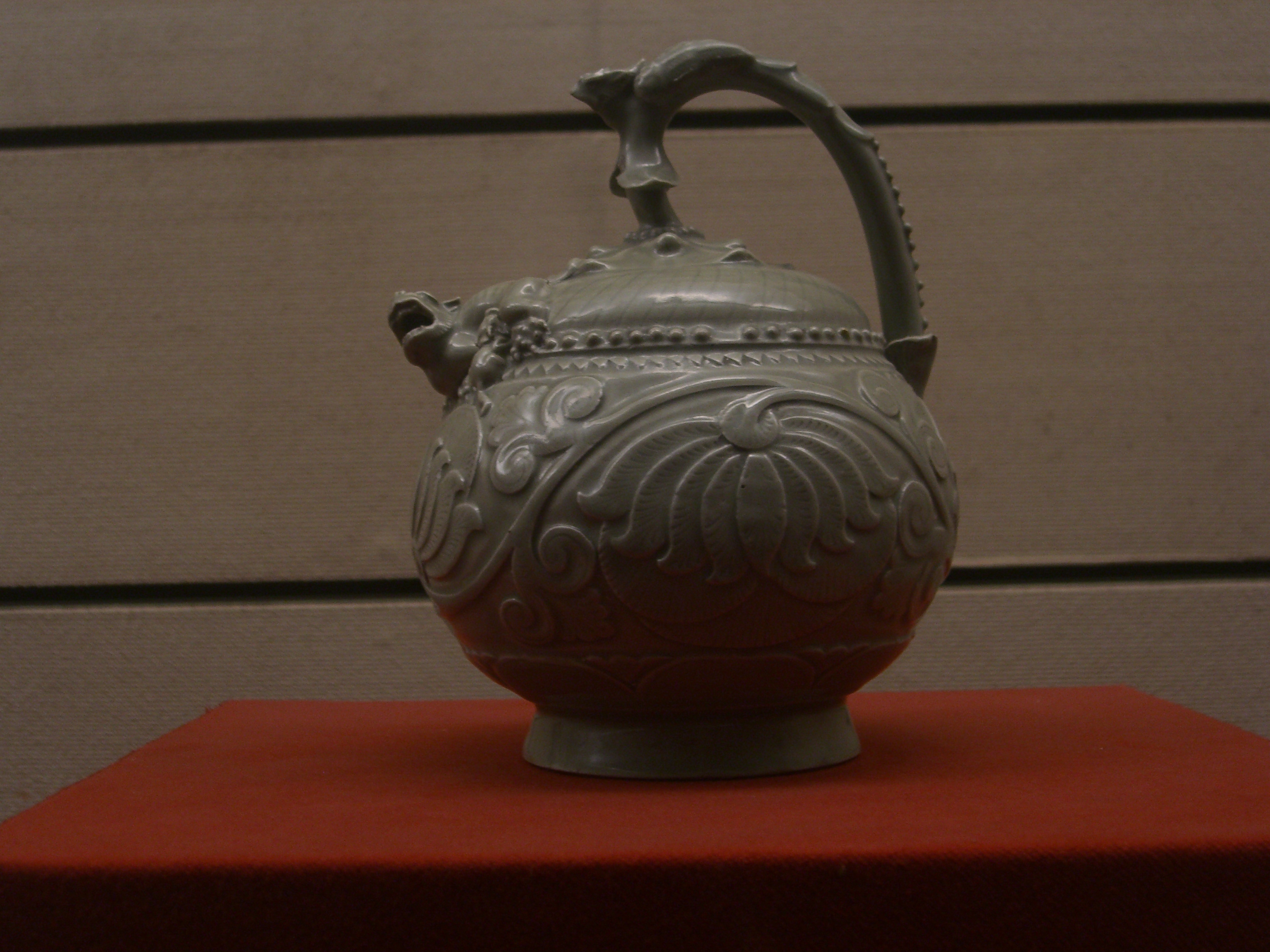
Teapot from the Shaanxi H. Museum

The Han Dynasty lasted more than 400 years – from 206 BCE to 220 CE. In many ways, it defined much of what China was to become. To this day, over 90% of the people in China consider themselves to be Hàn Rén 漢人 (lit. people of the Han) and the Chinese language in its totality is referred to as Hàn Yŭ 漢語 (the language of the Han).  A hǎohàn 好汉 in China is “a good guy.” The Han Dynasty produced some of the coolest inventions ever: Chinese paper was invented then, as was moveable type, instruments for measuring seismic activity, wheel barrows, suspension bridges and many other amazing innovations were said to have been invented during this longest of the Chinese dynasties.

One of the first exhibits to catch my eye at the Shaanxi History Museum was a tea pot with no lid. When the teapot was turned over there was a clay funnel built into the bottom of the teapot and scalding water would have been poured into the clay funnel. Turn the teapot right side up and the tea stayed in the pot. I’m still not sure how they put the tea leaves into the pot, though or how the inside of the pot was cleaned. Then there was the goose shaped smokeless bronze lamp. The smoke from the flame of the burning lamp went up through the long neck of the goose and back into the body of the lamp which contained water and there the smoke would die. One sided mirrors and coins with squares cut out of them. Water wells and grain grinders, axes and adzes, and even a Han loom that looked modern all were exhibited at the Shaanxi History Museum. From the Tang Dynasty there were wine pots made out of silver and drinking cups in the shape of horns mad out of agates. One of the most famous paintings there from the Tang Dynasty had five men mounted on horses playing polo English style.

The place we now call Xi’an had a different name up to the beginning of the Ming Dynasty (14th Century).  Chang’an was actually a few km northwest of the modern city of Xi’an. Chang’an loosely translates to Eternal Peace. It’s founders tried to insure that by positioning Chang’an near both the Huang He and the Wei rivers in an area surrounded on all sides by hills. Artifacts found near the site of Chang’an pre-date the Shang Dynasty and by the end of the Eastern Zhou Dynasty (771-256 BCE) Chang’an was China’s capital. At that time, Chang’an was one of the largest cities in the world having close to one million people. Chang’an was also China’s capital during the Han, the Sui (581-618 CE) and the Tang (618-907 CE) dynasties.

Chang’an was the eastern portal to the Silk Road. It was in 128 BCE during the Western Han Dynasty when Zhang Qian (張騫 Zhāng Qiān) , a young imperial officer, was sent by Emperor Han Wu Di (漢武帝 Hàn Wǔ dì) from Chang’an to explore the Western region to try to establish a military alliance with the Kingdom of Yuezhi in modern day Tajikistan. To do that, he needed to go through Inner Mongolia which was controlled by the Xiongnu (匈奴Xiōngnú).   Zhang Qian was captured by the Xiongnu in the Hexi Corridor and held captive for more than 10 years. While a prisoner Zhang Qian married a Xiongnu woman who bore him a son.  When the Xiongnu leader died, Zhang Qian and his good friend and guide, Ganfu (甘父 Gān fù) escaped with Zhang Qian’s wife and son, but instead of returning to Chang’an, they continued north to Khöshöö Tsaidam in modern day Mongolia and then followed the northern edge of the Tarim Basin , around the Kunlun mountains,  and even stopped at Kashgar. They then continued west to Ferghana (modern day eastern Uzbekistan, Tajikistan and Kyrgyzstan), and south to Bactria. While in Bactria (present day Afghanistan, Uzbekistan, and Tajikistan), Zhang Qian learned about Alexander the Great and this was the first recorded meeting between these great civilizations.  On their journey home,  Zhang Qian’s entourage traveled east below the Tarim Basin and crossed the Gobi Desert before eventually reaching Chang’an.

Zhang Qian was much more successful in his second journey to the west when he was accompanied by 300 men to present day Kazakhstan, Kyrgyzstan, Afghanistan, Pakistan, and Uzbekistan. Although Zhang was unable to visit India and the Macedonian and Parthian Empires, he did learn valuable information about those regions.  On his journey back, Zhang Qian was able to bring back alfalfa and grapes which grew easily in the western regions of China. He also brought back stories of horses from the Fergana valley (located between Kyrgystan and Tajikistan) which Han Wu Di renamed “Heavenly horses” (大宛馬 dàyuānmǎ aka 宛馬 yuānmǎ). Han Wu Di sent 20,000 infantry and 6,000 cavalry west to the Fergana valley to obtain these horses, but lost half of his soldiers along the way and they lost the first “War of the Heavenly Horses.” The Emperor was not happy so he sent another bigger force of 60,000 mostly prison recruits and 30,000 horses and they had no problem making there way to Dayuan (Fergana) and after a 40 day siege, the Han forces achieved victory. In the end, the Han General left Dayuan with 3,000 horses of which around 1,000 Heavenly Horses, the Lamborghinis and the Aston Martins of China 2000 years ago, finally arrived in Chang’An in 101 BCE.

“The Arrival of the Heavenly Mare”

天馬徠兮 從西極

經萬里兮 歸有徳

承靈威兮 降外國

渉流沙兮 四夷服

The heavenly horses have arrived

from the Western frontier

Having travelled 10,000 li,

they arrive with great virtue

With loyal spirit,

they defeat foreign nations

And crossing the deserts

all barbarians succumb in their wake!

–The Shiji, Chapter 24 (“The Treatise on Music”)  Shiji (史記) vol. 24, “Yueshu (楽書)” number 2.


Assalamu Alaikum

Chinese Odyssey 62

“Assalamu Alaikum”

heard more than “Ni hao”.

Was this really China?

If so, where was Mao?

A lake named for Heaven

felt just like my home.

Lake McDonald in Xinjiang

a picture, a poem.

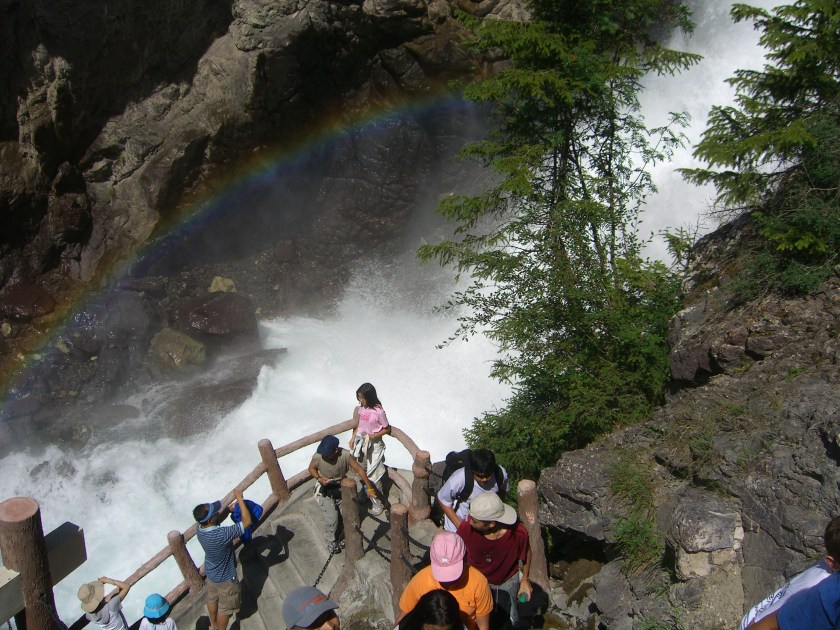
Waterfall by Heavenly Lake

Oo-loo-moo-chee is more or less how this far western Chinese city is pronounced in Mandarin. Ürümqi is the name of the same city on a map. In Pinyin and in Chinese characters,  it looks like this – Wūlǔmùqí 乌鲁木齐. Located a little north and west of the center of the Xinjiang Uyghur Autonomous Region, some say that Wulumuqi “is not the end of the world – but you can see it from there.” That said, the estimated population of Urumqi today is 3.5 million, by far the largest city in far western China.

Although some say that Xinjiang has historical claims going back to the Han Dynasty where China called the area a “protectorate of western regions”, most understand China’s legal claim to Xinjiang to have occurred in the Qing Dynasty as a result of the Dungan Revolt in 1884. The name “Xinjiang” actually means “new border” and refers to any area previously claimed to be a conquered region of China and was lost and then regained.

Islam has played a major role in Xinjiang for a millennium. The majority of people living in Urumqi are Han Chinese, but close behind are the Hui and the Uyghurs who are Sunni Muslims. Walking through this colorful city, I received many more smiles when I greeted people with the traditional “Assalamu Alaikum” greeting than I did when I tried to open a conversation with “ni hao”. But Urumqi also felt Chinese. Ethnicities abound, all having occupied this city since its beginning. Most of the stores and goods look the same as those available all over western China. I thought Urumqi to be a really nice amalgamation of people unlike any other city in China I had ever visited.

A little over 100 km due east of Urumqi is a lake called Tian Chi (Heavenly Lake). Located in the Tianshan mountain range, it receives the same snow melt as do the karezes in Turfan. Surrounded by glacial peaks, it really did remind me of Glacier National Park in Montana. Heavenly Lake reminded me of a smaller version of Lake McDonald in Glacier. On a small tour boat I asked the tour operator where people swam. She was adamant that no one could swim in Heavenly Lake. It was much too cold. When I told her about swimming in Lake McDonald, she assured me that it could not have been the same. No one could survive swimming in Heavenly Lake. I beg to disagree.

Although Xiwangmu (西王母) predates Daoism, no one knows her origin story. Time is imperceptible to her, “a thousand years, like a cricket’s chirp.” First appearing in oracle bone inscriptions 1500 years before the birth of Christ, Xiwangmu was revered as the Western Mother. Some incarnations portray her has having the teeth of a tiger early in her life. She was said to have lived in a palatial paradise where gods and humans could come together. She was a Daoist master who enamored  King Mu at Turquoise Pond (thought to have been Heavenly Lake) in the Zhou Dynasty. She was said to have visited the Emperor Han Wu Di in a chariot made of purple clouds. But neither King Mu nor Emperor Han Wu Di was able to complete her teachings which would have allowed them to attain immortality. She is also mentioned in the Journey to the West where she had a peach tree garden which only blossomed every three thousand years. The monkey king was still out of control at this time, insisting that everyone refer to him as Qítiān Dàshèng (齊天大聖), or the “Great Sage Equal to Heaven”. For eating all of the immortality peaches in the Jade Emperor’s garden, Sun Wu Kong (the Monkey King) was imprisoned under a mountain for 500 years.

Walking down a manicured path beside Heavenly Lake we eventually began our descent down wooden steps alongside a beautiful stream which turned into an amazing rainbow shrouded waterfall. The splashing water and the crisp air breathed new life into all of us before boarding the bus back to a birthday banquet in Urumqi.

The Karezes of Turfan

Chinese Odyssey 61

From Gansu to Xinjiang,

we traveled by rail.

By bus on a highway

where wind mill farms wail.

Karezes of Turfan

flowed down from Tian Shan.

Flaming Mountains nearby

were too hot for man

Screen Shot 2020-01-30 at 5.20.52 PM.pngSamuel Bailey (sam.bailus@gmail.com) [CC BY (https://creativecommons.org/licenses/by/3.0)%5D

Looking out the window of our air conditioned bus, the Flaming Mountains (火焰山 Huǒyànshān) aka Gaochang Mountains (高昌 Gāo Chāng) seem incredibly inhospitable. In summer the temperature of the Flaming Mountains frequently exceeds 50 °C (122 °F). Passing by in the early evening, the low hills seem to be on fire, henceforth their name. It was hard to believe that beneath these Flaming Mountains there were manmade tunnels built 2000 years ago carrying crystal clear water from the alluvial plain at the base of the Tianshan Mountains (天山) into the farmlands of Turfan nearly forty kilometres away.

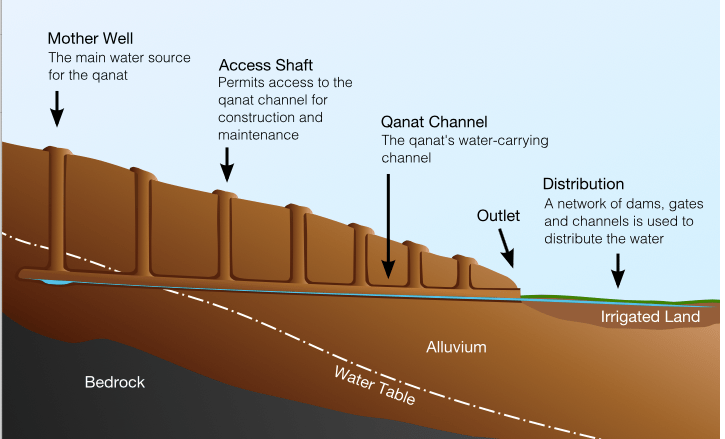
Turfan aka Turpan (吐鲁番市 Tǔlǔfānshì) lies about 180 km southeast of Urumqi. The 1.27 cm of rainfall a year it receives could never support an agricultural community. Nearly two thousand years ago, farmers and engineers figured out an elaborate system which would transport the snowmelt from the base of the Tianshan Mountains underneath the Flaming Mountains and into Turfan. This underground system (called karez a.k.a. qanats) was comprised of wells of varying depths, some up to 100 feet deep.  Between the wells (from 20-70 meters apart) they dug tunnels large enough for a person to stand up and walk through. These connecting tunnels would eventually carry pure sweet water to the grape, pear, pomegranate, apricot, apple, peach, fig, and walnut growing farms of Turfan. Most of the water in Turfan begins with the snow melt at the foot of the Tianshan mountains. This city of 600,000 rests in the Turfan Depression, an area whose average elevation sits 154 m (505 ft) below sea level.

Today, there are only a couple of hundred working karezes in Turfan, down from over 1800 in the 1950’s. Located in a fault bounded trough, the 4,000 sq. kilometers of land situated below sea level called the Turfan Basin is shrinking because of oil-drilling, agricultural use, and glacier melting caused by global warming. To maintain the karezes, now, as in ancient times, once a week someone needs to be lowered down each well into the tunnels to clean out the silt and do whatever maintenance is necessary to keep the water flowing. Like the disappearing rice terraces north of Guilin in the Guanxi Zhuang Autonomous Region, young people who used to maintain these kinds of labor intensive agricultural jobs, no longer want to stay in rural China, but instead choose the more lucrative paths of factory work in mega-cities called Special Economic Zones like Shenzhen and Donguan in Guangdong province.

In the 1920’s when the French sisters and Cable, first arrived in this amazing oasis, they commented “. . . Turfan lies like a green island in a sandy wilderness, its shores lapped by grit and gravel instead of ocean waters, for the division between arid desert and fertile land is as definite as that between shore and ocean. Its fertility is amazing, and the effect on the traveller, when he steps from the sterility and desiccation into the luxuriance of Turfan is overwhelming.” The Gobi Desert by Mildred Cable w/ Francesca French, The Macmillan Company 1944.