The Flying Nymphs of Mogao

Chinese Odyssey 60

In the grottoes of Mogao

high up on the walls

were angels and fairies

who flew through the halls

The message apsara

had helped us to find

“perfection of wisdom,

brings peace to the mind.”

File-Apsara_playing_a_Chinese_flute_-_Yulin_Cave_15https://upload.wikimedia.org/wikipedia/commons/8/8f/File-Apsara_playing_a_Chinese_flute_-_Yulin_Cave_15.jpg

Sometimes alone, sometimes in pairs or groups, pale and dark, Chinese and foreign, mostly female. They danced, flew, played musical instruments, performed acrobatics with colorful ribbons, rode on horseback, and protected others.  Similar but somehow different images from Buddhist temples in Ankgor Wat and Hindu temples in India. They called them “apsara”, but at Mogao, the question emerged whether or not these were apsara at all. I had learned that apsara were “cloud and water” female spirits, nymphs or fairy like figures, whose major role appeared to be that of pleasing men.” What really got me thinking however was an article called “The Case for Feitian”. Feitian (飛天) is the Chinese name for the figures one finds decorating the walls of many of the caves of Mogao. Fei means “to fly” and “tian” means “sky” or “heaven.” The more I studied the 5,000 feitian from the 700 plus caves at Mogao, the more I began to see that these figures were unique. They were not all idealized figures of women. Some of these apsaras were male and some of the male and female figures were muscular and most were more modest than those on the walls of temples in India and Cambodia. Had the feitian been influenced by Buddhist or Hindu art? Without a doubt. Were there strong Chinese influences on these figures created over the course of nearly 1,000 years? Definitely.

The Oxford Dictionary defines apsara as “a celestial nymph, typically the wife of a heavenly musician.” Your Dictionary provided an even more interesting definition: “In Hindu and Buddhist tradition, one of a race of beautiful female supernatural beings that inhabit the sky, dance for the entertainment of other celestial beings, and often attempt to seduce mortal men practicing asceticism.” The same dictionary explores the origin of Apsara as “ āp, ap- water and saras as things that flow, lake -the Apsaras being depicted as delighting in water.” “Apsara.” Apsara Dictionary Definition | Apsara Defined, http://www.yourdictionary.com/apsara.

When Le Zun (Lè Zūn 樂尊) stepped into the Hexi Corridor (Héxī Zǒuláng 河西走廊 ) in the 4th century C.E. and discovered pure, sweet spring waters near the present city of Dunhuang, he decided that would be a nice place to rest after his arduous journey across the Gobi Desert. In the evening, watching the sun set, images arose out of those mountains. Among the figures he saw in the heavens were thousands of fairy like apparitions dancing and playing music. Le Zun knew he had stumbled onto a sacred spot. A few years later, he was joined by another monk by the name of Faliang (Fǎ Liáng 法良) who had a similar vision. The word spread among Buddhist pilgrims that this was a sacred spot .  During the next millennium, mostly during the Tang Dynasty, over 500 caves were carved into the sandstone and filled with an amazing collection of Buddhist art. According to Karin Dienst’s article “Bringing ancient Buddhism to light” published by Princeton University, there were “2,000 Buddhist sculptures, 45,000 square meters of murals and more than 60,000 texts.”

Like so many places in China, one needs to plan a trip to the Mogao caves. As more Chinese enter the middle class and have more expendable income, the first place many Chinese want to see is China. Whether its climbing up stairs to the Great Wall at Mutianyu, or following the trails and stairs cut into the rocks of Huangshan or exploring the Buddhist art on the caves of Mogao, there will be crowds of people – all pilgrims hoping to see the fairy like apparitions seen by Le Zun so many centuries ago.

Dunhuang – a Diamond in the Rust

Chinese Odyssey 59

We came to some walls

in the midst of the sand

doors lead into caves

remarkably grand

where they preserved

statues, sutras and art

the oldest, the Diamond

the deepest, the Heart

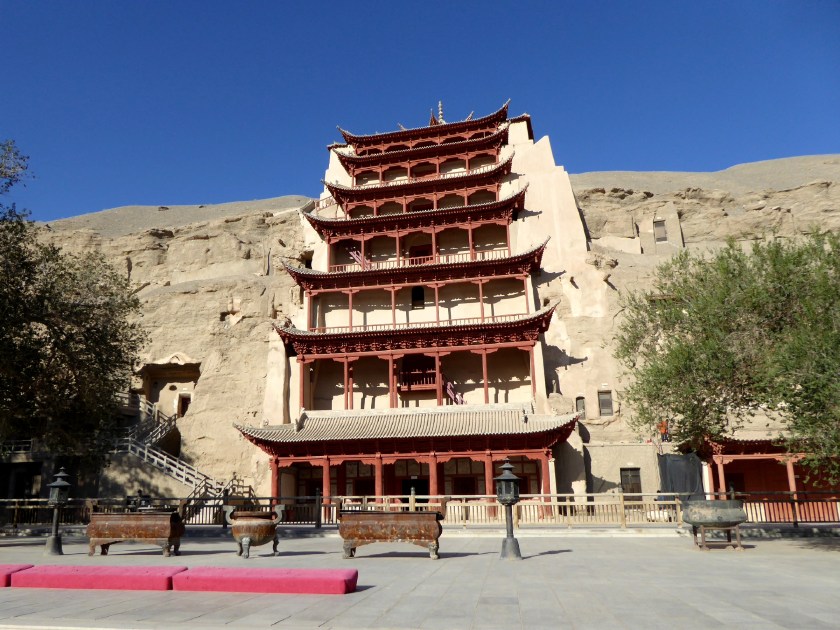
Mogao_Caves_Dunhuang_Gansu_China_敦煌_莫高窟_-_panoramio_(4)Hiroki Ogawa [CC BY (https://creativecommons.org/licenses/by/3.0)%5D

Located in western China, 200 plus miles west of Jiayuguan on the eastern edge of the Taklamakan Desert, Dunhuang was a nexus where merchants and traders from China and the west interacted with Buddhist pilgrims on the western edge of the Gobi desert. About 25 km southeast of Dunhuang lies an area known as the “Caves of a Thousand Buddhas” (千佛洞 Qiānfó Dòng). It is also called the “Mogao Grottos” (莫高窟Mògāo Kū). They are, in fact, a one mile stretch of nearly 500 caves which were burrowed into sandstone by 366 monks in the middle of nowhere about 1000 years ago.

In 1900, a Daoist monk by the name of Wang Yuan Lu (王圓籙Wáng Yuánlù),  discovered a hidden door in one of those caves (cave #17 aka the Library Cave) while doing some painting restoration work. Behind the mysterious door, Wang discovered nearly 50,000 ancient manuscripts, rare textiles, silk embroideries, and other artefacts dating back more than a millenium.

In 1907, Hungarian born British archaeologist Aurel Stein first arrived at the Mogao Grottos. A year later, Paul Pelliot, the French Sinologist and Orientalist followed. Between the two of them, they “purchased” thousands of manuscripts, paintings, embroideries, and other artefacts from Wang Yuan Lu which they sent back to museums in London and Paris. Russian and Japanese explorers and collectors followed close behind.

Stein and Pelliot were also followed by the likes of Langdon Warner of the Fogg Museum in Boston who (according to Dong Linfu) cut out pieces from twelve frescoes because he wanted to preserve Chinese culture and thought that the Chinese were “subhuman, uncivilized, and unable to appreciate their past culture.” Alan Priest followed Warner carving out fourteen pieces of a stone frieze and carrying away six heads of Buddhist statues bound for the Metropolitan Museum of Art. (from Dong, Linfu. Cross Culture and Faith: the Life and Work of James Mellon Menzies. University of Toronto Press, 2005.)

The Mogao caves were designated as a UNESCO World Heritage Site in 1987.

The Heart Sutra was one of the documents retrieved from the Mogao caves. It’s recent translation by Thich Nhat Hanh as “The Insight that Brings Us to the Other Shore” (2014) is licensed under a Creative Commons Attribution-Non Commercial 4.0 International License.

Avalokiteshvara, while practicing deeply with
the Insight that Brings Us to the Other Shore, suddenly discovered that
all of the five Skandhas are equally empty, and with this realisation
he overcame all Ill-being.

“Listen Sariputra, this Body itself is Emptiness
and Emptiness itself is this Body. This Body is not other than Emptiness and Emptiness is not other than this Body. The same is true of Feelings, Perceptions, Mental Formations, and Consciousness.

“Listen Sariputra, all phenomena bear the mark of Emptiness; their true nature is the nature of no Birth no Death, no Being no Non-being, no Defilement no Purity, no Increasing no Decreasing.

“That is why in Emptiness, Body, Feelings, Perceptions, Mental Formations and Consciousness are not separate self entities.

The Eighteen Realms of Phenomena which are the six Sense Organs, the six Sense Objects, and the six Consciousnesses are also not separate self entities.

The Twelve Links of Interdependent Arising and their Extinction are also not separate self entities.  Ill-being, the Causes of Ill-being, the End of Ill-being, the Path, insight and attainment, are also not separate self entities.

Whoever can see this no longer needs anything to attain.

Bodhisattvas who practice the Insight that Brings Us to the Other Shore see no more obstacles in their mind, and because there are no more obstacles in their mind, they can overcome all fear, destroy all wrong perceptions and realize Perfect Nirvana.

“All Buddhas in the past, present and future by practicing the Insight that Brings Us to the Other Shore are all capable of attaining Authentic and Perfect Enlightenment.

“Therefore Sariputra, it should be known that
the Insight that Brings Us to the Other Shore is a Great Mantra,
the most illuminating mantra, the highest mantra,
a mantra beyond compare, the True Wisdom that has the power
to put an end to all kinds of suffering. Therefore let us proclaim
a mantra to praise the Insight that Brings Us to the Other Shore:

Gate, Gate, Paragate, Parasamgate, Bodhi Svaha! Gate, Gate, Paragate, Parasamgate, Bodhi Svaha! Gate, Gate, Paragate, Parasamgate, Bodhi Svaha!” (completely gone to the further shore)


Shadows of Tibet

https://upload.wikimedia.org/wikipedia/commons/2/2e/Tibetan%2C_Central_Tibet%2C_Tsang_%28Ngor_Monastery%29%2C_Sakya_order_-_Four_Mandalas_of_the_Vajravali_Series_-_Google_Art_Project.jpg

At university, I read Herman Hesse’s Siddhartha. Curious to learn more about Buddhism, I waded through the Evans-Wentz translation of the Tibetan Book of the Dead and was fascinated when I found a road map describing what happens to a person after they die. According to the “Bardo Thodol”, there is a period of 49 days when a person can either become enlightened or begin their journey back to the land of the living in a new incarnation.

In Buddhism, there are 4 Noble Truths, and an 8-Fold Path which directs you on how to live your life in ways that support the 4 Noble Truths:

  • All life is suffering
  • suffering is the result of desire
  • get rid of desire and you’ll no longer suffer
  • to end suffering, follow the 8-fold path

The 8-fold path includes right view, right intention, right speech, right action, right livelihood, right effort, right concentration, and right mindfulness.

Like other religions, not all Buddhists believe exactly the same things or practice in the same ways. There are two major branches. Mahayana (the greater vehicle) dedicates itself to the liberation of all sentient beings through a combination of compassion and wisdom.  Theravada (the lesser vehicle) concerns itself with the liberation of oneself.

Vajrayana Buddhism is often called the third branch, although it has its roots in Mahayana Buddhism. Also referred to as Esoteric Buddhism, this is certainly the root of what we call Tibetan Buddhism. Tibetan Buddhism is also heavily influenced by Bon, a traditional religion in Tibet before Buddhism was introduced in the 8th century CE. Tibetan Buddhism has spread beyond Tibet, however, and is currently practiced in Bhutan, Sikkim, Ladakh, and Mongolia. There are also large Tibetan communities in Sichuan, Yunnan, Qinghai, Gansu, and in the Xinjiang Uygur Autonomous Region.

One unique aspect of Tibetan Buddhism is the Dalai Lama. Bodhisattvas are reincarnated holy people who have been reborn into the world for the specific purpose helping all people. The Dalai Lama is believed to be the reincarnation of Avalokitshvara or Chenrezig, the Bodhisattva of Compassion. The current Dalai Lama’s primary message is one of compassion and harmony.

Tibetan Buddhists believe that we live in a continuing cycle of birth and rebirth (samsara). They believe that the actions of this life will impact on this life and on future lives (karma). They also believe that the goal of Buddhism is to escape from this cycle of birth and rebirth by becoming enlightened. The spiritual teachers who help Buddhists navigate towards enlightenment (Nirvana) are called lamas. They teach their students activities that benefit all living beings and the environment since every living creature is believed to have an “energy” (which somehow differs from a permanent essence or “soul”). Lamas and rinpoches abound, some Buddhist scholars, some laypeople, often reincarnations of teachers from the past.

Tibetan Buddhists carry prayer beads and use them to count the times that they chant mantras (short prayers) to help them connect with enlightened beings or Buddhas. The most popular chant, “Om Mani Padme Hum” is not only heard but seen, all over the Buddhist world. It is commonly translated as “The jewel in the lotus” but is meant to direct one’s focus to attaining the level of compassion and wisdom that Bodhisattvas have reached. Not for the purpose of achieving enlightenment but rather to direct one’s actions towards others. In Tibetan Buddhism, symbols are pervasive. Whether prayer wheels, prayer flags, or on shrines made of stones, on walls, on tapestries, prayers, and mantras are meant to be shared with all sentient beings. They’re not limited to the interiors of monasteries or the homes of practitioners. Like thousands of tiny prayer flags, they flap in the wind spreading and sharing their messages.

There is a breadth and depth to Tibetan Buddhism, I could not begin to unearth (or understand at this writing). A huge number of Buddhas and Bodhisattvas, supernatural beings and spirits (many not from Buddhism) abound in writing, on paintings, tapestries,  on prayer wheels, sand art, prayer flags, and in a wealth of tantras of all sorts.

The final image that comes to my mind is that wherever Tibetan Buddhism is practiced, people pray by prostrating themselves to show respect to the Buddha, the Dharma, or the Sangha. This act is also done to humble oneself and to release one’s ego.

Chinese Odyssey 57

There were monks all about

wearing red robes with sashes,

prostrating themselves

nearby incense and ashes.

Like a Buddhist golf course,

18 halls at Labrang

reminded us softly

it was time to move on.

Dinosaurs, Fairies, and Noodles

1024px-Gansu_Museum_2007_257

https://commons.wikipedia.org/wiki/file:Gansu_Museum_2007_257.jpg

The capital of Gansu Province, Lanzhou, is located on the banks of the Yellow River. In 2012, Lanzhou was designated as a Special Economic and Administrative Zone. When we visited Lanzhou’s Gansu Provincial Museum (甘肃省博物馆 Gānsù Shěng Bówùguăn) in the early 2000s, to see the famous Flying Horse of Gansu (馬踏飛燕), our middle schoolers were not all that impressed. What they were most taken with was an almost completely intact Ancient Huang He elephant (Stegodon Huanghoensis) skeleton. Jurassic Park was not even a decade old and it was still fresh in the minds of these middle-schoolers. On a later trip into Sichuan, we visited the Zigong Dinosaur Museum 自贡恐龙博物馆 (Zìgòng Kǒnglóng Bówùguǎn ), China’s first special museum dedicated to dinosaurs. A May 2018 article in Smithsonian.com called China the “the epicenter of paleontology.” A portion of that article likened the scope and magnitude of recent Chinese finds to those dinosaur discoveries in the American west in the late 19th century.

It was at the same museum, we saw our first “apsara” in an exhibit on the northern silk road. The word “apsara” was new to me. Like fairies, apsara inhabit both the sky and the water and are found in both Buddhist and Hindu cultures. In both cultures, apsara are female. In the images we saw, they were young, playful, nubile, and appeared as graceful dancers and gifted musicians. Chinese call the nymphs,飞天fēi tiān. We looked forward to learning more, but it was time for some la mian.

There’s a rumor that Lanzhou La Mian is currently the largest fast-food franchise in the world. Not sure I believe that, but I’m pretty sure it’s in the running for top spot in China. What’s so special about兰州拉面 lán zhōu lā mìan aka 兰州牛肉面lán zhōu níu ròu mìan? The character 拉 (lā) means “pulled”. The noodle recipe is simple: water, flour, and salt. The right amount of salt is the critical ingredient to get the noodle dough to the proper consistency. Proper lamian chefs then do their magic by stretching and folding and pulling until the initial rectangle of dough becomes beautiful thick tasty noodles. Lanzhou Lamian is made by putting slices of beef, turnip, scallion, and cilantro into a special broth (recipes easy to find.)  Many people like to add chili sauce to make these noodles even tastier.

With a population of about 3 million, Lanzhou is not a particularly large city, but it is a historical gateway city to the west. It also serves as a major hub of the Belt and Road project linking China’s prosperous eastern region to Central Asia. Formerly one of China’s most polluted cities, it has taken great strides towards cleaning its air by planting trees in the eastern edge of the Gobi desert.

Chinese Odyssey 55

In the morning I wandered

the streets all alone.

In a Lanzhou museum,

a dinosaur bone,

some caveman graffiti

inscribed on a bow.

There were apsara flying

in warm desert glow.

On the train to Gansu

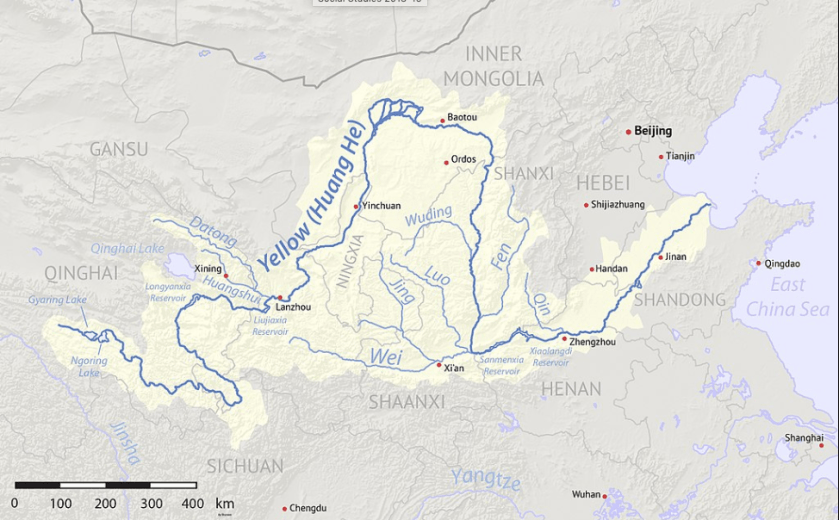
Yellow River Hohhot to GansuShannon1 [CC BY-SA 4.0 (https://creativecommons.org/licenses/by-sa/4.0)]

In the early 2000s there were three types of tickets foreigners could buy for trains. Soft sleeper was the premier class. There were 4 beds to a coach and once situated, you could shut the door and keep the smoke out of your room. This worked best, of course, if you were traveling in a group of 4. Otherwise, there was no way of knowing who you might end up next to. An added benefit to many foreigners was that the soft sleeper cars usually had access to a sit-down toilet. For those not accustomed to squat type toilets, train toilets could create additional challenges.

Hard sleepers were actually more fun. There were two sets of three-layered bunks in each open doored section. Although you often had to scrounge for a place to store your bags, once you finally settled into your bunk, the ride was every bit as comfortable as the soft sleeper. For kids, it was like a giant sleepover and was a highlight of many of their China trips.

Seats were fine for short rides of a few hours and I believe there were different categories of seats as well. Tickets would also be sold with no seat number and during holidays, people would sit anywhere they could park their bums. Including inside the toilet (or so I’m told.)

(note: Trains like the ones we rode back in the early 2000s still exist in China, but China also has high-speed and bullet trains and smoking on trains is no longer allowed. Not long ago, I boarded a high-speed train in Beijing at 10:00 a.m. By 8:00 p.m., I was enjoying a meal with my family back on Hong Kong Island.)

From Hohhot (呼和浩特 Hūhéhàotè) to Baotou (包头市 Bāotóu) is less than 100 miles, as the crow flies. We boarded the hard sleeper in Hohhot, following the northernmost plateau of Yellow River before it dipped down just north of the Ordos Desert (鄂爾多斯沙漠 È’ěrduōsī Shāmò in Inner Mongolia flowing towards Yinchuan (银川市Yín chuān shì) in the Ningxia Hui Autonomous Region (宁夏回族自治区 Níngxià Huízú Zìzhìqū) and ending in Lanzhou (兰州市Lánzhōu), Gansu 甘肃省 (Gānsù Shěng). For a little while starting in Yinchuan, we were close enough to the Great Wall to almost see it. Even if we didn’t see it, we knew it was there.

From Inner Mongolia down to Gansu, we saw monks in robes, Tibetan steles, and prayer flags, all indicators that Buddhism in this part of China was more similar to Tibetan Buddhism than the Buddhism we experienced in the southern and eastern parts of China. It was like traveling from America’s east coast megalopolis into the corn belt of the mid-west. The pace and the mannerisms seemed somehow different.

Chinese Odyssey 54

I was feeling complacent

on the train to Gansu,

reading Renmin Ribao,

eating Mapo Doufu.

Watched the Huang He meander

through loess plateau corn.

On a crumbling Great Wall,

heard a Tibetan horn.


The 3 “manly skills” of Inner Mongolia

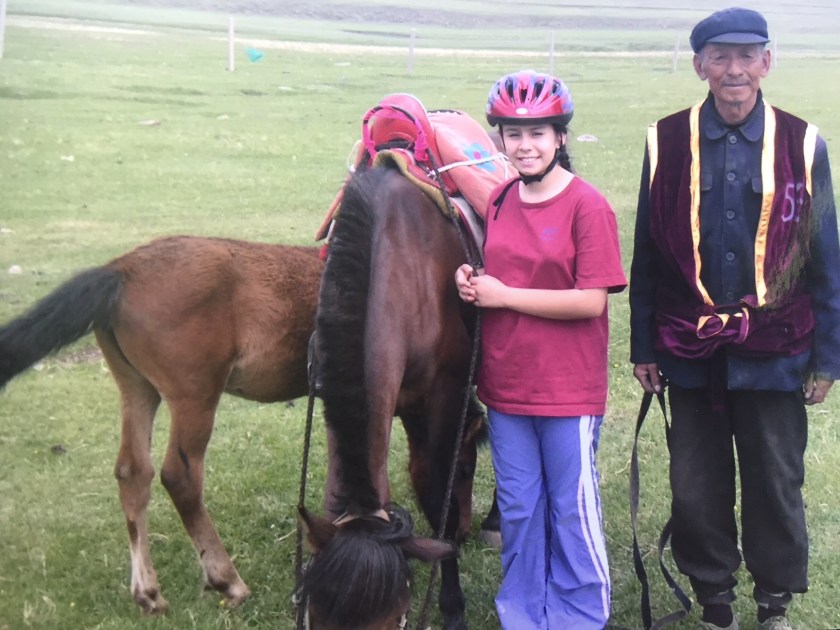
Ana and the Inner Mongolian Saddle

China was only “conquered” twice. First, by Mongolians during the Yuan Dynasty (1271-1368 A.D.) and then by Manchus in the Qing Dynasty (1644-1912 A.D.) Most of what we know today as Inner Mongolia was a part of Mongolia which defeated the Chinese during the Yuan Dynasty. At the fall of the Mongolians to the Ming armies, there were already divisions among the various tribes. At the end of the Qing Dynasty, the new Republic of China incorporated both Manchuria and a large segment of Mongolia into its new Republic. And it wasn’t until 1945 that most of the rest of the world recognized what we now know as Mongolia as an independent country. Inner Mongolia is an autonomous region of China. Mongolia remains an independent country.

Inner Mongolia reminds me of parts of Montana. It’s the 3rd largest political region of China and is a bit off the normal tourist track. Horseback riding and livestock are abundant on the lush grasslands. There are no really big cities. It also has the longest northern border in China, bordering both Mongolia and Russia. In Inner Mongolia, horse riding, archery, and wrestling used to be known as the “three manly skills.”  Rodeo is still big in Montana, but few Montanans wrestle, and guns trumped bows and arrows shortly after Crazy Horse and Sitting Bull defeated Custer at the Little Big Hole in 1876.

We rode horses on rolling grasslands a few hours from Hohhot. Colorful prayer flags like those in Tibet flew from mounds of stones topped with willow branches (敖包 áobāo) and a local family invited us into their house to have tea and sweet cheese. We spoke Putonghua with kids and asked what they would most like and they said “better schools” and asked us if we could stay and teach. After spending time in the schools and hills, it was time to trot back to our cement yurts complete with bathrooms, western sit-down toilets, air conditioners, and hot showers.

The salty butter tea we drank in the yurts we visited was probably made from cow’s milk and not yak. The “cheese” was sweet and chewy and more like candy than the cheese we were used to.

Inner Mongolia’s traditional musical claim to fame is throat singing – Khoomei (songs of eternity), as it is called in Mongolian, starts with a single pitch. As that pitch is being produced, a second, and sometimes a third pitch comes from the same throat and one is able to hear two and sometimes three sounds simultaneously. This happens by the singer tightening or loosening his throat and manipulating his tongue to produce multiple sounds at the same time.

I first heard Mongolian throat singers in Hong Kong in the 1990s and marveled how one person could produce several sounds simultaneously. Traditionally a male art, females are now becoming quite adept at the technique. Khoomei was once practiced only on the pastoral highlands of Mongolia, but has found its way into many parts of Inner Mongolia. “Khoomei” means “song of eternity” and dates back more than 1000 years. In Inner Mongolia, where the Heilongjiang (Amur River in Russia) forms the border between Russia and China, Mongolian hunters began settling in as nomadic farmers and it is in this environment Khoomei is said to have begun. If you’re curious to hear Khoomei, try listening to a youTube entitled “Huun-Huur-Tu – Live” at

https://www.youtube.com/watch?v=i0djHJBAP3U&feature=youtu.be&t=9m41s  In 1929, Arthur Miles tried his luck at Tuvan overtone singing in his rendition of “Lonely Cowboy” Parts 1 & 2 (Dallas, Texas, 1929) hillbilly https://www.youtube.com/watch?v=DpAFZnMyC7o

Chinese Odyssey 53

Our journey continued,

we too headed west

to the grasslands near Hohhot

Mongolian steppes.

Shared yak butter tea

with a family of peasants.

At night we retired

to our yurts, warm and pleasant.

Monkey King vs. the White-Boned Demon – 3 Strikes and You’re Out

Monkey King from Mei Zhong Kuai Bao孙悟空三打白骨精 Sūn Wù Kōng sān dǎ Bái Gǔ Jīng) from 西游記 Xīyóu Jì (Journey to the West)

In CO 30, I wrote about the birth of Sun Wu Kong, the Monkey King, and mentioned how that after he was freed from his internment under the mountain, he and his piggy friend, Zhu Ba Jie (猪八戒 Zhū Bājiè), helped the monk, Tripitaka (三藏經), aka Tang Sanzang (唐三藏) aka Tang Seng (唐僧) aka Táng Zhēn (唐甄), bring the Buddhist scriptures from India to China. This ancient trio of superheroes was often joined by another monk called  Sha Seng (沙僧) aka Shā Wùjìng (), and Tang Seng’s faithful white steed, Bai Long Ma (白龍馬).

“Sun Wu Kong and the 3 hits of the White-Boned Demon” is one of the most loved of the Monkey King stories.

Bái Gǔ Jīng 白骨精 (the White-Boned Demon) hunkered down and licked her lips when Tang Seng passed by.  She knew that if she tasted the flesh of Tang Seng, she would live forever.

In the White Tiger Mountain Range, there lived a young peasant girl who plowed the fields with her mother and father. Unseen by the innocent young girl and her family, Bai Gu Jing flew down and put deadly poison into their drinking water. The young girl took a ladle, and after first serving her parents, she then drank a ladle full of water herself. Within minutes, the entire family lay dead. Bai Gu Jing cackled softly as she moved the bodies to a safe place where they wouldn’t be found.

Soon after, Tang Seng and his followers walked into the clearing.  Sun Wu Kong’s skin began to tingle and he knew he was in the presence of pure evil. “Master”, Sun Wu Kong addressed Tang Seng, “Nearby there are many beings who would like nothing better than a taste of your flesh.” With his magic staff, Monkey drew a perfect circle around his friends and warned them. “Nothing can harm you within the confines of this magic ring. Stay inside while I search for food and water. If you step outside of the circle, you put yourself in great peril.”

As you might expect, Zhu Ba Jie felt his piggy tummy rumbling and soon began to complain. Where is that lazy monkey? I’m famished!” Unbeknownst to Zhu Ba Jie and the rest of the family, Bai Gu Jing had moved her spirit into the body of the young girl and walked on a path towards Tang Seng and Zhu Ba Jie.

“Handsome sir”, she addressed the pig. “Master” she bowed to Tang Seng. “It’s so nice to welcome you to our home.” Bai Gu Jing (disguised as the young girl) moved toward them and was surprised when she could not step into the invisible barrier which protected them.

“Where are you going with that delicious looking basket of food?” asked Piggy.

“I’m taking it to my elderly parents, but I would be happy to share it with you” the girl responded and spread a small cloth on the ground outside of the circle and carefully displayed the food.

“Oh, yes” cried Piggy. “We would love some.” Zhu Ba Jie jumped out of the magic circle and lumbered towards the feast. Bai Gu Jin could barely refrain herself from devouring the pig, but she knew the real prize was the monk.

Hunger finally got the best of Tang Seng, as the sun was setting. As soon as Tang Seng stepped out of the circle, Bai Gu Jing made her move, but Sun Wu Kong came out of nowhere and pummelled Bai Gu Jing with his red cudgel. Neither Tang Seng nor Zhu Ba Jie had seen Bai Gu Jing’s approaching attack, so they were both shocked that the Monkey King would murder this nice young girl.

“What have you done?” shouted Tang Seng. Only the monkey king could see the injured spirit separate from the young girl’s body and move to assuage her wounds.

“Didn’t you see?” cried Sun Wu Kong. That was Bai Gu Jing in disguise.” Tang Seng and Zhu Ba Jie approached the dead girl, but there was nothing to suggest that the girl was Bai Gu Jing. Piggy did notice that the food that he had found so appealing had turned into rocks and sticks, but he said nothing to Tang Seng.

Sun Wu Kong quickly pushed Tang Seng and Zhu Ba Jie back into the magic circle so they would be protected in the event Bai Gu Jing returned.

Tang Seng then began murmuring a Buddhist chant and each time he repeated the chant, the golden headband on the monkey king grew tighter. When Monkey finally cried out in pain, Tang Seng scolded him and reminded Sun Wu Kong about the preciousness of life.

As Sun Wu Kong was recovering from his headache, an old lady approached them. Hiding behind the old lady so only Sun Wu Kong could see her, was Bai Gu Jing.

Zhu Ba Jie cried out. “Master, master. The young girl’s mother is coming. What do we do?”

Tang Seng once again stepped out of the circle and approached the women. “Venerable lady, your daughter is dead. She was accidentally killed by my overprotective disciple. Please forgive us. Please forgive us.”

“My poor innocent daughter. How could anyone suspect her gentle soul to be a threat to anyone? How could you? How could you?” She rushed towards Tang Seng.

Again, neither Zhu Ba Jie nor Tang Seng saw the transition from an old lady to the White-Boned Demon.  What they did see was the lightning speed of Sun Wu Kong’s staff as it broke open the head of the old lady – unaware that Bai Gu Jing had already killed the old woman earlier that day. In the eyes of Tang Seng and Zhu Ba Jie, Sun Wu Kong had murdered yet another innocent woman whose only crime had been to react to the death of her daughter.

“Wu Kong”, yelled the master. “You’ve done it again. Another innocent person died due to your overreaction to an imaginary threat. You may no longer accompany me on my sacred journey. I cannot be protected by a murderer. Leave now, and never return.”

“But Master,” cried Sun Wu Kong. “The old lady was Bai Gu Jing as well. Didn’t you see her fangs as she came in to kill you? Did you not see the speed and power of her movements? Those were not the moves of an old lady. That was Bai Gu Jing!’

“Leave now, Monkey. I am no longer your Shifu (master).

“Shifu. Shifu.” Monkey pleaded as he watched Tang Seng and Zhu Ba Jie continue on.

But the Monkey King could not leave. Sun Wu Kong knew that his master and his friend were in grave peril and that the violence he had been guilty of committing was only to protect his master and the scriptures. So, he followed at a distance and when they were stopped by an old man, Sun Wu Kong’s hair once again stood on end.

“Nan wu a mi to fo, nan wu a mi to fo”  The old man was chanting a time-honored Buddhist prayer. Hiding behind him was Bai Gu Jing.

Zhu Ba Jie asked Tang Seng. “Master. May I go bless that old man and give him an offering.”

Tang Seng responded. “No, let me go. You’re too ugly. I’m afraid you would frighten him off.” Zhu Ba Jie stood pouting.

Tang Seng approached the old man and said. “Greetings, honorable gentleman.”

“Hello, kind sir.” said the old man. “Welcome to our countryside.”

“Do you have a family?” enquired Tang Seng

“I have a young daughter.” Responded the old man. She left this morning and has not yet returned. My wife went out looking for her, but she hasn’t come home either.”

“Master” whispered Zhu Ba Jie loudly. “Those were the two people that the monkey killed.”

As the old man reacted, Tang Zhen shouted out. “We are so sorry. Forgive us, please.”

“Forgive you?” Bai Gu Jin shouted as she threw down the husk of the old man and appeared in all of her ugliness and splendor. “Ha, ha, ha! Not only will I forgive you, I will consume you. I will eat you and then I will live forever. And since you banished Sun Wu Kong, no one will come to your rescue.”

Bai Gu Jin stepped forward to devour Tang Seng, but this time, Sun Wu Kong dealt the death blow and Bai Gu Jing ceased to exist.

“Wu Kong, you’re here! How?” asked Tang Seng.

“You are my shi fu, master. Wherever my master is, that is where I will be.” That was the only response the Monkey King had to give.

Chinese Odyssey 52

A monkey, a pig,

and a priest on a quest

set out on a journey

which took them out west.

Their harrowing stories

are known far and wide;

Tang Seng, Zhu Ba Jie,

Sun Wu Kong was their guide

When the end is the beginning

Tiger Leaping Gorge Sea of Clouds blurry

The old lady on the road was right. I probably knew more about China than most foreigners, but I had still barely scratched the surface. But, I was discovering words and ideas on my “journey” that I kept bumping into, no matter where I was in China, and many of them led back to Lǎo zǐ  (老子) and the Dào Dé Jīng (道德经), that 5000 character, 81 chapter canon which forms the foundation of  Daoism a.k.a. Taoism. There is something compelling and homegrown about the character “道 dào”, which translates as “path” or “way”. Growing up in the West where the scientific method makes one search for answers. Paths and ways must have beginnings and end points. . . mustn’t they? Yet, according to the Dao De Jing, 有 “yǒu”(to have) and 無  “wú”  (to lack) are born from one another. Difficult and easy complement each other.  It is only because people accept certain ideas of beauty, that the concept of ugliness even exists. Does contrast define? Can there be a path with no beginning and no end point?

Laozi forced me to think differently. The lessons are often simple and profound which makes them even more difficult to translate into English. Take for example, wú wéi (無爲 ). Wu wei is often translated as “non-action”, but what is action? Is it movement? Can you be involved in “action” without instigating or influencing action? Wu wei does not mean non-doing or non-action, but rather not attempting to influence action.” Sort of a ‘go with the flow.’ Indeed, Laozi said that the highest good was like water. Water is content with wherever it is. But even when water moves, it is never the instigator of the move. Water is powerful like the Dao.

Laozi said that the space where there is nothing is the most important space. It is into the space of a cup where there is nothing that tea is poured. It is into the space where there is nothing that light flows into a building. And it is into the space where there is nothing that a wheel moves into. Just as we appreciate and take advantage of what is, we should also recognize the usefulness of what is not.

In the Dao De Jing, we are introduced to the simplicity and the power of the “uncarved block” and asked to question both wisdom and knowledge and to embrace selflessness and lessening of desire. Once the block is carved, there will be names. Like Zhuangzi’s “ugly tree” (see CO 2), Laozi believes that straight only manifested itself next to the crooked, that it was the hollow that could be made full, and that one can be defined without defining oneself. Laozi warns us that we should not tamper with Heaven and that those who tamper with it, lose it. One does not glorify nor boast about what one has done. One of my favorite passages is where Laozi said that when Dao was lost, only power remained. When power dissipated, there was human kindness; after human kindness left, there was morality; and then ritual. Laozi said that ritual was “the mere husk of loyalty and promise keeping” and eventually led to brawling which is “the beginning of folly.” (Laozi and Arthur Waley. The Way and Its Power: A Study of the Tao Tê Ching and Its Place in Chinese Thought. New York: Grove Press, 1958. Print.)

Laozi says that the loftiest power can appear as an abyss; the way into the light can seem dark;  the purist state can look faded and disheveled; and the loveliest music can have the subtlest notes. The Dao is often hidden in plain sight. One can therefore see without looking and by doing nothing can achieve everything.

I was on the edge of the precipice and staring into the west of China – the void. I knew how to float and to swim. It was time to leave that part of China where I could touch the bottom of the pool and move into the deep end.

Chinese Odyssey 50

“You think you know China,

you’ve been to the core.

Your journey’s just started,

Go west and see more”

How could she have known that

from “reading” my face?

Yet her message was clear,

no doubt. Not a trace.

Entering the Tiger’s Lair

Tiger_Cub

Keven Law [CC BY-SA 2.0 (https://creativecommons.org/licenses/by-sa/2.0)%5D

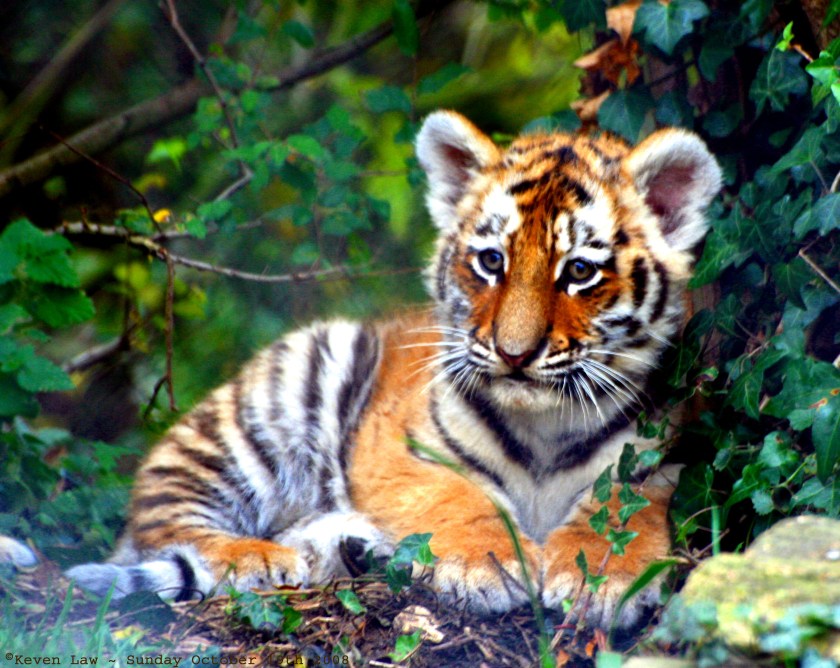
不入虎穴,焉得虎子 (bù rù hǔ xué, yān dé hǔ zǐ)  “To catch the tiger cub, one must enter the tiger’s lair.” Problem was, I found myself in the middle of the tiger’s lair, but I had no desire to catch a tiger cub. I was, however, enjoying my surroundings and was curious to know more. There’s another Chinese saying, 不到长城非好汉 (búdào chángchéng fēi hǎohàn).  “You can’t really call yourself a real man (hǎohàn) until you been to the Great Wall of China.” I’d been to the Great Wall, but I still didn’t feel that I’d earned my “hǎohàn” merit badge.

Not sure when the “tiger cub” idiom first appeared, but the best-known backstory centers on an historical figure by the name of Bān Chāo (班超) who hailed from Xianyang in the province of Shaanxi. He was both a military leader and a diplomat who lived in the Eastern Han dynasty during the first century A.D. The story goes that Bān Chāo, along with 36 subordinates, was on a diplomatic mission for the Eastern Han Emperor to visit the kingdom of Lóu Lán (楼兰) in the Tarim Basin, located in the present day Xinjiang Uygur Autonomous Region. He had been asked to cement a relationship with its king. When Bān Chāo arrived, he was given a warm reception and things were looking good. After a few days, however, things seemed to cool down. He learned that another delegation had arrived at about the same time as his. This much larger delegation were Xiongnu (匈奴), fierce warriors from northeastern China.  Bān Chāo knew the only real weapon he possessed at that moment was surprise. He sent 10 men to beat drums and start shouting. The rest of  Bān Chāo’s men lay in ambush and swiftly slew 30 of the Xiongnu soldiers, including the leader, whose head he severed. The remaining Xiongnu fled the kingdom erroneously believing that they had been attacked by a large Han force.  The next day, Bān Chāo presented the severed head of the Xiongnu leader to the King of Lóu Lán, and the Lóu Lán King decided to form an alliance with the Eastern Han. Bān Chāo had entered the tiger’s Lair and had successfully captured the tiger cub.

As I was writing this, a third idiom came to mind. Yue Guang(樂廣)invited a friend to a bar about a thousand years ago during the Jin Dynasty(晉朝). While tippling and staring into his cup, the friend appeared startled and suddenly left the bar. Wondering what had happened,  Yue Guang popped by his friend’s home later on to make sure he was OK.  “I thought I saw a snake swimming in my drink.” said his friend. “It really scared me so I came home.” Yue Guang was curious. He went back to the bar and sat at the same spot his friend had sat and drunk the same drink. Then he smiled. The snake his friend had seen, was, in fact, the reflection of a bow that was hanging on the wall. He quickly returned to his friend’s house and explained the illusion. . . and they went back to the bar and finished their drinks.

I knew I was no Bān Chāo. There have been a few times in China, however, when I have felt a little like Yue Guang’s friend,  where I may have possibly mistaken a snake for a bow  杯弓蛇影(bēi gōng shé yǐng.) The road back to Beijing reminded me of the snake in the cup, but my eyes closed and I drifted back into the tiger’s lair.

Chinese Odyssey 49

The road back to Beijing

was curvy and long

We spied an old lady,

but something seemed wrong.

She beckoned us over

and said that she knew

some secrets about me

and things I must do.


Fishing at the Great Wall

Fishing at the Great Wall

Walls in China pre-date the earliest historical dynasties. Built as enclosures, walls have been a part of every Chinese village and city for most of China’s history. Indeed the character chéng (城), depending on how it is used, can colloquially mean either wall or city. Beijing, Shanghai, and Nanjing all had walls surrounding them, long gone now. Today, you can rent a bicycle to ride the nearly 14 km perimeter on the top of the city wall of Xi’an, one of the few remaining city walls in China.

In his quest for immortality, Emperor Qin Shi Huang burned books and destroyed historical records so that Chinese history would recognize him as China’s first emperor. Some historians believe that the name “China” came from Qin (pronounced “chin”). It was this emperor who had over 6,000 life-sized terra cotta soldiers and horses made to protect him in the after-life. And, it was Emperor Qin, China’s most narcissistic ruler ever, who decided that he wanted to unite the already existing walls into a barrier wall that would protect all of China and keep the northern barbarian invaders from entering into his kingdom.

Stretching from Shanhaiguan (山海关区)  in Hebei Province, 270 km northeast of Tianjin, the Great Wall stretches about 2,250 km (1400 miles) across northern China to the final resting post, Jiayuguan (嘉峪关) in Gansu province. It varies in dimensions, but is nearly 10 meters tall (over 30 feet) in some places and is as wide as a single lane road on the top. It crosses deserts, steep mountain passes, and plains. Combining the lengths of all the tributary walls with that of the northern wall, it is estimated that the Great Wall stretches for nearly 8,000 km (5,000 miles) in length.

Only a fraction of the current Great Wall was initially connected together by Emperor Qin. Most of the Great Wall was built during the Ming Dynasty (1368-1644). The Ming Dynasty overthrew the Yuan Dynasty which had been ruled by the Mongolian people to the north. A large portion of the Great Wall was built to prevent another invasion from the Mongolian steppes. There is no way of ascertaining the human cost of building the wall. Historians believe that the number of people who died constructing the wall exceeds 1,000,000. Scientists all agree that there’s no way that a person could make out the Great Wall or any other man-made construction from the moon. And most military minds agree that a wall is an ineffective way of protecting a border.

That said, the Great Wall is impressive. And it’s crowded. Remember my formula for visiting Chinese sites. Walk for 10 minutes and the crowd diminishes by half; another 10 and it can be quiet; 30 minutes and you can be by yourself. Definitely the case for the Great Wall. All the sites are impressive. That’s why they were chosen in the first place. I think my favorite – so far – is the 10 km stretch of the ‘wild’ wall starting at Jinshanling (金山岭) and ending at Simatai (司马台). One used to be able to walk the entire stretch pretty much hassle free. In recent years, certain parts have been closed off for a variety of reasons. At the Simatai end, there used to be an amazing zip-line that would take you from the wall itself over a reservoir onto a platform right outside the tourist area of Simatai. Probably not the safest of Chinese tourist attractions, but maybe they’ve upped the standards. Sure was fun!

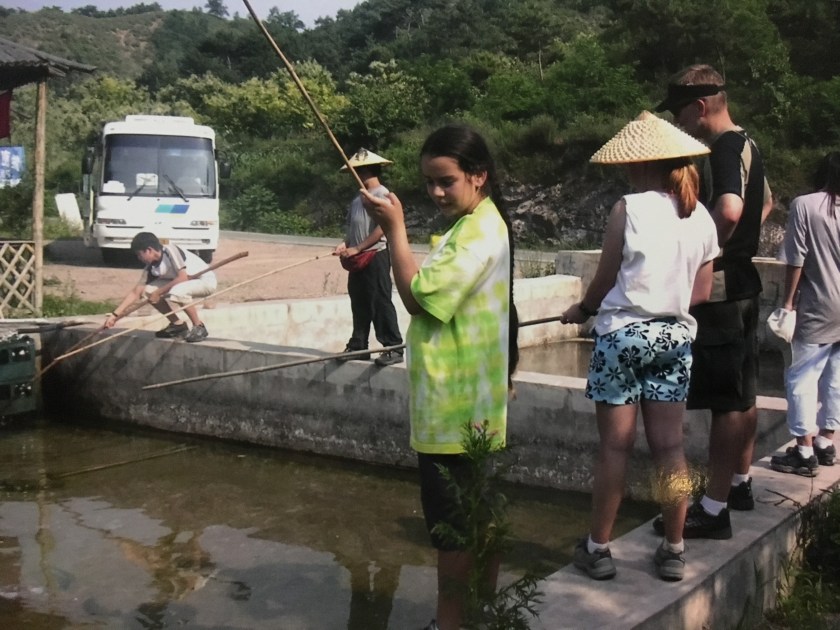
Outside the walls at Badaling (八达岭), Simatai (司马台),  and Mutianyu (慕田峪), there were fishing ponds where you could rent cane poles with hooks covered in balls of dough which you cast into small concrete fishing pools teaming with rainbow trout and salmon. After catching a trout, it would then be barbequed on a wood fire and served with local greens and a kind of cornbread. My Montana fly-fishing father is probably turning in his grave reading this, and it wasn’t much of a fishing experience, but the local people did know how to barbeque the fish and they were delicious.

Chinese Odyssey 48

Outside of Beijing

at the Jinshanling wall,

we scrambled and trekked

trying hard not to fall.

We slid down the zip line

into Si-Ma-Tai,

went fishing for trout

on the 4th of July.