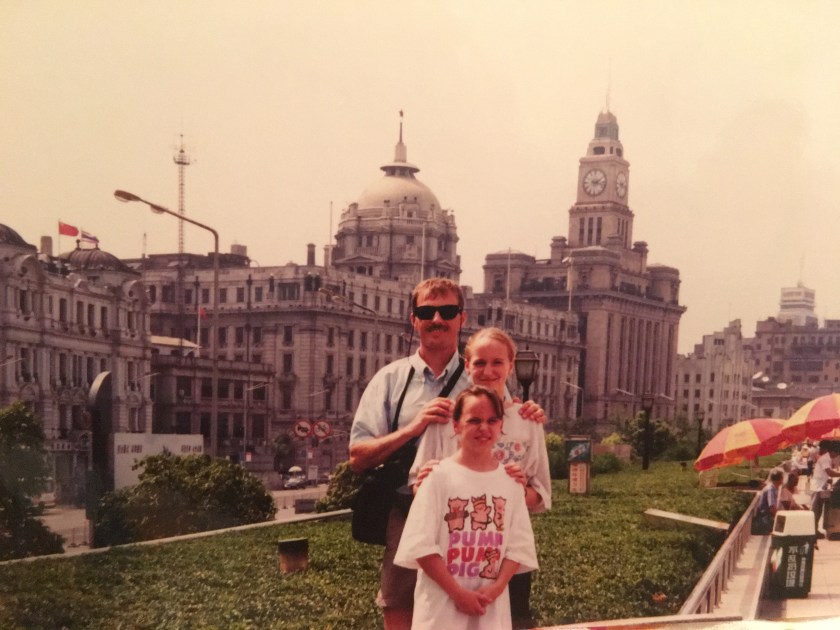
Shanghai

Brockberg, Bund, Pump Pump Pig

One of my favorite Stephen Spielberg movies is “Empire of the Sun.” I love seeing the young Christian Bale playing the role of J. G. Ballard, the author of the book by the same name. I also marvel at the access Speilberg got to Shanghai as it was transitioning from the ravages of the Cultural Revolution to the boom of the 1990s. The opening shots of the film remind me of a quote from J.G. Ballard’s novel:

“Every night in Shanghai those Chinese too poor to pay for the burial of their relatives would launch the bodies from the funeral piers at Nantao, decking the coffins with paper flowers. Carried away on the tide, they came back on the next, returning to the waterfront of Shanghai with all the other debris abandoned by the city. Meadows of paper flowers drifted on running tide and clumped in miniature floating gardens around the old men and women, the young mothers and small children, whose swollen bodies seemed to have been fed during the night by the patient Yangtze.” 

With its current population of 24 million plus (nearly 3 times that of New York City), Shanghai is the most populous city in the world (within a single administrative region.) Although Shanghai displays some of the world’s most modern architectural structures,  it has also decided – at least for the moment – to preserve one of the richest collections of art deco architecture of any city in the world. The Bund  (外滩 Wàitān) remains the image which comes to the minds of many Westerners when they hear the name, Shanghai.  The word, “bund” is a hybrid Persian, Hindi, English, and German word with the original meaning “embankment”. The traditional Bund is a mile-long stretch along the river in Puxi. Pu is short for Huángpǔ (), the river which divides Shanghai into Pǔxī 西 (west of the Huangpu) and 浦东 Pǔdōng (east of the Huangpu). Along the two sides of the Huangpu now  stands the 2017, 128 story, energy efficient, typhoon resistant Shanghai Tower上海中心大厦, the 2008, 101 story Shanghai World Financial Center上海环球金融中心, and the hybrid modern/art deco 88 story Jin Mao Tower金茂大厦 (1999), alongside the 10 story Fairmont Peace Hotel上海费尔蒙和平酒店(1926), the 17 story Bank of China Building 中国银行大厦 (1937), and the iconic Cathay Theater 国泰电影院 (1932). Shanghai is definitely worth visiting for its architecture alone.

The city of Shanghai is one of four Municipalities (直辖市 Zhíxiáshì) in China. The other three are Beijing, Tianjin, and Chongqing. A municipality in China operates in a similar way to the District of Columbia in the USA. Municipalities are not considered to be part of any province. Municipalities are under the direct administration of the Chinese central government.

In the 1920s, Shanghai was known as the “Paris of the Orient”, and was China’s most international city. There was opulence sitting next door to abject poverty. Whitey Smith played jazz in the Astor House, the Paramount, and the Fairmont. The Green Gang lead by Big Eared Du (杜月生 Dù Yuèshēng) controlled the lucrative opium and heroin trade. The latest Hollywood films showed at the Cathay Theater, and flappers wore the same outfits and hairstyles as their counterparts did in New York, London, and Tokyo.

Shanghai was also a city of politics. The first congress of the Communist Party was held in Shanghai in July 1921. It’s formal name, Zhōngguó Gòngchǎn Dǎng 中國共産黨 was also established at that time. Just two years prior to that, the May 4th movement (五四运动 Wǔsì Yùndòng) had erupted in Beijing partially due to the granting of European concessions to the Japanese in Shanghai and partly to protest against the 21 demands made by the Japanese directed at China. In 1927, a youthful Chiang Kai-Shek, recognizing the imminent threat of the Communists to his Guomintang (KMT) Party, conducted what became known as the Shanghai Massacre, when he sent in his troops and conscripts from the infamous Green Gang to wipe out the Communist scourge from Shanghai. By 1934, the Communists were pretty much gone from Shanghai, with most following Mao on the Long March.

Another classic 1920’s mansion, Shanghai’s Jinjiang Hotel (锦江大酒店), formerly the Cathay Mansion, was the site of the historic 1972 meeting between US President Richard Nixon, and Premier Zhou Enlai where the Joint Communique of the USA and the PRC aka the Shanghai Communique, reopened the relationship between the US and China.

Like its “sister city”, Hong Kong, 1200 km to the south, Shanghai has always prided itself as an international city. And there is definitely a friendly rivalry which exists between these two behemoths. Although Shanghai’s population is three times that of Hong Kong, Hong Kong’s population density is nearly twice that of Shanghai. At age 32, Shanghai’s median age is 10 years younger than Hong Kong. Rent in HK is roughly double that of rent in Shanghai. Transportation is twice as expensive in Hong Kong, but ease of transportation has Hong Kong far exceeding Shanghai. That is one of the main reasons that Hong Kong is easier for families than Shanghai. Getting a Hong Kong drivers license is fairly simple and many ex-pats have cars. More would if parking was less expensive and more accessible. The internet is reasonably fast in Hong Kong and there are no firewalls preventing communication of controversial topics. Both private and public medical care are easily accessed in Hong Kong and there are always competent English speakers for those who don’t speak Chinese. Restaurant food’s cheaper in Shanghai, but both places sport some amazing eateries. I think if I was young and single, I might choose Shanghai over Hong Kong just because of its potential. Being neither young nor single, however, Hong Kong’s definitely the place for me.

Chinese Odyssey 37

Our leisurely train went

northeast to Shanghai.

The Bund was amazing!

We all wondered why,

in the middle of China

the majestic Huangpu

mirrored art deco skylines —

split Shanghai in two.


Joseph Needham & the Grand Canal

emperor yang di and the grand canalCHINA: EMPEROR AND BOATS. – Yang Ti, Sui emperor of China (604-618), and his fleet of sailing craft, including a dragon boat being pulled along the Grand Canal. Painted silk scroll, 17th century.. Fine Art. Britannica ImageQuest, Encyclopædia Britannica, 25 May 2016.
quest.eb.com/search/140_1707542/1/140_1707542/cite. Accessed 29 Jan 2019.

Most people don’t spend a lot of time thinking about canals. We’re all familiar with the Panama Canal and the Suez Canal. If you studied elementary school music when I did, you learned the American folk song, “The Erie Canal.” It does seem strange to me, however, that  I had never even heard of the longest man-made canal in the world. Stretching well over 1,000 miles (think NYC to Miami) from Hangzhou to Tianjin, construction started nearly 2,500 years ago during the Spring and Autumn period. It didn’t really become the “Grand Canal” 京杭大運河 Jīng-Háng Dà Yùnhé  though until the short lived Sui Dynasty, about a thousand years later. When completed, it connected the Yellow River 黄河 Huáng Hé, the Qiantang River 钱塘江 Qiántáng Jiāng, and the Huai River 淮河 Huái Hé, with the Yangtze River 长江 Cháng Jiāng and, through a series of tributaries extended west all the way to the ancient capital of Chang’An 長安  (near present day Xi’An 西安).

Sui Emperor Yang Di (帝 Suí Yángdì) conscripted upwards of 5 million people to build the section of the Grand Canal from Luoyang to Beijing during the Sui Dynasty. Nearly one of three of these laborers died.  It was created to transport grain from southern China to Beijing and was also used to supply and reenforce military operations. When finished, Emperor Yangdi traveled on a huge boat pulled by hundreds  of men. The canal was 40 metres wide, large enough to transport boats which could carry over 100 people. In many ways, the Grand Canal is reminiscent of the Great Wall. It was a labor intensive project which took many centuries to complete.

Some of the most amazing parts of the Grand Canal, however, are the locks. These are the parts of a canal used for raising and lowering boats, enabling them to navigate in significantly lower or higher terrain. The way a “pound lock” works is by using the gates at either end of a chamber to “lock” water in where the boat is positioned. The gates control the amount of water let in, thus raising and lowering the level of water in the chamber allowing the boats to float up or lower down. Pound locks were first created by the Chinese on the Grand Canal during the 10th  century. Altogether, there were 24 locks on the Grand Canal.

To my knowledge, Joseph Needham (Lǐ Yuē sè), never made it to the Grand Canal. He did, however, recognize both the significance of the “pound lock” and the magnificence of the Grand Canal in Science and Civilization in China, his epic compendium of scientific discoveries and inventions in China.

According to Arthur Toynbee in the London Observer, Joseph Needham was able “. . . to interpret the Chinese mind in Western terms, and he is perhaps unique among living scholars in possessing the necessary combinations of qualifications for this formidable undertaking. The practical importance of Dr. Needham’s work is as great as its intellectual interest. It is a Western act of ‘recognition’ on a higher plane than the diplomatic one.“

Joseph Needham, like the Grand Canal, was quite remarkable. In his early 20’s, already an esteemed scholar and biochemist at Cambridge, Needham knew very little about China until 1937, when he became infatuated with both the Chinese language and a young female biochemist from China by the name of Lu Gui Zhen. Already fluent in seven languages, at the age of 37, Needham decided to learn Chinese. Within 2 years, he could read nearly 5000 Chinese characters and was able  to read authentic Chinese classical texts. He made his first trip to China in 1943, towards the end of WW2, when the Japanese occupied vast portions of China.  By flying “over the hump” (the Himalayas) to Kunming in the province of Yunnan, he was able to set up and office and lab at a university in Chongqing, Sichuan. As the result of several chance encounters during the course of his research, Needham became aware of the magnitude of China’s scientific acheivements and contributions to the world and was appalled that most of the world outside of China was ignorant of those contributions. So, Needham started a quest which was to be continued throughout the rest of his life. He would enlighten the West about China’s genius through a series of books he was prepared to write. By the time of his death in 1995, 17 volumes of Science and Civilization in China had gone to print and they rocked the world of science as the West had come to know it. In a strange twist, it rocked the world of many Chinese as well.

If you’re not quite ready to jump into Science and Civilization in China, but are curious about Joseph Needham, I strongly recommend listening to Lazslo Montgomery’s 2-part podcast, #’s 155 & 156 from his amazing China History podcast:

https://www.teacup.media/2015/06/24/chp-155-joseph-needham-part-1/

https://www.teacup.media/2015/07/14/chp-156-joseph-needham-part-2/

A fantastic book about Joseph Needham, published in 2009,  is the New York Times best-seller,  The Man Who Loved China by Simon Winchester. Also, strongly recommended by moi.

Chinese Odyssey 36

In the Sui (before Tang)

a long, long time ago,

China built a canal

from Beijing to Hangzhou.

A million men worked

so that Emperor Yang Di

could inspect his kingdom

in pompous luxury.

Tales from Hangzhou

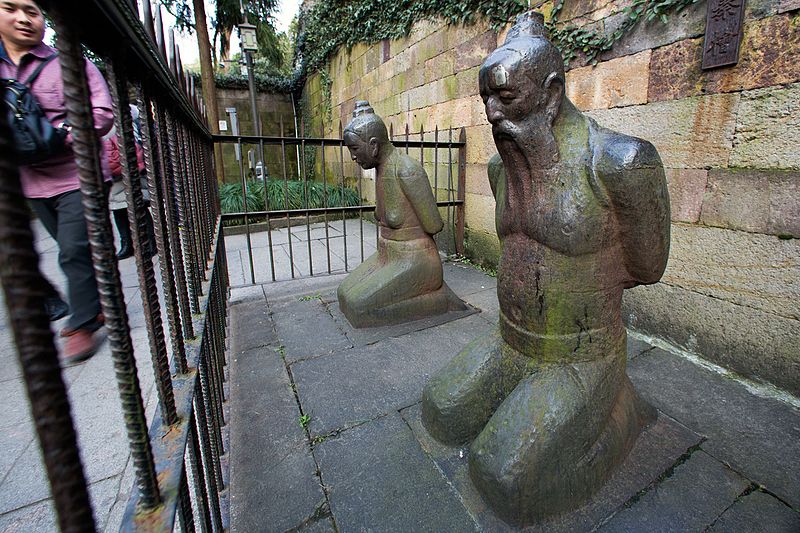
qin hui and lady wangQin Hui and Lady Wang  –  Morio [CC BY-SA 4.0 (https://creativecommons.org/licenses/by-sa/4.0)%5D, from Wikimedia Commons
My introduction to Hangzhou was poetry. When I first gazed on West Lake, I couldn’t wait to search out Ping Hu Qiu Yue aka Placid Lake Autumn Moon (平湖秋月 Pínghú Qiūyuè). It was the nexus of West Lake, where one could watch clouds flying and the reflection of distant hills, while sipping the perfect cup of Long Jing Green Tea under a full Autumn moon. Visually, it was all I had hoped for. I knew the tea house would look and feel old and weather-worn, but that was OK. Pen and notepad in hand, I sat down to compose a poem. Unfortunately, a very loud and excited member of our China tour named Bill, from the Bronx, saw me sitting alone and thought I wanted company. I never did get my poem written. Thankfully, I can borrow and share one from Tang Dynasty poet, Su Shi (aka Su Dongpo 苏东坡.)

 曲:

盘。

看?

 Yang Guan Qu: Zhong Qiu Zuo by 苏轼 Su Shi

Mu yun shou jin yi qing han

Yin han wu sheng zhuan yu pan.

Ci sheng ci ye lou chang hao,

Ming yue ming nian he chu kan ?

Mid-Autumn Composition by Su Shi

Sunset clouds together and then dissipate, air clear and cold

Milky Way without a sound, moon moves across the sky。

This life, like this evening, not always so good

Next year, where will I be living to see this moonlight?

I did, however, get to see much of the West Lake the poets wrote about. There was the mountain crag called the “Peak Who Flew in from Afar” (飞来峰 Fēilái Fēng), that legend claims transported itself from India, the Six Harmonies Pagoda (六和塔 Liùhé Tǎ), which, for centuries served as a lighthouse on the Qiantang River, and the Broken Bridge (断桥duàn qiáo), backdrop for the Legend of the White Snake, where a young boy innocently consumed immortality pills, thinking he was eating sweet dumplings. The sweets seller,  actually one of the eight immortals, seeing what had happened, made the boy regurgitate the pills into the water by Broken Bridge where they were consumed by a small white snake swimming by. As you might imagine, there is a lot more to that story.

My favorite tale, however, is about the patriot, Yue Fei (岳飛 Yuè Fēi). He was born into a poor, but very patriotic family. When he was young, his own mother engraved the tatoo, 盡忠報國 jìn zhōng bào guó  “serve the country with the utmost loyalty”, on his back, and that message served as Yue Fei’s driving force. Yue Fei later managed to become both educated and a respected general in the Jin military. While fighting to recover Kaifeng, the Northern Song capital,  Yue Fei was called back to Hangzhou by the Emperor Gaozong (宋高宗Sòng Gāozōng), but he failed to heed that call initially. Qin Hui (秦桧) falsely accused Yue Fei of being a traitor to his country on some trumped up charges and Yue Fei was put to death. Although later history points much of the finger of guilt at Emperor Gaozong, it was Qin Hui and his wife, Lady Wang, who were to ultimately be remembered – in a very unique manner – as traitors to China.

One of the most popular pastries in China is called You Tiao (油條). Some people liken You Tiao to a donut without sugar, but it’s shape is a bit like that of two foot-long hotdogs glued together. In Taiwan, we used to eat youtiao with steaming hot doujiang (soybean milk) for breakfast. In Hong Kong, people will often eat these alongside their morning jok, aka congee (粥 zhōu).

The story goes that a doughmaker and his friend were sitting around at the end of the day, reeling about the unjust death of Yuefei and the dispicable nature of Qin Hui and his wife, and the doughmaker picked up a couple of pieces of remaining dough and said. “This is what I’d really like to do with those two. He stuck two long pieces of dough together, fashioned faces for each, and dropped them into boiling oil. Take that, you traitors, you “deep-fried devils” (油炸鬼 yóuzháguǐ). The Cantonese term, yàuhjagwái, is still popularly used for youtiao.

I would be remiss, however, if I didn’t update my story to the year 2018. As my Chinese friends would say, “bian hua hen da” (變化很大  biànhuà hĕn dà) – the change is enormous. I really didn’t recognize Hangzhou the last time I went there. I flew into a small, but very modern, airport.  My friend, Stan, said its faster for him to fly from the old Songshan airport in Taipei to Hangzhou than it is to go from his home in Taipei to the main Taipei airport. Streets once crowded with bicycles are now jammed pack with cars, and the air is a constant grey from the accompanying smog. Although many of the low-rise places along West Lake itself have been preserved, high rise, modern architecture abounds. There is a Starbucks now not far from Ping He Qiu Yue. Maybe great poems are being written there now over Caramel Macchiatos.

Chinese Odyssey 35

Our next stop, Hangzhou,

placid lake, autumn moon

broken Bridge, riding bikes—

took a break around noon.

Paid respects to Yue Fei,

ate some zongzi for free.

Like the Emperor Qian Long,

sipped Dragon Well tea


Crouching Tiger, Hidden Dragon

fei cui pool

There are only a handful of Chinese films which have enjoyed even moderate success in the West. In 2000, Ang Lee gathered together an all-star cast including Chow Yun-fat, Michelle Yeou, and Zhang Zi Yi. In the USA, “Crouching Tiger, Hidden Dragon” was the highest grossing foreign-language film produced overseas, and it won the Academy Award for the Best Foreign Language Film in 2001.

About 40 km from the Yellow Mountains (黄山 Huángshān) sits the village of Hongcun  (宏村 Hóngcūn). When we walked through it 10 years ago, it was a quiet step back into a past where a village was built around a pond. I remember the amazing wood carvings surrounding the doors and windows opening into homes where villagers would invite strangers in to share a cup of tea.

It was in this village that Chow Yun-fat’s character journeyed to rid himself of the Green Destiny sword which he had wielded as a hero and master of martial arts. The sword, meant as a gift to an old friend, was stolen, and once again found itself to be a weapon. Chow Yun-Fat’s character tries to rid himself of the sword by throwing it into the Fei Cui pool (翡翠池 Fěicuì chí) , but Zhang Zi Yi’s character recovers it. It emerges once more  in a struggle to the death with his old nemesis, Jade Fox. Michele Yeoh and Zhang Ziyi personify both the beauty and the strength of female martial arts heroes as they beguile and subdue anyone standing in their way. Sword fights, acrobatics, and a variety of martial arts find our heroes running on the tops of the swaying leaves and forests of bamboo which cover the hills of southern Anhui, and flying on the back of wild horses dashing through the the wild valleys and crevasses of Xinjiang chasing down a robber who becomes a lover.

Hongcun village was the village where many of the characters first came into contact. The pond in real life is just as it was in the movie and it was easy to imagine the story when walking through the village. We were told by the local people that the village was in the shape of an Ox with a nearby hill and trees forming the head and the horns. The upturned roofs on the houses of Hongcun are known as horses heads for the way the edges of the roof flow down in rivulets like the mane of a horse.

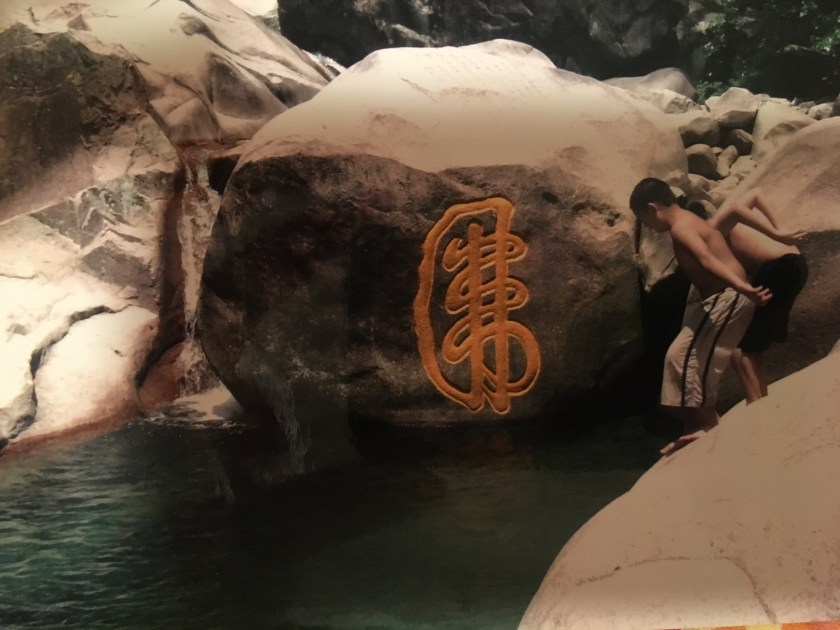
The real magic happened for us, however, when we accidentally found our way to Fei Cui pool in Huang Shan. This was the pool, we were told, where the Green Destiny sword was flung. When we arrived, there was no one there. Our kids were in shorts. There were no signs that said “no swimming”. So for about two hours, we got to play in a crystal clear water pool at the base of Huang Shan. When a man did come by and told us that we weren’t supposed to be swimming there, I let him know that I was a lifeguard in a former life and the kids were perfectly safe. I was probably playing the “ask forgiveness” card once again, but it all worked out in the end. We had a beautiful afternoon frolicking in the waters at Fei Cui pool.

Chinese Odyssey 33

They say Hongcun village

is shaped like an Ox.

Reflections are magic —

jade eyes of a fox.

Green Destiny’s message

was crystalline clear

in the pool at Fei Cui

its message, ‘no fear’.


Cold Mountain (寒山 Hán Shān)

Hanshan and Shide

This stone rubbing is from an engraved stone stele in the Han Shan Temple in Suzhou.

from Gary Snyder’s translation:

“White clouds gather and billow.
Thin grass does for a mattress,
The blue sky makes a good quilt.
Happy with a stone under head
Let heaven and earth go about their changes.”

Snyder, Gary, Gary Snyder, and Hanshan. Riprap & Cold Mountain Poems. San Francisco: Four Seasons Foundation, 1965. Print.

One of my all time favorite poets is thought to have lived more than 1000 years ago in Tang Dynasty China. No one knows what Han Shan’s real name was nor where he was from, but the cave called Cold Mountain, where he is said to have lived, is in the province of  Zhejiang, about a day’s foot journey from the sacred range of mountains called Tian Tai (天台).

One commonly held story is that an official by the name of Lu Jiuyin 閭丘胤 Lǘqiū yìn went to Mount Tiantai in order to meet Han Shan.  He was told that there were actually two Bodhisattvas living there, Han Shan 寒山 and Shi De  拾得.  Asked how he might know them, he was told, “If you see them, you won’t recognize them; if you recognize them, you won’t see them.” He didn’t see them, but they saw him.  And when they did, they laughed out loud and ran away, obviously having no desire to meet him.

When I first read Gary Snyder’s translation of 24 of Han Shan’s 300 poems, the translations and interpretations – by the young 24 year old budding poet – of the words and antics of Han Shan, spoke to me, and now, nearly 50 years later, I’m still listening.

Patrick Murphy noted in his preface of Snyder’s book, Riprap & Cold Mountain Poems: “These poems are something more than translations precisely because Snyder renders them as a melding of Han Shan’s Chinese Ch’an Buddhist mountain spirit trickster mentality and Snyder’s own mountain wilderness meditation and labor activities. The suite of 24 poems was published in the 1958 issue of The Evergreen Review, and the career of one of America’s greatest poets was launched.”

It was partly the sacrilege of Han Shan’s poetry that appealed to me. I loved that I never knew whether Han Shan and Shi De were Zen (Ch’an) Buddhists or Daoists or neither or both. Neither did religion own them, nor did they necessarily embrace a religion. I loved that they worked hard at menial tasks and were true to their own natures. They knew then that the answers were not to be found in the gadgets and the glitz and the glamour that so defined success in the eyes of so many. In years past, they may have been “boomers” who worked the buck rakes and beaver slides on the large cattle ranches in Montana, or the “old uncles” in American Chinatowns sipping Po-lay and reading the China Times, after the Chinese exclusion act insured that these men would remain bachelors until the act was repealed in 1943. Today, these old people might be homeless street sleepers in any large metropolitan area in the world. These men and women lived and live largely solitary lives where they had/have a fair amount of down time to  contemplate the secrets of the universe. If you see them, you won’t recognize them; if you recognize them, you won’t see them.

To learn more about Han Shan, check out: https://terebess.hu/zen/chang/hshan.html#a

Chinese Odyssey 32

Once again there were pictures

emblazoned on sails;

not Han Zi, not words.

More like fish without scales

swimming into the night.

Through menacing clouds

the mountains were yellow.

There were no more crowds.

Fujian Farewell

Tulou in Fujian

Wuyi Shan was like a mini-Guilin with karst mountains and a river called the Nine Bend Stream  (九曲溪 Jiǔ qū xī) winding through it. We floated on 4” diameter bamboo pole rafts and fell off into the cooling waters which we weren’t supposed to swim in. I found out early in my travels in China that it was a lot easier to ask for forgiveness than for permission. There are very few natural water areas in China where swimming is actually permitted.

I would be remiss to leave Wuyi Shan without mentioning Da Hong Pao, one of the world’s most renowned and expensive teas. Nearly a thousand years ago, it was leaves from these  tea plants growing under Tianxin Rock which were highly coveted by the emperor. I never thought that tea grew on trees until I visited Xishuangbanna, in southeastern China, home of Pu Er tea and saw tea trees that reminded me of the apple and cherry trees growing in my grandparents orchard in Missoula. Prior to that experience, I thought all tea grew on bushes like the wonderful green tea plants around Hangzhou and Moganshan. What I discovered was that tea plants let to grow wild, grew into trees. Da Hong Pao (大红袍 dàhóngpáo), a very dark Oolong tea, grows in the heavily oxidized soil of Wuyi Shan where, in 2002, 20 grams of a very high grade Da Hong Pao sold for around US$28,000. By 2016, there were only six of the Ming Dynasty Da Hong Pao trees left.

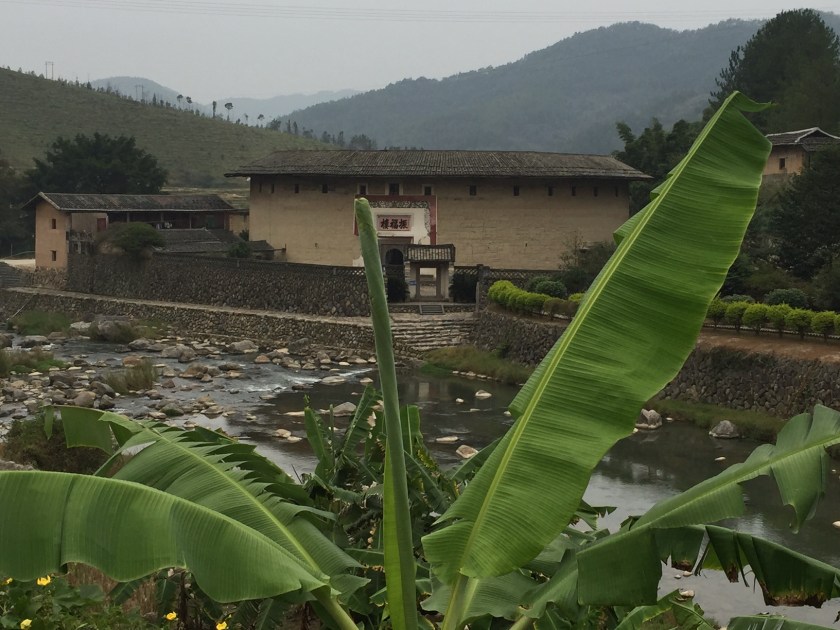
Before leaving Fujian, I also need to direct you south from Wuyi Shan to some amazing homes called “tulous” (土楼 tǔlóu)which have graced southeastern China for almost a millennia. Appearing like natural outgrowths among the terraced fields and persimmon trees in southern Fujian, these massive bagel shaped homes were built by the Hakka people aka 客家 Kèjiā (lit. translation – “guest families”– sometimes referred to as the “Gypsies of China”). These multi-story units, some over 70 metres in diameter with six foot thick walls, could house hundreds of people.  One wonders how a building made out of mud could withstand the weather until one actually approaches the structure and feels the walls. The rammed earth has hardened like cement and these homes have proven to be remarkably resistent to wind, rain, and even earthquakes.

Several of the tulous, which served as family homes for centuries, have now opened up to accommodate tourists – complete with flush toilets, showers, and breakfasts. Fall is a beautiful time to bicycle through the low hills of southern Fujian and experience these magnificent structures from a distant past.

Chinese Odyssey 31

As we coasted downstream

on a long bamboo raft,

Sliding into the river

and feeling quite daft.

The clouds up above

formed a quizzical cast

like a sail held high

overhead on a mast.

Monkey King – The Origin Story

Sun Wu Kong - Yoshitoshi

Tsukioka Yoshitoshi [Public domain or Public domain], via Wikimedia Commons

Every Chinese child knows about Sun Wu Kong (孫悟空 Sūn Wùkōng), the Monkey King. Hatched from a magical rock, he grew up on Flower Fruit mountain. At the base of the mountain flowed a stream, where one day the young monkey convinced his friends to follow the stream to its source, and there they discovered a beautiful waterfall. The young monkey, on a dare, jumped into the waterfall to see what would happen. To his surprise, he found himself inside a giant cave. He quickly jumped back through the water curtain and goaded his friends in. Monkey and his friends had found their new home in the magical Water Curtain Cave. To reward him for his resourcefulness, the other monkeys and his many animal friends decided that the monkey born from stone would be their king.

For a while, the Monkey king was happy in his new role, and romped and frolicked and ate and drank and played. After many years of this kind of living, however, the Monkey King became despondent. He had concluded that he was mortal and was going to turn old and die. He went looking for a master who could teach him how to live forever. After spending years on the road looking for immortals, sages, and Buddhas, he finally happened upon an enlightened master who was impressed by the stone monkey’s cleverness and agreed to take him on as a student. He then gave him a new name, Sun Wu Kong, which means “Sun, who knows emptiness.”

Sun Wu Kong happily took to the life of a disciple and years passed by. When the master delivered his teachings though, Sun Wu Kong found it very difficult to sit and listen. He explained to his master that he found the teachings so exciting he could not contain himself and needed to jump about. Sun Wu Kong was clever and very quickly learned spells and transformations which amazed his teachers. He also acquired his only weapon. It looked like a walking stick with gold bands on either end and he could vary the size to his wishes. It was perfect. He could somersault 60,000 miles in one full loop, and by taking one hair out of his body and blowing on it, he could create an army of monkeys just like him. All in all, Sun Wu Kong acquired the ability to make 72 transformations. So, he decided to return to his kingdom at Flower Fruit Mountain.

As his powers increased, however, so did his ego. With every victory, Sun became more aggressive and proud and he was beginning to upset the immortals who wondered how he had ever achieved such great powers. To appease him, the immortals finally awarded him the title, “Great Sage, Equal to Heaven.” Sun Wu Kong loved his new name and he aspired to sit on the throne of Heaven. Finally, the Buddha challenged the Monkey to jump off the palm of his hand. If he succeeded, he would indeed, be awarded the title he so desired. Monkey laughed as he accepted the challenge and leapt off the hand somersaulting many times before landing at the base of five pink pillars. Thinking this was the end of the world, Sun Wu Kong peed on a pillar after writing “Great Sage, Equal to None” on one of the pillars as proof that he had made it there. The Buddha then showed Sun Wu Kong his hand, and held Sun’s nose close to the base of one finger where Sun not only smelled his own urine, but saw the words he had written there. With that, Sun Wu Kong was sealed under the Mountain of the Five Elements where he would serve out a long penance.

And that is only the beginning of the story. After centuries of penance, trapped under the weight of the mountain and his ego, Sun Wu Kong was released and became an heroic disciple of the Buddha. Along with a pig, a horse, and the monk,Tang Zhen (Tripitaka), Sun Wu Kong undertook the perilous journey of transporting the teachings of Buddha from India to China.

In 1981, transportation options were limited in Fujian. There were trains, but they were like something out of the 19thcentury. Riding on narrow gauge tracks, their coal fire engjnes belched out black billowing smoke. We were warned not to wear anything light colored because the windows were wide open the whole way from Quanzhou to Wu Yi Shan (武夷山 Wǔyí Shān).

Wu Yi Shan are mountains where immortal beings lived during the Sung Dynasty. There are steep crags and demon shaped rocks said to have been placed there by the Gods. In the past there were hundreds of temples and “boat coffins” on the faces of the cliffs which  was home to a large Daoist community. We hiked along a trail to a water fall they had named the Water Curtain Cave (水帘洞 Shuǐ lián Dòng) and were told that some people believe it to be the Water Curtain Cave. But the cave we saw behind the water did not have quite the splendor or the drama I would have expected.

The name of the book about the monkey king is actually “Journey to the West” (西游记 Xī Yóu Jì). It was most probably written by Wu Cheng’en(吳承恩 WúChéng’ēn), a Chinese writer and poet who lived in 17th century late Ming and early Qing Dynasties. The translation I’m most familiar with is one simply called “Monkey” by Arthur Waley. Although not the complete work, it does offer a fantastic first look at the Monkey King. (Wu, Cheng’en, and Arthur Waley. Monkey. , 1958. Print.)

 Chinese Odyssey 30

We traveled up north

to a place called Quanzhou.

Climbed a statue of Laozi

in a green bamboo grove.

Took a smoky black steam train

through hills of Wuyi.

Saw the king’s water curtain

Sun Wu Kong, the monkey.

The Pirate of Piano Island

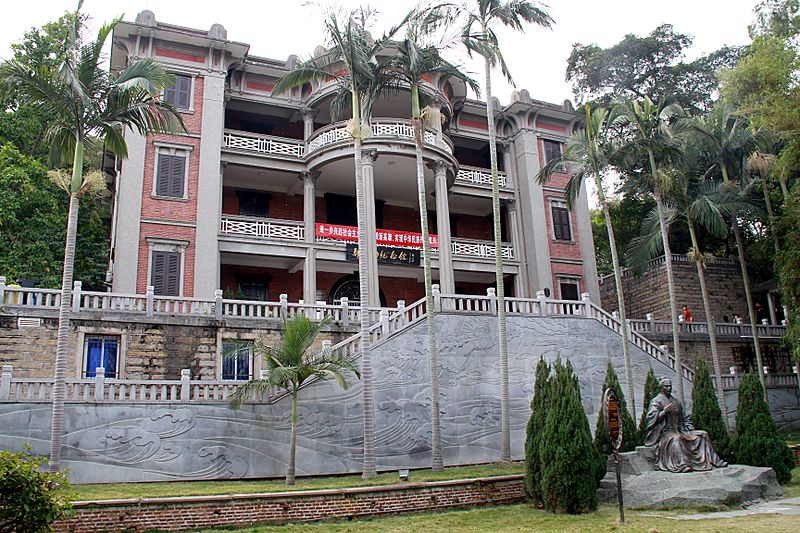
Koxinga Museum in Gulangyu

Koxinga Museum in Gulangyu – Rolfmueller [CC BY-SA 3.0 (https://creativecommons.org/licenses/by-sa/3.0)%5D, from Wikimedia Commons

When I first visited the island of Gulangyu in 1981, it was truly a magical place. Anyone could step up to the ferry terminal in front of the Lujiang Harbourview Hotel in Xiamen, and enjoy a five minute hop over to “Piano Island.” There were no cars or other motorized vehicles and one could walk the 3 mile circumference of the island in a couple of hours. As we walked around 1981 Gulangyu, we were awed by the architecture. Crowded stalls were gateways to 1930’s art deco mansions which used to be consulates, banks, and homes to the wealthy foreign and Chinese elite. During the Cultural Revolution the mansions had been subdivided and many families occupied what had once been the lavish get aways for Chinese Jay Gatsby’s. Wandering through the rolling hills on this tiny island, it was easy to imagine grand parties with alcohol flowing, dapper multinational sheiks, beautiful shebas in cocktail dresses, and Whitey Smith jazz wannabes drifting south from Shanghai. One could stand on the balconies, stroll in the beautifully kept gardens, and listen to the natural drum beat from the waves pounding on the shores.

A lot can change in 30 years, however. The quiet island of 1981 Gulangyu made famous for its classical music, its churches, tunnels where people escaped the summer heat, and laid back locals has been transformed into an island of Airbnb’s for young lovers. The five minute ferry is still there, but since it became so popular, only local people are allowed to use it. Foreigners must take a 25 minute taxi to a ferry station where an advanced booking has been made for them and a passport is required. The island’s still beautiful and many of the old mansions have been restored. The former Christ the King Catholic Cathedral (now a UNESCO World Heritage site) has been newly painted and you can visit the Trinity Church (三一堂 Sān Yī Táng) there. The former US Consulate and the former HSBC mansion are both privately owned, but both have survived nicely.

Zheng Chenggong (Zhèng Chénggōng 鄭成功) aka Koxinga 國姓爺 Guóxìngyé  (man given an imperial surname by the government) was the only Chinese commander ever to win a decisive battle against a major Western power, when he forcibly ejected the Dutch from Taiwan 350 years ago. He was a Ming Loyalist who fought against the newly established Qing Dynasty.

Zheng Chenggong was born in Japan. His father was the head of a large merchant group based in Japan and Taiwan. His mother was Japanese. When he was young, he went by the name of Fukumatsu. He often traveled with his father and went to live and study in Fujian, his father’s ancestral home, when he was only 8 years old. He was well schooled in Confucianism and studied at the imperial university in Nanjing and was given his imperial name when he was 21.  When the invading Qing army from Manchuria conquered the Ming, Zheng Chenggong’s father (who had become a general in the Ming army) was executed by the Qing, and Zheng Chenggong dedicated himself to rebellion against the Qing Dynasty and the restoration of the Ming. It was in Xiamen, that Zheng first set up his base. But when the Ming army pushed south, Zheng sailed east across the Taiwan Strait where he founded Dōngníng Wángguó 國 (the Kingdom of Dongning). It was from this base that he, along with 25,000 Chinese troops and the infamous Black Guard, “made up of ex-African slaves brought to Asia by the Portuguese” (https://www.scmp.com/article/993666/idol-worship)defeated the 10,000 strong private army of ‘red-haired barbarians’ stationed at Fort Zeelandia aka Rèlánzhē Chéng 熱蘭遮城, near the current city of Tainan, and routed the Dutch East India Company and the Dutch from Taiwan.

From Xiamen to Taiwan to Japan to Beijing, stories of Zheng Chenggong abound. Britannica calls him the “pirate leader of the Ming Court”. Taiwan sees him as a champion of the struggle for independence, where Beijing points to his reclaiming Taiwan for China, and Japan used him as a way to connect during their 50 year occupation of Taiwan during the first half of the 20thcentury. Was he a selfless patriot or a self serving entrepreneurial pirate? Probably more than a little bit of all of the above.

Chinese Odyssey 29

Commander Koxinga

really didn’t do much —

just resisted the Manchus,

defeated the Dutch.

On the island stood mansions

like F. Scott’s Gatsby

might have owned on West Egg

old now, and drafty.


Lu Xun – China’s Greatest early 20th Century Author

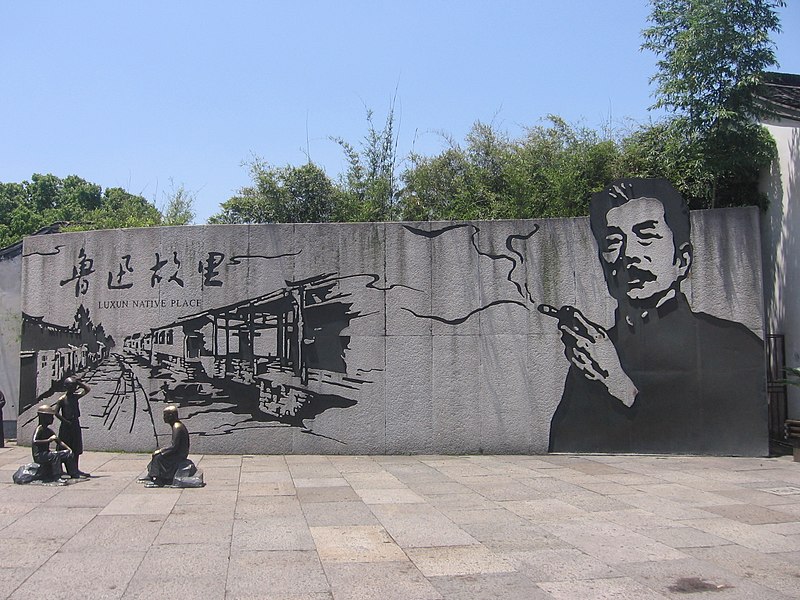
Lu Xun Native PlaceZhou Guanhuai [CC BY-SA 4.0 (https://creativecommons.org/licenses/by-sa/4.0)%5D, from Wikimedia Commons

What was it about Lu Xun’s writing that led Mao Ze Dong to call him the “commander of China’s Cultural Revolution“?

Although Lu Xun  (迅 Lǔ Xùn) aka Lu Hsun – had a formal education, he was much more interested in the stories he heard from uneducated peasants than in the great works of literature. Born in 1881, he was 38 when the 1919 May 4th movement championed writing in the vernacular “白话” instead of in classical Chinese (文言文). Lu Xun opened windows into the lives of uneducated peasants, of women who were branded by superstitions and beliefs which relegated them to roles of shame and dishonor they could never hope to climb out of. His writings were not hopeful. They were often dark and desperate and were an honest reflection of the lives of vast numbers of Chinese lǎo bǎi xìng 老百姓 (common people) during the early part of the 20th century. His most popular works were his short stories. Many are available on-line and I’ll mention three which I have read and believe would be a good introduction to Lu Xun.

Probably, the most iconic Lu Xun story is “The True Story of Ah-Q”.  Nobody knew what Ah-Q’s name really was or where he came from. It is evident from the beginning though, that Ah-Q is a loser – in everything he tries. He has no family. His only claim to fame is that the handi-work he does around town to pay for his food and drink seems to be acceptable. He is a blowhard, a braggart and a drunk, all of which bring on more ridicule and bullying from the townspeople. Ah Q represented much of China’s peasant population in the tragedy of his life, and the reader can’t help but feel that his lot was not his fault.

In the story, “Medicine”, a peasant couple whose son is dying of tuberculosis spend their last penny on steamed bread soaked in the blood of an executed criminal. The story was a powerful scream aimed directly at the ignorance which was burdening the masses. Ironic that Lu Xun himself would die at the age of 55 from the same disease.

“New Years Sacrifice” was one of the saddest stories I read. It was an almost voyeuristic glimpse at the lives of widows who were blamed for their own bad fortune both in this life and in the next. After being forced to remarry, Xiang Lin’s wife found herself pregnant and for the briefest of moments was happy with the son she bore until tragedy visited her again in the form of a wolf.

So much of what Lu Xun wrote was a commentary on the superstitions that enveloped China during the chaos of China’s Republican period. Maybe the reason that Lu Xun became Mao’s revolutionary poster boy was that he died in 1936. Mao Zedong, along with 4,000 stalwarts had completed the two year, 6,000 mile Long March which cemented his position as the undisputed leader of the revolution only one year earlier. The revolution was still young and those who died in its name were heroes. Although Lu Xun never joined the Communist Party, Mao understood Lu Xun to be someone who appreciated the plight of the peasants and was trying through his writing to help them rise up.

“The True Story of Ah-Q” (阿Q正传) and “The New Year’s Sacrifice”(祝福)  are both available in the Public Domain to read in English.

Chinese Odyssey 28

Xiamen had been open

for less than a year.

The colors were drab

but the air was quite clear.

Lu Xun used to write

in the Nan Putuo temple

and the Gulangyu

musical island felt gentle.

Slow Boat to China

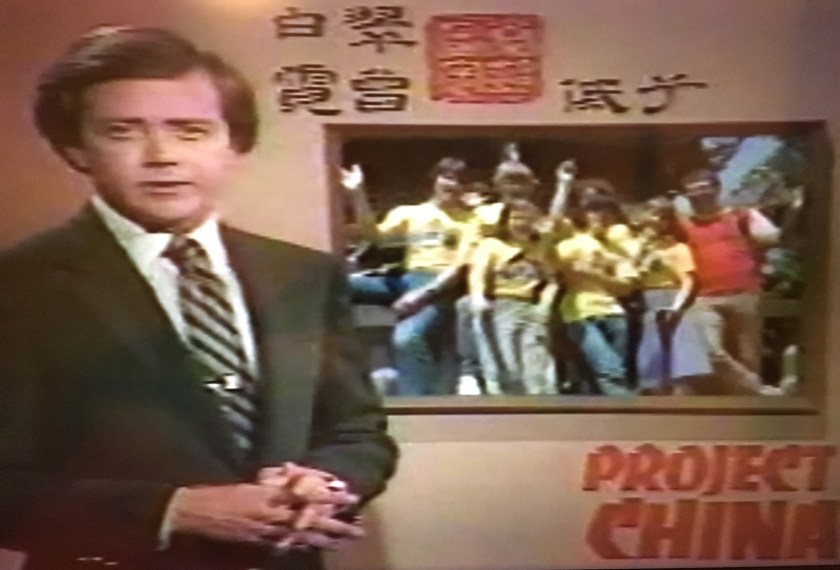
Project China Mark Nicks

Hong Kong is located in the southeastern part of China. It is surrounded by the province of Guangdong. Adjacent to Hong Kong to the northeast is the province of Fujian. Located in the southeastern part of Fujian is the city of Xiamen. The distance from Hong Kong to Xiamen is only about 300 miles, as the crow flies. Fujian is the Chinese province directly across from Taiwan, separated by the Taiwan Strait. Taiwan is about twice the distance from Fujian as Cuba is from the state of Florida. Today, if we want to travel from Hong Kong to Xiamen, we can choose to take a 40 minute flight or a 5 hour high speed train.

In June 1981, our only travel option was the Jimei passenger ship, the proverbial slow boat to China. From Hong Kong to Xiamen would take us 22 hours plus some change. Our six Tulsa high schoolers joined a rather odd assortment of 20+ individuals from all over the USA. Our kids were the youngest of the bunch. At 80 plus, Abe Gurvitz, a dentist from Boston shared the senior mantle with Frankie Wu from Prairie City, Kansas. We also had a smattering of missionaries, college students, and recent graduates along for the adventure. Accompanying us all was a news crew from Tulsa’s KJRH TV station. Reporter, Mark Nicks and cinematographer, John Ross were never far from our sides.

In earlier posts, we established that names for people, places, and things Chinese often have very different names, depending on their context.  China is called Zhongguo in Chinese; Taiwan is also known as Formosa; Hong Kong is Xianggang in Mandarin (aka Putonghua); Macau is known by most Chinese as Aomen; Canton can refer to either the province of Guangdong or city of Guangzhou; Kongzi is the Chinese way of saying Confucius; Zheng Chenggong is what most Chinese call Koxinga; just to name a few. In today’s post, there are some really different names. Xiamen is still called Amoy by many and Quemoy is most often referred to as Jinmen (or sometimes Kinmen.) Both Amoy and Quemoy are names which sound closer to the names used by local inhabitants in their dialects.

Just before arriving in Xiamen, we passed by the island of Quemoy (Jinmen) which sits less than 2 miles off the coast of mainland China, where we were awed by a Taiwan (ROC) flag the size of a football field waving in the breeze (much to the chagrin of the PRC I’m sure.) Just a few years earlier, Quemoy and Amoy had traded progaganda laden missiles every other day. Landmines were strewn along the beaches to stop an invasion from the mainland. The island is latticed with tunnels. Nearly 100,000 KMT troops were stationed in Quemoy during the Cold War with over 500,000 missiles lobbed in 1958 alone. Intermittent shelling went on until 1978, just three years prior to our arrival. When we lived in Taiwan, I used to hear stories of Taiwanese soldiers swimming over to Xiamen on a dare to watch a movie in a local theatre and come back with a movie ticket stub. Friends of ours who served in the Taiwan military told us that was crazy. Still, it makes for a good story and I can’t help but wonder.

At the time we arrived, Xiamen had only been opened to foreigners for one year. The only other non-Chinese we saw there were an American teaching couple who had been living in Xiamen for 8 months. Our food was very local. Much of the produce was grown on campus. Fruits and vegetables were smallish and very unlike the perfectly shaped and equally sized produce that we were used to in American supermarkets. The good stuff got shipped to Hong Kong where it commanded a much higher price. Even Coca-Cola had yet to reach these hinterlands. It was water, tea, a sickly sweet orange soda, or . . . local beer. I had met with parents before leaving and had told them that beer was not illegal for their kids to consume in Xiamen and it might be safer and healthier than some of the other alternatives. Some parents signed off on that, so beer began to be served with our evening meal.

Today, things are a little different. Anyone can board a plane in Taiwan and fly to Jinmen. It’s even easier in China. In  Xiamen, there is an hourly “Cross-Strait Ferry” from Xiamen to Jinmen which takes about one-half hour. You can only buy one-way tickets because tickets in Xiamen are sold in ¥RMB (Renminbi) and tickets sold in Jinmen are in $NT (new Taiwan dollars.)

Chinese Odyssey 27

Accompanying us

was a Tulsa news crew;

Oklahoma to Xiamen

turned into a coup.

On a boat called the Jimei —

Hong Kong to Amoy —

passed flags of two Chinas,

drank milk made of soy.