The British Colony of Hong Kong

600px-Flag_of_Hong_Kong_(1959–1997).svg

No one who ever landed at Hong Kong’s Kai Tak airport in the heart of Kowloon ever forgot the experience. There are tons of photos from planes landing that captured clothes hanging outside windows and on balconies of Kowloon high rises and some passengers claimed they could watch TV shows through the doors open behind the balconies. There was only one short runway built on “reclaimed land” in Victoria Harbour just south of Kwun Tung.  Some say that the reason there were never any serious mishaps were that pilots were just too scared coming in.

June is a muggy month in Hong Kong. Coming off a 15 hour flight from Los Angeles, we stepped into a steam bath of exhaustion and energy. A part of all of us just wanted a shower and a bed, but another part wanted to drop our stuff off and explore. Air conditioning wasn’t as ubiquitous then as it is now in Hong Kong so heat and jet-lag won out and it was on to the New World Hotel. For many of our kids, jet lag was a new experience. After all, it was sixteen hours earlier in Tulsa than it was in Hong Kong and none of our bodies or minds knew quite what to make of that.

In the early 1980’s, Hong Kong harbour was wider. Kellett Island, home of the Hong Kong Yacht Club, was not yet a part of Hong Kong Island. There was no peninsula where the Hong Kong Convention Center now resides. The first cross harbor tunnel had only opened 10 years earlier. The Fleet Club at Fenwick Pier had a McDonalds sitting right on the harbour where American sailors passing by could stop off and have a draft beer. The Star Ferry terminal sat next door to the main post office in Central. And one could have tea on the first floor of the Peninsula Hotel with and unobstructed view of Hong Kong harbour. They call what’s happened in Hong Kong harbour “land reclammation,” but I always wondered how land that was never land before could have been reclaimed.

Those were the days of really cheap public transportation. Double decker trams cost 10 cents for an hour long ride from Shaukeiwan to Western District. The Peak Tram was still going strong ever since opening up in the 1890’s. Taxi’s dropped their flags at $2. The Star Ferry cost 10 cents for the lower deck and 20 cents for the upper and there were always rickshaw drivers standing right outside to run you in, around, and through Central. For some reason, Morning Star was the ferry every kid wanted to ride. Anybody smoked whenever and wherever they wanted, and that included on all forms of transportation.

Hong Kong has always had the best Dim Sum in the world and it didn’t disappoint. Our kids from Tulsa had their first taste of Cha Shao Bao 叉烧包, Siu Mai 燒賣, Har Gao 蝦餃, Chicken Feet 鳯爪, Spring Rolls 春捲, Turnip Cakes 蘿蔔糕, Spareribs with Black Beans 豉汁蒸排骨 – which were just the tip of the iceberg. And all washed down with Jasmine 茉莉花茶 or Pu-Erh aka Polay 普洱 tea. And they did it the old fashioned way.  Food carts weaving among tables, stopping whenever anyone asked, placing the saucer sized plates and mini-bamboo baskets filled with Ma Lai Gao 馬來糕 or the steel plates with covers heaped with Changfen 腸粉 (shrimp, beef, or barbeque pork). At the end of the meal, the cost was tabulated by the number of plates on the table (most plates costing less than one US dollar). The literal translation of “dim sum” is “a little bit of heart”. Whenever and wherever I eat dim sum today it always takes me back to Hong Kong. Maybe it really is a  little bit of heart.

Chinese Odyssey 26

Thirty-one hours later,

touched down in Hong Kong

stepped into a steam bath

but moved right along.

We rode the Star Ferry

looked dapper and chic

ate dim sum, drank Po-lay

and trammed to the Peak.
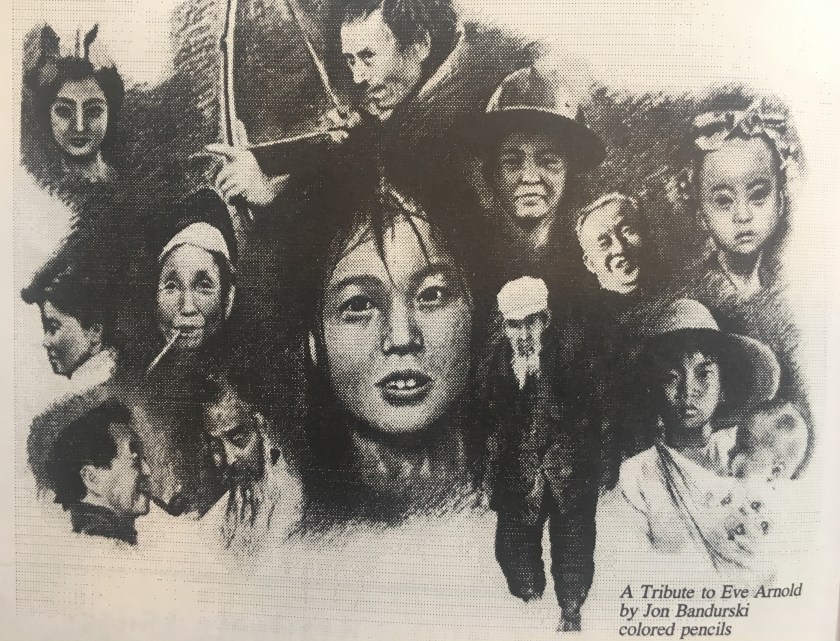
When Oklahoma said “Ni hao”

Jon Bandurski Drawing copyAccording the The Oklahoma Historical Society, the Chinese were the first Asians to settle in Oklahoma. Soon after the 1889 Land Run, a Chinese entrepreneur set up the Tom Sing Laundry in Guthrie (near Oklahoma City). Other laundries and restaurants followed. The 1940 census showed only 110 Chinese living in Oklahoma. By 1980 that number had increased to 2,461. (https://www.okhistory.org/publications/enc/entry.php?entry=AS006).
The 1980’s was a good decade for improved connections between Oklahoma and China.

  • In 1980, Tulsa established a “Sister City” agreement with Kaohsiung in Taiwan.
  • In 1980, Booker T. Washington High School and G.W. Carver Middle School offered Mandarin Chinese as a part of our foreign language curriculum in Tulsa.  At B.T. Washington, we published the “American Express” 美國快報, which later became the “Chinese American Express” 美中快報, a student newsletter which invited  young students of Chinese from all over America to contribute their experiences and perspectives regarding the learning of Chinese.
  • In 1981, I accompanied six high school students and a news crew from KJRH in Tulsa to Xiamen University, in southern Fujian Province where we spent 8 weeks studying Chinese. Xiamen had only been open to foreigners for one year at that time. KJRH won a Peabody Award (along with Hill Street Blues) for their documentary, “Project China.”
  • In 1985, Oklahoma and Gansu Province became “Sister States.”
  • In 1987, Tulsa established a “Sister City” agreement with Beihai in the Guangxi Zhuang Autonomous Region in China.
  • Later, that year, the Tulsa Global Alliance put together “Operation Breakthrough: China’s Middle America Initiative” in Tulsa where former President Gerald Ford was a Keynote speaker and Chinese scholar and interpreter, Perry Link, exposed Oklahomans to Chinese comedy in the form of Cross Talks. 100 Chinese governors, mayors and business leaders from 14 provinces and cities met and set up business deals with entrepreneurs from Oklahoma and middle America.
  • In 1989, 15 year old Booker T. Washington high school sophomore, Jon Bandurski became the first Tulsa Public School student ever to live for six months with a Chinese family in Shekou, near Shenzhen in southeastern China (near Hong Kong) where he studied Chinese and art for six months at Yucai School. Jon was the best unofficial ambassador the United States ever sent to China. When he wasn’t studying, he played soccer for the school team and even DJ’d for a school radio program.

Chinese Odyssey 25

It was in Oklahoma,

kids learning Chinese

thought they should go, too.

They even said, “Please!”

From a high school in Tulsa

six students departed

on a life-changing trip

destinations, uncharted


Old men, young women, and mountains

IMG_3050

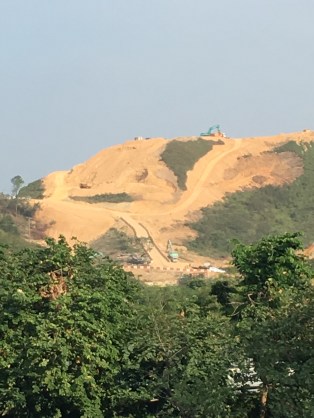
When someone immigrates to the USA, the expectation of Americans is that the new immigrant will learn to speak English and will learn to behave in culturally appropriate ways. When a foreigner moves to China, the expectation of Chinese is that the new “resident” will not learn how to speak Chinese and will not learn to behave in culturally appropriate ways. Most foreigners I’ve met in Taiwan, Hong Kong, and China have come planning to learn Chinese. In Hong Kong, most quickly discover that there is no need to learn Chinese since many Chinese in Hong Kong speak English well. In China and Taiwan, that’s not as often the case. Of the people who try to learn Chinese, the majority toss in the towel after a single course. Of those who continue, few become fluent, and only a handful become literate. I’ve been wondering if learning Chinese is like the mountain that will take generations to move.

The idiom is 愚公移山 Yúgōng yí shān (The foolish old man who moved the mountain.) Although not directly derived from the Dao De Jing, it is certainly Daoist in thought and dates back to at least the 5th century BCE.

There was an old man who had spent his life living in a house on the opposite side of a hill several hours from the nearby village. Having been to the top of the mountain many times, he knew that the distance between his house and the village was much shorter as the crow flies. So, when he grew old and his famly no longer needed him to work at home, he decided he would move the mountain. He started digging with a shovel, a bucket, and a hoe, and people wondered what he was doing. When he said he was going to move the mountain, everyone laughed and called him crazy.

But the “foolish” old man knew better and kept on digging. He understood that he would never be able to move the mountain by himself. His sons and his daughters would need to continue his work and their sons and daughters as well. It may take several generations, but in the end, the mountain would be moved.

Growing up in the USA, most people don’t have a “move the mountain” mentality. When planting a new lawn, most Americans want grass that is ready to roll around in, in a few months. We plant vegetables and fruit with the idea of harvesting at the end of one season, and plant trees that will provide shade in 5 years. In China, people plant trees and shrubs, and flowers that may take years or sometimes decades to mature.

China is not the mountain, Chinese is.  Each bucket of earth represents understandings that keep non-Chinese speaking and culturally illiterate people walking around the mountain. The old man wasn’t foolish. Neither was he old. And neither was s(he) necessarily a man.

Chinese Odyssey 22

The US and China

were in this together

A curious friendship,

some interesting weather.

Kids all over China

learned English with zest.

The same was not happening

here in the West.

Wandering through Art

A_Hundred_Steeds-1
This is a faithful photographic reproduction of a two-dimensional, public domain work of art.

When I was in junior high, my parents sent me to Camp Garland, a Boy Scout camp near Locust Grove, Oklahoma.  Flowing through the camp was Spring Creek, a pristine watershed, amazingly clear and refreshingly cold. It reminded me of Montana. There was a small feeder spring flowing into Spring Creek that sometimes I would visit. It flowed down the side of a steep cliff and settled onto a natural rock table. I would sit on the table rock and watch the water flow over and around the rocks and algae, through the myriad of plants growing there. Of course, there were lots of bugs, butterflies, and birds and sometimes I’d glimpse minnows darting in and out of the rocks. The longer I sat, the more I became mesmerized by my surroundings, and mini-me would leave my body and wander down by the water (which had become a roiling river), climb up the clefts in the wall and discover paths that would lead from the pools on the table rock up the cliffs all the way to the mysterious source of the crystal clear water below.

When I first began to really look at Chinese landscapes, I was reminded of Spring Creek. I found myself being drawn towards the mountains, disappearing into clouds, and strolling beside rivers. Sometimes in the paintings there were other people walking there as well. Landscapes weren’t limited to natural landforms and water. There were pagodas and temples and markets.

Perhaps the most famous wandering painting of all is “Along the River during Qing Ming” (清明上河圖 Qīngmíng Shànghé Tú) which was painted more than 800 years ago during the Sung Dynasty.  In this amazing glance at what we now know as the city of Kaifeng in the province of Henan (then China’s capital), we find ourselves walking through the painting with our eyes. In our walk, we get to experience Sung Dynasty daily life as we stroll past merchants, laborers, sedan chairs carrying scholars, restaurants and taverns, people loading and unloading boats along the Bian River (汴河 Biàn Hé), donkeys bringing in firewood from the outlying areas. And the action isn’t limited to the paths, roads, and bridges. Much of what happens in the painting is on the river itself. Only 10” (25 cm) in width, it stretches over 17 feet (about 5 meters) in length. Starting at the far right, one inches left across the painting savoring the journey; stopping sometimes to shop in the market or grab something to eat on the Rainbow bridge.

“Qingming” is a day to remember one’s ancestors. Some people call it “grave sweeping day”. Families will visit cemetaries on this day. They will tell stories, picnic, and tidy up the plot by sweeping the grounds, repainting the writing on the tombstones with red paint and they will burn incense. Qingming is not a sad day, but a day of thanksgiving and rememberance.

Some Chinese paintings feature a hundred things like children or birds or butterflies. Giuseppe Castiglione (郎世寧, Láng Shì Níng), the Italian Jesuit brother and imperial painter for three Qing Dynasty emperors during the early 18th century, has a famous painting in the Palace Museum in Taipei of 100 horses. Even though he painted in classic Qing style, there are elements in his art that definitely speak to his western origins.

Chinese Odyssey 16

The bowl was her family’s

since she was a child.

The painting inside it

so natural and wild.

There were mountains surrounding

a natural pool

where young kids were playing

decidedly cool.
