Hanoi to Hainan – Haves and Have Nots

Chinese Odyssey 80

 From Xingyi to Nanning

and west to Hanoi,

a Friendship Pass opened

bringing sorrow and joy.

In the midst of the war,

a banana peel

discarded by Gonggong

became one family’s meal.

https://upload.wikimedia.org/wikipedia/commons/1/1d/Banana_peel.jpg

My father-in-law came from a family of traders and merchants. China was a scary place to live in the 1930’s and 40’s. By December of 1938, much of the province of Guangdong had been occupied by Japanese forces. All Chinese males between the ages of 15 and 60 were suspected by the Japanese to be enemies or “enemies pretending to be local people.” Survival in southern China meant a lot of out of the box thinking and creative problem solving.

Gonggong left his home village in the Nanhai district of Guangdong to seek his fortune and help support his family by traveling south and west eventually ending up in Vietnam. Like his forefathers who had made their ways to San Francisco and then south to El Salvador 100 years earlier, Gonggong was a keen observer and was able to connect dots between what was available in certain areas and what was sought after in others. He saw possible business opportunities opening up in French controlled Vietnam, so he sought out distant relatives in Hanoi. There, he learned the lay of the land and was able to consider his options. Sometimes he would take the southern route, staying on the coast to Beihai – even taking the slow boat to Hainan Dao.  I have no idea how many times Gonggong crossed the 500 odd miles between Hanoi and Jiujiang, but I do know that there were enough trips for him to develop a familiarity with the region. From Hanoi north and east to Nanning before traveling the remaining 350 miles north and east to Jiujiang.

There was the 530 mile narrow-gage (1,000 mm – 3 ft 3 3⁄8 in) railway line built by the French between Hanoi and Nanning (Yunnan–Haiphong railway (滇越铁路 Diānyuè Tiělù) that was completed in 1910. Goods were transported on that line to both the KMT and others in China in need of European goods in the early days of the war, but once Nanning was taken and the Japanese occupied Vietnam, this line too was severed (for the allies), making “the Hump” air route the only way of getting supplies into China.

During the Han Dynasty, Emperor Han Wu Di (漢武帝 Hàn Wǔ Dì) conquered Vietnam (then known as Nan Yue 南越 Nányuè) and for 1,000 years, Vietnam was effectively a part of China. Many Chinese migrated there, drawn by the rich farmland and fishing of the Red River Delta. Scholars and government officials also alighted and set up a Chinese centralized state. Like Korea and Japan, Viet Nam adopted the Chinese writing system – until they recognized it was inadequate for their own linguistic needs nearly 1,000 years later. Confucianism also seemed to be a good fit for the Vietnamese as did Buddhism and Daoism.

Barely two hundred years into Chinese occupation, there was a famous rebellion started by two sisters by the surname of Tru’ung. Tru’ung Trac and Tru-ung Nhi came from a military family where they learned the arts of war. After Tru’ung Trac’s husband was killed, and Tru’ung Trac raped by the Chinese for resisting Chinese rule, Tru’ung Nhi convinced Tru’ung Trac to avenge their treatment and liberate Vietnam from the Chinese.  In 43 CE, the Tru’ung sisters led an independence revolt against the Chinese government which nearly succeeded, but after three years of fierce fighting, their revolt was ultimately crushed by the Chinese forces and the Tru’ung sisters drowned themselves to avoid capture. To this day, the Tru’ung sisters are national heroes in Vietnam. Chinese Premier Zhou En Lai visited a temple dedicated to the Tru’ung sisters as a show of respect during his first state visit to Viet Nam in 1956.

Towards the end of the Tang  Dynasty in the 10th century CE, however, the Vietnamese took advantage of the weakened Chinese government and upon prevailing in the Battle of Bach Dang River declared Vietnam free of the Chinese yolk, and finally secured independence for Vietnam which they called Annam.

The Friendship Pass 友誼關 Yǒuyì Guān; older name Ải Nam Quan (隘南關) was actually first established between Viet Nam and China during the Ming Dynasty in the 17th century. Then, it was called South Suppressing Pass 鎮南關 Zhèn Nán Guān,  and the pass itself actually served as the border between Viet Nam and China. This pass was later used by China and Vietnam during the early 1970’s to help the Vietnamese fight “American Aggression” in Vietnam. During that period, the Friendship Pass was anything but friendly. All along the pass were land mines, bamboo spikes, and barbed wire meant to prevent disruptions to the flow of goods.

When the initial clashes between China and Vietnam began in 1977, the Vietnamese government put pressure on its ethnic Chinese population and many of them fled north across the border. In 1979 400,000 PLA troops suddenly appeared on that same border to teach the Vietnamese a lesson for their assistance in bringing down the Khmer Rouge regime in Cambodia, who had been a close ally of the PRC. That was the last “border war” between the two countries. Vietnam and China began patching things up in the 1990’s as they worked together for common economic interests. Today, there remains a love-hate relationship between Vietnam and China, not unlike the scars the still exist in many families as the results of unresolved family feuds.

The one story I remember Gonggong telling about his traveling over Friendship Pass was when he felt hungry while walking along the road near present day Lang Son. He reached into his travel bag and pulled out a banana. As soon as he did, he noticed a small group of people following him. As he walked, the number grew. When he finally finished his snack, he tossed his banana peel into the road. Before it even hit the ground it was snatched up and torn apart by people desperate for anything to eat. Such was southern China in the early 1940’s.
Guizhou Cornucopia

Chinese Odyssey 79

Yet the wonders of Guizhou

made up for them all,

the Dong town of Zhaoxing,

Huangguoshu waterfall.

In the gorges near Xingyi,

we kayaked white water.

Arriving in Guangxi,

heard Liu San Jie’s daughter.

Huangguoshu Waterfall 2

From the Dong Village of Zhaoxing in the far south-eastern corner of Guizhou, we travelled west to  Kaili. There, they have a fun Sunday market where Dong and Miao people ply their crafts, art, and household wares. Thirty years ago wooden buckets could be picked up at any rural  community in southern China. I remember friends riding bicycles through Guangdong and buying these buckets off farmers for a few pennies. I’m sure farmers were dismayed by anyone wanting to buy their night soil buckets, but at that time, the farmers could turn around and buy a couple of new buckets for those same pennies. Today, shop keepers laugh at me when I ask if they sell “木桶 mù tǒng.” Why would anyone want a wooden bucket, when plastic buckets are so much lighter and easier to take care of? A few years ago, I was still able to find those wooden buckets in the Kaili Sunday market.

From Kaili to Guiyang is only about one-half hour by high speed train or a couple of hours by car. Guiyang (贵阳, Guìyáng) is the capital of Guizhou and is mostly unpretentious. That said, Guiyang is making a name for itself in the area of “big data.”  In this city of 4.5 million people, there are over 20,000 surveillance cameras aimed at the people of Guiyang. Flashback to Tom Cruise in the futuristic Minority Report. The future is here. The claim is that marketing analysis can be obtained real time by using the appropriate tools at a grand scale. Big data is not as much about the amount of data gathered, but rather how that data is organized to discover patterns and trends related to human behavior. And China is sitting on big data’s cusp. Part of China’s advantage has to do with China’s 730 million internet users. Guizhou got the nod of storing big data for companies like Tencent Holdings Ltd. (腾讯 Téngxùn) largely because  of its isolation and its insulation.

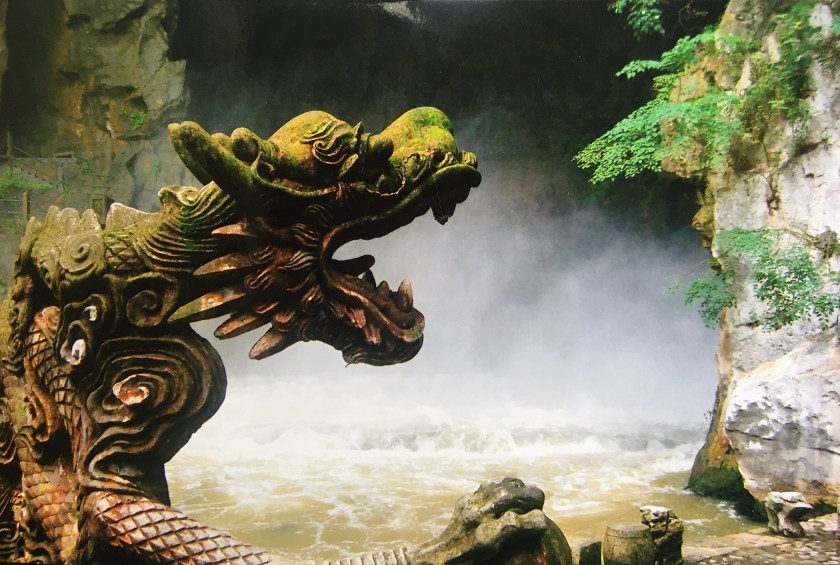
Continuing southwest about 100 miles, we arrived in Anshun (安顺 Ānshùn) and from there it was another 25 miles south to Huangguoshu Waterfall(黄果树瀑布 Huángguǒshù Pùbù)the largest waterfall in China. It was late June or early July and it had been raining a lot so the falls were at their fullest and they were really impressive. We broke out our rain gear and thoroughly enjoyed splashing our way through natural shower geysers firing at us from all directions. I remember walking under the water curtain into a cave (水帘洞) reminiscent of the one where the monkey king was born. Other waterfalls seem to converge from several directions into what looked like a massive earthenware sink called the Rhinoceros Pool (犀牛潭 Xīniú Tán) where I imagined a giant stooping down to do his morning ablutions. Still other waterfalls seemed more like strands of vermicelli or glassy Thai bean noodles hanging over a ledge in the distance. For an hour or more, we wandered through this natural water wonderland. When we came out near where we began, we were tired, and soaked, and smiling.

Maling Gorge (马岭河峡谷) near Xingyi (兴义) has been called the “birthplace of whitewater kayaking in China.” I wish I could say that we actually got to test the waters there ourselves, but alas, this was something we had not planned for and our time was too short. Still, we got to look down on the white water from the concrete arch Maling Gorge Arch Bridge, the first high bridge over the gorge. From our vantage point at the scenic lookout next to the bridge we could see at least a dozen waterfalls tumbling more than 100 meters down sheer cliffs into the roiling waters below. When our host asked us if we’d like to go down to the water, we thought she was kidding. We found hiking paths and steps that led us down about 30 meters, but the big surprise was a 70 meter elevator which took us the rest of the way down (and back up – of course.) At the bottom of the gorge there were foot bridges that allowed us to feel the river up close and personal. In 1998, China’s first whitewater kayaking competition was held there and since the 2008 Beijing Olympics, Maling Gorge has been the “National Training Base of Whitewater Kayaking.”

The story of Liu San Jie (刘三姐) is a popular story in China. Liu is a family name. The term “San Jie” means the “third oldest sister.” I mentioned in an earlier CO story that Chinese are commonly called by their rank in the family.  I think of the girls in one family of close friends who, to this day, I only know as Da Jie (big sister), Er Jie (second oldest sister), and San Mei (third youngest  sister).

Liu San Jie belonged to the Zhuang Minority (壮族 Zhuàngzú) and lived in the Guangxi Autonomous Region due south of Guizhou. The story started with a haunting song being sung by a female voice coming from a boat going through what looked like the karst hills around Guilin. The voice itself was not appealing to my western trained ear, but I kept listening as the picture panned into an old man and a handsome young man fishing from a small covered wooden boat where they, too, were mesmerized by the voice. White egrets and small nesting birds shared the screen with seven men with ropes around their bodies pulling a boat laden with merchandise up the river. Suddenly in a distance, Liu San Jie appears and we see actress Huang Wanqiu (黃婉秋) on a small boat made of tree branches, still covered with leaves, singing as she steers her way down the river with nothing but a bamboo pole. The two men decide to check her out so they pole their way over to her small skiff. The old man asks who she is, and Liu San Jie responds to all of his questions in song. Suddenly the young man bursts forward and says, “I know who you are. You are Liu San Jie!” They invite her on board and she accepts their invitation. The old man bursts into song, and the young man then dives into the water and catches a fish and then bursts into song himself. Liu San Jie is renowned in the area for her beautiful voice, her intelligence, and her courage. She had been orphaned at a young age and had been raised by her elder brother. Singing was a natural way for the Zhuang people to communicate. Liu San Jie sang songs about freedom and justice and about the way that the peasants were abused by the wealthy landowners. The laobaixing 老百姓 (common people) loved Liu San Jie, but the upper crust did not. Early in the movie, Liu San Jie got into a singing duel with one of the ruling elite and he had a heart attack and died after hearing the harsh accusations that Liu San Jie made about him and his family. The man’s family accused Liu San Jie of killing the man and arranged for her to be arrested. There are many incidents during the story where Liu San Jie stands up against tyrants like the infamous Mo Huai Ren. When the young man she befriends early on in the movie, defeats Mo Huai Ren’s lacky in a fist fight, Mo Huai Ren informs them that he owns everything in the area and that Liu San Jie and her friends would no longer be able to fish or hunt there. Liu San Jie challenges Mo Huai Ren to a singing duel and Mo accepts. Mo then hires three scholars who know “all the songs in the world” as his backup. Like freestyle battles between rappers, Liu and Mo’s songs go one after one another until Mo finally challenges Liu with the lines: “Tell now now, young lady, without pause: How many nails are there on our boat? How much do those mountains over there weigh? AND How many grains are there in a basket of oats?” To which, Liu San Jie answers without hesitation. Liu then quietly disappears from the scene with her lover, Li Xiao Niu.

In 2004, acclaimed director Zhang Yi Mou decided to stage Liu San Jie as yet another grand spectacular on the Li River in Yangshuo near Guilin. As with the Tea Horse Road extravaganza in Lijiang, this show involves approximately 600 performers who have been hired mostly from the local Zhuang community. They included fishermen, merchants, farmers, and young people. The 70 minutes show portrays actors on bamboo rafts performing on the actual Li River. “San Jie Liu Impressions” claims to be performed on the world’s largest natural stage. If you don’t understand Putonghua (Mandarin), becoming familiar with the story beforehand really helps get the most out of the experience. Maybe you will be able to answer: How many nails are there on our boat? How much do those mountains over there weigh? AND How many grains are there in a basket of oats?”


Guizhou – Poverty, politics, and pulchritude

Chinese Odyssey 78

The province of Guizhou

was poor and remote.

It’s said there were three things

they all lived without;

no three feet of flatland,

three days without rain,

three pieces of silver

were in their domain.

IMG_1392

Xi Jinping, China’s Premier, has been getting a lot of bad press these days, especially in the USA. Most recently due to the Hong Kong national security legislation, but that runs neck-to-neck with the coronavirus. Before that it was unfair trade practices, cyberespionage, the treatment Uyghurs in Xinjiang, and a host of other issues. What we don’t hear about very often, however, are some of Xi’s positive initiatives.

In October 2015, Xi vowed to eradicate poverty among the remaining 70 million poor Chinese people by the year 2020. Actually, the poverty eradication initiative started in 1984 when Deng Xiaoping said in a meeting with foreign guests:  “Socialism must eradicate poverty, and poverty is not socialism.” Since the year 2000, 600 million poor people had already been lifted out of poverty. Xi relied on his own experience growing up in a small impoverished agricultural community in the north-western part of Shaanxi province in the 1950’s and 60’s. This year, Xi has reiterated his solemn pledge during the March 2020 18th National Congress of the CCP, that despite Covid-19, this goal shall be met.

Even though, the name Guizhou, could be translated as “rich land”, for most of its history, Guizhou has been one of the poorer provinces of China largely due to topography and isolation. Guizhou sits on an old eroding plateau called the Yunnan Guizhou (aka Yun Gui) Plateau. It’s steep slopes, poor drainage, and red and yellow soil  make it challenging for farming. Only about 3% of Guizhou’s land is suitable for any type other than terrace farming and terrace farming requires large numbers of people working for little pay. Imagine not a hill, not a mountain, but a range of mountains sculpted by hand into steps of various sizes and shapes that all need to be maintained by an intricate system of irrigation controlled by massive numbers of men, women, and children using the most basic of farming tools.

Topography also made trade difficult since there were very few roads and no navigable rivers in Guizhou. Guizhou’s does have natural wealth, however, in terms of forests and plant and animal diversity, it is a treasure land to practitioners of Chinese medicine.

To address Guizhou’s poverty, there have been major initiatives throughout the province. New crops have been introduced that are more nutritious and have higher yields, both in terms of production and health benefits. Over 4,000 miles of new roads, highways, and modern suspension bridges have been built reaching some of the more isolated areas in the province. A well known idiom in China is 要想富先修路 yāo xiǎng fù xiān xiū lù which translates to, “If you want to become prosperous, you must first build roads.” In 1978, there were 18 million people living in poverty in Guizhou. 40 years later, in 2018, that number had been reduced to 1.5 million.

In December of 1934, after trudging 320 miles from Ruijin, Jiangxi, the 34th Division of the Red Army was nearly destroyed by Nationalist Troops at the Battle of the Xiang River (血战湘江) in Guangxi province. By the end of that battle only about 30,000 of the original 130,000 Red Army troops remained and things were looking bleak. With their strong reduction in numbers, they knew they would have to jettison much of their equipment, like x-ray machines,  printing presses, and heavy artillery, so they dumped it into the Xiang River and carried on. Mao persuaded Zhu De, Lin Biao, Zhang Wentian aka Lo Fu, and others that they should change course and meet up in Zunyi in Guizhou instead of south-eastern Sichuan. By the time they reached Zunyi in Guizhou in early January, 1935, it was clear that tactics and leadership needed to change. Otto Braun, the German comintern commander of the 1st army alongside Zhou En Lai and Bo Gu aka Qin Bangxian were poised to step aside. By the end of the Zunyi Conference (遵義會議 Zūnyì huìyìn) January 15-17, 1935, it is fair to say that Mao Zedong was poised to take over as both military commander and acknowledged leader of the Chinese Communist Party. It’s probably no coincidence that China’s premiere “baijiu” (grain alcohol), Maotai (made from red sorghum), is distilled only minutes away from Zunyi.

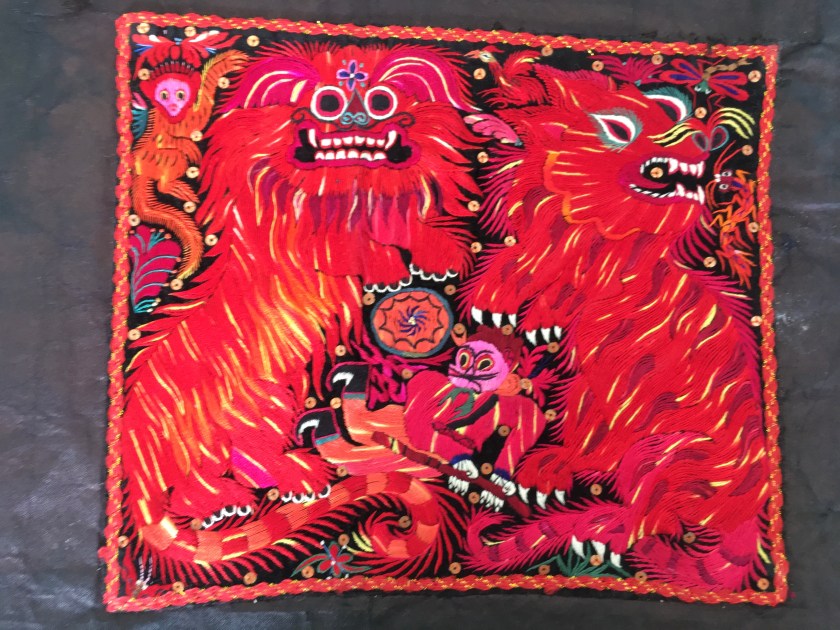
According to legend, the people from the Miao minority in Guizhou came from one of a dozen eggs laid by a butterfly mother who came from a Maple tree. Among the remaining eleven eggs there was hatched a dragon, an ox, an elephant, a tiger, a thunder god, a centipede, a snake, a boy and a girl. Miao religion is animistic in nature. Shamans communicate with spirits. Animals, stones, trees, water, lightening, and thunder all play important parts in traditional Miao religion. The embroidery of the Miao people is striking. The photo is of a portion of a sleeve which we discovered in a house outside of Kaili in western Guizhou. The two lions depicted represent the autumn harvest celebration and the deep red color symbolizes fortune and prosperity. The cotton fabric was made by the Miao people and dyed red to become “cow blood fabric.” The fabric is often coated with egg white to give it a kind of sheen or gloss and to make the fabric water resistant. Indigo is also prevalent in Guizhou. Blue indigo actually comes from green leaves. Indigo leaves are crushed and left in a vat of water to ferment. After a few months, quick lime is added and the result is indigo. Cotton fabric is soaked in the dye and then hung to dry. If the color is not dark enough, the fabric may be dipped again until it reaches the desired shade of blue. Indigo is still the primary dye used in making blue jeans. Sometimes hemp is used instead of cotton and similar techniques are used to preserve the hemp cloth. Hemp fibers, however, are much shorter than cotton and unsuitable for spinning.

Besides the beautiful embroidery, Miao people are also silver artisans. Miao women adorn themselves with an abundance of silver jewellery which typically includes necklaces, earrings, bracelets, rings, and even heavy silver tiaras and crowns. Sometimes these crowns are adorned with silver horns or head flowers. Women wear silver “vests” decorated with all kinds of bling. Silver is also used by the Miao to test the purity of water and to fight disease and misfortune. Like many arts in China, however, silver artisans are a dying breed. Like embroidery, this art is time consuming and takes patience and persistence. But the results are both delicate and elegant.

If you were to meander through Zhaoxing, the largest and most accessible Dong village, in far eastern Guizhou, you couldn’t  help but feel that you’ve entered a time warp. The village rests in an idyllic setting surrounded by jade colored hills with a river flowing through it. The houses are almost all constructed of wood with many built on stilts. There are five drum towers, one for each of five Confucian virtues: Ren 仁 (benevolence), Yi 义(righteousness), Li 礼 (ceremony),  Zhi 智(wisdom), and Xin 信 (integrity). Each is unique, both in style and design.

Imagine a covered bridge made of wood that was wide enough for a bus to go over, but was made for people, not vehicles. Held aloft by five rectangular pillars made of concrete and stone, it’s an open bridge which supports multi-level towers (one on top of each pillar). There are benches and railings along the entire distance of the bridge where old men are playing xiangqi (Chinese chess), young couples are courting, and people of all ages are playing and exercising. All along the bridge and on the walls of the towers are carved and painted works of art. Calligraphy and auspicious flowers, dragons, gourds, cranes are everywhere. And lest I forget, strong mortise and tenon joints alleviate the need for a single nail or screw. These are the Wind and Rain Bridges of the Dong minority.

A Belt and Road Primer

2000px-One-belt-one-road.svg.png        wikimedia.org/wiki/File:One-belt-one-road.svg
The late 19th and early 20th centuries were not China’s finest hour. From one of the most powerful nations in the world, it had become a decaying relic of its former greatness. Europeans, Japanese, and Americans tried hard to make places like Tianjin reflect their own cultures. Sometimes I wonder as I stroll along the Bund in Shanghai or Yingkou Road in the former British Concession in Tianjin where Harry Liu lived, how Chinese feel about these relics of the past. Do they mourn the loss of iconic foreign architecture from the Concession Era, or do they welcome the distinctly modern creations by Chinese architects?

For many foreigners looking at China, it’s easy to get stuck in the past, be it 15 years ago leading students up China’s east coast, or 2,500 years ago, when Confucius, Laozi, and Gautama Buddha (OK Gautama Buddha was India) walked this Earth at the same time. Or to remember the Ancient Silk road which spread not only goods but Chinese culture across western Asia into Europe.

But most people in today’s China don’t live in the past. They live in a very future driven present.

Tianjin is the closest port to Beijing.  Located on the Bohai Sea, it has been a northern center for foreign trade in China since the Qing Dynasty, and today stands as the opening northern port of China’s 21st Century Maritime Silk Road, meeting up near Tianjin with the Eastern Land Silk Road, both a part of the “Belt and Road”, which is probably the most important 21st century economic initiative in the world today.

The “Belt and Road Initiative” aka “One Belt, One Road 一路 aka the “Silk Road Economic Belt and the 21st-century Maritime Silk Road 丝绸之路经济带和21海上丝绸之路was first unveiled to the world by President Xi Jinping in October 2013 in Kazakhstan. A few weeks later, Premier Li Keqiang promulgated China’s vision to  “help promote the economic prosperity of the countries along the Belt and Road and regional economic cooperation, strengthen exchanges and mutual learning between different civilizations, and promote world peace and development.”

We would be very naïve to think that altruism plays much of a role at all in the multi-trillion dollar Belt and Road Initiative. It’s designed to make it easier for the world to trade with China. At a national level, China would like to lessen gaps between the underdeveloped hinterlands and rust belt with the wealthier coast of China, and, by upscaling China’s status as a global leader, further enhance pride and love for the Mother Country.  At an international level, they would like to create new markets for China; to allow easier access to raw materials which China will continue to need; to find ways to reuse and repurpose surplus goods, equipment, and factories as China repositions itself as a more eco-friendly producer and manufacturer of goods; to create future customers for some of its new technological innovations AND to further develop its posture and position as a global economic leader.

The Belt is not a single path; it is actually six land corridors all starting in China:

1) The first corridor extends into Mongolia and Russia.

2) The second from China through to Europe. It’s now possible to go from China to London by railroad. In mid-March 2019, Italy announced that it would join the Belt and Road Initiative, becoming the first European country to sign on.

3) China-Central & West Asia Corridor make up the third corridor; the Central Asia-China gas pipeline, linking China with the Caspian Sea is up and running.

4) In the Pakistan Corridor China has helped build seaports, highways and high-speed railways.

5) There is a China-Bangladesh-India-Myanmar Corridor.

6) The final corridor is the China-Indochina Corridor. In Cambodia, between 65 and 80% of all the energy projects across the board are Chinese invested, built, or owned.

The Road refers to a maritime sea route extending from China through Indonesia, India, East Africa,  Egypt, into the Mediterranean – and which might very well extend west to South America in the not-too-distant future.

Some things to think about

  1. China has a unique requirement that it must be involved in all of the building of the projects it supports.
  2. Seven of the top ten global contractors are Chinese.
  3. The “Belt and Road” has been a big hit with the less democratic countries; In recent history, countries have often had to meet strict ethical standards when setting up global partnerships, but China, for the most part, does not require those kinds of ethical conditions be met:
    1. China has already signed agreements with Belarus, Azerbaijan, Saudi Arabia, and Thailand.
    2. China has been quietly developing economic connections with Afghanistan, Ukraine, Yemen, and Iraq.
  4. BRI is a risky plan involving several countries who may have a difficult time paying China back. In 2017, China signed a 99 year deal with Sri Lanka giving China control of the port they helped build. China also has a 40-year lease on the strategic Gwadar Port in Pakistan.
  5. There is a theory that China is trying to establish a chain of naval bases (“a string of pearls”) that will allow it to guard shipping routes where China has interests, thus giving it some strategic benefits.

For more in-depth reading, check out the Lowy Foundation “Understanding China’s Belt and Road Initiative” by Peter Cai https://www.lowyinstitute.org/publications/understanding-belt-and-road-initiative

Chinese Odyssey 44

Before Liberation,

Tianjin had “Concessions”

Europeans, US, Japanese

claimed possessions

The Astor Hotel 

housed the Emperor Pu Yi

There was Keisslings for borscht

for baozi, Gou Bu Li


China and Wal-Mart

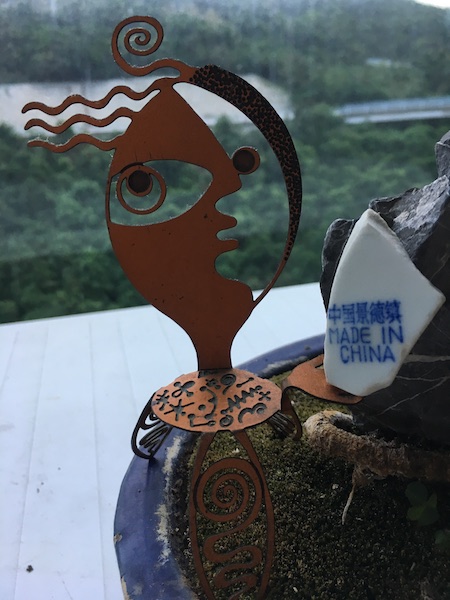
Made in China

When I was a kid, everything my family bought was made in the USA. It wasn’t because we were super patriotic. Foreign products were just out of our price range. I really don’t remember seeing “Made in America” or “Made in the U.S.A.” signs or labels.  The first TV’s were RCA, G.E., or  Zenith. Cars were Fords, Chevy’s and Plymouth’s. Coke, 7-Up, and Pepsi cost a dime in a pop machine, and if you needed some extra coin, you’d ride around on your bike picking up bottles and sell them back to Safeway’s for 2 cents a bottle. People would have called you crazy if you had told them that in 20 years, they would be spending two dollars for a small bottle of plain water from France.

The change was probably gradual but it seemed like it happened over night.  Records morphed into cassette tapes and then into CD’s. VW bugs snuck into the American car market and were barely noticed, but Toyotas and Hondas became game changers. Japan started making the best cameras, TV’s, and stereos and the US manufacturers were rapidly getting priced out of the US market. American blue collar workers were scrambling to hold onto their jobs, their benefits, and, in some cases, their retirements.

As so often happens, the finger of blame was pointed at others. Instead of blaming greedy Americans for relocating their factories overseas to take advantage of lower wages and less expensive working conditions, Americans blamed the Chinese and Japanese for flooding our markets. Of course these countries wanted a piece of the American market. Who wouldn’t? America was a consumer’s paradise. And American retailers like Walmart and Target were making out like bandits. Like the illegal slave trade and the ongoing illicit drug trade, there have to be buyers for what “they” are selling and in America everyone seemed to want more.

In 1982, the backlash against Asians took a deadly turn when Hong Kong born American, Vincent Chin, was beaten to death with a baseball bat outside a Detroit bar by Ronald Ebens and his stepson Michael Nitz because they mistakenly thought that Vincent Chin was a Japanese car maker. Initially given 25 years on a second degree murder conviction, on appeal, that was later turned into a manslaughter three years probation. Ebens and Nitz never served a day.

Chinese Odyssey 23

America needed

a way to awaken —

something to stir us.

How could we be shaken?

It happened when shopping

in Wal-Mart one day.

Not one item said

“Made in US of A.”