Hello Dali

Chinese Odyssey 77

In Dali, we found

a lake shaped like an ear

biking beside it,

the water was clear.

The ancient walled city,

a backpacker’s dream

minority cultures

Bai, Hui, and Yi
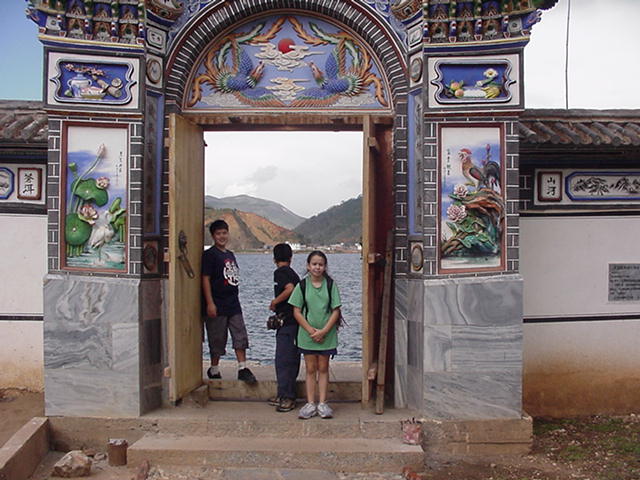
MVC-006S (2) copy

Imagine a bamboo stalk 6” in diameter reaching up into the sky higher than 20 feet. Now imagine six of those bamboo poles strapped together with bamboo fibre and floating on a giant lake the shape of an ear. Standing on the boat, a single fisherman. The fisherman is barefoot and wears a wide hat with a cone on top which looks a little bit like an enormous semi-flattened chocolate drop. Around the fisherman’s shoulders there is a rain jacket made out of woven grass and on his shoulders rests a pole. Balanced at either end of the pole are two massive black with a greenish-blue sheen cormorants, each weighing approximately five pounds. Cormorants have long necks and a hook at the end of their strong bills, perfect for grabbing fish out of the water. Each cormorant sports a ring around his neck to keep them from swallowing their catch. On a signal from the fisherman, the pole is steadied and both cormorants take off, one right after the other.  These amazing birds have been known to dive to depths of more than 30 feet and capture fish well over three pounds. When the cormorant returns, the fishermen collect the fish which are disgorged into the boat.

Many of the fishermen on these boats are from the Bai minority. Descendants of the Qiang people who probably moved from the Himalayas in far western China, they founded the Nanzhao Empire more than a thousand years ago in the area around present day Dali. Other groups of Qiang people became the more powerful Yi clan who ultimately ruled the Bai. It is said that the Yi people dressed in black and that the people who served them, the Bai people, dressed in white. (Many Bai women continue to where white headgear, with colorful embroidered costumes and many Yi women continue to wear black headgear, combined with colorful, embroidered clothes, and silver jewelry.)

The Bai Kingdom of Nanzhao existed during the 8th and the 9th centuries followed by the Kingdom of Dali from 937-1253 CE. Towards the end of the Nanzhao Empire the Bai rebelled and took over the kingdom, but it didn’t last long. Towards the end of the 13th century, Kublai Khan and the Mongols invaded and the formerly  independent Nanzhao kingdom became a part of Yuan China.

Among the people accompanying Kublai Khan were members of the Hui minority, who are Muslim, but are ethnically Han Chinese. The Hui make up a part of the rich diversity of the people in Dali, a community of 650,000 residents situated in north-central Yunnan about halfway between Kunming and Lijiang. The Hui people have fully integrated with the local population, becoming shop owners, traders along the Tea-Horse road, farmers, mine-workers, and restaurant owners. Their path to integration, however was not always an easy one. During the 1860’s, there was a Muslim uprising in Dali, when, for a short period of time, Dali became an “independent city state” with a Sultan. Du Wenxiu (杜文秀 Dù Wénxiù), Chinese Muslim leader of the Panthay Rebellion became the “Sultan of Dali” for 16 years. In 1873, however, Qing troops under the command of Cen Yuying (岑毓英) laid waste to his “kingdom.” Cen Yuying, from neighboring Guangxi had risen quickly to power, and when he arrived in Dali, he supervised the decapitation of Du Wenxiu. Three days after Du’s decapitation, Du’s top generals were welcomed by Cen to a banquet, where 17 of the generals, on a signal from Cen, were beheaded at the table. The following day, a 3-day massacre began, with no Muslim man, woman, or child spared. Cen, himself, estimated that 4,000 Muslims were slaughtered and that number is considered by many as a conservative estimate. For three decades after that, a sign hung over the city gate stating that “traitorous Hui” were forbidden to enter Dali.

Dali was healing and just getting used to its new normal at the beginning of the 20th century. The Republic of China was established, and Yunnan pledged its loyalty to the fledgling republic. Cai E (蔡鍔 Cài È) was a Chinese revolutionary from Yunnan who challenged Yuan Shikai when Yuan attempted to dissolve the nascent Republic of China in 1916. Cai later became Governor of Yunnan and Governor of Sichuan, before becoming a very influential warlord who served as an inspiration to Zhu De, Mao Zedong’s staunchest ally from the beginning of the Communist revolution. Cai and other warlords managed to hold on to a fair amount of autonomy thanks to both trafficking in opium and the fact that Yunnan was geographically distant from most of the action happening in China during the Republican period.

Fast forward to the opening of the bamboo curtain and backpackers discovering Dali in the late 1980’s thanks to Lonely Planet’s China – a Survival Kit. Dali welcomed foreign newcomers at first, even renaming one of their main roads Yangren Jie (Foreigners Street) – aka Huguo Lu (护国路). Along that road there were restaurants which sold pizza and banana pancakes as well as regional cuisine at low prices. There was freshly baked bread, spicy potato and corn dishes and freshly brewed Yunnan coffee. Cafes like Marley’s, Jim’s Peace Café, and the Tibet Café (said to be the oldest western café in Dali – opened in 1984) were perfect places to read, write, and socialize with journeyers from around the world. Travel Writer, Bruce Connolly from China Daily called Dali his personal “Heaven on Earth” in the 1990’s when there were still horse-drawn taxis that would take local people up to their homes on the mountain slopes.

And the beat goes on. In March 2020, a researcher for Sixth Tone Fresh voices from today’s China, Xu Song wrote an article entitled “Why Dali’s Hippie Migrants are a Model for Chinese Communities” in which he introduces the Chinese public to artists, novelists, and musicians in Dali’s diverse migrant community. Dali has become a haven for people who want to break away from the hectic life of China’s megacities. They even have alternative schools there, which ameliorate the academic pressure ubiquitous in the vast majority of Chinese schools through an emphasis on creativity and self-motivated learning. Xu has personally met with other “alternative migrant communities” around the world and is running a long term study in hopes that they may learn from one another.

Within the newly restored city wall surrounding Dali’s eclectic Old Town, one can sip amazing coffee at the Shi ZiShu Café or drink beer at Baldy’s Belgian Beer Garden. In the mountain village of Nuodeng (诺邓古村) 100 miles to the northwest, Bai people still cover fresh pig legs with a half inch of salt from a thousand year old salt well and cure them in cool, dark rooms for about a week. After that, they are hung up to dry in the fresh mountain air for from one to three years. The results are a dark, fatty, flavorful prosciutto-like ham. This ham is often eaten as a solo dish, although it sometimes cooked with cabbage, or served in soups. It also can be thinly sliced and served with breakfast eggs or in a sandwich.

On one side of Dali is Erhai lake, a longish (about 25 miles by 4 miles) lake, about the size of Flathead Lake in Montana. It sits at the base of the Cangshan (苍山 Cāngshān) Mountain range with an altitude of about 6200’ in elevation. The Cangshan mountains are beautiful by their own right. Steps have been replaced by a cable car (actually 3 cable cars). There are mountain streams, a beautiful lake, and an 11-mile paved trail called the Jade Belt Road which you can easily hike in a day. Perhaps, the greatest wealth of Dali and all of Yunnan is its diversity. In addition to the Bai, the Hui, and the Yi people, at least 22 of the other 56 recognized minorities in China call Yunnan their home.


Sichuan – Poets, Pandas, and Peppers

Chinese Odyssey 67

Southwest into Sichuan

where four rivers flowed

Gold monkeys and pandas

roamed through Jiuzhaigou

Du Fu and Li Bai

two poets of Tang

Remembered today

in poems, paintings, and song.

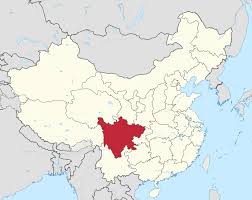
Sichuan and Chinahttps://commons.wikimedia.org/wiki/File:Sichuan_in_China_(%2Ball_claims_hatched).svg

Sichuan is the Pinyin spelling of Szechuan. Many westerners who see this word associate it with spicy food. The word Si (四 sì) means “4”. The word Chuan (川 chuān) means “river”.  The four rivers are the Jiālíng, the Jīnshā, the Mín, and the Tuó. So Sichuan means “Four Rivers.”  As you can see from the map, Sichuan is located in the dead center of China, but most Chinese think of it being in western China (kind of like Ohio and Indiana referred to as mid-western states in the USA.) Sichuan used to include the city in China with the largest population – Chongqing (重庆 Chóngqìng) aka Chungking (30.8 million people). In 1997, Chongqing was declared China’s 4th municipality which meant it was self-governing (like Beijing, Shanghai, and Tianjin) and no longer belonged to any province. Kind of like Washington D.C. not being a part of any state.

Now, back to the two things that people know about Sichuan:

  • Sichuan has hot, spicy food: Kung Pao Chicken (宫保鸡丁Gōngbǎojīdīng), Mother Po’s Beancurd (麻婆豆腐 Mápó dòufu), Dandan Noodles (担担面Dàndàn miàn), and Chongqing Hot Pot(重庆火锅 Chóngqìng Huǒguō)
  • Pandas – Although there are pandas in Shaanxi and Gansu, most wild pandas live in the cool, moist bamboo forested mountainous northern regions of Sichuan at elevations over 5,000 feet (1500 meters). It is almost impossible for a tourist in China to spot a panda in the wild. There are, however, Panda research centers in Sichuan where tourists can see and interact with pandas.

In Dr. John C.H. Wu (吳經熊)’s classic, The Four Seasons of Tang Dynasty Poetry, he called the poet, Li Bai aka Li Po (李白 Lǐ Bái), the “Prince of Spring”. Li Bai’s contemporary and good friend, Du Fu, once said of Li Bai:

“All the world wants to kill him

I alone dote on his genius

Quick-witted,

he has hit off a thousand poems

A waif in the world,

his only home is a cup of wine.”

Born in far western China, or possibly present day Kyrgyzstan, Li Bai was living in Chengdu, Sichuan at age 4 and continued to spend his next two decades there before he began to wander. Li Bai was a living testament to Tolkien’s great line, “not all who wander are lost.” A great friend and soul-mate to Daoist holy men, after meeting Li Bai, Ho Chih Chang (賀之章 Hè Zhī zhāng), a Daoist poet said of Li Bai “Why, you do not belong to this world. You are an angel banished from Heaven.” Li Bai reminds me of the American poet and song writer of the depression era, Woodie Guthrie. They were both prolific in their writing and their poetry had mass appeal. Neither one was able to keep a family together, so strongly were they drawn to the road and their poetry.

 送別                                                   Sòngbié                                  

下馬飲君酒                                        Xiàmǎ yǐn jūn jiǔ,

問君何所之?                                    wèn jūn hé suǒ zhī?
君言不得意                                        Jūn yán bù déyì,

歸臥南山陲                                        guī wò nánshān chuí.
但去莫復聞                                        Dàn qù mò fù wén,

白雲無盡時。                                    báiyún wújìn shí.

 Farewell – Li Bai

Come down off your horse, my friend, and have a drink!

Where are you off to?

Nowhere in particular.

Heading towards the Southern Hills.

That’s all I know for sure.

Just plan to drift like the clouds.

Dr. Wu said of Li Bai: “He is the perfect embodiment of the spirit of romanticism, in life, as well as in letters. He is romantic, imaginative, passionate, contemptuous of form and convention, grandiose and picturesque in thought and language, remote from experience, and visionary – there is no romantic quality that he lacks.”

If we consider Li Bai as the “party poet”, then Du Fu, aka Tu Fu (杜甫Dù Fǔ), could rightfully be called the “Poet Sage” (詩聖 shī sheng.) The young Du Fu was a great admirer of Li Bai, who was twelve years his senior. Li Bai, a romantic, reckless alcoholic, married multiple times, much more drawn to Daoist alchemists than he was to the Analects of Confucius, was the polar opposite of Du Fu, devoted Confucian scholar, who desired nothing more than to be a contributing civil servant, and a devoted family man. And yet, the “yin” and the “yang” were friends who held one another in the greatest esteem.

Climbing High – Du Fu

Swift wind, heaven high, an ape’s cry of grief,
At the islet of clear white sand, birds circle round.
Endlessly, trees shed leaves, rustling, rustling down,
Without cease, the great river surges, surges on.
Ten thousand miles in sorrowful autumn, always someone’s guest,
A hundred years full of sickness, I climb the terrace alone.
Suffering troubles, I bitterly regret my whitening temples,
Frustratingly I’ve had to abandon my cup of cloudy wine.

登高                                                   Dēng Gāo
风急天高猿啸哀                                Fēng jí tiān gāo yuán xiào āi
渚清沙白鸟飞回                                zhǔ qīng shā bái niǎo fēi huí
无边落木萧萧下                                wú biān luò mù xiāo xiāo xià
不尽长江滚滚来                                bú jìn cháng jiāng gǔn gǔn lái
万里悲秋常作客                                wàn lǐ bēi qiū cháng zuò kè
百年多病独登台                                bǎi nián duō bìng dú dēng tái
艰难苦恨繁霜鬓                                jiān nán kǔ hèn fán shuāng bìn
潦倒新停浊酒杯                                liáo dǎo xīn tíng zhuó jiǔ bēi

Guanyin, the God(dess) of Mercy

Chinese Odyssey 64

Saw my favorite Guanyin

and we stopped for a soda

Remembered Xuanzang

at the Wild Goose Pagoda

Rode bikes on a wall

which encircled Xi An

Inside the Great Mosque

we could hear the Qur’an.Guanyin

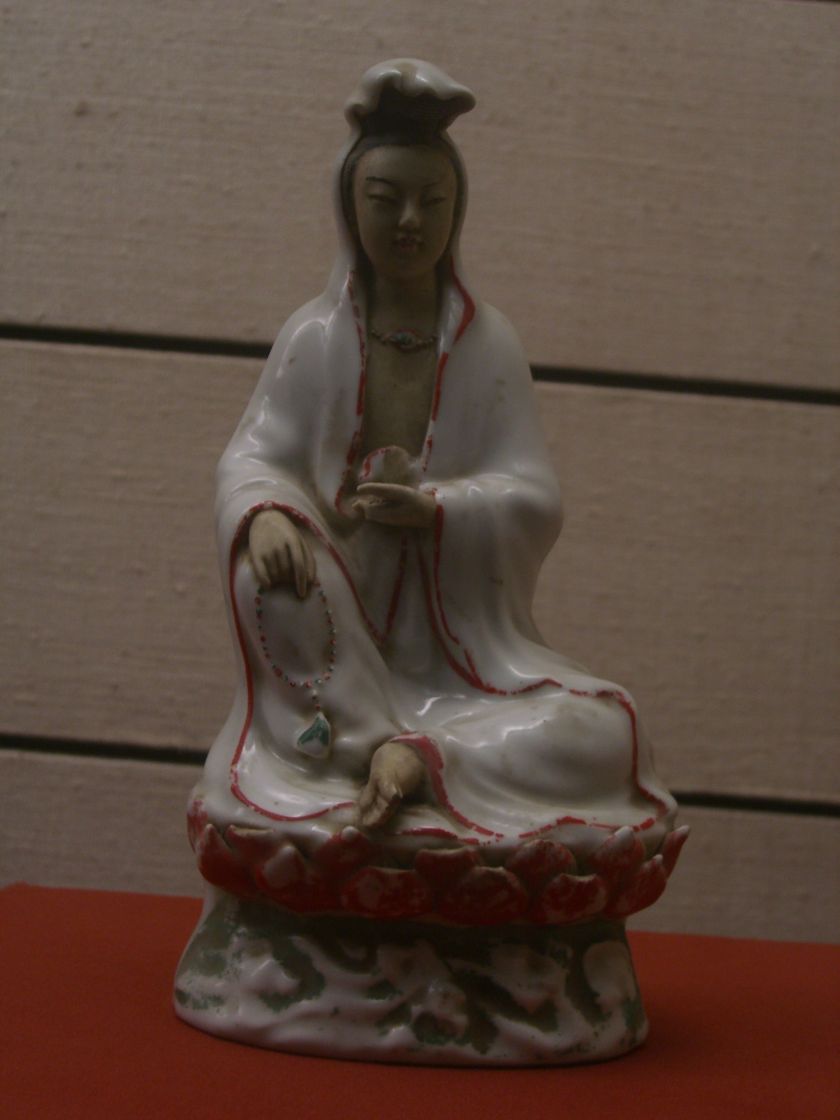
Guanyin has always been my favorite Bodhisattva. (Does anyone else have a favorite Bodhisattva?) Not sure whether it was the amazing 11th or 12th century “Guanyin of the Southern Sea” residing at the Nelson-Atkins Museum of Art in Kansas City or the Qing Dynasty Guanyin (Avalokitesvara) ceramic figure at the Shaanxi Historical Museum that made me fall in love with Guanyin. Having seen thousands of Guanyins in temples,  museums, street markets, and antique shops throughout the world, these two are still my favorites. I loved that Guanyin was the God/Goddess of Compassion and that he/she could have been male or female in origin. The Lotus Sutra says that “Guanyin travels throughout the world guiding beings towards freedom from suffering.” The word, “Guanyin” in Chinese means “pays attention to all sounds” which may also be interpreted as “hearing all prayers and pleas for help.”

“There is no place where s/he will not manifest her/himself.

The suffering of those in troubled states of being;

Hell-dwellers, hungry ghosts and animals;

And the suffering of birth, old age, illness, and death

Will gradually be extinguished”

The Lotus Sutra, trans. Tsugunari Kubo and Akira Yuyama, Bukkyō Dendō Kyōkai 2007.

Guanyin, (Avalokiteshvara in India), was almost certainly a male figure when s/he first appeared in Chinese Buddhist temples during the early centuries of the Common Era. It wasn’t until the Song Dynasty (960-1279 CE) that Guanyin transmogrified fully into her current female form. The Ming Dynasty Buddhist, Miaoshan (妙善 miào shàn) is often portrayed as a human manifestation of Guanyin. Miaoshan was the youngest of three daughters. At an early age, she had wanted to be a follower of Buddha, but her father had other ideas and insisted that she marry. When she adamantly refused, her furious father punished her by sending her to a nunnery, which he later tried to burn down. Legend has it that he tried again to have his daughter killed. Two soldiers took Miaoshan out to an open space in the forest and drew their swords. But a tiger appeared and the soldiers dropped their swords and fled whereupon the tiger took Miaoshan to a cave on a mountain and left her there. Some time later, Miaoshan’s father became very sick. He was told that the only way he could be cured was by a compassionate person gouging out an eye and cutting off an arm. Miaoshan’s father did not believe that someone would actually step forward and make that kind of a sacrifice. In the end, it was Miaoshan who gouged out her eye and cut off an arm to cure him. When her father gazed upon his mutilated daughter, and realized that she was the compassionate person,  he immediately realized what a selfish and heartless person he was, and begged her to forgive him. Some people believe that that thousand eyed, thousand armed Guanyin statues came into being as a result of the story about Miaoshan.

Guanyin statues and stories abound. One incarnation of the Guanyin statue which has always intrigued me is the one where she is carrying a baby (usually thought to be a baby boy.) I’ve often wondered whether that manifestation of Guanyin might have been influenced by Madonna statues brought in by Catholic priests when they first arrived China in the 14th century.

About 7 km (4.5 miles) due north of the Shaanxi History Museum, located in the heart of the old city of Xi’an, stands the best preserved and maintained city wall in all of China – with the possible exception of the wall around the Forbidden City in Beijing. Started in the Tang Dynasty (618-907 CE) and refurbished to its present state in the Ming Dynasty (1368-1644 CE), the total perimeter of the city wall is 13.7 km (8.5 miles). It is 15-18 meters (50-60 ‘) wide at the bottom and approximately 12-14 meters (40-45’) across on the top. The wall is approximately 12 meters (40 ‘) tall. Of the 6,000 cities in China which used to have walls, only about ten continue to exist today. A city within a city lies within these walls complete with schools, mosques, temples, commercial areas, museums, and anything else which makes up a city in China. One fun thing to do is to rent a bike on top of the wall. If you want, you can bike the entire perimeter of the wall.

One of my favorite places to visit within the wall is the Great Mosque. I actually lived in Xi’an for nearly a month in the early 2000’s. Every time I visited the mosque, it was quiet and serene. When I first went there in the early 80’s, I met a young English speaking Muslim student who lived and studied at the mosque. I wrote down his name and when I went back nearly twenty years later and asked about him, he was still there. I’m not sure he remembered me but we had a nice reunion .

The Muslim Quarter surrounding the Great Mosque has some of the best street food in Xi’an. A local Xi’an favorite is the Paomo Lamb & Pita Soup (羊肉泡馍 Yáng Roù Pào Mó). At its core, Paomo is a potage, a delicious thick broth filled with lamb and shredded flat bread.  Dumplings are also  nice in Xi’an. Unlike traditional jiaozi or xiaolongbao, dumplings here often contain spices like cumin, chives, and sweet garlic. Try the 灌汤饺子 Guàntāng Jiǎo which are translated as the Steamed Dumplings from Heaven.

You may remember Xuanzang (玄奘Xuán zàng) from the Monkey stories. He lived from 602-664 CE in the Tang Dynasty and was the real life Buddhist monk who took a pilgrimage to India to visit the sources of Buddhism in areas we now call India, Pakistan, Bangladesh, and Nepal. He was aware of an earlier Buddhist monk  by the name of Fa Xian (法顯 Fǎxiǎn) who had traveled to India with nine other monks in the 5th century in a similar quest for Buddhist scriptures. It is said that the Big Wild Goose Pagoda (大雁塔 Dàyàn Tǎ) in Xi’an was the storage place of over 500 cases of Buddhist scriptures and artifacts that Xuanzang brought back to China from India – among them some of the most important of the Mahayana Buddhist scriptures.


Dinosaurs, Fairies, and Noodles

1024px-Gansu_Museum_2007_257

https://commons.wikipedia.org/wiki/file:Gansu_Museum_2007_257.jpg

The capital of Gansu Province, Lanzhou, is located on the banks of the Yellow River. In 2012, Lanzhou was designated as a Special Economic and Administrative Zone. When we visited Lanzhou’s Gansu Provincial Museum (甘肃省博物馆 Gānsù Shěng Bówùguăn) in the early 2000s, to see the famous Flying Horse of Gansu (馬踏飛燕), our middle schoolers were not all that impressed. What they were most taken with was an almost completely intact Ancient Huang He elephant (Stegodon Huanghoensis) skeleton. Jurassic Park was not even a decade old and it was still fresh in the minds of these middle-schoolers. On a later trip into Sichuan, we visited the Zigong Dinosaur Museum 自贡恐龙博物馆 (Zìgòng Kǒnglóng Bówùguǎn ), China’s first special museum dedicated to dinosaurs. A May 2018 article in Smithsonian.com called China the “the epicenter of paleontology.” A portion of that article likened the scope and magnitude of recent Chinese finds to those dinosaur discoveries in the American west in the late 19th century.

It was at the same museum, we saw our first “apsara” in an exhibit on the northern silk road. The word “apsara” was new to me. Like fairies, apsara inhabit both the sky and the water and are found in both Buddhist and Hindu cultures. In both cultures, apsara are female. In the images we saw, they were young, playful, nubile, and appeared as graceful dancers and gifted musicians. Chinese call the nymphs,飞天fēi tiān. We looked forward to learning more, but it was time for some la mian.

There’s a rumor that Lanzhou La Mian is currently the largest fast-food franchise in the world. Not sure I believe that, but I’m pretty sure it’s in the running for top spot in China. What’s so special about兰州拉面 lán zhōu lā mìan aka 兰州牛肉面lán zhōu níu ròu mìan? The character 拉 (lā) means “pulled”. The noodle recipe is simple: water, flour, and salt. The right amount of salt is the critical ingredient to get the noodle dough to the proper consistency. Proper lamian chefs then do their magic by stretching and folding and pulling until the initial rectangle of dough becomes beautiful thick tasty noodles. Lanzhou Lamian is made by putting slices of beef, turnip, scallion, and cilantro into a special broth (recipes easy to find.)  Many people like to add chili sauce to make these noodles even tastier.

With a population of about 3 million, Lanzhou is not a particularly large city, but it is a historical gateway city to the west. It also serves as a major hub of the Belt and Road project linking China’s prosperous eastern region to Central Asia. Formerly one of China’s most polluted cities, it has taken great strides towards cleaning its air by planting trees in the eastern edge of the Gobi desert.

Chinese Odyssey 55

In the morning I wandered

the streets all alone.

In a Lanzhou museum,

a dinosaur bone,

some caveman graffiti

inscribed on a bow.

There were apsara flying

in warm desert glow.

Fishing at the Great Wall

Fishing at the Great Wall

Walls in China pre-date the earliest historical dynasties. Built as enclosures, walls have been a part of every Chinese village and city for most of China’s history. Indeed the character chéng (城), depending on how it is used, can colloquially mean either wall or city. Beijing, Shanghai, and Nanjing all had walls surrounding them, long gone now. Today, you can rent a bicycle to ride the nearly 14 km perimeter on the top of the city wall of Xi’an, one of the few remaining city walls in China.

In his quest for immortality, Emperor Qin Shi Huang burned books and destroyed historical records so that Chinese history would recognize him as China’s first emperor. Some historians believe that the name “China” came from Qin (pronounced “chin”). It was this emperor who had over 6,000 life-sized terra cotta soldiers and horses made to protect him in the after-life. And, it was Emperor Qin, China’s most narcissistic ruler ever, who decided that he wanted to unite the already existing walls into a barrier wall that would protect all of China and keep the northern barbarian invaders from entering into his kingdom.

Stretching from Shanhaiguan (山海关区)  in Hebei Province, 270 km northeast of Tianjin, the Great Wall stretches about 2,250 km (1400 miles) across northern China to the final resting post, Jiayuguan (嘉峪关) in Gansu province. It varies in dimensions, but is nearly 10 meters tall (over 30 feet) in some places and is as wide as a single lane road on the top. It crosses deserts, steep mountain passes, and plains. Combining the lengths of all the tributary walls with that of the northern wall, it is estimated that the Great Wall stretches for nearly 8,000 km (5,000 miles) in length.

Only a fraction of the current Great Wall was initially connected together by Emperor Qin. Most of the Great Wall was built during the Ming Dynasty (1368-1644). The Ming Dynasty overthrew the Yuan Dynasty which had been ruled by the Mongolian people to the north. A large portion of the Great Wall was built to prevent another invasion from the Mongolian steppes. There is no way of ascertaining the human cost of building the wall. Historians believe that the number of people who died constructing the wall exceeds 1,000,000. Scientists all agree that there’s no way that a person could make out the Great Wall or any other man-made construction from the moon. And most military minds agree that a wall is an ineffective way of protecting a border.

That said, the Great Wall is impressive. And it’s crowded. Remember my formula for visiting Chinese sites. Walk for 10 minutes and the crowd diminishes by half; another 10 and it can be quiet; 30 minutes and you can be by yourself. Definitely the case for the Great Wall. All the sites are impressive. That’s why they were chosen in the first place. I think my favorite – so far – is the 10 km stretch of the ‘wild’ wall starting at Jinshanling (金山岭) and ending at Simatai (司马台). One used to be able to walk the entire stretch pretty much hassle free. In recent years, certain parts have been closed off for a variety of reasons. At the Simatai end, there used to be an amazing zip-line that would take you from the wall itself over a reservoir onto a platform right outside the tourist area of Simatai. Probably not the safest of Chinese tourist attractions, but maybe they’ve upped the standards. Sure was fun!

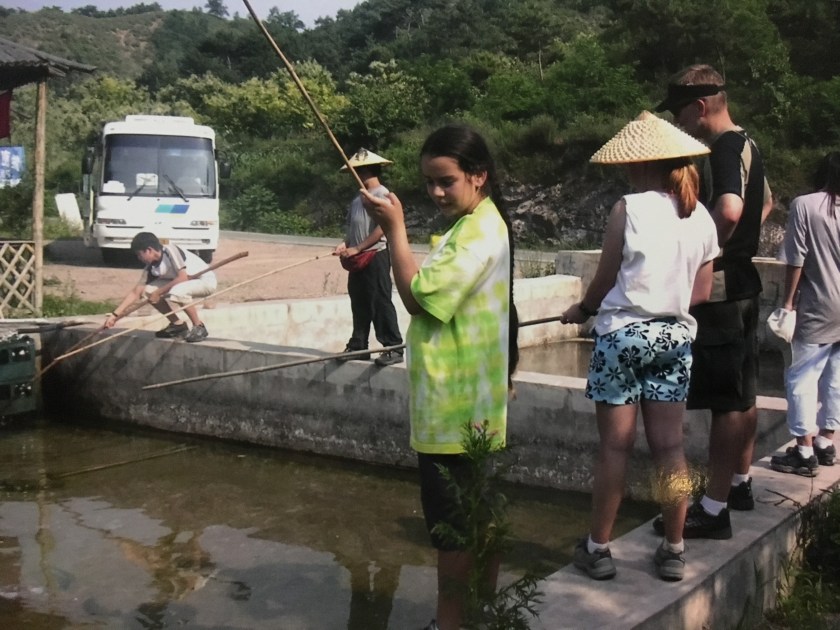
Outside the walls at Badaling (八达岭), Simatai (司马台),  and Mutianyu (慕田峪), there were fishing ponds where you could rent cane poles with hooks covered in balls of dough which you cast into small concrete fishing pools teaming with rainbow trout and salmon. After catching a trout, it would then be barbequed on a wood fire and served with local greens and a kind of cornbread. My Montana fly-fishing father is probably turning in his grave reading this, and it wasn’t much of a fishing experience, but the local people did know how to barbeque the fish and they were delicious.

Chinese Odyssey 48

Outside of Beijing

at the Jinshanling wall,

we scrambled and trekked

trying hard not to fall.

We slid down the zip line

into Si-Ma-Tai,

went fishing for trout

on the 4th of July.


Beijing, Peking, Peiping, Yanjing, Dadu – what’s in a name?

Beijing_Old_Railway_Station

Gene Zhang [CC BY 2.0 (https://creativecommons.org/licenses/by/2.0)]

My first trip from Beijing to Tianjin took over three hours on a slow-moving passenger train. Today, one can get from Beijing South Railway Station to Tianjin Railway Station on the Beijing-Tianjin High-Speed Train in 30 minutes.

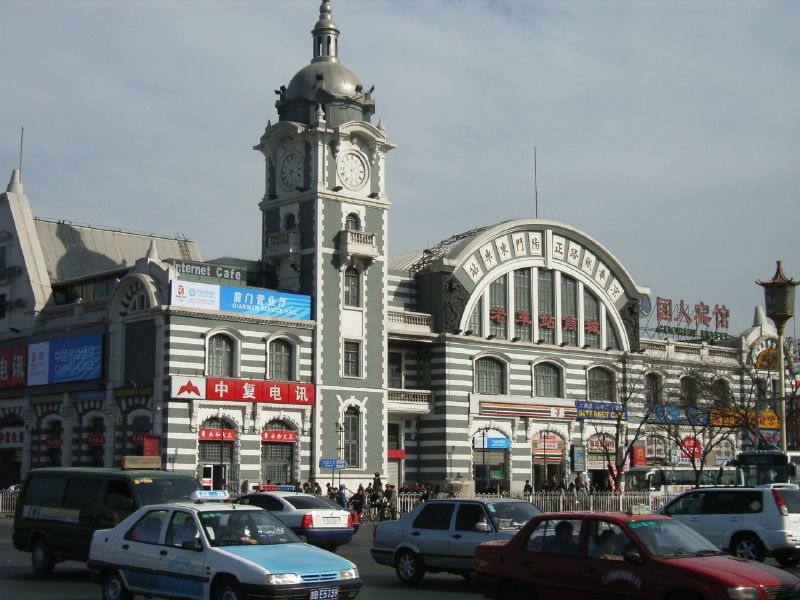
There was a vibrancy in the air when we stepped off of the train at the Beijing Station 北京站 Běijīngzhàn on a hot July day in 1982. The grey, blue, and green colors of day faded softly into the concrete and stone buildings and bridges and the air of China’s capital city. Moving like a snail in a Didi Chuxing car (China’s Uber), it’s hard to imagine many of these same streets packed chock-a-block with bicycles. There still seem to be bunches (not billions) of bikes in Beijing, but most of them are shared bikes. And an increasing number of shared bikes are broken bikes. Bikes no longer own the road, cars do.

So many things taken for granted a few decades ago are a shadow of what they used to be. Barbers had spots on the street and at sidewalk intersections in the parks. It’s said that one can still find old men at Yùyuāntán Park 玉渊潭公园 who will trim your hair for a few yuan. And in the early morning, men walking their birds and Taiqi “boxers” have been joined by practioners of Qigong, a variety of wǔ shù (武术) martial arts, badminton players, gymnasts, and ballroom dancers.

Beijing lawmakers banned bāozi (包子) and jettisoned jiānbǐng (煎饼) when they made the Haidian hawkers close down shop. Baozi is the quintessential northern comfort food. It’s a fist-sized wheat flour pastry filled with meat and/or vegetables and then steamed. Jianbing is more difficult to describe. It’s made with flour (millet or wheat), thickness somewhere between a crepe and a dosa. After the flour mixture is poured and spread onto the large, round cast iron pan, it becomes the “bing”. Add an egg (or two) by spooning or brushing it onto the bing. Then a generous sprinkling of green onions and a pinch of salt; some sweet bean paste; a shake or two of sugar; maybe a little baste of hot pepper sauce aka là jiāo jiàng (辣椒酱).  On top of all of that spread a few shards of guǒ bì (馃箅), that crispy fried dough that goes on top of everything else. Then roll it up like a big burrito, fold it in two, cut it in half, and put into a paper or plastic bag. Beijing breakfast.

I heard the street food’s also gone in Xidan and Sanlitun. Is there still someone selling green onion cakes aka cōng yóubǐng 葱油饼 outside of the Temple of the Azure Clouds in Xiangshan? Thank God for Wangfujing. Rumor has it, the night market is still going strong. I’m sure they still have the amazing Xinjiang kebabs (串儿Chuànr) and sugar coated haw fruit aka tánghúlu 糖葫芦 . It’s been a few years, but I’m heading up to Beijing next week. Guess I get to see for myself.

Chinese Odyssey 45

Three hours from Tianjin

to the heart of Beijing.

There were vendors on bikes

hawking fresh congyoubing.

Haircuts on the corners,

men walking their birds,

Sword Taiqi at daybreak

not saying a word.


Yantai is Chefoo

Yantai (Chefoo) ChinaChe-Foo, China (engraving). Illustration. Britannica ImageQuest, Encyclopædia Britannica, 26 Mar 2018.  quest.eb.com/search/108_2472893/1/108_2472893/cite. Accessed 16 Mar 2019.

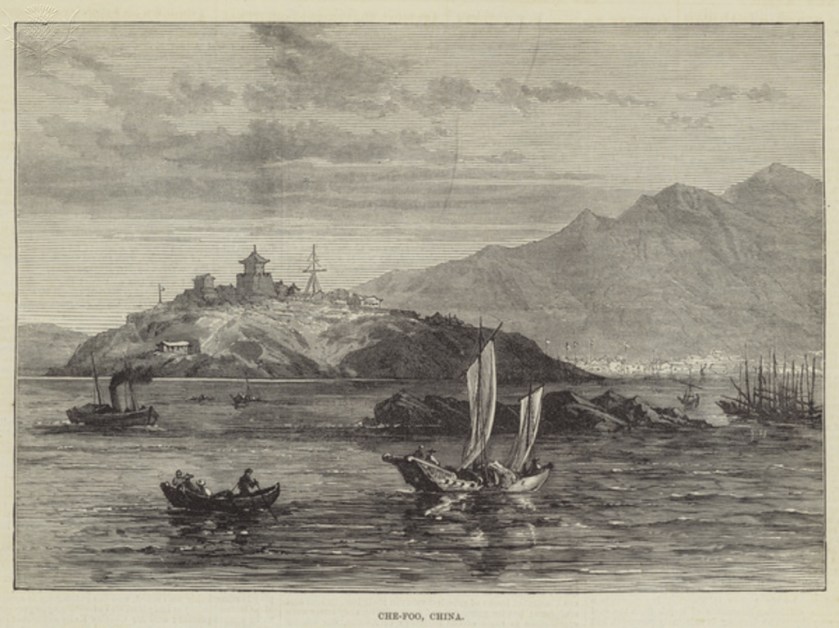
In 1997, the plan was to travel by train from Taishan to Yantai. Yantai (烟台市 Yāntái shì) is located on the southern shore of the Bohai Sea which turns into  Korea Bay and then becomes the Yellow Sea and then the East China Sea and finally the Pacific Ocean. It is nearly due south of Dalian (formerly known by non-Chinese speakers as “Port Arthur”), and it looked to be a straight shot by boat to Tianjin. Twice I tried and twice my plan was foiled. But I’d still like to ride that boat.

Chefoo 芝罘  Zhīfú was the name most Westerners used when they referred to the city we now know as Yantai. Although it is a city of nearly 7 million people, my guess is that many people reading this have never heard of it. There was a Christian school that opened there in 1881 called the Protestant Collegiate School or Chefoo China Inland Mission School 芝罘学校  Zhīfú Xuéxiào, and it served as a Christian boarding school for the China Inland Mission. I find the accounts of Christians living in China fascinating. More came to teach than to learn. The ways they lived and dressed and considered their missions were multifold and multi-layered. Many provided the first solid connections between China and the West. Some men and women would dedicate their entire lives to the service of the church in China. I found this account of the life of missionary children at the Chefoo School by Larry Clinton Thompson, an interesting window into how the children of these missionaries lived their lives:          https://www.academia.edu/8994079/Missionary_Children_in_China_The_Chefoo_School_and_a_Japanese_Prison

In 1941, the children and staff who had not managed to leave before the Japanese invaders arrived were first interned in the Temple Hill Internment Camp in Chefoo before being transferred to the larger Weihsien Internment Camp 潍县集中营 Wéixiàn Jízhōngyíng, a Japanese operated “Civilian Assembly Center” about 260 km southwest of Chefoo. Among the residents of the camp was Eric Liddell, the famous Scottish gold medal runner turned missionary who was featured in the 1982 Oscar best picture film, “Chariots of Fire.” When he was finally taken prisoner by the Japanese, he was sent to Weihsien where he continued his ministry, setting up sports events, teaching science to children, and running a Sunday school every week. While there, he was diagnosed with a brain tumor but was inspirational to the end. The title track from “Chariots of Fire” is often used in sporting events today and is still one of the most recognizable instrumental movie themes ever written.

A fun story connecting Yantai to the West involved an American sailor by the name of Jimmy James. Most people don’t know that Jimmy’s actual last name was Skalicky. After dropping out of college in Minnesota in 1902, Jimmy joined the army and ended up in Tianjin (then known by Westerners as Tientsin) where he was discharged from the 15th Infantry in 1922. At that town, there were naval ships that would dock at Yantai, and Jimmy had the bright idea of opening up a hamburger stand there. It was such a big hit, people begged him to do something similar in Shanghai, so Jimmy decided to give it a go. In 1924, he opened up a diner on Broadway Road (now Da Ming Lu) in Shanghai, called The Broadway Lunch. In 1927, he changed the name to Jimmy’s Kitchen, and the rest is history. And for those who don’t know that history . . . the restaurant is an icon in Hong Kong from the Colonial era. You can still get the same Steak Diane and Baked Alaska that were favorites of John Wayne and Cary Grant. Still dishing up great grub on Wyndham Street in Central and at the Jinjiang Hotel in Shanghai.

 Chinese Odyssey 42

 On the map it appeared

to be one easy sail

from Yantai to Tianjin;

there was no way to fail.

No boats in the Bohai,

so an overnight bus

where the seats turned to beds

was a hotel for us.

Lion’s Head, Trotters, and 1,000 Year Old Eggs

800px-Xiao_Long_Bao_at_Shanghai_Wind,_VancouverKent Wang from Richmond, Vancouver (https://creativecommons.org/licenses/by-sa/2.0)%5D, via Wikimedia Commons

Shanghai’s history is rich, but, as a cosmopolitan city,  relatively short. Before the 1842 Treaty of Nanjing,  following the 1st  Opium War, Shanghai was little more than a fishing village. All that changed when the British named Shanghai as a treaty port. As Shanghai grew,  it was not as a single entity, but rather as a conglomeration of “concessions” to foreign powers. The French, British, and Americans along with the Germans, Dutch, Japanese, Portuguese, and Russians all had “concessions” in Shanghai, and they all demanded the right of “extraterritoriality.” They would be bound only by the laws of their own countries, not by the laws of China.  What emerged was an interesting mixture of architecture and industry, Chinese and European cultures that both blended and clashed. By 1943, the Japanese were largely in control, and by the end of the 1940’s most foreigners had cut and run, leaving Shanghai as the heart of the new guard, from whence the Cultural Revolution received guidance from Mao’s wife Jiang Qing, ¼ of the Gang of 4.

Aside from its proximity to the ocean (“Shanghai” 上海 actually means “on the sea”), it is also within a few hours of a large number of some of China’s more popular (and populous) places. The Yangtze River Delta (長江三角洲) is a bulging Megalopolis, 88 million strong. Hangzhou (杭州) is 100 km to the southwest. Suzhou () is 100 km due west. And Wuxi () and Tai Lake (太湖) are 100 km northwest. Larger cities of Ningpo (宁波) and Nanjing (南京) are 160 km south and 240 km west respectively.  River towns like Tongli (铜陵) and Wuzhen (乌镇), and hillside resort villages like Moganshan (莫干山are all only a few hours from Shanghai. Shanghai was at the right place at the right time for its rapid emergence in the new China.

Maybe because of its patchwork history and it’s spider web like delta geography, it’s hard to associate a particular cuisine with Shanghai. That said, there are certainly dishes which connoisseurs of Chinese food associate with Shanghai.

Foremost among these has got to be Xiǎolóngbāo (). Like other Chinese dishes, the English translation, “steamed dumplings” just doesn’t do this tasty treat justice. A thin flour pastry is wrapped around a filling of pork, sesame oil, ginger, soy sauce and shaoxing wine. Handling these floppy balls of steamy soup and ‘filling’ with chopsticks so that they don’t burst between the bamboo steamer, the small ceramic dipping plate filled with Zhenjiang vinegar (镇江) and slivers of fresh ginger, and your mouth, takes practice, but it’s well worth the effort.

I’ll never forget the first time I tried Pídàn Dòufu 皮蛋豆腐.  When it came to my plate, it was already minced up and I didn’t really pay attention to the black and brown specks stirred with a white, cold, almost cheesy mass. All I knew was that I really liked it. When I was then shown my first pidan (usually translated as “thousand year old egg” or “century egg”),  my first thought was “no way am I going to eat this”. Think of peeling a hard boiled egg, but instead of the outside of the egg being white, it is amber black. When cut open, the yolk is greenish blue grey. It’s actually an egg that has been preserved by being treated with ash and alkaline, wrapped in clay and buried for 6-8 weeks. It is not, nor was it ever, soaked in horse urine – as I was first lead to believe. Pidan can be made with a duck egg or a chicken egg, but it’s not something one usually eats solo. My favorite way to eat it is in the Shanghai style cold dish, Pidan Doufu. Combined with fresh silky doufu, finely chopped cilantro, diced fresh ginger, soy sauce, sesame oil, and often accompanied by pork floss, its pleasing taste is second only to it’s presentation. Really a delightful way to start a Shanghainese meal.

Another largely unknown dish outside of China is, Típáng (红烧蹄膀 Hóngshāo Típáng). Appearing like a pork roast covered in fat with a thin layer of skin covering the entire thing, in actuality, it is a pork trotter or a pork shoulder that is stewed for hours on the top of a stove in a combination of soy sauce, water, garlic, shaoxing wine, green onions, rock sugar, and star anise until it emerges from the wok ready to eat. Cooked well, it is unbelievably tender and is easily picked off the bone with chopsticks. Not only is the meat delicious, many people believe that the fat and the rind are really the tastiest portions of Tipang. Not sure where it had its beginning, but it’s a popular winter dish in Shanghai and surrounding areas.

Another fun winter food with Zhejiang origins is called “Lion’s Head” or Shīzitóu 狮子头.  It can be described as a stewed pork and cabbage meatball. It’s large size and it’s shape are probably the reasons for the name. Like most dishes, there are variations of Shīzitóu. Color varies from white to red (soy sauce). Usually made with pork (can be beef or even vegetarian).  Chinese cabbage, diced mushrooms, doufu, and diced bamboo shoots can all be found in Shizitou.

Last, but not least, is 炒年糕 Chǎo Niángāo –  The name means fried (new) years cake.  I always associated the name niangao with a sweet fried treat we eat during the Chinese New Year. In Shanghai, however, chao niangao is eaten all year round and it often takes the form of a wide, thick noodle. Sometimes, it takes other shapes. Rectangles, ovals, and circles (representing coins) are all common. During CNY, another common form one sees is that of a pair of fish. The New Years saying “年年有餘 nián nián yǒu yú” means that you should have surplus at the end of every year. The word yú “surplus” is a homonym for another word yú which means “fish”. Two years, two fish.

Like so many other things Chinese, I’ve introduced only the tip of the iceberg, with a few well known Shanghainese foods. Hairy Crab, Beggar’s Chicken, and Drunken Shrimp are all fun and tasty as well. And the modern cuisine, both Chinese and International, which one can find in areas like Xintiandi (新天地), is some of the best in all of China.

Chinese Odyssey 38

Peace Hotel, Peoples Park

to the west, old Shanghai

Pudong, growing out

building up to the sky.

Xiaolongbao at Nan Xiang

fusion food Xintiandi

Bicycles replaced

by the new MRT


Tales from Hangzhou

qin hui and lady wangQin Hui and Lady Wang  –  Morio [CC BY-SA 4.0 (https://creativecommons.org/licenses/by-sa/4.0)%5D, from Wikimedia Commons

My introduction to Hangzhou was poetry. When I first gazed on West Lake, I couldn’t wait to search out Ping Hu Qiu Yue aka Placid Lake Autumn Moon (平湖秋月 Pínghú Qiūyuè). It was the nexus of West Lake, where one could watch clouds flying and the reflection of distant hills, while sipping the perfect cup of Long Jing Green Tea under a full Autumn moon. Visually, it was all I had hoped for. I knew the tea house would look and feel old and weather-worn, but that was OK. Pen and notepad in hand, I sat down to compose a poem. Unfortunately, a very loud and excited member of our China tour named Bill, from the Bronx, saw me sitting alone and thought I wanted company. I never did get my poem written. Thankfully, I can borrow and share one from Tang Dynasty poet, Su Shi (aka Su Dongpo 苏东坡.)

 曲:

盘。

看?

 Yang Guan Qu: Zhong Qiu Zuo by 苏轼 Su Shi

Mu yun shou jin yi qing han

Yin han wu sheng zhuan yu pan.

Ci sheng ci ye lou chang hao,

Ming yue ming nian he chu kan ?

Mid-Autumn Composition by Su Shi

Sunset clouds together and then dissipate, air clear and cold

Milky Way without a sound, moon moves across the sky。

This life, like this evening, not always so good

Next year, where will I be living to see this moonlight?

I did, however, get to see much of the West Lake the poets wrote about. There was the mountain crag called the “Peak Who Flew in from Afar” (飞来峰 Fēilái Fēng), that legend claims transported itself from India, the Six Harmonies Pagoda (六和塔 Liùhé Tǎ), which, for centuries served as a lighthouse on the Qiantang River, and the Broken Bridge (断桥duàn qiáo), backdrop for the Legend of the White Snake, where a young boy innocently consumed immortality pills, thinking he was eating sweet dumplings. The sweets seller,  actually one of the eight immortals, seeing what had happened, made the boy regurgitate the pills into the water by Broken Bridge where they were consumed by a small white snake swimming by. As you might imagine, there is a lot more to that story.

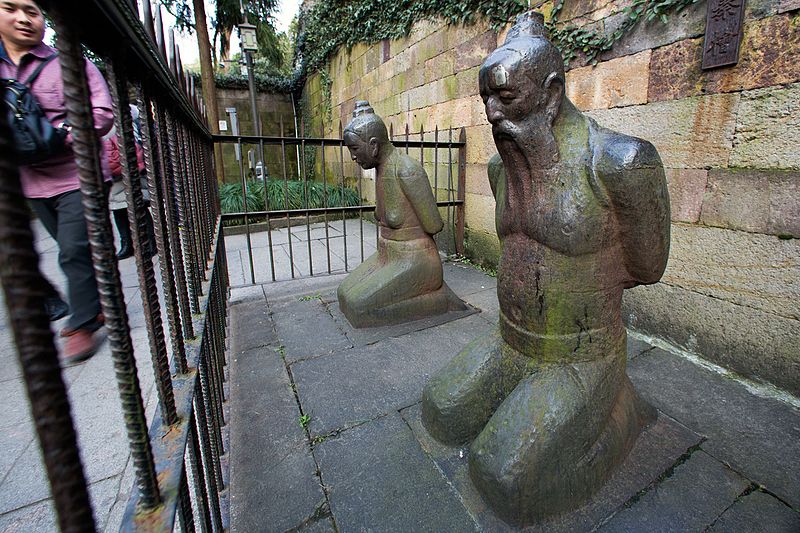
My favorite tale, however, is about the patriot, Yue Fei (岳飛 Yuè Fēi). He was born into a poor, but very patriotic family. When he was young, his own mother engraved the tatoo, 盡忠報國 jìn zhōng bào guó  “serve the country with the utmost loyalty”, on his back, and that message served as Yue Fei’s driving force. Yue Fei later managed to become both educated and a respected general in the Jin military. While fighting to recover Kaifeng, the Northern Song capital,  Yue Fei was called back to Hangzhou by the Emperor Gaozong (宋高宗Sòng Gāozōng), but he failed to heed that call initially. Qin Hui (秦桧) falsely accused Yue Fei of being a traitor to his country on some trumped up charges and Yue Fei was put to death. Although later history points much of the finger of guilt at Emperor Gaozong, it was Qin Hui and his wife, Lady Wang, who were to ultimately be remembered – in a very unique manner – as traitors to China.

One of the most popular pastries in China is called You Tiao (油條). Some people liken You Tiao to a donut without sugar, but it’s shape is a bit like that of two foot-long hotdogs glued together. In Taiwan, we used to eat youtiao with steaming hot doujiang (soybean milk) for breakfast. In Hong Kong, people will often eat these alongside their morning jok, aka congee (粥 zhōu).

The story goes that a doughmaker and his friend were sitting around at the end of the day, reeling about the unjust death of Yuefei and the dispicable nature of Qin Hui and his wife, and the doughmaker picked up a couple of pieces of remaining dough and said. “This is what I’d really like to do with those two. He stuck two long pieces of dough together, fashioned faces for each, and dropped them into boiling oil. Take that, you traitors, you “deep-fried devils” (油炸鬼 yóuzháguǐ). The Cantonese term, yàuhjagwái, is still popularly used for youtiao.

I would be remiss, however, if I didn’t update my story to the year 2018. As my Chinese friends would say, “bian hua hen da” (變化很大  biànhuà hĕn dà) – the change is enormous. I really didn’t recognize Hangzhou the last time I went there. I flew into a small, but very modern, airport.  My friend, Stan, said its faster for him to fly from the old Songshan airport in Taipei to Hangzhou than it is to go from his home in Taipei to the main Taipei airport. Streets once crowded with bicycles are now jammed pack with cars, and the air is a constant grey from the accompanying smog. Although many of the low-rise places along West Lake itself have been preserved, high rise, modern architecture abounds. There is a Starbucks now not far from Ping He Qiu Yue. Maybe great poems are being written there now over Caramel Macchiatos.

Chinese Odyssey 35

Our next stop, Hangzhou,

placid lake, autumn moon

broken Bridge, riding bikes—

took a break around noon.

Paid respects to Yue Fei,

ate some zongzi for free.

Like the Emperor Qian Long,

sipped Dragon Well tea


The British Colony of Hong Kong

600px-Flag_of_Hong_Kong_(1959–1997).svg

No one who ever landed at Hong Kong’s Kai Tak airport in the heart of Kowloon ever forgot the experience. There are tons of photos from planes landing that captured clothes hanging outside windows and on balconies of Kowloon high rises and some passengers claimed they could watch TV shows through the doors open behind the balconies. There was only one short runway built on “reclaimed land” in Victoria Harbour just south of Kwun Tung.  Some say that the reason there were never any serious mishaps were that pilots were just too scared coming in.

June is a muggy month in Hong Kong. Coming off a 15 hour flight from Los Angeles, we stepped into a steam bath of exhaustion and energy. A part of all of us just wanted a shower and a bed, but another part wanted to drop our stuff off and explore. Air conditioning wasn’t as ubiquitous then as it is now in Hong Kong so heat and jet-lag won out and it was on to the New World Hotel. For many of our kids, jet lag was a new experience. After all, it was sixteen hours earlier in Tulsa than it was in Hong Kong and none of our bodies or minds knew quite what to make of that.

In the early 1980’s, Hong Kong harbour was wider. Kellett Island, home of the Hong Kong Yacht Club, was not yet a part of Hong Kong Island. There was no peninsula where the Hong Kong Convention Center now resides. The first cross harbor tunnel had only opened 10 years earlier. The Fleet Club at Fenwick Pier had a McDonalds sitting right on the harbour where American sailors passing by could stop off and have a draft beer. The Star Ferry terminal sat next door to the main post office in Central. And one could have tea on the first floor of the Peninsula Hotel with and unobstructed view of Hong Kong harbour. They call what’s happened in Hong Kong harbour “land reclammation,” but I always wondered how land that was never land before could have been reclaimed.

Those were the days of really cheap public transportation. Double decker trams cost 10 cents for an hour long ride from Shaukeiwan to Western District. The Peak Tram was still going strong ever since opening up in the 1890’s. Taxi’s dropped their flags at $2. The Star Ferry cost 10 cents for the lower deck and 20 cents for the upper and there were always rickshaw drivers standing right outside to run you in, around, and through Central. For some reason, Morning Star was the ferry every kid wanted to ride. Anybody smoked whenever and wherever they wanted, and that included on all forms of transportation.

Hong Kong has always had the best Dim Sum in the world and it didn’t disappoint. Our kids from Tulsa had their first taste of Cha Shao Bao 叉烧包, Siu Mai 燒賣, Har Gao 蝦餃, Chicken Feet 鳯爪, Spring Rolls 春捲, Turnip Cakes 蘿蔔糕, Spareribs with Black Beans 豉汁蒸排骨 – which were just the tip of the iceberg. And all washed down with Jasmine 茉莉花茶 or Pu-Erh aka Polay 普洱 tea. And they did it the old fashioned way.  Food carts weaving among tables, stopping whenever anyone asked, placing the saucer sized plates and mini-bamboo baskets filled with Ma Lai Gao 馬來糕 or the steel plates with covers heaped with Changfen 腸粉 (shrimp, beef, or barbeque pork). At the end of the meal, the cost was tabulated by the number of plates on the table (most plates costing less than one US dollar). The literal translation of “dim sum” is “a little bit of heart”. Whenever and wherever I eat dim sum today it always takes me back to Hong Kong. Maybe it really is a  little bit of heart.

Chinese Odyssey 26

Thirty-one hours later,

touched down in Hong Kong

stepped into a steam bath

but moved right along.

We rode the Star Ferry

looked dapper and chic

ate dim sum, drank Po-lay

and trammed to the Peak.