Chinese food in Taiwan was the best Chinese food in the world in the 1970’s. Nearly two million people from all over China descended on Taiwan in 1949, bringing with them a plethora of delicious delicacies to combine with the great Taiwan food already on the island. And the best of the best was the cheap street food. I discovered Sour Plum Juice (酸梅汤 Sūan Méi Tāng) near the New City Park, to be a great thirst quencher in the summer and Star Fruit Juice (杨桃汁 Yángtáo Zhī) was a natural soother for a sore throat. Boiled and Fried Dumplings (餃子 jiǎozi) and 鍋貼 guō tiē) cost 2 NT$ – 5 cents US, each. When I went out with my friends, I would always order at least 20 for myself. Cristy’s favorite snack just outside of the front gate of Fujen University – you guessed it, “Run, run, fast as you can, you can’t get away from the Stinky Bean Curd man .” Stinky Bean Curd (臭豆腐 chòu dòufu). Still a popular treat in Taiwan, Hong Kong and all over China, it is an acquired smell and taste, I suppose. Sort of like limburger cheese in Germany and durian fruit in southeast Asia.
And then there were the amazing noodles. In the winter time, it had to be beef noodles (牛肉面 niúròu miàn) at a cost of about 20 NT – 50 cents US – a bowl. In the summer, it was cool noodles ( 涼麵 liáng miàn), made with shredded chicken, julienned carrots, green onions, cucumber, fresh ginger, and sesame sauce). Another popular noodle in the Ximending (西門町) area of Taiwan was pork chop noodles (排骨麵 páigŭ miàn). I once told Cristy that they were called pìgu miàn 屁股麵 (lit. “butt noodles”). She never could remember which one was correct – and never forgave me for that. My favorite noodles, however, were Lao Deng’s Dan Dan Mian ( 擔擔麵 dàn dàn miàn). Hot, spicy, sesame noodles, perfect any time of the year. I liked to pair them with sliced pig ear, dried bean curd, and sea weed. Later, I learned that Dan Dan Noodles were not originally from Taiwan. They were from Sichuan, but to this day, I prefer Taipei’s version to the ones I get in Chengdu.
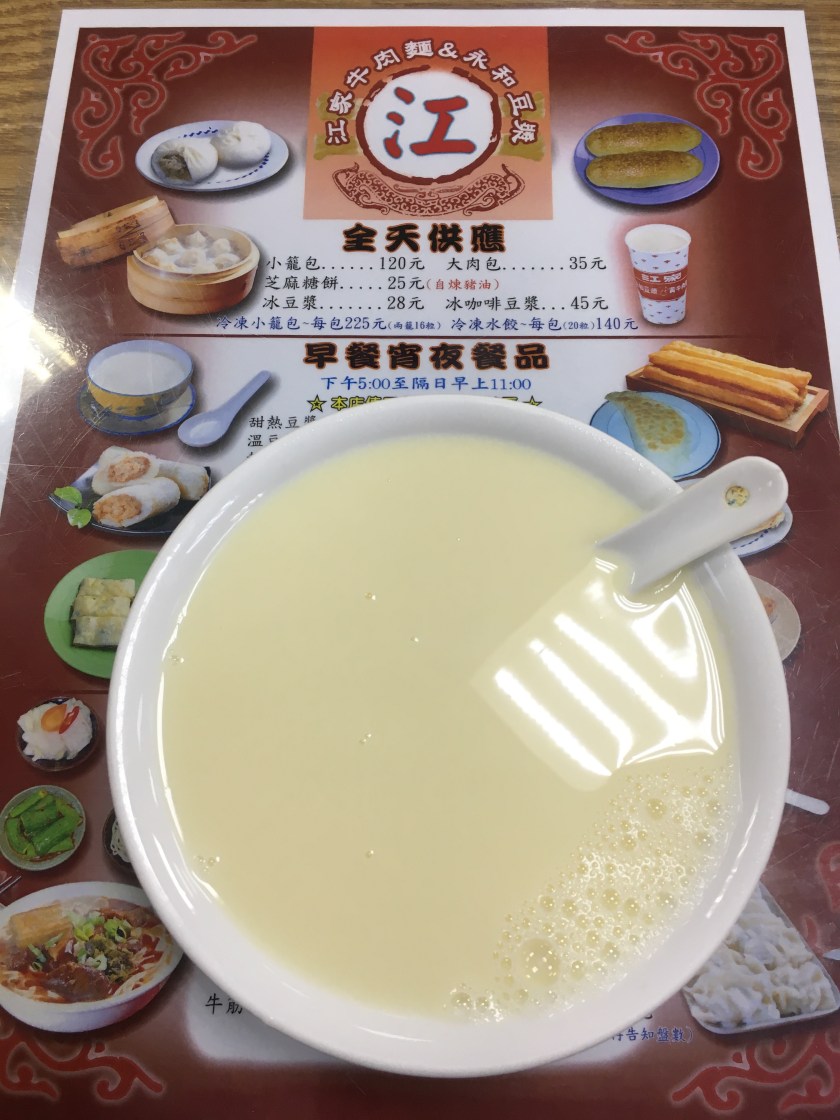
When I landed in Taiwan, I was clueless. I had studied Mandarin in Missoula, Montana for only one year. My professor had helped find a room for me with an elderly female judge who had come over from Shanghai with the KMT in 1949. I had an appointment the day after I arrived to enroll at Fujen University’s Mandarin Language Center which was over an hour away by bus. I left home at 7:00 every morning. On my way to school, I would pass the Recover the Mainland Café (復國餐廳 Fùguó Cāntīng) where smiling people would be enjoying their Chinese breakfasts. I really wanted to try the food, but I had no idea what they were eating or how to ask about it. One day as I stood there drooling at the steaming hot milk and the long pieces of deep fried dough, the cook came up to me and asked me in perfect English, “Do you want some of this?” I said, “Sure, what is it?” He said, “The white stuff is soy bean milk” (豆漿 dòu jiāng). You can get it salty or sweet. And that (he pointed at the fried long donut in a sesame bun concoction and struggled for a translation) is kind of like a Chinese hot dog without the meat.” I later found out this was called Shāobing Yóutiáo 燒餅油條. “OK”, said I, “I’ll give it a try.” It was love at first bite. I became a regular. It turns out that the cook had picked up his English when he served with the US military in Vietnam for five years.
I supported my studies at FuJen University by teaching English in tutorial centers (補習班 bǔ xí bān) and by singing and playing at the Idea Coffee House – about a mile from the old airport. Almost all of my students had English names as well as Chinese names. Sometimes students chose their own English names so I had quite a few with names like “Brave”, “Loyal”, “Swallow”, but my personal favorite was “Sweet Potato”. As hard as I tried, I could not convince “Sweet Potato” to change his name. Later I learned that the sweet potato has a special significance to the Taiwanese. Indeed, the shape of the island of Taiwan is the shape of a giant sweet potato.
Chinese Odyssey 10
The island was shaped like
a big purple yam.
For my first dinner there
I had fried rice with ham.
Next morning early,
I went for a walk
Ate youtiao and shaobing
but still couldn’t talk.
 The Panda in the Room PD