The Tail of the Dragon

Chinese Odyssey 81

So different today

many fine roads and schools

and ferries to Hainan

and great swimming pools

The beaches of Sanya

crowned Miss Universe

The old revolution

seemed now in reverse.

OLYMPUS DIGITAL CAMERA

Hainan Dao is the smallest Chinese province and is an island only slightly smaller than Taiwan. Shaped like a fig, it sits in the South China Sea about 25 miles off the tamarind shaped Leizhou Peninsula (雷州半岛 Léizhōu Bàndǎo) off the southern tip of the Guangxi Zhuang Autonomous Region. 200 miles to the east of Hainan, across the Gulf of Tonkin lies Vietnam. Travel north and east along the China coast for 330 miles and you’ll arrive in Hong Kong. Although, China sometimes refers to Hainan Island as the “Hawaii of China”, it’s not quite there yet. It is about the same size as all of the Hawaiian islands combined, has beautiful white sand beaches and crystal clear waters and you can swim there all year round – but the infrastructure has a ways to go.

When we arrived at our 4 star hotel in Sanya in the early 2000’s, I was surprised to see a massive number of ‘Europeans’ everywhere. It didn’t take me long to realize that these ‘Europeans’ were really Russians. Signs in Russia were everywhere. There was Russian TV at the hotel. And I was addressed in Russian by vendors on the street. It turns out that huge numbers of Russians come to Hainan as much for the beaches and tropical sun, as for the medical tourism with Traditional Chinese Medicine being very popular (especially acupuncture, moxibustion, and cupping.)

Hainan first became a part of China in 110 BCE during the reign of Han Wu Di (漢武帝Hàn Wǔ Dì) in the Han Dynasty when a military garrison was set up there. The original inhabitants of the Island were the Li minority (黎族 Lízú) aka Hlai people, who were not happy about the invasion of their island by the Han Chinese and held onto control of the island well into the Tang Dyasty (618-907 CE.) Up to that time, Hainan Island was also a place where political and intellectual enemies of the ruling Chinese elite were banished. The Han Chinese who lived on Hainan were confined to the coastal areas. During the Song Dynasty (960−1279 CE), Hainan Island became a part of Guangxi Province and large numbers of Han Chinese moved there. Later on, during the Ming Dynasty (1368 to 1644 CE), Hainan was put under the administration of Guangdong Province.

Some of the early lures of Hainan Island were its northern bed of pearls as well as the precious gems and scented woods from the region’s rich interior. Two major groups of Li people occupied the island. The Sheng Li (生黎) were also known as the savage Li or the wild Li where the Shu Li (熟黎) were considered to be the tame or the civilized Li. The Shu Li accepted the supremacy of the ruling Chinese and intermarried with the Han, whereas the Sheng Li continued to rebel and separate themselves from the invading Han. Like Taiwan, Hainan Island was also a haven for pirates and buccaneers and was a haven for opium smugglers and merchants to ply their trade.  As regards legitimate trade, timber became a lucrative item, especially in the Five Finger Mountain region. Hakka traders dealt in Xin Hua Li (a type of scented rosewood), Sandal Wood, and Nan Mu, a precious wood unique to this region used for boat building, architectural woodwork, and furniture. Towards the end of the Qing Dynasty (1644-1911 CE), the British Navy put an end to much of the piracy in the area and foreign religious groups established churches, hospitals, schools, and orphanages.

Hainan Dao remained underdeveloped until well into the 20th century. It was not until Liberation in 1952 that a road was finally built intersecting the mountainous central part of the island. There is a legend from the area called Five Finger Mountain (五指山Wǔzhǐshān). The story is that a man and his wife met a stranger on the road one day. After walking and talking with the man, the man presented them with a magic knife. The knife, he claimed, would make them rich . . . and it did. When an evil demon found out, however, he decided to rob and kill the couple so he could have the knife for himself. The couple learned of the plot and told their five sons who came to their rescue. Unfortunately, the sons were unsuccessful and all five sons were killed and the devil ended up with the knife. When five immortals heard the story, they went after the devil, slew him, and buried the sons in five parallel mounds. The mounds grew into hills and the hills became the Five Finger Mountains. Other stories claim that the five fingers are the fossilized fingers of a dead Li minority Chief and still another story dedicates the five mountain peaks to five Li gods.

Two events occurred in the 2000’s which focused the eyes of the world – many for the first time – on this beautiful island.

The first was the mid-air collision of a U.S. Navy spy plane with an interceptor fighter from the PRC in April, 2001. According to the Chinese People’s Daily, two Chinese F-8 fighter pilots were following a larger American plane flying near the coast of China, when suddenly the larger plane veered, striking one of the Chinese planes. The pilot of the Chinese fighter was killed in the incident and the American pilot of the EP-3 and his 24 man crew were forced to “violate Chinese air space.” US officials claimed that the US plane was flying over international waters and that the Chinese planes swooped in twice before “clipping the leftmost propeller on the third pass.” Even though permission to land was denied by the Chinese authorities, the American aircraft was disabled and was forced to make an emergency landing on Hainan Island where they were detained and interrogated by Chinese authorities for 10 days. To free the American crew, a “Letter of two sorries” was issued which was, according to US authorities “not a letter of apology” since the US had nothing to apologize for.

Mao Zedong had banned all beauty pageants in China. He called them “bourgeois nonsense” and said that participants were “lacking in self-respect.” In the early 1980’s, there were calls to “allow women to be women.” (Dr. Louise Edwards, director of the Modern China Studies program at the University of Hong Kong). Edwards went on to say, “The contemporary idea of womanhood seems to be linked to the ‘right to be beautiful and to beautify’ in China.” Actually one of the first acknowledged beauty pageants in the PRC was the Goat City Youth Beauty Competition which happened in 1985 in Guangzhou. Even though, looks only accounted for 15% of the final decision (the other 85% relied on a knowledge of politics, literature, economics, chemistry, temperament, and Putonghua proficiency), there was still plenty of controversy. Wasn’t this bourgeois liberalism? In 1993, Beijing University women rejected beauty pageants because they “objectified women” and in 1994, the China Federation of Women declared that beauty pageants were “products of a male-dominated society.” It wasn’t until 2003 that the Chinese Communist Party officially lifted the ban on beauty pageants. This was just in time for the resort city of Sanya (三亚市 Sānyàshì), on southern tip of Hainan Island, to host the Miss World contest. One year later, a transgender model by the name of Chen Lili applied to the compete in the Chinese Miss Universe contest and was initially accepted, but that was overturned before the actual contest. According to the Shanghai Morning Post, Miss Li “seemed to outshine all the beauty queens onstage.”

Hanoi to Hainan – Haves and Have Nots

Chinese Odyssey 80

 From Xingyi to Nanning

and west to Hanoi,

a Friendship Pass opened

bringing sorrow and joy.

In the midst of the war,

a banana peel

discarded by Gonggong

became one family’s meal.

https://upload.wikimedia.org/wikipedia/commons/1/1d/Banana_peel.jpg

My father-in-law came from a family of traders and merchants. China was a scary place to live in the 1930’s and 40’s. By December of 1938, much of the province of Guangdong had been occupied by Japanese forces. All Chinese males between the ages of 15 and 60 were suspected by the Japanese to be enemies or “enemies pretending to be local people.” Survival in southern China meant a lot of out of the box thinking and creative problem solving.

Gonggong left his home village in the Nanhai district of Guangdong to seek his fortune and help support his family by traveling south and west eventually ending up in Vietnam. Like his forefathers who had made their ways to San Francisco and then south to El Salvador 100 years earlier, Gonggong was a keen observer and was able to connect dots between what was available in certain areas and what was sought after in others. He saw possible business opportunities opening up in French controlled Vietnam, so he sought out distant relatives in Hanoi. There, he learned the lay of the land and was able to consider his options. Sometimes he would take the southern route, staying on the coast to Beihai – even taking the slow boat to Hainan Dao.  I have no idea how many times Gonggong crossed the 500 odd miles between Hanoi and Jiujiang, but I do know that there were enough trips for him to develop a familiarity with the region. From Hanoi north and east to Nanning before traveling the remaining 350 miles north and east to Jiujiang.

There was the 530 mile narrow-gage (1,000 mm – 3 ft 3 3⁄8 in) railway line built by the French between Hanoi and Nanning (Yunnan–Haiphong railway (滇越铁路 Diānyuè Tiělù) that was completed in 1910. Goods were transported on that line to both the KMT and others in China in need of European goods in the early days of the war, but once Nanning was taken and the Japanese occupied Vietnam, this line too was severed (for the allies), making “the Hump” air route the only way of getting supplies into China.

During the Han Dynasty, Emperor Han Wu Di (漢武帝 Hàn Wǔ Dì) conquered Vietnam (then known as Nan Yue 南越 Nányuè) and for 1,000 years, Vietnam was effectively a part of China. Many Chinese migrated there, drawn by the rich farmland and fishing of the Red River Delta. Scholars and government officials also alighted and set up a Chinese centralized state. Like Korea and Japan, Viet Nam adopted the Chinese writing system – until they recognized it was inadequate for their own linguistic needs nearly 1,000 years later. Confucianism also seemed to be a good fit for the Vietnamese as did Buddhism and Daoism.

Barely two hundred years into Chinese occupation, there was a famous rebellion started by two sisters by the surname of Tru’ung. Tru’ung Trac and Tru-ung Nhi came from a military family where they learned the arts of war. After Tru’ung Trac’s husband was killed, and Tru’ung Trac raped by the Chinese for resisting Chinese rule, Tru’ung Nhi convinced Tru’ung Trac to avenge their treatment and liberate Vietnam from the Chinese.  In 43 CE, the Tru’ung sisters led an independence revolt against the Chinese government which nearly succeeded, but after three years of fierce fighting, their revolt was ultimately crushed by the Chinese forces and the Tru’ung sisters drowned themselves to avoid capture. To this day, the Tru’ung sisters are national heroes in Vietnam. Chinese Premier Zhou En Lai visited a temple dedicated to the Tru’ung sisters as a show of respect during his first state visit to Viet Nam in 1956.

Towards the end of the Tang  Dynasty in the 10th century CE, however, the Vietnamese took advantage of the weakened Chinese government and upon prevailing in the Battle of Bach Dang River declared Vietnam free of the Chinese yolk, and finally secured independence for Vietnam which they called Annam.

The Friendship Pass 友誼關 Yǒuyì Guān; older name Ải Nam Quan (隘南關) was actually first established between Viet Nam and China during the Ming Dynasty in the 17th century. Then, it was called South Suppressing Pass 鎮南關 Zhèn Nán Guān,  and the pass itself actually served as the border between Viet Nam and China. This pass was later used by China and Vietnam during the early 1970’s to help the Vietnamese fight “American Aggression” in Vietnam. During that period, the Friendship Pass was anything but friendly. All along the pass were land mines, bamboo spikes, and barbed wire meant to prevent disruptions to the flow of goods.

When the initial clashes between China and Vietnam began in 1977, the Vietnamese government put pressure on its ethnic Chinese population and many of them fled north across the border. In 1979 400,000 PLA troops suddenly appeared on that same border to teach the Vietnamese a lesson for their assistance in bringing down the Khmer Rouge regime in Cambodia, who had been a close ally of the PRC. That was the last “border war” between the two countries. Vietnam and China began patching things up in the 1990’s as they worked together for common economic interests. Today, there remains a love-hate relationship between Vietnam and China, not unlike the scars the still exist in many families as the results of unresolved family feuds.

The one story I remember Gonggong telling about his traveling over Friendship Pass was when he felt hungry while walking along the road near present day Lang Son. He reached into his travel bag and pulled out a banana. As soon as he did, he noticed a small group of people following him. As he walked, the number grew. When he finally finished his snack, he tossed his banana peel into the road. Before it even hit the ground it was snatched up and torn apart by people desperate for anything to eat. Such was southern China in the early 1940’s.

Guizhou – Poverty, politics, and pulchritude

Chinese Odyssey 78

The province of Guizhou

was poor and remote.

It’s said there were three things

they all lived without;

no three feet of flatland,

three days without rain,

three pieces of silver

were in their domain.

IMG_1392

Xi Jinping, China’s Premier, has been getting a lot of bad press these days, especially in the USA. Most recently due to the Hong Kong national security legislation, but that runs neck-to-neck with the coronavirus. Before that it was unfair trade practices, cyberespionage, the treatment Uyghurs in Xinjiang, and a host of other issues. What we don’t hear about very often, however, are some of Xi’s positive initiatives.

In October 2015, Xi vowed to eradicate poverty among the remaining 70 million poor Chinese people by the year 2020. Actually, the poverty eradication initiative started in 1984 when Deng Xiaoping said in a meeting with foreign guests:  “Socialism must eradicate poverty, and poverty is not socialism.” Since the year 2000, 600 million poor people had already been lifted out of poverty. Xi relied on his own experience growing up in a small impoverished agricultural community in the north-western part of Shaanxi province in the 1950’s and 60’s. This year, Xi has reiterated his solemn pledge during the March 2020 18th National Congress of the CCP, that despite Covid-19, this goal shall be met.

Even though, the name Guizhou, could be translated as “rich land”, for most of its history, Guizhou has been one of the poorer provinces of China largely due to topography and isolation. Guizhou sits on an old eroding plateau called the Yunnan Guizhou (aka Yun Gui) Plateau. It’s steep slopes, poor drainage, and red and yellow soil  make it challenging for farming. Only about 3% of Guizhou’s land is suitable for any type other than terrace farming and terrace farming requires large numbers of people working for little pay. Imagine not a hill, not a mountain, but a range of mountains sculpted by hand into steps of various sizes and shapes that all need to be maintained by an intricate system of irrigation controlled by massive numbers of men, women, and children using the most basic of farming tools.

Topography also made trade difficult since there were very few roads and no navigable rivers in Guizhou. Guizhou’s does have natural wealth, however, in terms of forests and plant and animal diversity, it is a treasure land to practitioners of Chinese medicine.

To address Guizhou’s poverty, there have been major initiatives throughout the province. New crops have been introduced that are more nutritious and have higher yields, both in terms of production and health benefits. Over 4,000 miles of new roads, highways, and modern suspension bridges have been built reaching some of the more isolated areas in the province. A well known idiom in China is 要想富先修路 yāo xiǎng fù xiān xiū lù which translates to, “If you want to become prosperous, you must first build roads.” In 1978, there were 18 million people living in poverty in Guizhou. 40 years later, in 2018, that number had been reduced to 1.5 million.

In December of 1934, after trudging 320 miles from Ruijin, Jiangxi, the 34th Division of the Red Army was nearly destroyed by Nationalist Troops at the Battle of the Xiang River (血战湘江) in Guangxi province. By the end of that battle only about 30,000 of the original 130,000 Red Army troops remained and things were looking bleak. With their strong reduction in numbers, they knew they would have to jettison much of their equipment, like x-ray machines,  printing presses, and heavy artillery, so they dumped it into the Xiang River and carried on. Mao persuaded Zhu De, Lin Biao, Zhang Wentian aka Lo Fu, and others that they should change course and meet up in Zunyi in Guizhou instead of south-eastern Sichuan. By the time they reached Zunyi in Guizhou in early January, 1935, it was clear that tactics and leadership needed to change. Otto Braun, the German comintern commander of the 1st army alongside Zhou En Lai and Bo Gu aka Qin Bangxian were poised to step aside. By the end of the Zunyi Conference (遵義會議 Zūnyì huìyìn) January 15-17, 1935, it is fair to say that Mao Zedong was poised to take over as both military commander and acknowledged leader of the Chinese Communist Party. It’s probably no coincidence that China’s premiere “baijiu” (grain alcohol), Maotai (made from red sorghum), is distilled only minutes away from Zunyi.

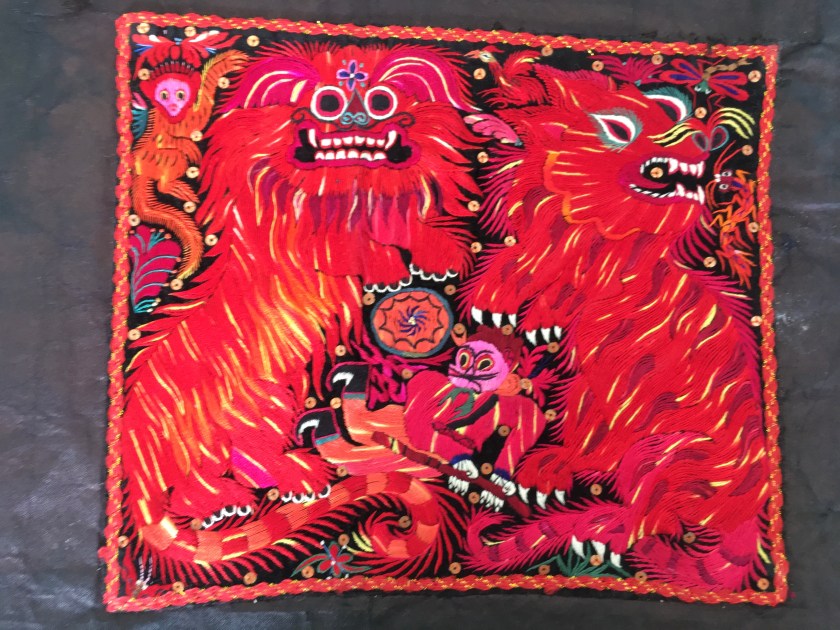
According to legend, the people from the Miao minority in Guizhou came from one of a dozen eggs laid by a butterfly mother who came from a Maple tree. Among the remaining eleven eggs there was hatched a dragon, an ox, an elephant, a tiger, a thunder god, a centipede, a snake, a boy and a girl. Miao religion is animistic in nature. Shamans communicate with spirits. Animals, stones, trees, water, lightening, and thunder all play important parts in traditional Miao religion. The embroidery of the Miao people is striking. The photo is of a portion of a sleeve which we discovered in a house outside of Kaili in western Guizhou. The two lions depicted represent the autumn harvest celebration and the deep red color symbolizes fortune and prosperity. The cotton fabric was made by the Miao people and dyed red to become “cow blood fabric.” The fabric is often coated with egg white to give it a kind of sheen or gloss and to make the fabric water resistant. Indigo is also prevalent in Guizhou. Blue indigo actually comes from green leaves. Indigo leaves are crushed and left in a vat of water to ferment. After a few months, quick lime is added and the result is indigo. Cotton fabric is soaked in the dye and then hung to dry. If the color is not dark enough, the fabric may be dipped again until it reaches the desired shade of blue. Indigo is still the primary dye used in making blue jeans. Sometimes hemp is used instead of cotton and similar techniques are used to preserve the hemp cloth. Hemp fibers, however, are much shorter than cotton and unsuitable for spinning.

Besides the beautiful embroidery, Miao people are also silver artisans. Miao women adorn themselves with an abundance of silver jewellery which typically includes necklaces, earrings, bracelets, rings, and even heavy silver tiaras and crowns. Sometimes these crowns are adorned with silver horns or head flowers. Women wear silver “vests” decorated with all kinds of bling. Silver is also used by the Miao to test the purity of water and to fight disease and misfortune. Like many arts in China, however, silver artisans are a dying breed. Like embroidery, this art is time consuming and takes patience and persistence. But the results are both delicate and elegant.

If you were to meander through Zhaoxing, the largest and most accessible Dong village, in far eastern Guizhou, you couldn’t  help but feel that you’ve entered a time warp. The village rests in an idyllic setting surrounded by jade colored hills with a river flowing through it. The houses are almost all constructed of wood with many built on stilts. There are five drum towers, one for each of five Confucian virtues: Ren 仁 (benevolence), Yi 义(righteousness), Li 礼 (ceremony),  Zhi 智(wisdom), and Xin 信 (integrity). Each is unique, both in style and design.

Imagine a covered bridge made of wood that was wide enough for a bus to go over, but was made for people, not vehicles. Held aloft by five rectangular pillars made of concrete and stone, it’s an open bridge which supports multi-level towers (one on top of each pillar). There are benches and railings along the entire distance of the bridge where old men are playing xiangqi (Chinese chess), young couples are courting, and people of all ages are playing and exercising. All along the bridge and on the walls of the towers are carved and painted works of art. Calligraphy and auspicious flowers, dragons, gourds, cranes are everywhere. And lest I forget, strong mortise and tenon joints alleviate the need for a single nail or screw. These are the Wind and Rain Bridges of the Dong minority.

Hello Dali

Chinese Odyssey 77

In Dali, we found

a lake shaped like an ear

biking beside it,

the water was clear.

The ancient walled city,

a backpacker’s dream

minority cultures

Bai, Hui, and Yi

MVC-006S (2) copy

Imagine a bamboo stalk 6” in diameter reaching up into the sky higher than 20 feet. Now imagine six of those bamboo poles strapped together with bamboo fibre and floating on a giant lake the shape of an ear. Standing on the boat, a single fisherman. The fisherman is barefoot and wears a wide hat with a cone on top which looks a little bit like an enormous semi-flattened chocolate drop. Around the fisherman’s shoulders there is a rain jacket made out of woven grass and on his shoulders rests a pole. Balanced at either end of the pole are two massive black with a greenish-blue sheen cormorants, each weighing approximately five pounds. Cormorants have long necks and a hook at the end of their strong bills, perfect for grabbing fish out of the water. Each cormorant sports a ring around his neck to keep them from swallowing their catch. On a signal from the fisherman, the pole is steadied and both cormorants take off, one right after the other.  These amazing birds have been known to dive to depths of more than 30 feet and capture fish well over three pounds. When the cormorant returns, the fishermen collect the fish which are disgorged into the boat.

Many of the fishermen on these boats are from the Bai minority. Descendants of the Qiang people who probably moved from the Himalayas in far western China, they founded the Nanzhao Empire more than a thousand years ago in the area around present day Dali. Other groups of Qiang people became the more powerful Yi clan who ultimately ruled the Bai. It is said that the Yi people dressed in black and that the people who served them, the Bai people, dressed in white. (Many Bai women continue to where white headgear, with colorful embroidered costumes and many Yi women continue to wear black headgear, combined with colorful, embroidered clothes, and silver jewelry.)

The Bai Kingdom of Nanzhao existed during the 8th and the 9th centuries followed by the Kingdom of Dali from 937-1253 CE. Towards the end of the Nanzhao Empire the Bai rebelled and took over the kingdom, but it didn’t last long. Towards the end of the 13th century, Kublai Khan and the Mongols invaded and the formerly  independent Nanzhao kingdom became a part of Yuan China.

Among the people accompanying Kublai Khan were members of the Hui minority, who are Muslim, but are ethnically Han Chinese. The Hui make up a part of the rich diversity of the people in Dali, a community of 650,000 residents situated in north-central Yunnan about halfway between Kunming and Lijiang. The Hui people have fully integrated with the local population, becoming shop owners, traders along the Tea-Horse road, farmers, mine-workers, and restaurant owners. Their path to integration, however was not always an easy one. During the 1860’s, there was a Muslim uprising in Dali, when, for a short period of time, Dali became an “independent city state” with a Sultan. Du Wenxiu (杜文秀 Dù Wénxiù), Chinese Muslim leader of the Panthay Rebellion became the “Sultan of Dali” for 16 years. In 1873, however, Qing troops under the command of Cen Yuying (岑毓英) laid waste to his “kingdom.” Cen Yuying, from neighboring Guangxi had risen quickly to power, and when he arrived in Dali, he supervised the decapitation of Du Wenxiu. Three days after Du’s decapitation, Du’s top generals were welcomed by Cen to a banquet, where 17 of the generals, on a signal from Cen, were beheaded at the table. The following day, a 3-day massacre began, with no Muslim man, woman, or child spared. Cen, himself, estimated that 4,000 Muslims were slaughtered and that number is considered by many as a conservative estimate. For three decades after that, a sign hung over the city gate stating that “traitorous Hui” were forbidden to enter Dali.

Dali was healing and just getting used to its new normal at the beginning of the 20th century. The Republic of China was established, and Yunnan pledged its loyalty to the fledgling republic. Cai E (蔡鍔 Cài È) was a Chinese revolutionary from Yunnan who challenged Yuan Shikai when Yuan attempted to dissolve the nascent Republic of China in 1916. Cai later became Governor of Yunnan and Governor of Sichuan, before becoming a very influential warlord who served as an inspiration to Zhu De, Mao Zedong’s staunchest ally from the beginning of the Communist revolution. Cai and other warlords managed to hold on to a fair amount of autonomy thanks to both trafficking in opium and the fact that Yunnan was geographically distant from most of the action happening in China during the Republican period.

Fast forward to the opening of the bamboo curtain and backpackers discovering Dali in the late 1980’s thanks to Lonely Planet’s China – a Survival Kit. Dali welcomed foreign newcomers at first, even renaming one of their main roads Yangren Jie (Foreigners Street) – aka Huguo Lu (护国路). Along that road there were restaurants which sold pizza and banana pancakes as well as regional cuisine at low prices. There was freshly baked bread, spicy potato and corn dishes and freshly brewed Yunnan coffee. Cafes like Marley’s, Jim’s Peace Café, and the Tibet Café (said to be the oldest western café in Dali – opened in 1984) were perfect places to read, write, and socialize with journeyers from around the world. Travel Writer, Bruce Connolly from China Daily called Dali his personal “Heaven on Earth” in the 1990’s when there were still horse-drawn taxis that would take local people up to their homes on the mountain slopes.

And the beat goes on. In March 2020, a researcher for Sixth Tone Fresh voices from today’s China, Xu Song wrote an article entitled “Why Dali’s Hippie Migrants are a Model for Chinese Communities” in which he introduces the Chinese public to artists, novelists, and musicians in Dali’s diverse migrant community. Dali has become a haven for people who want to break away from the hectic life of China’s megacities. They even have alternative schools there, which ameliorate the academic pressure ubiquitous in the vast majority of Chinese schools through an emphasis on creativity and self-motivated learning. Xu has personally met with other “alternative migrant communities” around the world and is running a long term study in hopes that they may learn from one another.

Within the newly restored city wall surrounding Dali’s eclectic Old Town, one can sip amazing coffee at the Shi ZiShu Café or drink beer at Baldy’s Belgian Beer Garden. In the mountain village of Nuodeng (诺邓古村) 100 miles to the northwest, Bai people still cover fresh pig legs with a half inch of salt from a thousand year old salt well and cure them in cool, dark rooms for about a week. After that, they are hung up to dry in the fresh mountain air for from one to three years. The results are a dark, fatty, flavorful prosciutto-like ham. This ham is often eaten as a solo dish, although it sometimes cooked with cabbage, or served in soups. It also can be thinly sliced and served with breakfast eggs or in a sandwich.

On one side of Dali is Erhai lake, a longish (about 25 miles by 4 miles) lake, about the size of Flathead Lake in Montana. It sits at the base of the Cangshan (苍山 Cāngshān) Mountain range with an altitude of about 6200’ in elevation. The Cangshan mountains are beautiful by their own right. Steps have been replaced by a cable car (actually 3 cable cars). There are mountain streams, a beautiful lake, and an 11-mile paved trail called the Jade Belt Road which you can easily hike in a day. Perhaps, the greatest wealth of Dali and all of Yunnan is its diversity. In addition to the Bai, the Hui, and the Yi people, at least 22 of the other 56 recognized minorities in China call Yunnan their home.


Lost Horizon

Chinese Odyssey 75

The roads there were narrow

and sometimes we worried,

turned blind mountain curves

where June snow still flurried.

Descending at last

to a Yunnan plateau

like James Hilton’s hero

we, too, chose to go.

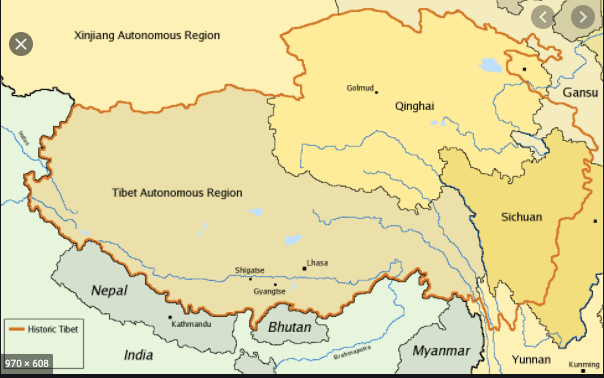
Historic Tibet“File:Historic Tibet Map.png.” Wikimedia Commons, the free media repository. 8 Jul 2019, 02:51 UTC. 26 Jun 2020, 01:00 <https://commons.wikimedia.org/w/index.php?title=File:Historic_Tibet_Map.png&oldid=357437409

Tibet Tidbits

  • Tibet is about the size of the entirety of western Europe. Tibet is larger in area than the states of Alaska and California combined.
  • Tibet exists on a plateau which averages 4,500 meters or a little under 15,000’. It would be safe to say that the 3.2 million people who inhabit Tibet all live their daily lives at an elevation that most people in the world have never experienced.
  • Tibet is the southern of the two autonomous regions which make up far western China.
  • Tibet is commonly referred to as the “Rooftop of the World.”
  • The highest mountain in the world, Qomolangma (Mount Everest) is called by many names: Sagarmatha सगरमाथा in Nepali; Chomolungma ཇོ་མོ་གླང་མ in Tibetan; and 珠穆朗玛 Zhūmùlǎngmǎ in Chinese. It sits on the border of Tibet and Nepal.
  • The name, Everest, comes from British surveyor Colonel George Everest since it was determined in 1865 to have “no name intelligible to civilised men.” It is said that Colonel Everest was somewhat embarrassed by the honor.

Deqin is as close as I have come to actually being in Tibet. Deqin and other parts of northern Yunnan, western Sichuan, Gansu and almost all of present day Qinghai used to be parts of Tibet.

Zipping around the turns on the single two lane road from Zhongdian to Deqin reminded me of mountain roads we used to take in Montana. I’m talking about those paved country roads that weave through mountain passes connecting one valley to another. The bus driver was a little crazy and we had to ask him to slow down several times. Looking out the window, the countryside appeared mostly wild and mostly untamed. Untamed, except for the red, pink and white azaleas popping up around what seemed like every corner as we approached Fēiláisì (飞来寺), a temple complex on the mountain road overlooking Deqin and the Beijiang River Gorge. The multi-colored prayer flags and bright white chortens set against the electric blue sky combined with a stunning view of Kawakarpo Peak (梅里雪山 Méi lǐ xǔe shān) in the distance made me stop in my tracks. It must have been what Hugh Conway experienced when he turned the corner in the tunnel leading from the harsh, bitter, and snowy winds where his plane had crash landed and stared into the idyllic and pastoral setting of Shangri-la. For the briefest moment, as our  bus turned the corner and came to a halt, I, too was awestruck and couldn’t help but utter, “Thank you, God.”

Curious about the mountains, I learned that Kawakarpo is the highest of 13 peaks in the range and that it has never been conquered although there have been attempts by Americans, Europeans, Japanese, and Chinese to summit this 6,740 meter peak. The loss of 17 lives of a joint Sino-Japanese expedition in 1991 combined with an increased sensitivity to both the religious and the cultural norms of the area caused the local government to ban further climbing attempts in the year 2000.

I remember Lord Gainsford’s lines from the 1937 film, “Lost Horizon”:  “They’ll never forget the devil-eyed stranger who six times tried to go over the mountain pass that no other human being dared to travel. And six times he was forced back by the severest storms. They’ll never forget the mad man who stole their food and clothing, who they locked up in their barracks, but who fought six guards to escape. Their soldiers are still talking about their pursuit to overtake him and shuddering at the memory. Oh, he led them on the wildest chase through their own country and finally he disappeared over that very mountain pass that they themselves dared not travel.”

Was Conway’s Shangri-la a place which could only be found by conquering Kawakarpo? Was Shangri-la a pure land which could only be found and only be entered by one who was pure of heart and was invited in.

“How pure are the mountain peaks

  Shining in the sunlight

  Such is the purity of my heart

  The purity I sing to you . . .

  How pure is the mountain air

  permeating the peaks and valleys

  Such is the purity of my heart

  The purity I sing to you. . .”

(Sonam Act 1, Scene 1 p.5 “Ago” by Stan Lai)

Tibet/China Timeline

  • China and Tibet were certainly well aware of one another’s existence as early as the Tang Dynasty when Tibet sent its first official diplomatic mission to China in 634 CE.
  • Mongol rulers first conquered Tibet for China during the Yuan Dynasty, but Tibet was granted a high degree of autonomy. According to the PRC, from that point until now, Tibet has been under Chinese suzerainty.
  • In 1912, the Dalai Lama proclaimed Tibet’s independence to the world, created its own national flag, printed its own stamps, and attempted to establish diplomatic relationships with neighbouring countries. The Republic of China’s government, however, did not recognize their claim for independence even after the death of the 13th Dalai Lama in 1933.
  • In 1951, Tibet was forced to sign a treaty known as the “17 point agreement” which guaranteed Tibetan autonomy but which allowed China to set up both civilian and a military headquarters in Lhasa.
  • In 1959 there was a large scale revolt in Lhasa where thousands of lives were lost; the current Dalai Lama, Tenzin Gyatso fled to Dharamsala, in northern India where he continues to reside as a political refugee.
  • Since 1974, the Dalai Lama has stated many times that Tibet does not demand independence, but does seek “meaningful autonomy.” In 2017, in a speech to the Chamber of Commerce in Kolkata, the Dalai Lama reiterated, “The past is the past. We will have to look into the future.” He went on to say, “We are not seeking independence… We want to stay with China. We want more development.”

I really do love the words and the attitude of the current Dalai Lama. He is amazingly humble and does not consider himself to be more special or significant than anyone else.  In an interview with Jörg Eigendorf for the German newspaper Die Welt, the Dalai Lama seemed optimistic about both Xi Jinping and the future of Tibet. Here a few of the Dalai Lama’s words from that 2014 interview which I believe should be mulled over:

  • “A few years ago when I met students, they were serious and reserved. Today they smile. Those are signs of change.”
  • “A new era has begun with the presidency of Xi Jinping. He wants to create a more harmonious society than the one under his predecessor”
  • “The leader of the Communist Party saying something positive about Buddhism is definitely new. He has Buddhists in the family; his mother even practices Tibetan Buddhism. And many Chinese people are fascinated by our religion.”
  • “He resolutely fights corruption. And corruption is the main source of mistrust. Xi Jinping is brave. He has alienated large parts of the old cadres. Some high-ranking Chinese officials have been arrested. The president seriously thinks about values.”
  • “It is good that China was integrated into the world economy. I’ve always said so. What matters now is that the modern world supports China becoming a democratic country — with rule of law, human rights and freedom of press. So integration is good, for Tibet as well.”


A Tale of Three Rivers

Chinese Odyssey 74

Zhongdian changed its name

to San Ga Li La,

a mythical city

in Himalaya.

On the bus to Deqin,

Azaleas ablaze.

Meili snowy mountains

in foggy grey haze.

MINOLTA DIGITAL CAMERA

Naxi people believe that God resides in north-western Yunnan. UNESCO World Heritage calls this area one of the most biologically diverse temperate regions on the planet. The Three Parallel River area of Yunnan (云南三江并流 Yúnnán Sānjiāng Bìngliú) contains lakes and meadows, steep gorges, luxuriant forests, snow-capped peaks 19,000’ high, and some of the most stunning vistas to be found  anywhere in the world. The three rivers that run parallel are the Jinsha (金沙江,  Jīnshājiāng), one of the headwaters of the Yangtze (长江 Chánɡ jiānɡ), the Lancang or Mekong (澜沧江 Láncāng Jiāng), and the Nu River aka Salween (怒江Nù Jiāng.)

Deqin (德欽 Déqīn), a Tibetan town of 300,000 people sits between the Jinsha (Yangtze) River and the Lancang (Mekong) River. In this same part of northern Yunnan, the Nu River runs parallel to the Yangtze and the Mekong. Deqin lies in the Lancang River Valley 30 km east of the 6740 metres high Meili Snow Mountains (梅里雪山 Méilǐ Xuěshān.)   In 2005, we had arranged a short pack trip up to the Mingyong Glacier with a dozen middle schoolers. The glacier is located at the base of the main peak in the Meili Snow Mountains. Unfortunately there was a landslide in the area where we were going to begin our journey, so we had to turn back to Deqin. That same road was part of the Ancient Tea Horse Road (茶马古道 Chámǎgǔdào.) It meandered through this spectacular region of China from Lhasa to Lijiang. In the 7th century, Tibetan horses were traded for Yunnan tea. Caravans consisting of up to 500 yaks would be driven up and over the Tea Horse Road from Lhasa to Lijiang and back.

The Nu River (怒江) aka Salween River

The Nu people live in the Gongshan area (贡山独龙族怒族自治县 Gòngshān Dúlóngzú Nùzú Zìzhìxiàn) of northwestern Yunnan, not far from Deqin.  On the 15th day of the 3rd month, about the time when the azaleas first begin to bloom, there is a celebration called the Flower Fairy Festival (鲜花节) to celebrate and commemorate the amazing life of a young woman called Ah-Rong (阿茸 Ā Róng) A-rong’s ingenuity, strength, bravery, and beauty are celebrated by the drinking of “holy water” which comes from the caves.  Nu people stay up all night dancing, drinking, and singing songs and prayers to fairies and mountain Gods in the hopes that their fields and families will be blessed for another year.

When A-Rong was a young girl, she loved to immerse herself in the nature that surrounded her. She was especially intrigued by birds, butterflies, and bugs. Her favorites, however, were the spiders. She loved their strength, their artistry, and especially their engineering. How could they create a single thread that was strong enough to form a bridge between the branches of two trees? How were spiders able to create geometric designs that were not only sturdy, but beautiful, and almost transparent?

Living next to the Nu River, A-Rong was well aware of both the dangers and the difficulties people had going from one side to the other. Certain times of the year navigating a boat across the river wasn’t only dangerous, it was impossible. One day A-Rong was watching a mosu spider on a tree near the river and finally understood how this spider was able to get his thread from where he was sitting on one branch to the branch of another tree. By “reading” the wind, the spider was able to control a single thread in the direction of a tree across a small stream. As A-Rong patiently watch the single thread eventually grew long enough to fasten itself to the branch of the other tree. Since the thread had a natural glue attached to it, the spider was then able to use the thread as a kind of bridge to transport herself to the other tree. Inspired by her discovery, A-Rong continued to watch spiders create thread and weave webs and it occurred to her that it might be possible to do something similar. She would weave a web across the river.

A-Rong must have tried and failed many times before she successfully created a rope made out of bamboo fiber which was light enough and strong enough to reach across the river. The story goes that an archer sent an arrow with the line attached to the other side and from this first bamboo filament, the people created a system of bamboo rope bridges and zip-lines where people and goods could be transported back and forth across the Nu River during any season of the year.

Impressed by both her ingenuity and her beauty an ‘old toad’ of a chief decided he wanted to make A-Rong his bride. Although stories differ, the general theme is that A-Rong escaped and was captured and contained in a cave where she died (or some say was burned to death) and where her body transformed into a stone statue. Other stories say that A-Rong’s body turned into fields of Azaleas which blanket the countryside every Spring.

The Jinsha River (金沙江,  Jīnshājiāng), one of the headwaters of the Yangtze (长江 Chánɡ jiānɡ)

Although the headwaters of the Yangtze River are most certainly in the Tibetan Plateau in Qinghai, by the time it becomes the Jinsha river in northern Yunnan, it has already morphed into a powerful force of nature.

In 2004, the central government had almost completed plans for building a dam across Tiger Leaping Gorge. The dam would have risen approximately 200 meters high and would have displaced more than 100,000 mostly Naxi minority people. Since the beginning of the PRC, nature was looked at by Chairman Mao as something to conquer, not to nurture. One of the mantras of the Great Leap Forward was “Man can conquer nature” (人定胜天 rén dìng shèng tiān.) Millions of people were mobilized to defeat nature for the good of the people. When the central government made a decision, there was no room for dissent.

As fate would have it, however, the right mix of local farmers, activists, budding environmentalists, and journalists teamed up to see if they could halt this project in its tracks. The odds of a relatively small group of activists actually changing the course of the Chinese government were negligible, but a 57 year old farmer and “local leader” by the name of Ge Quanxiao (葛全孝 Gě Quánxiào) stepped in to save the day. Spurred by his success in the local villages, the word spread and before anyone knew, the dam at Tiger Leaping Gorge became the subject of a national debate. Like other projects, this one began before it had been officially approved by the central government. Surveyors had begun mapping and laying markers down where the construction was planned to take place. When Ge Quanxiao realized what was happening, he spent countless hours compiling information and educating the residents. Instead of blindly accepting their fate, the villagers decided to fight back. One of their first acts was to confront a group of seven surveyors and ask them for their official documents (which they did not have.). After being told that they were going to need to relocate, the villagers seized these officials and held them hostage in the field. Later they were joined by nearly 10,000 local people and the provincial government actually stepped in to support the villagers. The protesters were warned that armed police would be brought in if they didn’t disband, so they went home with a strong sense that victory was theirs. The next day, the government posted a flyer saying that no dams would be built without the support of the local population and a violent escalation was nipped in the bud.

The story is beautifully told in “Waking the Green Tiger”, a film by Gary Marcuse and produced by Betsy Carson. The second part of their title is “A Green Movement Rises in China.”  Further information can be obtained through www.facetofacemedia.ca . Although not the only movement of its kind, this was one of the first incidents of environmental activism in China. In 2004, a movement called “The Green Camel Bell” was already looking at the sludge accumulating in the Yellow River near Lanzhou in the province of Gansu where it was said that breathing the factory air in Lanzhou was equivalent to smoking a pack of cigarettes a day.

Lancang (澜沧江 Láncāng Jiāng) aka the Mekong River  

On the edge of Yanjing aka Yerkalo, there is a lovely Catholic Church founded by a group of 35 French missionaries in 1865. At one time, 90% of the residents of Yerkalo considered themselves to be Catholic. The architecture of the church is partly Gothic and partly Tibetan and there is a bell tower and a huge green cross prominently displayed high above the whitewashed front entrance. The Catholic church of Yerkalko is truly unique and continues to operate to this day. Babies are still baptized there, and there are masses on Christmas and Easter. During the first part of the 20th century conflicts arose between the church and Tibetan Buddhists, and by 1945, when Father Maurice Tornay assumed the position of parish priest at Yerkalo, there was a Tibetan lama leader called Gun-Akhio who had an intense hatred of the Catholics and demanded all the priests to leave or “apostatize and all their children wear lama’s robes.” In August of 1949, while journeying to Lhasa in hopes of meeting with the Dalai Lama, Father Tornay was killed by gunshot for the crime of “spreading the Catholic Religion in Yerkalo.” Like all foreign churches in China, this one suffered during the first years of communist rule and there was very little contact between remaining Catholics there with the outside world. In the 1980’s however, the church was allowed to reopen as a Chinese Catholic Church.

盐井镇 Yánjǐng Zhèn is a town on the Tea Horse Road (茶马古道) in the far south of Sichuan which borders northwestern Yunnan. It sits about 900 meters above the Lancang (Mekong) River and is about 110 km north of Deqin. Most of the 30,000 people in Yanjing are involved in the salt industry. The name of the town, Yanjing means, “salt well.”  Adjacent to the town of Yanjing flows the Mekong River and it’s on the banks of this river there exists a unique process for collecting and processing salt. There are salt wells dotted along both sides of the Mekong, and when the salt brine is collected in wooden barrels from these river wells, it is poured into a multitude of salt ponds until it reaches a certain concentration. At that point, it is transferred into a system of salt pans scattered along the river. There, the intense sun and the wind do their work and in a few days the salt dries and is collected in bags to be taken to the market. Both men and women are involved in the processing and harvesting salt, but gender roles are obvious (although the reasons for the gender roles are not.) There are different prices for different qualities of salt obtained, but collecting salt is not seasonal, although due to rain and wind conditions, output varies throughout the year.


The Long March

Chinese Odyssey 71

On a bridge near Shi Gu

was a plaque on an arch —

told how red army soldiers

crossed here in their march.

A six thousand mile trek

lead by Zhu, Zhou, and Mao

through the heartland of China

such contrast to now.

Long March BridgeOn a

In the 1920’s the Chinese government was in turmoil. For a short period of time in 1924, the KMT aka the Nationalists  (國民黨 Guómíndǎng) and the CCP ( 中国共产党 Zhōnɡɡuó ɡònɡchǎndǎnɡ – the Chinese Communist Party) closed ranks in an attempt to rid China of the warlords. Together, they formed the KMT-CPC Alliance (聯俄容共 Lián É Róng Gòng) a.k.a. the “First United Front”, and they created the National Revolutionary Army.

But this was not what the leader of the KMT, Generalissimo Chiang Kai-shek ( Jiǎng Jiè shí), had in mind. He decided to end this alliance by purging all communists from the ranks starting with the 1926 Canton Coup (中山事件 Zhōng shān jiàn shì jiàn). On April 12, 1927 Chiang then ordered the Shanghai Massacre (四一二反革命政變 sì yī èr fǎn gé mìng zhèng biàn).  The Generalissimo ordered his troops to purge all Communists from the ranks of the KMT. With the help of Big Eared Tu (杜月生 Dù Yuèshēng), leader of the Green Gang (青幫 Qīng Bāng), a ‘criminal organization and secret society’,  1000 Communists were arrested, 300 were executed and 5,000+ “went missing.” In the “White Terror” that followed, more than 10,000 Communists in Changsha, Hangzhou, Ningbo, Nanjing, Guangzhou, and Xiamen were executed. This series of events were the spark that ignited the Chinese civil war between the Communists and the KMT. It was a war that never officially ended. To this day, no peace treaty or armistice between these two warring parties has ever been signed.

In 1931, the Chinese Soviet Republic (中華蘇維埃共和國 Zhōnghuá Sūwéi’āi Gònghéguó) a.k.a. “the Jiangxi Soviet” was established by Mao Zedong, Zhu De, and others in the city of Ruijing (瑞金), in Jiangxi (江西省 (Jiāngxī Shěng), a land-locked province north of Guangdong and west of Fujian. It was sort of a country within a country. Máo Zédōng was elected as Chairman. Zhū Dé was his second in command. Deng Xiaoping and Zhou En Lai also joined Mao in Ruijin. Mao, Zhu, and Zhou enjoyed a long and complementary relationships throughout the revolution.

By 1934, Chiang Kai-shek’s five “Encirclement Campaigns” planned on dealing the death blow to the Communists in Ruijin, but spies informed the Communists, and Zhou En Lai (周恩来 Zhōu Ēnlái) came up with a plan. In the late afternoon of October 16, 1934, amidst a confusion caused by a strong rear guard, the main body of 84,000 soldiers of the Red Army under the command of Bó Gǔ (博古) and German Communist Otto Braun (Chinese name 李德 Lǐ Dé) began its strategic retreat from Jiangxi. Several thousand troops stayed behind to serve as the rear guard for the retreating forces. Among them, 29 year old Máo Zétán (毛泽覃), younger brother of Mao Ze Dong, was executed by the KMT. Chiang’s annihilation campaigns had taken their toll on the communists, and they decided that their only play was to abandon their southern bases and regroup in Shaanxi, Gansu, and Ningxia in northern China.

Author, Sun Shu Yun, started her book “The Long March” by saying, “Every nation has its founding myth. For communist China, it is the Long March, . . .” (红军长征 Hóngjūn Chángzhēng.)  The Long March is truly an amazing story of perseverance, commitment, and resilience replete with stories of heroism, self-sacrifice, and suffering which has been told to generations of Chinese children.

Mao, himself, was in terrible shape from a bad bout of malaria and had to be carried on a litter by two soldiers at the beginning of the Long March. A very pregnant, He Zizhen (贺子珍), Mao’s 3rd wife, accompanied him. The child she bore during those early days of the Long March was given away to a family in Fujian. He Zizhen was one of only about 35 women who started out on the Long March.

For a guerrilla army, the Red Army, was way too laden with “stuff.” Besides printing presses and an x-ray machine that required 20 people to carry, this retreating military carried a library of books and documents, food, weapons, ammunition, and gold so they could pay their way.

New recruits were expected to always abide by the 8 primary rules:

1) Speak politely and help people whenever you can;

2) Return doors and straw matting to their owners [doors were used as beds];

3) Pay for any damage caused;

4) Pay a fair price for all goods;

5) Be sanitary; build a latrine away from houses;

6) Don’t take liberties with the women;

7) Don’t ill-treat prisoners;

8) Don’t damage the crops.

Bo, Braun, and Zhou took their retreat south and then due west, where the crossing of the Xiang River (湘江 Xiānɡ Jiānɡ) in Hunan proved to be a major obstacle. The Red Army lost over half of its forces by January of 1935 –  many due to the fighting, but probably just as many to desertion. The original 84,000 soldiers were soon whittled down to around 30,000.

In late January, in the province of Guizhou, there was a famous meeting of the Chinese Communist Party called the Zunyi Conference (遵义会议 Zūnyì huìyì.) Those in attendance were definitely among the Who’s who of the early Chinese communists including Mao Zedong, Zhou Enlai, Liu Shaoqi, Zhu De, Lin Biao, and Deng Xiao Ping. It was as a result of this meeting at Zunyi that Mao Zedong soon after emerged as the unequivocal leader of the Chinese Communist Revolution.

From Zunyi, Mao and the Red Army took a surprising turn south and crossed the Jīnshājiāng (金沙江), an upstream branch of the Yangtze River in Yunnan in May of 1935, much to the surprise of Chiang Kai-shek. Mao’s capture of the Luding suspension bridge over the Dadu River on the border of Tibet is legendary, although Deng Xiaoping once told Zbigniew Brzezinski, former National Security Advisor to President Carter, that  capturing the bridge at Dadu was really no big deal, but it did make for some great propaganda.

From Dadu, Mao lead the Red Army through the “Snowy Mountains” (Yùlóng Xuěshān 玉龙雪山), in Yunnan in early June of 1935.  His troops struggled and many died as a result of the thin air, exposure, and frostbite while crossing  a snowy pass of about 14,000 feet with heavy packs. The Snowy Mountains were just the first of several mountain passes the Red Army troops traversed. These mountains were followed by the Zoigê Marsh (湿  Ruòěrgài Shī) “Great Morass”, a 10,000 foot high swampy plateau in northern Sichuan where it rained every day. This wet grassland proved incredibly difficult to navigate and thousands of troops were lost.

Long Marcha poem written by Mao Zedong October 1935

Red Army unafraid of the journey

Torrents of water, jagged mountains abound

Five ridges flow like rippling water

Wu Meng mountains roll, mounds of clay

Jinsha water sprays cloud cliffs,

Freezing cables of Dadu Bridge

Thousand li snow in Minshan,

Faces of the three armies illuminate

红军不怕远征难

万水千山只等闲。

五岭逶迤腾细浪,

乌蒙磅礴走泥丸。

金沙水拍云崖暖,

大渡桥横铁索寒。

更喜岷山千里雪,.

三军过后尽开颜

Local people in China’s far west were sometimes openly hostile to the Red Army and other times Mao’s army was met with incredible hospitality and open arms. As much as Mao would have wanted, the soldiers did not always abide by the eight primary rules and occasionally had to resort to theft and threats in order to survive.

In October 1935, 8,000 people, about 10% of the original 84,000 marchers arrived in Shaanxi Province. Even though, at its roots, the 6,000 kilometer “L” shaped Long March was a retreat, it was quickly rebranded as a regrouping and reforming against unsurmountable odds. Mao, Zhou, Deng and company were somehow able to transform a retreat into an epic victory over the hearts and minds of the Chinese people.

In his book, Red Star Over China , Edgar Snow added to the story of the Long March. Snow traveled many months with Red Army troops in 1936 and was able to spend ten days almost exclusively with Mao as he narrated his autobiography. Snow used his conversations with Mao and other leaders to write the first detailed account of the Long March from the perspective of a westerner. Through Snow’s account, both Chinese and foreigners alike, began to take a serious look at the Chinese communist movement.


American Indians and Chinese

Chinese Odyssey 66

In the Banpo museum

at the edge of Xi’An

There was “Hopi” clayware

and ancient floor plans

In 4000 BC

were the same stories told

in Pueblo kivas and

Shaanxi bungalows?

Ban Po Basin 5-7 thousand years old

Growing up in Montana and Oklahoma, both states with large indigenous populations, I learned from my history classes that Indians walked across a land bridge from Asia over to Alaska across the Bering Strait  during the last ice age and that the first documented site of an Indian settlement was in Clovis, New Mexico around 13,000 years ago. Lots of pieces were missing, but still, that worked for me . . . at least until I was exposed for the first time to American Indian creation stories in Roger Dunsmore’s Humanities class at the University of Montana. It was also during university, that I finally realized that the study of history was not necessarily static and that new discoveries meant different hypotheses which included the peopling of the America’s. National Geographic articles showing the Olmec stone heads discovered near La Venta, Mexico left me without a shadow of a doubt that not all pre-Colombian Americans were of Asian heritage. In the early 80’s, I took a group of public high school students from Oklahoma to Shanghai for a six week study course. One of the members of our group was a Native American who was constantly being addressed in Mandarin. Mainland Chinese were not only convinced she was Chinese, some insisted that she was Cantonese. She was, in fact, Creek, Seminole, and Cherokee.

There have been many connections made between North America and Asia. I don’t have any doubts that there were people who crossed the Beringia Land Bridge and filtered down through the Americas over the course of thousands of years. I also have little doubt that America was peopled from other parts of the world as well. Some tribes and nations have stories and songs that suggest that they have always been in a particular region of America and I have no proof that they were not.

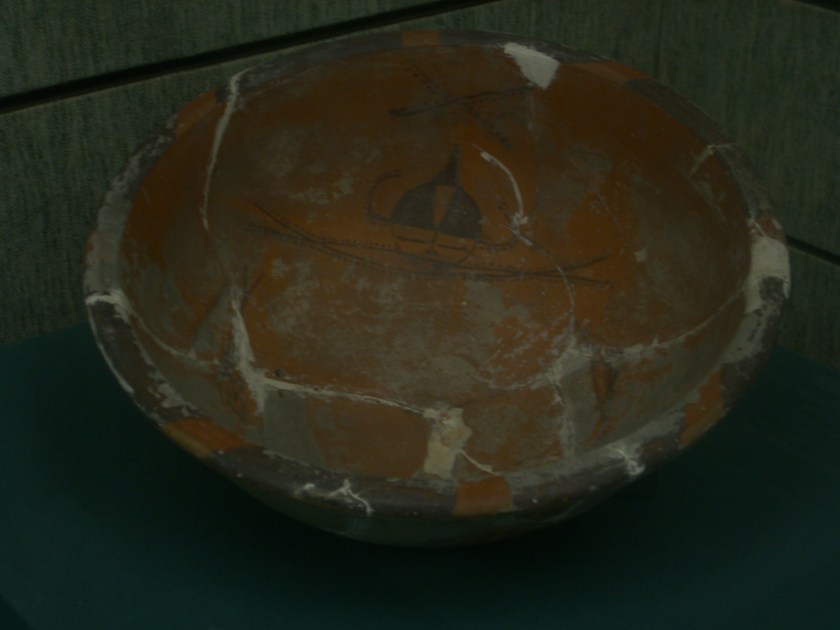
But it was the bowl above that really caught my eye when I walked into the small building that housed the Xi’An Banpo Museum (西安半坡博物馆) in 1982. The clay and the designs were similar to bowls I had seen at the Gilcrease Museum in Tulsa, Oklahoma growing up. But these bowls were Neolithic Chinese, from about 4,000 BCE and they represented what is called Yangshao Culture (仰韶文化 Yǎngsháo wénhuà). Besides Yangshao culture having a presence in the loess plateaus along the Yellow River near Xi’an, remnants and artefacts from Yangshao Culture reach beyond Shaanxi into Henan and Shanxi (note: There is a Shaanxi and a Shanxi). Relatively little is known about the Yangshao people who lived at Banpo other than they were farmers who grew millet, wheat, and sorghum. They understood water and built terraces to prevent flooding. They also built pens for domesticated sheep, pigs, dogs, cattle, and goats.

Banpo was a community of small houses, each 10-16 feet across partially sunk into the ground. This was done to keep the homes cooler in the summer. The houses appeared to be of a wattle and daub variety similar to those of American Indians who lived in Louisiana, Mississippi, Alabama and Kentucky. Wattle and daub used wooden strips and/or branches woven into a lattice design and coated generously (daubed) with a mixture of mud, clay, animal poop, and straw. The roofs were conical and made of grass bundled together (thatch) which allowed the rain to run off.

It was the frog, pig, and bird faces, the deer and fish figures, and the geometric designs that really hooked me though. They were made with strong black lines, circles, rings, triangles. Some were etched while others appeared to be pressings of fabric or rope. On some of the pots were cuttings and lines that could have been an elementary form of writing or merely identification symbols. Among the nearly 10,000 artefacts and stone tools that have been uncovered were sickles and plows, bone and stone beads, ceramic bowls, basins, water jars, and urns (both for cooking and for burial). There were also fishhooks, bone needles, arrowheads, stone axes, and knives found in Banpo.

The fact that a cemetery was found very near the village suggested that there were defined burial rites and religion. Near the ancestral bones were found some of the best preserved artefacts of the Banpo people indicating the belief in an afterlife. Of the 130 adults buried there, all were buried face-up with their heads pointed towards the setting sun. Infants and young children were buried differently. They were placed in clay urns with a hole on the top.

In my search for other American Indian/Chinese Connections, I found very little. I did, however, discover two stories that were amazingly similar.

“Smearing the Bell”, was a story that first appeared in Song Dynasty China (960-1279 CE.) After a robbery, a group of thieves was assembled and confronted with a temple bell that had a magical power. If a real thief touched the bell, it would ring. If an innocent person touched the bell, it would remain silent. So the Magistrate placed the bell behind a curtain after ordering his constables to paint the bell. The thieves were then instructed to reach behind the curtain and strike the bell. Each of the men reached in and “touched” the bell, but the bell did not chime. Then, the Magistrate noticed that one of the men who claimed to have struck the bell had clean hands.  When the Magistrate confronted the thief, the thief confessed.

‘Children of the Frost’, a story by American, Jack London, author of “The Call of the Wild” (1903),  told of an Indian woman in the Klondike who reported to a local ‘Shaman that she had lost a blanket. The Shaman took a raven and placed the raven in a black soot covered pot in a dark room. He then commanded every villager to put their hand into the pot and touch the raven. If a thief touched the raven, the raven would cry out. All the villagers went in, but the raven never cried out. Then the shaman noticed one man with clean hands and confronted the thief, whereupon, the thief confessed. The blanket was found in the thief’s house and was returned to the woman.1”

 1Ting, Nai-tung. “A Comparative Study of Three Chinese and North-American Indian Folktale Types.” Asian Folklore Studies, vol. 44, no. 1, 1985, pp. 39–50. JSTOR.

I found two studies of American Indians and Chinese in America during the 19th century which I also found interesting just in case anyone might be interested:

“They Looked Askance”: American Indians and Chinese in the Nineteenth Century U.S. West by Jordan Hua, Honors Thesis, Professor Townsend, April 20, 2012

Horizontal Inter-Ethnic Relations: Chinese and American Indians in the Nineteenth Century American West Author(s): Daniel Liestman Source: Western Historical Quarterly, Vol. 30, No. 3 (Autumn, 1999), pp. 327-349 Published by: Oxford University Press Stable URL: https://www.jstor.org/stable/971376 Accessed: 22-02-2020 01:03 UTC


Emperor with an Ego

Chinese Odyssey 65

We followed the footsteps

of men made from clay

who travelled the Silk Road

in Chang An by day

At night in their chariots

they served their Huang Di

He died, they died too

far away from the sea.Qin_Shi_Huang_(Chinese_characters).svg

https://upload.wikimedia.org/wikipedia/commons/8/8d/Qin_Shi_Huang_%28Chinese_characters%29.svg

As far as dynasties go, the First Emperor of China’s was really short. During his reign of only eleven years (221-210 BCE),  Emperor Qin Shi Huang (秦始皇帝 Qín Shǐ Huáng Dì) left a legacy that continues to this day. Indeed, the very name “China” probably has its origins in this first imperial dynasty. Qin is actually pronounced very similar to the English word “chin”. Emperor Qin Shi Huang standardized Chinese writing, weights and measures, established a common currency and connected the various walls at the northern border of China to create the Great Wall of China (万里长城 wàn lǐ cháng chéng.)

The Qin Dynasty was pivotal in the standardization of the Chinese written language. Emperor Qin did that by making the script that he was most familiar with – the Qin script, the official script of China. Other styles once popular in different parts of China eventually disappeared. The Qin script was simpler than most. In the picture above, the first row of characters and the second row are the same. The top script, known as zhuànshū 篆書 is usually translated as “seal script”, because it was used in “chops” or “seals” that appeared on documents and works of art. The second form of writing was called  lìshū 隸書, “clerical script” and was the traditional Qin form of writing – a simplified form of the seal script. A side note here. While Emperor Qin was very intent on unifying the Chinese written language, he also sought to unify Chinese thought. What better way to make history begin with him, than to kill scholars and destroy documents of recorded history? And so, he tried – with some success.

Emperor Qin also felt the need to simplify and standardize weights and measures. When he became emperor, China was a mishmash of different measuring systems. Qin Shi Huang started by going decimal and dividing a day by 10’s. A day was actually made up of one hundred kès (刻). Emperor Qin also had a special affinity for the number 6. Six chǐ (尺) = one bu (一步 yī bù ). A chǐ was roughly equivalent to a foot (the approximate length of the space between the joints of a standard stalk of bamboo.) 300 bù was equal to one lí 厘(sometimes called a ‘Chinese mile’ – actually about 1/3 of an English mile.)  Finally 1 jīn 市 equalled about 1.1 pounds or 500 gm. A jīn is also referred to as a “catty”. A liǎng was also known as a “Chinese ounce” or a “tael” and was how foreigners weighed silver. In the past a jīn was equal to 16 liǎng, but nowadays there are 10 liǎng 两 in one jīn.

Contrary to popular belief, Qin Shi Huang did not build the Great Wall of China. Early portions of the wall built to protect kingdoms began to appear in the Spring and Autumn Period (771–476 BCE) and were followed by more sections of walls in the Warring States Period (475–221 BCE). What Emperor Qin did was to connect those east-west walls in northern China from Gansu all the way to Manchuria, just to the north of Korea.

Emperor Qin was a brilliant military strategist who ruled with an iron fist. One by one, the kingdoms of the Warring States fell. He killed, castrated, or enslaved those who stood in his  way. He was a megalomaniac who was obsessed with the after-life and was tenacious in is search for immortality. To that end, Qin Shi Huang decided to make his tomb a mini-kingdom of Qin where he would take an entire life-size army with him (as well as real life servants, concubines and craftsmen.) While Qin Shi Huang was building his tomb, he sent Xu Fu 徐福 XúFú , a Chinese alchemist and explorer from Guangdong, off on a sea voyage with 3000 virgin boys and girls to search for the pill of eternal life (長生不老藥 chángshēngbùlǎo yào.) Legend has it Xu Fu and his entourage ended up in Japan, and some scholars credit him with helping to develop farming techniques and introduce new plants and agricultural advances there. In some parts of Japan people still worship Xu Fu as the God of farming. And Marvel features him as a Chinese character in some of their comic books.

Since the uncovering of a terracotta head and bronze arrowhead by peasant farmer, Yang Zhifa (杨志发) and his five brothers while digging a well during a drought in the village of Xiyang (西杨乡), about 35 kilometers east of Xi’an in 1974, only a small portion of the entire tomb of Qin Shi Huangdi has been unearthed. The parts which have not been removed are rumoured to have rivers flowing with mercury, gem encrusted ceilings and treasures galore. Legend says that the tomb was shaped like a miniature map of China at the time of his rule (I’m thinking Shenzhen’s “Miniature China” – 小人国) complete with the kind of crossbow booby traps which likely inspired some of the special effects in the Indiana Jones and National Treasure films. So far, only about 2,000 life size terra-cotta soldiers, horses, and chariots have been uncovered and about 1,000 restored. On average, it takes almost six  months for a team of three experts to restore one soldier. The work is painstaking and made more difficult by the fact that the clay quickly loses its color when it is exposed to air. Estimates suggest there may be upwards of 8,000 more terra cotta figures to unearth. Sima Qian (the most famous Han Dynasty historian) said that 700,000 laborers worked to create what I think of as ‘a macabre monument to narcissism.’

Qin Shi Huang Di arranged for a plethora of steles (碑石 bēi shí)  (stone slabs with intricately inscribed words created to memorialize individuals and events) to be prominently displayed all over “the middle kingdom” with accolades dedicated to Qin’s accomplishments. Of those, seven still remain. Nothing says “ego” better than the words from one of four of the 2200 year old still intact steles memorializing Qin Shi Huang. Before it was carved, it would have most certainly have been approved by the emperor himself:

“According to the season of mid-spring,

The mildness of Yang had just arisen.

The August Emperor travelled to the east,

On His tour He ascended (Mt.) Zhifu,

Looked down on and illuminated (the lands by) the sea.

The attending officials gazed in admiration,

Traced back and contemplated (His) excellence and brilliant

accomplishments,

Recalled and recited the fundamental beginning:

The great Sage created His order,

Established and fixed the rules and measures,

Made manifest and visible the line and net (of order).

Abroad He instructed the feudal lords;

Brilliantly He spread culture and grace,

Enlightening them through rightness and principle.

The six kingdoms had been restive and perverse,

Greedy and criminal, insatiable –

The August Emperor felt pity for the multitudes,

And consequently sent out His punitive troops,

Vehemently displaying His martial power.

Just was He in punishment, trustworthy was He in acting,

His awesome influence radiated to all directions,

And there was none who was not respectful and submissive.

He boiled alive and exterminated the violent and cruel,

Succored and saved the black-haired people,

And all around consolidated the four extremities.

He universally promulgated the shining laws,

Gave warp and woof to All-under-heaven –

Forever to serve as ritual norm and guideline.

Great, indeed, was […]

Within the universe and realm

One followed receptively His sage intent.

The multitude of officials recited His merits,

Asked to carve (this text) into stone,

To express and transmit the constant model.”

Source: Ouellette, P. (2010, February 1). Power in the Qin Dynasty: Legalism and External Influence over the Decisions and Legacy of the First Emperor of China. Retrieved October 10, 2014, from Haverford College: http://thesis.haverford.edu/dspace/bitstream/handle/10066/5251/2010OuelletteP.pdf?sequence=1

Guanyin, the God(dess) of Mercy

Chinese Odyssey 64

Saw my favorite Guanyin

and we stopped for a soda

Remembered Xuanzang

at the Wild Goose Pagoda

Rode bikes on a wall

which encircled Xi An

Inside the Great Mosque

we could hear the Qur’an.Guanyin

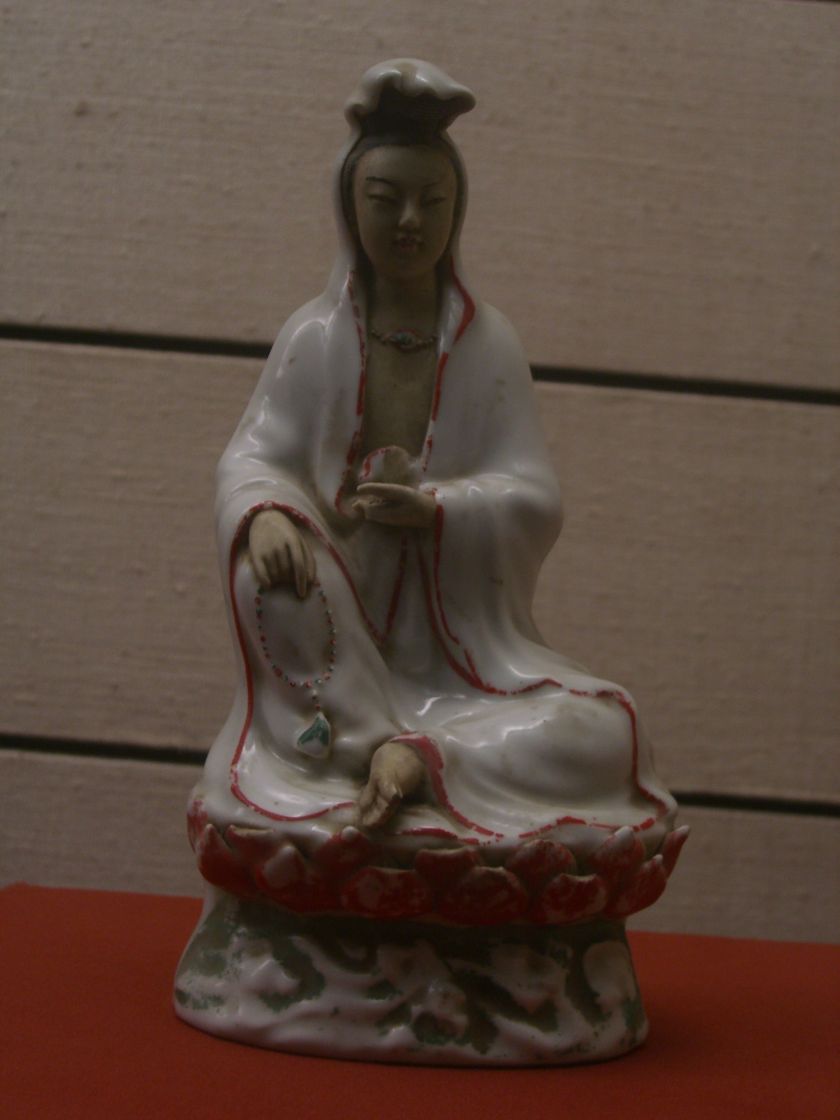
Guanyin has always been my favorite Bodhisattva. (Does anyone else have a favorite Bodhisattva?) Not sure whether it was the amazing 11th or 12th century “Guanyin of the Southern Sea” residing at the Nelson-Atkins Museum of Art in Kansas City or the Qing Dynasty Guanyin (Avalokitesvara) ceramic figure at the Shaanxi Historical Museum that made me fall in love with Guanyin. Having seen thousands of Guanyins in temples,  museums, street markets, and antique shops throughout the world, these two are still my favorites. I loved that Guanyin was the God/Goddess of Compassion and that he/she could have been male or female in origin. The Lotus Sutra says that “Guanyin travels throughout the world guiding beings towards freedom from suffering.” The word, “Guanyin” in Chinese means “pays attention to all sounds” which may also be interpreted as “hearing all prayers and pleas for help.”

“There is no place where s/he will not manifest her/himself.

The suffering of those in troubled states of being;

Hell-dwellers, hungry ghosts and animals;

And the suffering of birth, old age, illness, and death

Will gradually be extinguished”

The Lotus Sutra, trans. Tsugunari Kubo and Akira Yuyama, Bukkyō Dendō Kyōkai 2007.

Guanyin, (Avalokiteshvara in India), was almost certainly a male figure when s/he first appeared in Chinese Buddhist temples during the early centuries of the Common Era. It wasn’t until the Song Dynasty (960-1279 CE) that Guanyin transmogrified fully into her current female form. The Ming Dynasty Buddhist, Miaoshan (妙善 miào shàn) is often portrayed as a human manifestation of Guanyin. Miaoshan was the youngest of three daughters. At an early age, she had wanted to be a follower of Buddha, but her father had other ideas and insisted that she marry. When she adamantly refused, her furious father punished her by sending her to a nunnery, which he later tried to burn down. Legend has it that he tried again to have his daughter killed. Two soldiers took Miaoshan out to an open space in the forest and drew their swords. But a tiger appeared and the soldiers dropped their swords and fled whereupon the tiger took Miaoshan to a cave on a mountain and left her there. Some time later, Miaoshan’s father became very sick. He was told that the only way he could be cured was by a compassionate person gouging out an eye and cutting off an arm. Miaoshan’s father did not believe that someone would actually step forward and make that kind of a sacrifice. In the end, it was Miaoshan who gouged out her eye and cut off an arm to cure him. When her father gazed upon his mutilated daughter, and realized that she was the compassionate person,  he immediately realized what a selfish and heartless person he was, and begged her to forgive him. Some people believe that that thousand eyed, thousand armed Guanyin statues came into being as a result of the story about Miaoshan.

Guanyin statues and stories abound. One incarnation of the Guanyin statue which has always intrigued me is the one where she is carrying a baby (usually thought to be a baby boy.) I’ve often wondered whether that manifestation of Guanyin might have been influenced by Madonna statues brought in by Catholic priests when they first arrived China in the 14th century.

About 7 km (4.5 miles) due north of the Shaanxi History Museum, located in the heart of the old city of Xi’an, stands the best preserved and maintained city wall in all of China – with the possible exception of the wall around the Forbidden City in Beijing. Started in the Tang Dynasty (618-907 CE) and refurbished to its present state in the Ming Dynasty (1368-1644 CE), the total perimeter of the city wall is 13.7 km (8.5 miles). It is 15-18 meters (50-60 ‘) wide at the bottom and approximately 12-14 meters (40-45’) across on the top. The wall is approximately 12 meters (40 ‘) tall. Of the 6,000 cities in China which used to have walls, only about ten continue to exist today. A city within a city lies within these walls complete with schools, mosques, temples, commercial areas, museums, and anything else which makes up a city in China. One fun thing to do is to rent a bike on top of the wall. If you want, you can bike the entire perimeter of the wall.

One of my favorite places to visit within the wall is the Great Mosque. I actually lived in Xi’an for nearly a month in the early 2000’s. Every time I visited the mosque, it was quiet and serene. When I first went there in the early 80’s, I met a young English speaking Muslim student who lived and studied at the mosque. I wrote down his name and when I went back nearly twenty years later and asked about him, he was still there. I’m not sure he remembered me but we had a nice reunion .

The Muslim Quarter surrounding the Great Mosque has some of the best street food in Xi’an. A local Xi’an favorite is the Paomo Lamb & Pita Soup (羊肉泡馍 Yáng Roù Pào Mó). At its core, Paomo is a potage, a delicious thick broth filled with lamb and shredded flat bread.  Dumplings are also  nice in Xi’an. Unlike traditional jiaozi or xiaolongbao, dumplings here often contain spices like cumin, chives, and sweet garlic. Try the 灌汤饺子 Guàntāng Jiǎo which are translated as the Steamed Dumplings from Heaven.

You may remember Xuanzang (玄奘Xuán zàng) from the Monkey stories. He lived from 602-664 CE in the Tang Dynasty and was the real life Buddhist monk who took a pilgrimage to India to visit the sources of Buddhism in areas we now call India, Pakistan, Bangladesh, and Nepal. He was aware of an earlier Buddhist monk  by the name of Fa Xian (法顯 Fǎxiǎn) who had traveled to India with nine other monks in the 5th century in a similar quest for Buddhist scriptures. It is said that the Big Wild Goose Pagoda (大雁塔 Dàyàn Tǎ) in Xi’an was the storage place of over 500 cases of Buddhist scriptures and artifacts that Xuanzang brought back to China from India – among them some of the most important of the Mahayana Buddhist scriptures.