Guizhou Cornucopia

Chinese Odyssey 79

Yet the wonders of Guizhou

made up for them all,

the Dong town of Zhaoxing,

Huangguoshu waterfall.

In the gorges near Xingyi,

we kayaked white water.

Arriving in Guangxi,

heard Liu San Jie’s daughter.
Huangguoshu Waterfall 2

From the Dong Village of Zhaoxing in the far south-eastern corner of Guizhou, we travelled west to  Kaili. There, they have a fun Sunday market where Dong and Miao people ply their crafts, art, and household wares. Thirty years ago wooden buckets could be picked up at any rural  community in southern China. I remember friends riding bicycles through Guangdong and buying these buckets off farmers for a few pennies. I’m sure farmers were dismayed by anyone wanting to buy their night soil buckets, but at that time, the farmers could turn around and buy a couple of new buckets for those same pennies. Today, shop keepers laugh at me when I ask if they sell “木桶 mù tǒng.” Why would anyone want a wooden bucket, when plastic buckets are so much lighter and easier to take care of? A few years ago, I was still able to find those wooden buckets in the Kaili Sunday market.

From Kaili to Guiyang is only about one-half hour by high speed train or a couple of hours by car. Guiyang (贵阳, Guìyáng) is the capital of Guizhou and is mostly unpretentious. That said, Guiyang is making a name for itself in the area of “big data.”  In this city of 4.5 million people, there are over 20,000 surveillance cameras aimed at the people of Guiyang. Flashback to Tom Cruise in the futuristic Minority Report. The future is here. The claim is that marketing analysis can be obtained real time by using the appropriate tools at a grand scale. Big data is not as much about the amount of data gathered, but rather how that data is organized to discover patterns and trends related to human behavior. And China is sitting on big data’s cusp. Part of China’s advantage has to do with China’s 730 million internet users. Guizhou got the nod of storing big data for companies like Tencent Holdings Ltd. (腾讯 Téngxùn) largely because  of its isolation and its insulation.

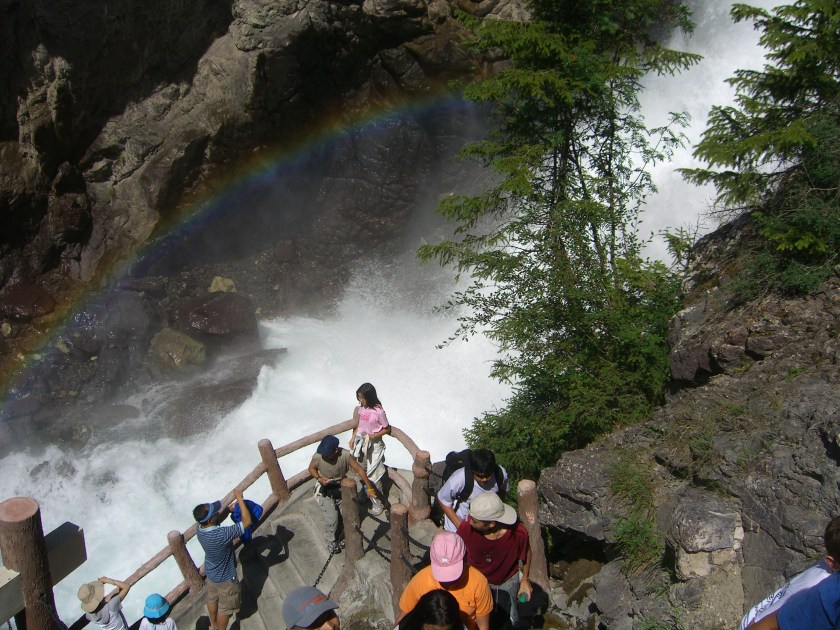
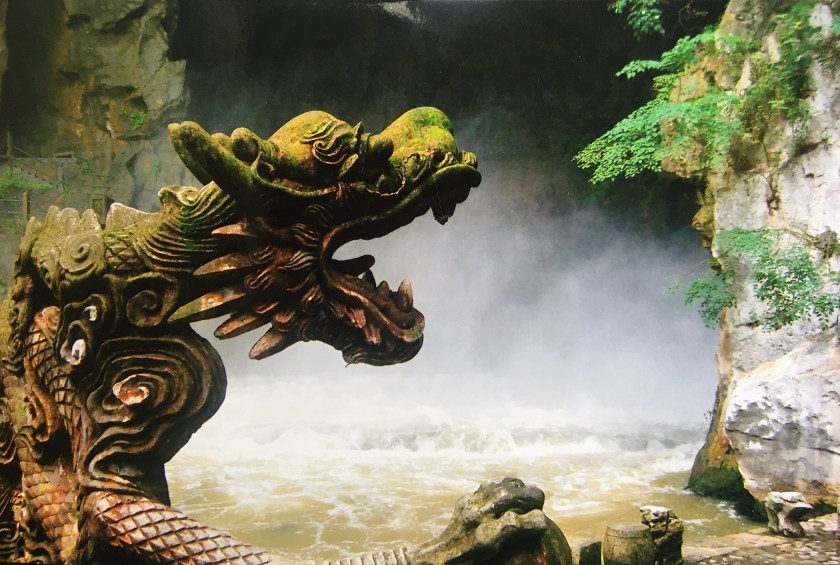
Continuing southwest about 100 miles, we arrived in Anshun (安顺 Ānshùn) and from there it was another 25 miles south to Huangguoshu Waterfall(黄果树瀑布 Huángguǒshù Pùbù)the largest waterfall in China. It was late June or early July and it had been raining a lot so the falls were at their fullest and they were really impressive. We broke out our rain gear and thoroughly enjoyed splashing our way through natural shower geysers firing at us from all directions. I remember walking under the water curtain into a cave (水帘洞) reminiscent of the one where the monkey king was born. Other waterfalls seem to converge from several directions into what looked like a massive earthenware sink called the Rhinoceros Pool (犀牛潭 Xīniú Tán) where I imagined a giant stooping down to do his morning ablutions. Still other waterfalls seemed more like strands of vermicelli or glassy Thai bean noodles hanging over a ledge in the distance. For an hour or more, we wandered through this natural water wonderland. When we came out near where we began, we were tired, and soaked, and smiling.

Maling Gorge (马岭河峡谷) near Xingyi (兴义) has been called the “birthplace of whitewater kayaking in China.” I wish I could say that we actually got to test the waters there ourselves, but alas, this was something we had not planned for and our time was too short. Still, we got to look down on the white water from the concrete arch Maling Gorge Arch Bridge, the first high bridge over the gorge. From our vantage point at the scenic lookout next to the bridge we could see at least a dozen waterfalls tumbling more than 100 meters down sheer cliffs into the roiling waters below. When our host asked us if we’d like to go down to the water, we thought she was kidding. We found hiking paths and steps that led us down about 30 meters, but the big surprise was a 70 meter elevator which took us the rest of the way down (and back up – of course.) At the bottom of the gorge there were foot bridges that allowed us to feel the river up close and personal. In 1998, China’s first whitewater kayaking competition was held there and since the 2008 Beijing Olympics, Maling Gorge has been the “National Training Base of Whitewater Kayaking.”

The story of Liu San Jie (刘三姐) is a popular story in China. Liu is a family name. The term “San Jie” means the “third oldest sister.” I mentioned in an earlier CO story that Chinese are commonly called by their rank in the family.  I think of the girls in one family of close friends who, to this day, I only know as Da Jie (big sister), Er Jie (second oldest sister), and San Mei (third youngest  sister).

Liu San Jie belonged to the Zhuang Minority (壮族 Zhuàngzú) and lived in the Guangxi Autonomous Region due south of Guizhou. The story started with a haunting song being sung by a female voice coming from a boat going through what looked like the karst hills around Guilin. The voice itself was not appealing to my western trained ear, but I kept listening as the picture panned into an old man and a handsome young man fishing from a small covered wooden boat where they, too, were mesmerized by the voice. White egrets and small nesting birds shared the screen with seven men with ropes around their bodies pulling a boat laden with merchandise up the river. Suddenly in a distance, Liu San Jie appears and we see actress Huang Wanqiu (黃婉秋) on a small boat made of tree branches, still covered with leaves, singing as she steers her way down the river with nothing but a bamboo pole. The two men decide to check her out so they pole their way over to her small skiff. The old man asks who she is, and Liu San Jie responds to all of his questions in song. Suddenly the young man bursts forward and says, “I know who you are. You are Liu San Jie!” They invite her on board and she accepts their invitation. The old man bursts into song, and the young man then dives into the water and catches a fish and then bursts into song himself. Liu San Jie is renowned in the area for her beautiful voice, her intelligence, and her courage. She had been orphaned at a young age and had been raised by her elder brother. Singing was a natural way for the Zhuang people to communicate. Liu San Jie sang songs about freedom and justice and about the way that the peasants were abused by the wealthy landowners. The laobaixing 老百姓 (common people) loved Liu San Jie, but the upper crust did not. Early in the movie, Liu San Jie got into a singing duel with one of the ruling elite and he had a heart attack and died after hearing the harsh accusations that Liu San Jie made about him and his family. The man’s family accused Liu San Jie of killing the man and arranged for her to be arrested. There are many incidents during the story where Liu San Jie stands up against tyrants like the infamous Mo Huai Ren. When the young man she befriends early on in the movie, defeats Mo Huai Ren’s lacky in a fist fight, Mo Huai Ren informs them that he owns everything in the area and that Liu San Jie and her friends would no longer be able to fish or hunt there. Liu San Jie challenges Mo Huai Ren to a singing duel and Mo accepts. Mo then hires three scholars who know “all the songs in the world” as his backup. Like freestyle battles between rappers, Liu and Mo’s songs go one after one another until Mo finally challenges Liu with the lines: “Tell now now, young lady, without pause: How many nails are there on our boat? How much do those mountains over there weigh? AND How many grains are there in a basket of oats?” To which, Liu San Jie answers without hesitation. Liu then quietly disappears from the scene with her lover, Li Xiao Niu.

In 2004, acclaimed director Zhang Yi Mou decided to stage Liu San Jie as yet another grand spectacular on the Li River in Yangshuo near Guilin. As with the Tea Horse Road extravaganza in Lijiang, this show involves approximately 600 performers who have been hired mostly from the local Zhuang community. They included fishermen, merchants, farmers, and young people. The 70 minutes show portrays actors on bamboo rafts performing on the actual Li River. “San Jie Liu Impressions” claims to be performed on the world’s largest natural stage. If you don’t understand Putonghua (Mandarin), becoming familiar with the story beforehand really helps get the most out of the experience. Maybe you will be able to answer: How many nails are there on our boat? How much do those mountains over there weigh? AND How many grains are there in a basket of oats?”


Guizhou – Poverty, politics, and pulchritude

Chinese Odyssey 78

The province of Guizhou

was poor and remote.

It’s said there were three things

they all lived without;

no three feet of flatland,

three days without rain,

three pieces of silver

were in their domain.

IMG_1392

Xi Jinping, China’s Premier, has been getting a lot of bad press these days, especially in the USA. Most recently due to the Hong Kong national security legislation, but that runs neck-to-neck with the coronavirus. Before that it was unfair trade practices, cyberespionage, the treatment Uyghurs in Xinjiang, and a host of other issues. What we don’t hear about very often, however, are some of Xi’s positive initiatives.

In October 2015, Xi vowed to eradicate poverty among the remaining 70 million poor Chinese people by the year 2020. Actually, the poverty eradication initiative started in 1984 when Deng Xiaoping said in a meeting with foreign guests:  “Socialism must eradicate poverty, and poverty is not socialism.” Since the year 2000, 600 million poor people had already been lifted out of poverty. Xi relied on his own experience growing up in a small impoverished agricultural community in the north-western part of Shaanxi province in the 1950’s and 60’s. This year, Xi has reiterated his solemn pledge during the March 2020 18th National Congress of the CCP, that despite Covid-19, this goal shall be met.

Even though, the name Guizhou, could be translated as “rich land”, for most of its history, Guizhou has been one of the poorer provinces of China largely due to topography and isolation. Guizhou sits on an old eroding plateau called the Yunnan Guizhou (aka Yun Gui) Plateau. It’s steep slopes, poor drainage, and red and yellow soil  make it challenging for farming. Only about 3% of Guizhou’s land is suitable for any type other than terrace farming and terrace farming requires large numbers of people working for little pay. Imagine not a hill, not a mountain, but a range of mountains sculpted by hand into steps of various sizes and shapes that all need to be maintained by an intricate system of irrigation controlled by massive numbers of men, women, and children using the most basic of farming tools.

Topography also made trade difficult since there were very few roads and no navigable rivers in Guizhou. Guizhou’s does have natural wealth, however, in terms of forests and plant and animal diversity, it is a treasure land to practitioners of Chinese medicine.

To address Guizhou’s poverty, there have been major initiatives throughout the province. New crops have been introduced that are more nutritious and have higher yields, both in terms of production and health benefits. Over 4,000 miles of new roads, highways, and modern suspension bridges have been built reaching some of the more isolated areas in the province. A well known idiom in China is 要想富先修路 yāo xiǎng fù xiān xiū lù which translates to, “If you want to become prosperous, you must first build roads.” In 1978, there were 18 million people living in poverty in Guizhou. 40 years later, in 2018, that number had been reduced to 1.5 million.

In December of 1934, after trudging 320 miles from Ruijin, Jiangxi, the 34th Division of the Red Army was nearly destroyed by Nationalist Troops at the Battle of the Xiang River (血战湘江) in Guangxi province. By the end of that battle only about 30,000 of the original 130,000 Red Army troops remained and things were looking bleak. With their strong reduction in numbers, they knew they would have to jettison much of their equipment, like x-ray machines,  printing presses, and heavy artillery, so they dumped it into the Xiang River and carried on. Mao persuaded Zhu De, Lin Biao, Zhang Wentian aka Lo Fu, and others that they should change course and meet up in Zunyi in Guizhou instead of south-eastern Sichuan. By the time they reached Zunyi in Guizhou in early January, 1935, it was clear that tactics and leadership needed to change. Otto Braun, the German comintern commander of the 1st army alongside Zhou En Lai and Bo Gu aka Qin Bangxian were poised to step aside. By the end of the Zunyi Conference (遵義會議 Zūnyì huìyìn) January 15-17, 1935, it is fair to say that Mao Zedong was poised to take over as both military commander and acknowledged leader of the Chinese Communist Party. It’s probably no coincidence that China’s premiere “baijiu” (grain alcohol), Maotai (made from red sorghum), is distilled only minutes away from Zunyi.

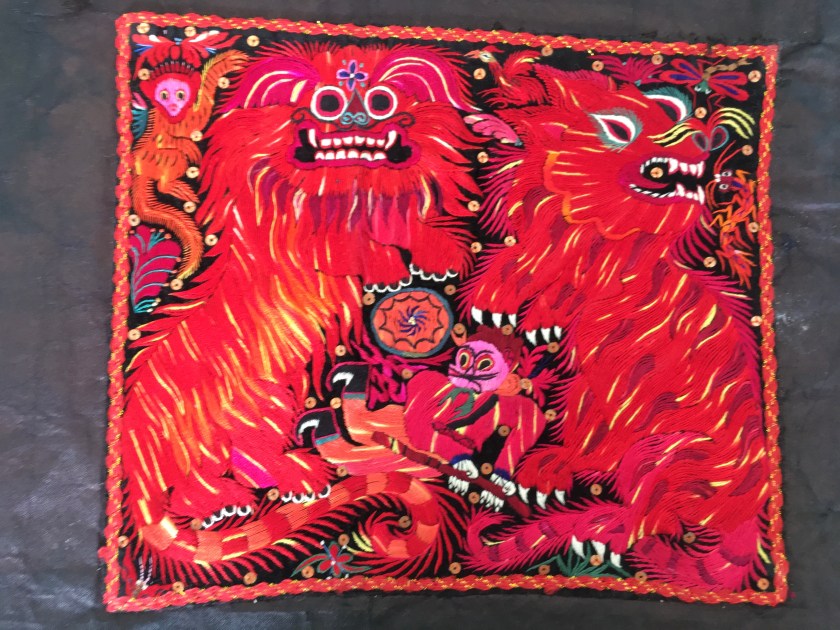
According to legend, the people from the Miao minority in Guizhou came from one of a dozen eggs laid by a butterfly mother who came from a Maple tree. Among the remaining eleven eggs there was hatched a dragon, an ox, an elephant, a tiger, a thunder god, a centipede, a snake, a boy and a girl. Miao religion is animistic in nature. Shamans communicate with spirits. Animals, stones, trees, water, lightening, and thunder all play important parts in traditional Miao religion. The embroidery of the Miao people is striking. The photo is of a portion of a sleeve which we discovered in a house outside of Kaili in western Guizhou. The two lions depicted represent the autumn harvest celebration and the deep red color symbolizes fortune and prosperity. The cotton fabric was made by the Miao people and dyed red to become “cow blood fabric.” The fabric is often coated with egg white to give it a kind of sheen or gloss and to make the fabric water resistant. Indigo is also prevalent in Guizhou. Blue indigo actually comes from green leaves. Indigo leaves are crushed and left in a vat of water to ferment. After a few months, quick lime is added and the result is indigo. Cotton fabric is soaked in the dye and then hung to dry. If the color is not dark enough, the fabric may be dipped again until it reaches the desired shade of blue. Indigo is still the primary dye used in making blue jeans. Sometimes hemp is used instead of cotton and similar techniques are used to preserve the hemp cloth. Hemp fibers, however, are much shorter than cotton and unsuitable for spinning.

Besides the beautiful embroidery, Miao people are also silver artisans. Miao women adorn themselves with an abundance of silver jewellery which typically includes necklaces, earrings, bracelets, rings, and even heavy silver tiaras and crowns. Sometimes these crowns are adorned with silver horns or head flowers. Women wear silver “vests” decorated with all kinds of bling. Silver is also used by the Miao to test the purity of water and to fight disease and misfortune. Like many arts in China, however, silver artisans are a dying breed. Like embroidery, this art is time consuming and takes patience and persistence. But the results are both delicate and elegant.

If you were to meander through Zhaoxing, the largest and most accessible Dong village, in far eastern Guizhou, you couldn’t  help but feel that you’ve entered a time warp. The village rests in an idyllic setting surrounded by jade colored hills with a river flowing through it. The houses are almost all constructed of wood with many built on stilts. There are five drum towers, one for each of five Confucian virtues: Ren 仁 (benevolence), Yi 义(righteousness), Li 礼 (ceremony),  Zhi 智(wisdom), and Xin 信 (integrity). Each is unique, both in style and design.

Imagine a covered bridge made of wood that was wide enough for a bus to go over, but was made for people, not vehicles. Held aloft by five rectangular pillars made of concrete and stone, it’s an open bridge which supports multi-level towers (one on top of each pillar). There are benches and railings along the entire distance of the bridge where old men are playing xiangqi (Chinese chess), young couples are courting, and people of all ages are playing and exercising. All along the bridge and on the walls of the towers are carved and painted works of art. Calligraphy and auspicious flowers, dragons, gourds, cranes are everywhere. And lest I forget, strong mortise and tenon joints alleviate the need for a single nail or screw. These are the Wind and Rain Bridges of the Dong minority.

Stan Lai (賴聲川)

Chinese Odyssey 76

In a play by a friend

was a Peach Blossom land

where a cuckolded fisherman

discovered first hand

a place with no conflict —

where all lived in peace.

How could he walk away

knowing his calm would cease?

Peter & Stan

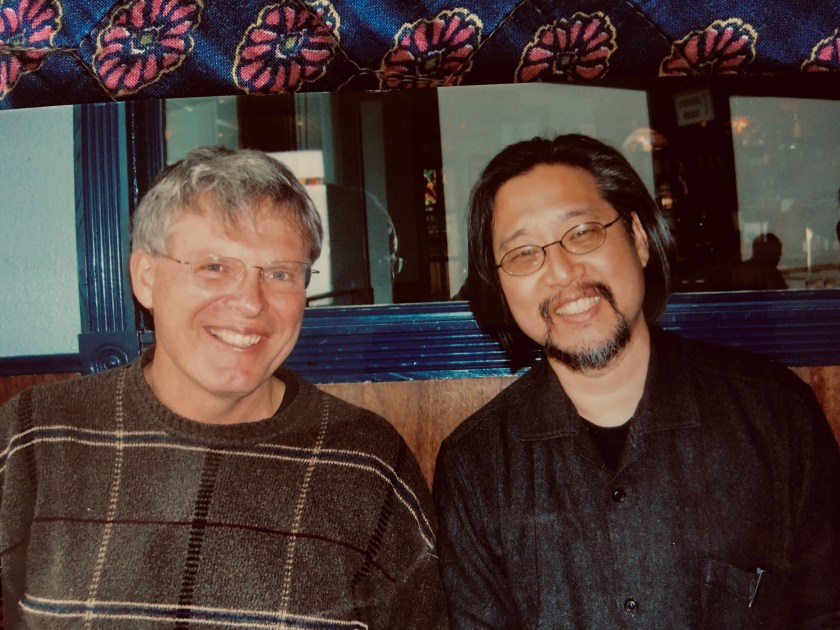
In CO 15, I wrote about a play my friend, Stan Lai (賴聲川 Lài Shēng Chuān) wrote called “Peach Blossom Land” (暗戀桃花源 Ànliàn Táohuāyuán). The English name of the play sometimes only translates the second part of the Chinese title, (桃花源 Táohuāyuán). The first part of the title  (Ànliàn 暗戀) “暗戀” means “unrequited love“ – and that was the story I told in CO 15. The original Peach Blossom Land, by Tao Yuan Ming (陶淵明), was written in the Six Dynasties Period (421 CE) and is one of the earliest “Shangri-la” stories on record. Stan took some wonderful liberties with Tao Yuan Ming’s story. The fisherman in Stan’s play was being cuckolded by his wife who was having an affair with her landlord. As the Peach Blossom story unfolds, it is being constantly interrupted by the “An Lian” story. “An Lian”, the tragedy, weaves its way over and around “Tao Hua Yuan” (which Stan tells as a slapstick comedy). The two plays perform a wild dance on the same stage as each play tries to complete rehearsals for their upcoming performances. A third story is, of course, the story of the two theatre companies preparing to perform. Somehow, although all three stories and even the dialogues overlap and intersect one another, in the end, there is resolution to each of the three stories. Audiences in Taiwan, Hong Kong, and China are all familiar with the loss that came with the KMT moving to Taiwan in 1949. Fathers, sons, brothers, and husbands had no idea when they landed in Taiwan that it would be 30 years before they could reconnect with their loved ones. Like the fisherman who left Peach Blossom Land, the mainlanders who came with the KMT must have yearned to return, but the door was sealed and the majority on both sides had only memories. Parents died. Husbands and wives remarried. Children grew up with no father or sometimes a new family when Dad failed to return. As China gradually reopened, searches were begun, contacts were made, and families began to reconnect. The KMT soldiers were my parents’ age. The generation who never got to know their mainland families were Stan’s age. Secret Love in Peach Blossom Land was performed for the entire summer at the Oregon Shakespeare Festival in 2015

Stan Lai was born in Washington D.C. His father was a diplomat at a time when Taiwan was the only “China” recognized by much of the world. Taiwan’s official name in English is still “The Republic of China.” When Stan arrived in Taiwan as an 11 year old, he could barely speak Chinese, but his parents were adamant that he and his brother learn their “mother tongue” and they were enrolled in local schools. By the time Stan graduated from Jianguo High School (臺北市立建國高級中學), his Chinese was almost as good as his English. Now Stan had one foot planted in the west and the other in Taiwan. After Jian Zhong, Stan received his BA in English literature from Taiwan’s Fu Jen Catholic University (輔仁大學). Following two years of mandatory military service in Taiwan, Stan decided to return to America for his graduate work. He earned his PhD. in Dramatic Arts from UC Berkeley in 1983.

Some of Stan’s works are not available in English and would, in fact, be hard to appreciate in languages other than Chinese. An example of this would be a series of plays in which Stan uses a Chinese comedy style called “crosstalk” (xiangsheng 相聲) where there is a straight man and a funny man. Stan’s crosstalk plays involved playing with words, language, and local politics.

Although most of Stan’s plays are written for Chinese audiences, he has opened several doors to western audiences who are truly interested in gaining a more personal understanding of 20th and 21st century China, Chinese people, and Chinese culture.  These works create a natural bridge between China and the English speaking west – starting with Secret Love in Peach Blossom Land. That’s the play I’ve already talked about. The DVD with English subtitles is not easily available but one can occasionally find a copy on E-Bay. I actually found a copy (without subtitles) on YouTube.

Another play which can be very much appreciated by people of different cultural backgrounds is The Village (寶島一村 Bǎo Dǎo Yī Cūn.)  First presented in 2008, The Village tells the story of a military dependent village (眷村 juàncūn) where KMT soldiers lived when they first arrived in Taiwan, and which many families continued to live in for generations. There were nearly 900 of these villages of which about 30 still remain. In these villages, former soldiers from all over China were thrown together. At first these villages were put together with whatever materials could be found. There were communal toilets and showers and electrical wires were strung randomly to provide power where needed. Houses were about 6-10 ping and a ping was the size of two regular tatamis (about 6’ square). In the play we peeked into the lives of families whose common language was Mandarin (國語 Guóyǔ) even though  many of the wives were Taiwanese. In the early scenes, the audience is privy to conversations about the soldiers’ own families and villages back home and what they planned to do when they returned. We experience children growing up in the “juancun” and – along with the villagers – mourn the death of Chiang Kai-Shek (蔣介石). The play begins in 1949 and then jumps to the interval from 1968-1975, before finishing up in the period of 1987-2007. At the end of the play, as the audience leaves the theatre, each person in the audience is given a paper bag with one of Grandma Qian’s warm pork buns (包子 bāozi) inside. Bāozi were a staple in the village throughout the generations. “The Village” was warmly received in Taiwan, the People’s Republic of China, Singapore, Hong Kong, and in the United States. I don’t know anyone who has seen The Village without being incredibly moved.

At the heart of Stan Lai’s theatre company is improvisation. I remember sitting in on one of Stan’s classes at Stanford University in Palo Alto as his class was brainstorming ideas for a play (in English) that started out with the name, Stories for the Dead. By the time I got to see the play in Beijing, the play’s name had been changed to Like Shadows (如影隨行 Rú Yǐng Suí Xíng.) Stan told me the most recent name for that same play is Bardo Blues.

In 2000, Stan Lai shook the theatre world with his seven and one-half hour long A Dream Like a Dream (如夢之夢 Rú Mèng Zhī Mèng.) When I first saw the play in 2002 in Hong Kong, I sat in the center of what would have been the stage in a normal show. The theatre was square with two levels of seating on all four sides. But with “Dreams”, each member of the audience was given our own rotating seat in the center of the “stage” and we watched the play performed in 8 spaces where the audience would normally sit.  Small “stages” were created on all four sides and on both levels. At about the 3:30 mark, the audience was given a dinner break, and then returned for the final four hours.  Dream Like a Dream was booked solid for every performance in Hong Kong. When it returned to Hong Kong in 2019, it was every bit as popular when performed at the new Freespace in West Kowloon. This time we watched it over a two day period. In addition to the Lotus Pond seats in the middle with the revolving chairs, there was now a seating area above the play where one can read surtitles in English and Chinese and watch some amazing stage effects on a giant screen while the play is happening.

Stan directed Dream of the Red Chamber for the San Francisco Opera (libretto by David Henry Hwang, music by Bright Sheng) in 2016 and created Nightwalk in the Chinese Garden, in which he wove elements from the 16th century Chinese classic, The Peony Pavilion, with early 20th century California history in a play created specifically for the Huntington Library’s Chinese Garden in 2018.

I haven’t seen the final play I want to mention, but I have read the script more than once. Ago (曾经如是  Céng Jīng Rú Shì) would be more literally translated as “Thus, therefore”, Ago is a journey involving a small community of Tibetans living in Yunnan, talking animals, basic elements, enlightened beings, spirits,  Wall Street tycoons, hookers, drug dealers, musicians, and cooks. Characters transform themselves seamlessly from life on the Tibetan high plateau to doing business on the 88th floor of the World Trade Center in Manhattan. All kept in check by “Time”, “Chance”, and “Space.”

In the June 2020 issue of the IATC journal/Revue de l’AICT, writer Yu Kuo-Hua said that “Ago is about migration.” He then suggests that in the play, “Lai poses the crucial question: What are people seeking when they undertake the journey of migration?”

Perhaps Stan is reminding us that we’re all migrants in the crazy world in which we inhabit. Whether we migrate physically, spiritually, or merely in our dreams, we all leave the mundane to inhabit worlds which we don’t control. In Stan Lai’s plays we can’t help but migrate through time and space, to take on new identities through his characters and sets. We yearn for that “Shangri-la” we might encounter around the next corner or over the next hill. As we walk through each new door, however, we leave something behind us and like Stan’s fisherman, and like Hilton’s Conway, those doors may have closed behind us.

The Long March

Chinese Odyssey 71

On a bridge near Shi Gu

was a plaque on an arch —

told how red army soldiers

crossed here in their march.

A six thousand mile trek

lead by Zhu, Zhou, and Mao

through the heartland of China

such contrast to now.

Long March BridgeOn a

In the 1920’s the Chinese government was in turmoil. For a short period of time in 1924, the KMT aka the Nationalists  (國民黨 Guómíndǎng) and the CCP ( 中国共产党 Zhōnɡɡuó ɡònɡchǎndǎnɡ – the Chinese Communist Party) closed ranks in an attempt to rid China of the warlords. Together, they formed the KMT-CPC Alliance (聯俄容共 Lián É Róng Gòng) a.k.a. the “First United Front”, and they created the National Revolutionary Army.

But this was not what the leader of the KMT, Generalissimo Chiang Kai-shek ( Jiǎng Jiè shí), had in mind. He decided to end this alliance by purging all communists from the ranks starting with the 1926 Canton Coup (中山事件 Zhōng shān jiàn shì jiàn). On April 12, 1927 Chiang then ordered the Shanghai Massacre (四一二反革命政變 sì yī èr fǎn gé mìng zhèng biàn).  The Generalissimo ordered his troops to purge all Communists from the ranks of the KMT. With the help of Big Eared Tu (杜月生 Dù Yuèshēng), leader of the Green Gang (青幫 Qīng Bāng), a ‘criminal organization and secret society’,  1000 Communists were arrested, 300 were executed and 5,000+ “went missing.” In the “White Terror” that followed, more than 10,000 Communists in Changsha, Hangzhou, Ningbo, Nanjing, Guangzhou, and Xiamen were executed. This series of events were the spark that ignited the Chinese civil war between the Communists and the KMT. It was a war that never officially ended. To this day, no peace treaty or armistice between these two warring parties has ever been signed.

In 1931, the Chinese Soviet Republic (中華蘇維埃共和國 Zhōnghuá Sūwéi’āi Gònghéguó) a.k.a. “the Jiangxi Soviet” was established by Mao Zedong, Zhu De, and others in the city of Ruijing (瑞金), in Jiangxi (江西省 (Jiāngxī Shěng), a land-locked province north of Guangdong and west of Fujian. It was sort of a country within a country. Máo Zédōng was elected as Chairman. Zhū Dé was his second in command. Deng Xiaoping and Zhou En Lai also joined Mao in Ruijin. Mao, Zhu, and Zhou enjoyed a long and complementary relationships throughout the revolution.

By 1934, Chiang Kai-shek’s five “Encirclement Campaigns” planned on dealing the death blow to the Communists in Ruijin, but spies informed the Communists, and Zhou En Lai (周恩来 Zhōu Ēnlái) came up with a plan. In the late afternoon of October 16, 1934, amidst a confusion caused by a strong rear guard, the main body of 84,000 soldiers of the Red Army under the command of Bó Gǔ (博古) and German Communist Otto Braun (Chinese name 李德 Lǐ Dé) began its strategic retreat from Jiangxi. Several thousand troops stayed behind to serve as the rear guard for the retreating forces. Among them, 29 year old Máo Zétán (毛泽覃), younger brother of Mao Ze Dong, was executed by the KMT. Chiang’s annihilation campaigns had taken their toll on the communists, and they decided that their only play was to abandon their southern bases and regroup in Shaanxi, Gansu, and Ningxia in northern China.

Author, Sun Shu Yun, started her book “The Long March” by saying, “Every nation has its founding myth. For communist China, it is the Long March, . . .” (红军长征 Hóngjūn Chángzhēng.)  The Long March is truly an amazing story of perseverance, commitment, and resilience replete with stories of heroism, self-sacrifice, and suffering which has been told to generations of Chinese children.

Mao, himself, was in terrible shape from a bad bout of malaria and had to be carried on a litter by two soldiers at the beginning of the Long March. A very pregnant, He Zizhen (贺子珍), Mao’s 3rd wife, accompanied him. The child she bore during those early days of the Long March was given away to a family in Fujian. He Zizhen was one of only about 35 women who started out on the Long March.

For a guerrilla army, the Red Army, was way too laden with “stuff.” Besides printing presses and an x-ray machine that required 20 people to carry, this retreating military carried a library of books and documents, food, weapons, ammunition, and gold so they could pay their way.

New recruits were expected to always abide by the 8 primary rules:

1) Speak politely and help people whenever you can;

2) Return doors and straw matting to their owners [doors were used as beds];

3) Pay for any damage caused;

4) Pay a fair price for all goods;

5) Be sanitary; build a latrine away from houses;

6) Don’t take liberties with the women;

7) Don’t ill-treat prisoners;

8) Don’t damage the crops.

Bo, Braun, and Zhou took their retreat south and then due west, where the crossing of the Xiang River (湘江 Xiānɡ Jiānɡ) in Hunan proved to be a major obstacle. The Red Army lost over half of its forces by January of 1935 –  many due to the fighting, but probably just as many to desertion. The original 84,000 soldiers were soon whittled down to around 30,000.

In late January, in the province of Guizhou, there was a famous meeting of the Chinese Communist Party called the Zunyi Conference (遵义会议 Zūnyì huìyì.) Those in attendance were definitely among the Who’s who of the early Chinese communists including Mao Zedong, Zhou Enlai, Liu Shaoqi, Zhu De, Lin Biao, and Deng Xiao Ping. It was as a result of this meeting at Zunyi that Mao Zedong soon after emerged as the unequivocal leader of the Chinese Communist Revolution.

From Zunyi, Mao and the Red Army took a surprising turn south and crossed the Jīnshājiāng (金沙江), an upstream branch of the Yangtze River in Yunnan in May of 1935, much to the surprise of Chiang Kai-shek. Mao’s capture of the Luding suspension bridge over the Dadu River on the border of Tibet is legendary, although Deng Xiaoping once told Zbigniew Brzezinski, former National Security Advisor to President Carter, that  capturing the bridge at Dadu was really no big deal, but it did make for some great propaganda.

From Dadu, Mao lead the Red Army through the “Snowy Mountains” (Yùlóng Xuěshān 玉龙雪山), in Yunnan in early June of 1935.  His troops struggled and many died as a result of the thin air, exposure, and frostbite while crossing  a snowy pass of about 14,000 feet with heavy packs. The Snowy Mountains were just the first of several mountain passes the Red Army troops traversed. These mountains were followed by the Zoigê Marsh (湿  Ruòěrgài Shī) “Great Morass”, a 10,000 foot high swampy plateau in northern Sichuan where it rained every day. This wet grassland proved incredibly difficult to navigate and thousands of troops were lost.

Long Marcha poem written by Mao Zedong October 1935

Red Army unafraid of the journey

Torrents of water, jagged mountains abound

Five ridges flow like rippling water

Wu Meng mountains roll, mounds of clay

Jinsha water sprays cloud cliffs,

Freezing cables of Dadu Bridge

Thousand li snow in Minshan,

Faces of the three armies illuminate

红军不怕远征难

万水千山只等闲。

五岭逶迤腾细浪,

乌蒙磅礴走泥丸。

金沙水拍云崖暖,

大渡桥横铁索寒。

更喜岷山千里雪,.

三军过后尽开颜

Local people in China’s far west were sometimes openly hostile to the Red Army and other times Mao’s army was met with incredible hospitality and open arms. As much as Mao would have wanted, the soldiers did not always abide by the eight primary rules and occasionally had to resort to theft and threats in order to survive.

In October 1935, 8,000 people, about 10% of the original 84,000 marchers arrived in Shaanxi Province. Even though, at its roots, the 6,000 kilometer “L” shaped Long March was a retreat, it was quickly rebranded as a regrouping and reforming against unsurmountable odds. Mao, Zhou, Deng and company were somehow able to transform a retreat into an epic victory over the hearts and minds of the Chinese people.

In his book, Red Star Over China , Edgar Snow added to the story of the Long March. Snow traveled many months with Red Army troops in 1936 and was able to spend ten days almost exclusively with Mao as he narrated his autobiography. Snow used his conversations with Mao and other leaders to write the first detailed account of the Long March from the perspective of a westerner. Through Snow’s account, both Chinese and foreigners alike, began to take a serious look at the Chinese communist movement.


Chinese Detective Stories

Chinese Odyssey 68

Ate juicy tomatoes

which monkeys all wanted

Monasteries at Emei

Van Gulikly haunted

Slurped Chong Qing hot pot

at Laozao in Cheng Du

The Dandan Mian

made me run to the loo

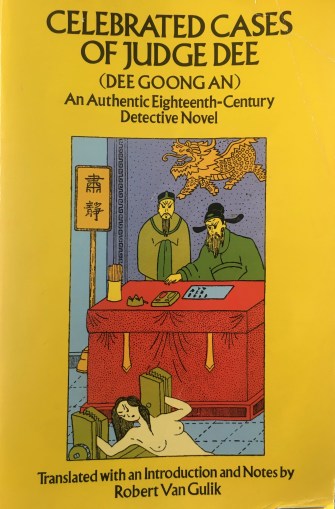
Celebrated Cases of Judge Dee

“He can have anyone arrested, he can put the question to suspects under torture, have recalcitrant witnesses beaten up on the spot, use hearsay evidence, bully a defendant to tell a lie, and then trip him up with relish, . . .” (Gulik, Robert Hans van. Celebrated Cases of Judge Dee = Dee Goong An: an Authentic Eighteenth-Century Chinese Detective Novel. Dover Publications, 1976)

Robert Hans van Gulik (髙羅佩Gāo Luópèi) , Dutch diplomat, correspondent, amateur primatologist, musician, calligrapher, and “Orientalist” will probably be best remembered as a mystery writer. Van Gulik wrote seventeen mysteries about a Tang Dynasty judicial super star by the name of Judge Dee aka 狄公案 Dí Gōng’àn . Fashioned after a real-life judge who lived in the Tang Dynasty during the reign of China’s only female emperor, Wu Zetian (武則天Wǔ Zétiān.) Judge Dee’s real name was Dí Rén jié (607-700), and he was a Tang dynasty prime minister under Empress Wu Zetian.

Born in the Netherlands, van Gulik’s family moved to Jakarta in 1913 when he was only three. His father was a physician and medical officer in the Dutch army corps. At that time, Jakarta was called Batvia and Indonesia went under the name of the Dutch East Indies. It was during his childhood there that van Gulik first began his studies of Chinese, something he continued throughout his life. His university studies focused on East Indian law and culture and he joined the Dutch foreign service in 1935. He served in various capacities in Japan, China, Lebanon, India, and in the USA. While stationed in Chongqing during WW2, he fell in love with and married Shui Shifang and they had four children.

In late 1940’s post-war Japan, while stationed in Tokyo , van Gulik picked up a book called  武則天四大奇案  (Four Great Strange Cases of Empress Wu’s Reign) in a used book store in the back alleys of Tokyo.  This was van Gulik’s first translation. He called it Celebrated Cases of Judge Dee. Since he was living in Japan at the time, his first editions were in Japanese and in Chinese. In 1949, he first self-published 1200 signed English copies.

What’s amazing about the van Gulik books though is the window they provide us to look into a legal system very far removed from ones that most of us are used to. The judge is not only the person who decides the outcome of a case, he also directs the investigations and with the proper mixture of intelligent questioning and irrefutable evidence compels even the most resistant to eventually confess. Torture, beratement, discomfort, humiliation, and even communication with spirits are all legitimate tools for the judge to apply with full compliance of the public. The judge is fully in charge from the initial arraignment through the public executions (of which he has a variety to select from depending on the nature of the crime.)

Starting at a trail near the base of Mt. Emei (峨眉山 Éméi shān), one of the “4 sacred Buddhist mountains” of China, we walked on a trail alongside a crystal clear stream. Bought fresh tomatoes and watermelon slices from local vendors and were surprised by monkeys (actually Tibetan macaques) who demanded their fair share. I wish I could say we walked the “10,000 steps to Heaven” to summit Emei, but I can say that we walked many a step before we arrived at a Buddhist temple (Baoguo Temple报国寺 Bàoguó Sì) which also served as our accommodation for the night. As soon as I set my back pack down in my room, I imagined myself smack in the middle of the Chinese Bell Murders. I was immediately transported to the “Buddhist Temple of Boundless Mercy” and imagined Judge Dee prowling its halls.


Sichuan – Poets, Pandas, and Peppers

Chinese Odyssey 67

Southwest into Sichuan

where four rivers flowed

Gold monkeys and pandas

roamed through Jiuzhaigou

Du Fu and Li Bai

two poets of Tang

Remembered today

in poems, paintings, and song.

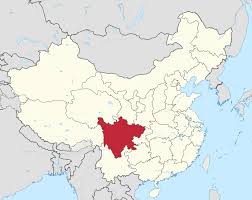
Sichuan and Chinahttps://commons.wikimedia.org/wiki/File:Sichuan_in_China_(%2Ball_claims_hatched).svg

Sichuan is the Pinyin spelling of Szechuan. Many westerners who see this word associate it with spicy food. The word Si (四 sì) means “4”. The word Chuan (川 chuān) means “river”.  The four rivers are the Jiālíng, the Jīnshā, the Mín, and the Tuó. So Sichuan means “Four Rivers.”  As you can see from the map, Sichuan is located in the dead center of China, but most Chinese think of it being in western China (kind of like Ohio and Indiana referred to as mid-western states in the USA.) Sichuan used to include the city in China with the largest population – Chongqing (重庆 Chóngqìng) aka Chungking (30.8 million people). In 1997, Chongqing was declared China’s 4th municipality which meant it was self-governing (like Beijing, Shanghai, and Tianjin) and no longer belonged to any province. Kind of like Washington D.C. not being a part of any state.

Now, back to the two things that people know about Sichuan:

  • Sichuan has hot, spicy food: Kung Pao Chicken (宫保鸡丁Gōngbǎojīdīng), Mother Po’s Beancurd (麻婆豆腐 Mápó dòufu), Dandan Noodles (担担面Dàndàn miàn), and Chongqing Hot Pot(重庆火锅 Chóngqìng Huǒguō)
  • Pandas – Although there are pandas in Shaanxi and Gansu, most wild pandas live in the cool, moist bamboo forested mountainous northern regions of Sichuan at elevations over 5,000 feet (1500 meters). It is almost impossible for a tourist in China to spot a panda in the wild. There are, however, Panda research centers in Sichuan where tourists can see and interact with pandas.

In Dr. John C.H. Wu (吳經熊)’s classic, The Four Seasons of Tang Dynasty Poetry, he called the poet, Li Bai aka Li Po (李白 Lǐ Bái), the “Prince of Spring”. Li Bai’s contemporary and good friend, Du Fu, once said of Li Bai:

“All the world wants to kill him

I alone dote on his genius

Quick-witted,

he has hit off a thousand poems

A waif in the world,

his only home is a cup of wine.”

Born in far western China, or possibly present day Kyrgyzstan, Li Bai was living in Chengdu, Sichuan at age 4 and continued to spend his next two decades there before he began to wander. Li Bai was a living testament to Tolkien’s great line, “not all who wander are lost.” A great friend and soul-mate to Daoist holy men, after meeting Li Bai, Ho Chih Chang (賀之章 Hè Zhī zhāng), a Daoist poet said of Li Bai “Why, you do not belong to this world. You are an angel banished from Heaven.” Li Bai reminds me of the American poet and song writer of the depression era, Woodie Guthrie. They were both prolific in their writing and their poetry had mass appeal. Neither one was able to keep a family together, so strongly were they drawn to the road and their poetry.

 送別                                                   Sòngbié                                  

下馬飲君酒                                        Xiàmǎ yǐn jūn jiǔ,

問君何所之?                                    wèn jūn hé suǒ zhī?
君言不得意                                        Jūn yán bù déyì,

歸臥南山陲                                        guī wò nánshān chuí.
但去莫復聞                                        Dàn qù mò fù wén,

白雲無盡時。                                    báiyún wújìn shí.

 Farewell – Li Bai

Come down off your horse, my friend, and have a drink!

Where are you off to?

Nowhere in particular.

Heading towards the Southern Hills.

That’s all I know for sure.

Just plan to drift like the clouds.

Dr. Wu said of Li Bai: “He is the perfect embodiment of the spirit of romanticism, in life, as well as in letters. He is romantic, imaginative, passionate, contemptuous of form and convention, grandiose and picturesque in thought and language, remote from experience, and visionary – there is no romantic quality that he lacks.”

If we consider Li Bai as the “party poet”, then Du Fu, aka Tu Fu (杜甫Dù Fǔ), could rightfully be called the “Poet Sage” (詩聖 shī sheng.) The young Du Fu was a great admirer of Li Bai, who was twelve years his senior. Li Bai, a romantic, reckless alcoholic, married multiple times, much more drawn to Daoist alchemists than he was to the Analects of Confucius, was the polar opposite of Du Fu, devoted Confucian scholar, who desired nothing more than to be a contributing civil servant, and a devoted family man. And yet, the “yin” and the “yang” were friends who held one another in the greatest esteem.

Climbing High – Du Fu

Swift wind, heaven high, an ape’s cry of grief,
At the islet of clear white sand, birds circle round.
Endlessly, trees shed leaves, rustling, rustling down,
Without cease, the great river surges, surges on.
Ten thousand miles in sorrowful autumn, always someone’s guest,
A hundred years full of sickness, I climb the terrace alone.
Suffering troubles, I bitterly regret my whitening temples,
Frustratingly I’ve had to abandon my cup of cloudy wine.

登高                                                   Dēng Gāo
风急天高猿啸哀                                Fēng jí tiān gāo yuán xiào āi
渚清沙白鸟飞回                                zhǔ qīng shā bái niǎo fēi huí
无边落木萧萧下                                wú biān luò mù xiāo xiāo xià
不尽长江滚滚来                                bú jìn cháng jiāng gǔn gǔn lái
万里悲秋常作客                                wàn lǐ bēi qiū cháng zuò kè
百年多病独登台                                bǎi nián duō bìng dú dēng tái
艰难苦恨繁霜鬓                                jiān nán kǔ hèn fán shuāng bìn
潦倒新停浊酒杯                                liáo dǎo xīn tíng zhuó jiǔ bēi

Emperor with an Ego

Chinese Odyssey 65

We followed the footsteps

of men made from clay

who travelled the Silk Road

in Chang An by day

At night in their chariots

they served their Huang Di

He died, they died too

far away from the sea.Qin_Shi_Huang_(Chinese_characters).svg

https://upload.wikimedia.org/wikipedia/commons/8/8d/Qin_Shi_Huang_%28Chinese_characters%29.svg

As far as dynasties go, the First Emperor of China’s was really short. During his reign of only eleven years (221-210 BCE),  Emperor Qin Shi Huang (秦始皇帝 Qín Shǐ Huáng Dì) left a legacy that continues to this day. Indeed, the very name “China” probably has its origins in this first imperial dynasty. Qin is actually pronounced very similar to the English word “chin”. Emperor Qin Shi Huang standardized Chinese writing, weights and measures, established a common currency and connected the various walls at the northern border of China to create the Great Wall of China (万里长城 wàn lǐ cháng chéng.)

The Qin Dynasty was pivotal in the standardization of the Chinese written language. Emperor Qin did that by making the script that he was most familiar with – the Qin script, the official script of China. Other styles once popular in different parts of China eventually disappeared. The Qin script was simpler than most. In the picture above, the first row of characters and the second row are the same. The top script, known as zhuànshū 篆書 is usually translated as “seal script”, because it was used in “chops” or “seals” that appeared on documents and works of art. The second form of writing was called  lìshū 隸書, “clerical script” and was the traditional Qin form of writing – a simplified form of the seal script. A side note here. While Emperor Qin was very intent on unifying the Chinese written language, he also sought to unify Chinese thought. What better way to make history begin with him, than to kill scholars and destroy documents of recorded history? And so, he tried – with some success.

Emperor Qin also felt the need to simplify and standardize weights and measures. When he became emperor, China was a mishmash of different measuring systems. Qin Shi Huang started by going decimal and dividing a day by 10’s. A day was actually made up of one hundred kès (刻). Emperor Qin also had a special affinity for the number 6. Six chǐ (尺) = one bu (一步 yī bù ). A chǐ was roughly equivalent to a foot (the approximate length of the space between the joints of a standard stalk of bamboo.) 300 bù was equal to one lí 厘(sometimes called a ‘Chinese mile’ – actually about 1/3 of an English mile.)  Finally 1 jīn 市 equalled about 1.1 pounds or 500 gm. A jīn is also referred to as a “catty”. A liǎng was also known as a “Chinese ounce” or a “tael” and was how foreigners weighed silver. In the past a jīn was equal to 16 liǎng, but nowadays there are 10 liǎng 两 in one jīn.

Contrary to popular belief, Qin Shi Huang did not build the Great Wall of China. Early portions of the wall built to protect kingdoms began to appear in the Spring and Autumn Period (771–476 BCE) and were followed by more sections of walls in the Warring States Period (475–221 BCE). What Emperor Qin did was to connect those east-west walls in northern China from Gansu all the way to Manchuria, just to the north of Korea.

Emperor Qin was a brilliant military strategist who ruled with an iron fist. One by one, the kingdoms of the Warring States fell. He killed, castrated, or enslaved those who stood in his  way. He was a megalomaniac who was obsessed with the after-life and was tenacious in is search for immortality. To that end, Qin Shi Huang decided to make his tomb a mini-kingdom of Qin where he would take an entire life-size army with him (as well as real life servants, concubines and craftsmen.) While Qin Shi Huang was building his tomb, he sent Xu Fu 徐福 XúFú , a Chinese alchemist and explorer from Guangdong, off on a sea voyage with 3000 virgin boys and girls to search for the pill of eternal life (長生不老藥 chángshēngbùlǎo yào.) Legend has it Xu Fu and his entourage ended up in Japan, and some scholars credit him with helping to develop farming techniques and introduce new plants and agricultural advances there. In some parts of Japan people still worship Xu Fu as the God of farming. And Marvel features him as a Chinese character in some of their comic books.

Since the uncovering of a terracotta head and bronze arrowhead by peasant farmer, Yang Zhifa (杨志发) and his five brothers while digging a well during a drought in the village of Xiyang (西杨乡), about 35 kilometers east of Xi’an in 1974, only a small portion of the entire tomb of Qin Shi Huangdi has been unearthed. The parts which have not been removed are rumoured to have rivers flowing with mercury, gem encrusted ceilings and treasures galore. Legend says that the tomb was shaped like a miniature map of China at the time of his rule (I’m thinking Shenzhen’s “Miniature China” – 小人国) complete with the kind of crossbow booby traps which likely inspired some of the special effects in the Indiana Jones and National Treasure films. So far, only about 2,000 life size terra-cotta soldiers, horses, and chariots have been uncovered and about 1,000 restored. On average, it takes almost six  months for a team of three experts to restore one soldier. The work is painstaking and made more difficult by the fact that the clay quickly loses its color when it is exposed to air. Estimates suggest there may be upwards of 8,000 more terra cotta figures to unearth. Sima Qian (the most famous Han Dynasty historian) said that 700,000 laborers worked to create what I think of as ‘a macabre monument to narcissism.’

Qin Shi Huang Di arranged for a plethora of steles (碑石 bēi shí)  (stone slabs with intricately inscribed words created to memorialize individuals and events) to be prominently displayed all over “the middle kingdom” with accolades dedicated to Qin’s accomplishments. Of those, seven still remain. Nothing says “ego” better than the words from one of four of the 2200 year old still intact steles memorializing Qin Shi Huang. Before it was carved, it would have most certainly have been approved by the emperor himself:

“According to the season of mid-spring,

The mildness of Yang had just arisen.

The August Emperor travelled to the east,

On His tour He ascended (Mt.) Zhifu,

Looked down on and illuminated (the lands by) the sea.

The attending officials gazed in admiration,

Traced back and contemplated (His) excellence and brilliant

accomplishments,

Recalled and recited the fundamental beginning:

The great Sage created His order,

Established and fixed the rules and measures,

Made manifest and visible the line and net (of order).

Abroad He instructed the feudal lords;

Brilliantly He spread culture and grace,

Enlightening them through rightness and principle.

The six kingdoms had been restive and perverse,

Greedy and criminal, insatiable –

The August Emperor felt pity for the multitudes,

And consequently sent out His punitive troops,

Vehemently displaying His martial power.

Just was He in punishment, trustworthy was He in acting,

His awesome influence radiated to all directions,

And there was none who was not respectful and submissive.

He boiled alive and exterminated the violent and cruel,

Succored and saved the black-haired people,

And all around consolidated the four extremities.

He universally promulgated the shining laws,

Gave warp and woof to All-under-heaven –

Forever to serve as ritual norm and guideline.

Great, indeed, was […]

Within the universe and realm

One followed receptively His sage intent.

The multitude of officials recited His merits,

Asked to carve (this text) into stone,

To express and transmit the constant model.”

Source: Ouellette, P. (2010, February 1). Power in the Qin Dynasty: Legalism and External Influence over the Decisions and Legacy of the First Emperor of China. Retrieved October 10, 2014, from Haverford College: http://thesis.haverford.edu/dspace/bitstream/handle/10066/5251/2010OuelletteP.pdf?sequence=1

Guanyin, the God(dess) of Mercy

Chinese Odyssey 64

Saw my favorite Guanyin

and we stopped for a soda

Remembered Xuanzang

at the Wild Goose Pagoda

Rode bikes on a wall

which encircled Xi An

Inside the Great Mosque

we could hear the Qur’an.Guanyin

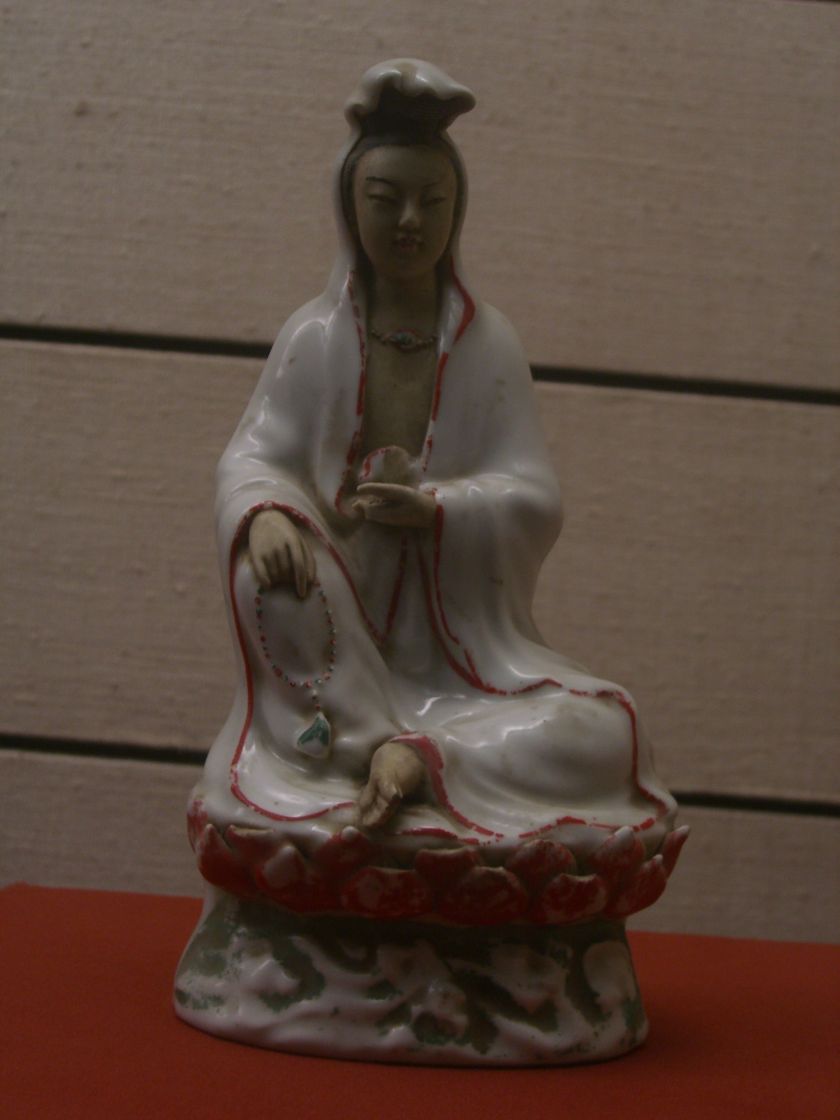
Guanyin has always been my favorite Bodhisattva. (Does anyone else have a favorite Bodhisattva?) Not sure whether it was the amazing 11th or 12th century “Guanyin of the Southern Sea” residing at the Nelson-Atkins Museum of Art in Kansas City or the Qing Dynasty Guanyin (Avalokitesvara) ceramic figure at the Shaanxi Historical Museum that made me fall in love with Guanyin. Having seen thousands of Guanyins in temples,  museums, street markets, and antique shops throughout the world, these two are still my favorites. I loved that Guanyin was the God/Goddess of Compassion and that he/she could have been male or female in origin. The Lotus Sutra says that “Guanyin travels throughout the world guiding beings towards freedom from suffering.” The word, “Guanyin” in Chinese means “pays attention to all sounds” which may also be interpreted as “hearing all prayers and pleas for help.”

“There is no place where s/he will not manifest her/himself.

The suffering of those in troubled states of being;

Hell-dwellers, hungry ghosts and animals;

And the suffering of birth, old age, illness, and death

Will gradually be extinguished”

The Lotus Sutra, trans. Tsugunari Kubo and Akira Yuyama, Bukkyō Dendō Kyōkai 2007.

Guanyin, (Avalokiteshvara in India), was almost certainly a male figure when s/he first appeared in Chinese Buddhist temples during the early centuries of the Common Era. It wasn’t until the Song Dynasty (960-1279 CE) that Guanyin transmogrified fully into her current female form. The Ming Dynasty Buddhist, Miaoshan (妙善 miào shàn) is often portrayed as a human manifestation of Guanyin. Miaoshan was the youngest of three daughters. At an early age, she had wanted to be a follower of Buddha, but her father had other ideas and insisted that she marry. When she adamantly refused, her furious father punished her by sending her to a nunnery, which he later tried to burn down. Legend has it that he tried again to have his daughter killed. Two soldiers took Miaoshan out to an open space in the forest and drew their swords. But a tiger appeared and the soldiers dropped their swords and fled whereupon the tiger took Miaoshan to a cave on a mountain and left her there. Some time later, Miaoshan’s father became very sick. He was told that the only way he could be cured was by a compassionate person gouging out an eye and cutting off an arm. Miaoshan’s father did not believe that someone would actually step forward and make that kind of a sacrifice. In the end, it was Miaoshan who gouged out her eye and cut off an arm to cure him. When her father gazed upon his mutilated daughter, and realized that she was the compassionate person,  he immediately realized what a selfish and heartless person he was, and begged her to forgive him. Some people believe that that thousand eyed, thousand armed Guanyin statues came into being as a result of the story about Miaoshan.

Guanyin statues and stories abound. One incarnation of the Guanyin statue which has always intrigued me is the one where she is carrying a baby (usually thought to be a baby boy.) I’ve often wondered whether that manifestation of Guanyin might have been influenced by Madonna statues brought in by Catholic priests when they first arrived China in the 14th century.

About 7 km (4.5 miles) due north of the Shaanxi History Museum, located in the heart of the old city of Xi’an, stands the best preserved and maintained city wall in all of China – with the possible exception of the wall around the Forbidden City in Beijing. Started in the Tang Dynasty (618-907 CE) and refurbished to its present state in the Ming Dynasty (1368-1644 CE), the total perimeter of the city wall is 13.7 km (8.5 miles). It is 15-18 meters (50-60 ‘) wide at the bottom and approximately 12-14 meters (40-45’) across on the top. The wall is approximately 12 meters (40 ‘) tall. Of the 6,000 cities in China which used to have walls, only about ten continue to exist today. A city within a city lies within these walls complete with schools, mosques, temples, commercial areas, museums, and anything else which makes up a city in China. One fun thing to do is to rent a bike on top of the wall. If you want, you can bike the entire perimeter of the wall.

One of my favorite places to visit within the wall is the Great Mosque. I actually lived in Xi’an for nearly a month in the early 2000’s. Every time I visited the mosque, it was quiet and serene. When I first went there in the early 80’s, I met a young English speaking Muslim student who lived and studied at the mosque. I wrote down his name and when I went back nearly twenty years later and asked about him, he was still there. I’m not sure he remembered me but we had a nice reunion .

The Muslim Quarter surrounding the Great Mosque has some of the best street food in Xi’an. A local Xi’an favorite is the Paomo Lamb & Pita Soup (羊肉泡馍 Yáng Roù Pào Mó). At its core, Paomo is a potage, a delicious thick broth filled with lamb and shredded flat bread.  Dumplings are also  nice in Xi’an. Unlike traditional jiaozi or xiaolongbao, dumplings here often contain spices like cumin, chives, and sweet garlic. Try the 灌汤饺子 Guàntāng Jiǎo which are translated as the Steamed Dumplings from Heaven.

You may remember Xuanzang (玄奘Xuán zàng) from the Monkey stories. He lived from 602-664 CE in the Tang Dynasty and was the real life Buddhist monk who took a pilgrimage to India to visit the sources of Buddhism in areas we now call India, Pakistan, Bangladesh, and Nepal. He was aware of an earlier Buddhist monk  by the name of Fa Xian (法顯 Fǎxiǎn) who had traveled to India with nine other monks in the 5th century in a similar quest for Buddhist scriptures. It is said that the Big Wild Goose Pagoda (大雁塔 Dàyàn Tǎ) in Xi’an was the storage place of over 500 cases of Buddhist scriptures and artifacts that Xuanzang brought back to China from India – among them some of the most important of the Mahayana Buddhist scriptures.


The Heavenly Horses of Chang’an

Chinese Odyssey 63

We opened a door

in the sky and stepped through.

Wulumuqi to Xi ‘An

on carpets, we flew.

In the History Museum

we wandered through time,

found ancient inventions

and poems without rhymes.

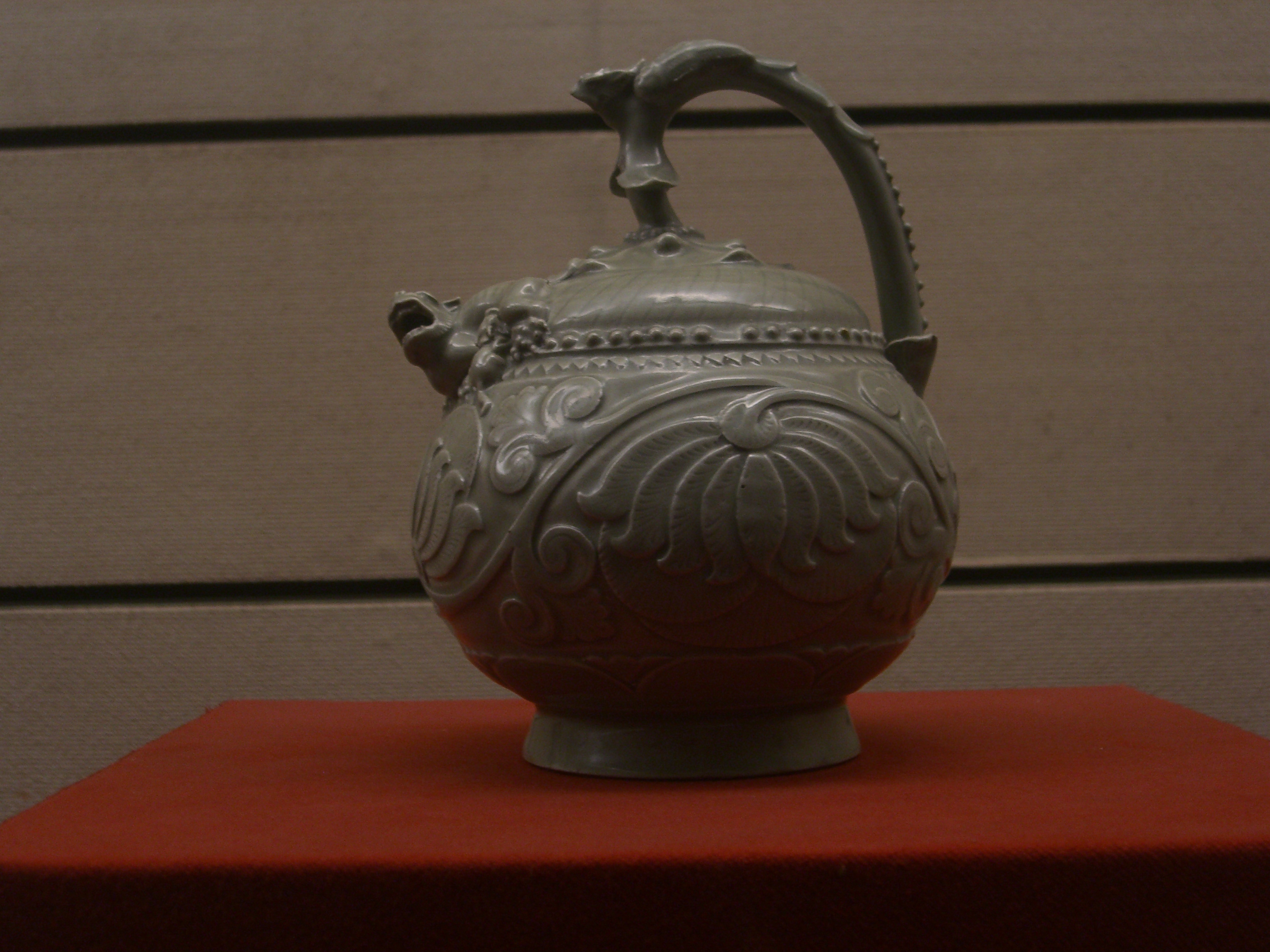
Teapot from the Shaanxi H. Museum

The Han Dynasty lasted more than 400 years – from 206 BCE to 220 CE. In many ways, it defined much of what China was to become. To this day, over 90% of the people in China consider themselves to be Hàn Rén 漢人 (lit. people of the Han) and the Chinese language in its totality is referred to as Hàn Yŭ 漢語 (the language of the Han).  A hǎohàn 好汉 in China is “a good guy.” The Han Dynasty produced some of the coolest inventions ever: Chinese paper was invented then, as was moveable type, instruments for measuring seismic activity, wheel barrows, suspension bridges and many other amazing innovations were said to have been invented during this longest of the Chinese dynasties.

One of the first exhibits to catch my eye at the Shaanxi History Museum was a tea pot with no lid. When the teapot was turned over there was a clay funnel built into the bottom of the teapot and scalding water would have been poured into the clay funnel. Turn the teapot right side up and the tea stayed in the pot. I’m still not sure how they put the tea leaves into the pot, though or how the inside of the pot was cleaned. Then there was the goose shaped smokeless bronze lamp. The smoke from the flame of the burning lamp went up through the long neck of the goose and back into the body of the lamp which contained water and there the smoke would die. One sided mirrors and coins with squares cut out of them. Water wells and grain grinders, axes and adzes, and even a Han loom that looked modern all were exhibited at the Shaanxi History Museum. From the Tang Dynasty there were wine pots made out of silver and drinking cups in the shape of horns mad out of agates. One of the most famous paintings there from the Tang Dynasty had five men mounted on horses playing polo English style.

The place we now call Xi’an had a different name up to the beginning of the Ming Dynasty (14th Century).  Chang’an was actually a few km northwest of the modern city of Xi’an. Chang’an loosely translates to Eternal Peace. It’s founders tried to insure that by positioning Chang’an near both the Huang He and the Wei rivers in an area surrounded on all sides by hills. Artifacts found near the site of Chang’an pre-date the Shang Dynasty and by the end of the Eastern Zhou Dynasty (771-256 BCE) Chang’an was China’s capital. At that time, Chang’an was one of the largest cities in the world having close to one million people. Chang’an was also China’s capital during the Han, the Sui (581-618 CE) and the Tang (618-907 CE) dynasties.

Chang’an was the eastern portal to the Silk Road. It was in 128 BCE during the Western Han Dynasty when Zhang Qian (張騫 Zhāng Qiān) , a young imperial officer, was sent by Emperor Han Wu Di (漢武帝 Hàn Wǔ dì) from Chang’an to explore the Western region to try to establish a military alliance with the Kingdom of Yuezhi in modern day Tajikistan. To do that, he needed to go through Inner Mongolia which was controlled by the Xiongnu (匈奴Xiōngnú).   Zhang Qian was captured by the Xiongnu in the Hexi Corridor and held captive for more than 10 years. While a prisoner Zhang Qian married a Xiongnu woman who bore him a son.  When the Xiongnu leader died, Zhang Qian and his good friend and guide, Ganfu (甘父 Gān fù) escaped with Zhang Qian’s wife and son, but instead of returning to Chang’an, they continued north to Khöshöö Tsaidam in modern day Mongolia and then followed the northern edge of the Tarim Basin , around the Kunlun mountains,  and even stopped at Kashgar. They then continued west to Ferghana (modern day eastern Uzbekistan, Tajikistan and Kyrgyzstan), and south to Bactria. While in Bactria (present day Afghanistan, Uzbekistan, and Tajikistan), Zhang Qian learned about Alexander the Great and this was the first recorded meeting between these great civilizations.  On their journey home,  Zhang Qian’s entourage traveled east below the Tarim Basin and crossed the Gobi Desert before eventually reaching Chang’an.

Zhang Qian was much more successful in his second journey to the west when he was accompanied by 300 men to present day Kazakhstan, Kyrgyzstan, Afghanistan, Pakistan, and Uzbekistan. Although Zhang was unable to visit India and the Macedonian and Parthian Empires, he did learn valuable information about those regions.  On his journey back, Zhang Qian was able to bring back alfalfa and grapes which grew easily in the western regions of China. He also brought back stories of horses from the Fergana valley (located between Kyrgystan and Tajikistan) which Han Wu Di renamed “Heavenly horses” (大宛馬 dàyuānmǎ aka 宛馬 yuānmǎ). Han Wu Di sent 20,000 infantry and 6,000 cavalry west to the Fergana valley to obtain these horses, but lost half of his soldiers along the way and they lost the first “War of the Heavenly Horses.” The Emperor was not happy so he sent another bigger force of 60,000 mostly prison recruits and 30,000 horses and they had no problem making there way to Dayuan (Fergana) and after a 40 day siege, the Han forces achieved victory. In the end, the Han General left Dayuan with 3,000 horses of which around 1,000 Heavenly Horses, the Lamborghinis and the Aston Martins of China 2000 years ago, finally arrived in Chang’An in 101 BCE.

“The Arrival of the Heavenly Mare”

天馬徠兮 從西極

經萬里兮 歸有徳

承靈威兮 降外國

渉流沙兮 四夷服

The heavenly horses have arrived

from the Western frontier

Having travelled 10,000 li,

they arrive with great virtue

With loyal spirit,

they defeat foreign nations

And crossing the deserts

all barbarians succumb in their wake!

–The Shiji, Chapter 24 (“The Treatise on Music”)  Shiji (史記) vol. 24, “Yueshu (楽書)” number 2.


Assalamu Alaikum

Chinese Odyssey 62

“Assalamu Alaikum”

heard more than “Ni hao”.

Was this really China?

If so, where was Mao?

A lake named for Heaven

felt just like my home.

Lake McDonald in Xinjiang

a picture, a poem.

Waterfall by Heavenly Lake

Oo-loo-moo-chee is more or less how this far western Chinese city is pronounced in Mandarin. Ürümqi is the name of the same city on a map. In Pinyin and in Chinese characters,  it looks like this – Wūlǔmùqí 乌鲁木齐. Located a little north and west of the center of the Xinjiang Uyghur Autonomous Region, some say that Wulumuqi “is not the end of the world – but you can see it from there.” That said, the estimated population of Urumqi today is 3.5 million, by far the largest city in far western China.

Although some say that Xinjiang has historical claims going back to the Han Dynasty where China called the area a “protectorate of western regions”, most understand China’s legal claim to Xinjiang to have occurred in the Qing Dynasty as a result of the Dungan Revolt in 1884. The name “Xinjiang” actually means “new border” and refers to any area previously claimed to be a conquered region of China and was lost and then regained.

Islam has played a major role in Xinjiang for a millennium. The majority of people living in Urumqi are Han Chinese, but close behind are the Hui and the Uyghurs who are Sunni Muslims. Walking through this colorful city, I received many more smiles when I greeted people with the traditional “Assalamu Alaikum” greeting than I did when I tried to open a conversation with “ni hao”. But Urumqi also felt Chinese. Ethnicities abound, all having occupied this city since its beginning. Most of the stores and goods look the same as those available all over western China. I thought Urumqi to be a really nice amalgamation of people unlike any other city in China I had ever visited.

A little over 100 km due east of Urumqi is a lake called Tian Chi (Heavenly Lake). Located in the Tianshan mountain range, it receives the same snow melt as do the karezes in Turfan. Surrounded by glacial peaks, it really did remind me of Glacier National Park in Montana. Heavenly Lake reminded me of a smaller version of Lake McDonald in Glacier. On a small tour boat I asked the tour operator where people swam. She was adamant that no one could swim in Heavenly Lake. It was much too cold. When I told her about swimming in Lake McDonald, she assured me that it could not have been the same. No one could survive swimming in Heavenly Lake. I beg to disagree.

Although Xiwangmu (西王母) predates Daoism, no one knows her origin story. Time is imperceptible to her, “a thousand years, like a cricket’s chirp.” First appearing in oracle bone inscriptions 1500 years before the birth of Christ, Xiwangmu was revered as the Western Mother. Some incarnations portray her has having the teeth of a tiger early in her life. She was said to have lived in a palatial paradise where gods and humans could come together. She was a Daoist master who enamored  King Mu at Turquoise Pond (thought to have been Heavenly Lake) in the Zhou Dynasty. She was said to have visited the Emperor Han Wu Di in a chariot made of purple clouds. But neither King Mu nor Emperor Han Wu Di was able to complete her teachings which would have allowed them to attain immortality. She is also mentioned in the Journey to the West where she had a peach tree garden which only blossomed every three thousand years. The monkey king was still out of control at this time, insisting that everyone refer to him as Qítiān Dàshèng (齊天大聖), or the “Great Sage Equal to Heaven”. For eating all of the immortality peaches in the Jade Emperor’s garden, Sun Wu Kong (the Monkey King) was imprisoned under a mountain for 500 years.

Walking down a manicured path beside Heavenly Lake we eventually began our descent down wooden steps alongside a beautiful stream which turned into an amazing rainbow shrouded waterfall. The splashing water and the crisp air breathed new life into all of us before boarding the bus back to a birthday banquet in Urumqi.