The Flying Nymphs of Mogao

Chinese Odyssey 60

In the grottoes of Mogao

high up on the walls

were angels and fairies

who flew through the halls

The message apsara

had helped us to find

“perfection of wisdom,

brings peace to the mind.”

File-Apsara_playing_a_Chinese_flute_-_Yulin_Cave_15https://upload.wikimedia.org/wikipedia/commons/8/8f/File-Apsara_playing_a_Chinese_flute_-_Yulin_Cave_15.jpg

Sometimes alone, sometimes in pairs or groups, pale and dark, Chinese and foreign, mostly female. They danced, flew, played musical instruments, performed acrobatics with colorful ribbons, rode on horseback, and protected others.  Similar but somehow different images from Buddhist temples in Ankgor Wat and Hindu temples in India. They called them “apsara”, but at Mogao, the question emerged whether or not these were apsara at all. I had learned that apsara were “cloud and water” female spirits, nymphs or fairy like figures, whose major role appeared to be that of pleasing men.” What really got me thinking however was an article called “The Case for Feitian”. Feitian (飛天) is the Chinese name for the figures one finds decorating the walls of many of the caves of Mogao. Fei means “to fly” and “tian” means “sky” or “heaven.” The more I studied the 5,000 feitian from the 700 plus caves at Mogao, the more I began to see that these figures were unique. They were not all idealized figures of women. Some of these apsaras were male and some of the male and female figures were muscular and most were more modest than those on the walls of temples in India and Cambodia. Had the feitian been influenced by Buddhist or Hindu art? Without a doubt. Were there strong Chinese influences on these figures created over the course of nearly 1,000 years? Definitely.

The Oxford Dictionary defines apsara as “a celestial nymph, typically the wife of a heavenly musician.” Your Dictionary provided an even more interesting definition: “In Hindu and Buddhist tradition, one of a race of beautiful female supernatural beings that inhabit the sky, dance for the entertainment of other celestial beings, and often attempt to seduce mortal men practicing asceticism.” The same dictionary explores the origin of Apsara as “ āp, ap- water and saras as things that flow, lake -the Apsaras being depicted as delighting in water.” “Apsara.” Apsara Dictionary Definition | Apsara Defined, http://www.yourdictionary.com/apsara.

When Le Zun (Lè Zūn 樂尊) stepped into the Hexi Corridor (Héxī Zǒuláng 河西走廊 ) in the 4th century C.E. and discovered pure, sweet spring waters near the present city of Dunhuang, he decided that would be a nice place to rest after his arduous journey across the Gobi Desert. In the evening, watching the sun set, images arose out of those mountains. Among the figures he saw in the heavens were thousands of fairy like apparitions dancing and playing music. Le Zun knew he had stumbled onto a sacred spot. A few years later, he was joined by another monk by the name of Faliang (Fǎ Liáng 法良) who had a similar vision. The word spread among Buddhist pilgrims that this was a sacred spot .  During the next millennium, mostly during the Tang Dynasty, over 500 caves were carved into the sandstone and filled with an amazing collection of Buddhist art. According to Karin Dienst’s article “Bringing ancient Buddhism to light” published by Princeton University, there were “2,000 Buddhist sculptures, 45,000 square meters of murals and more than 60,000 texts.”

Like so many places in China, one needs to plan a trip to the Mogao caves. As more Chinese enter the middle class and have more expendable income, the first place many Chinese want to see is China. Whether its climbing up stairs to the Great Wall at Mutianyu, or following the trails and stairs cut into the rocks of Huangshan or exploring the Buddhist art on the caves of Mogao, there will be crowds of people – all pilgrims hoping to see the fairy like apparitions seen by Le Zun so many centuries ago.

Dunhuang – a Diamond in the Rust

Chinese Odyssey 59

We came to some walls

in the midst of the sand

doors lead into caves

remarkably grand

where they preserved

statues, sutras and art

the oldest, the Diamond

the deepest, the Heart

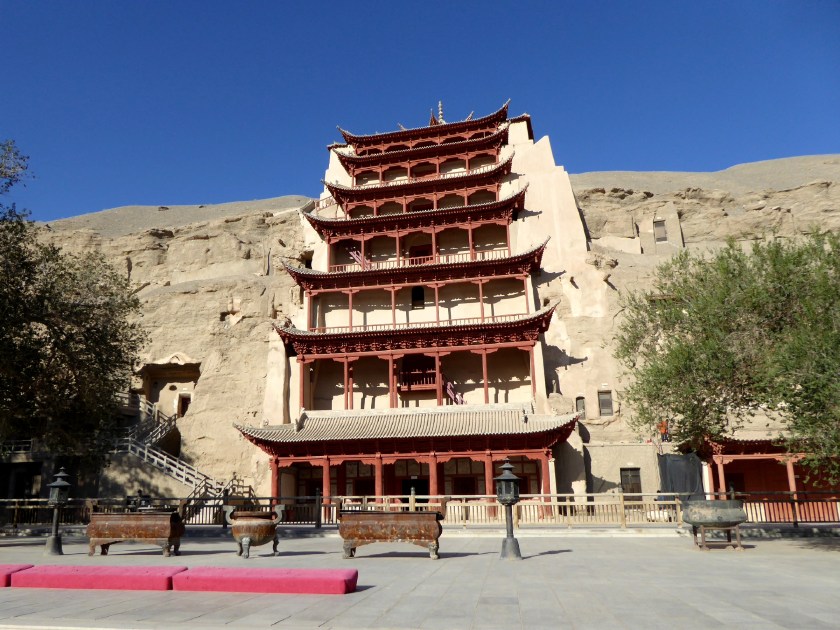
Mogao_Caves_Dunhuang_Gansu_China_敦煌_莫高窟_-_panoramio_(4)Hiroki Ogawa [CC BY (https://creativecommons.org/licenses/by/3.0)%5D

Located in western China, 200 plus miles west of Jiayuguan on the eastern edge of the Taklamakan Desert, Dunhuang was a nexus where merchants and traders from China and the west interacted with Buddhist pilgrims on the western edge of the Gobi desert. About 25 km southeast of Dunhuang lies an area known as the “Caves of a Thousand Buddhas” (千佛洞 Qiānfó Dòng). It is also called the “Mogao Grottos” (莫高窟Mògāo Kū). They are, in fact, a one mile stretch of nearly 500 caves which were burrowed into sandstone by 366 monks in the middle of nowhere about 1000 years ago.

In 1900, a Daoist monk by the name of Wang Yuan Lu (王圓籙Wáng Yuánlù),  discovered a hidden door in one of those caves (cave #17 aka the Library Cave) while doing some painting restoration work. Behind the mysterious door, Wang discovered nearly 50,000 ancient manuscripts, rare textiles, silk embroideries, and other artefacts dating back more than a millenium.

In 1907, Hungarian born British archaeologist Aurel Stein first arrived at the Mogao Grottos. A year later, Paul Pelliot, the French Sinologist and Orientalist followed. Between the two of them, they “purchased” thousands of manuscripts, paintings, embroideries, and other artefacts from Wang Yuan Lu which they sent back to museums in London and Paris. Russian and Japanese explorers and collectors followed close behind.

Stein and Pelliot were also followed by the likes of Langdon Warner of the Fogg Museum in Boston who (according to Dong Linfu) cut out pieces from twelve frescoes because he wanted to preserve Chinese culture and thought that the Chinese were “subhuman, uncivilized, and unable to appreciate their past culture.” Alan Priest followed Warner carving out fourteen pieces of a stone frieze and carrying away six heads of Buddhist statues bound for the Metropolitan Museum of Art. (from Dong, Linfu. Cross Culture and Faith: the Life and Work of James Mellon Menzies. University of Toronto Press, 2005.)

The Mogao caves were designated as a UNESCO World Heritage Site in 1987.

The Heart Sutra was one of the documents retrieved from the Mogao caves. It’s recent translation by Thich Nhat Hanh as “The Insight that Brings Us to the Other Shore” (2014) is licensed under a Creative Commons Attribution-Non Commercial 4.0 International License.

Avalokiteshvara, while practicing deeply with
the Insight that Brings Us to the Other Shore, suddenly discovered that
all of the five Skandhas are equally empty, and with this realisation
he overcame all Ill-being.

“Listen Sariputra, this Body itself is Emptiness
and Emptiness itself is this Body. This Body is not other than Emptiness and Emptiness is not other than this Body. The same is true of Feelings, Perceptions, Mental Formations, and Consciousness.

“Listen Sariputra, all phenomena bear the mark of Emptiness; their true nature is the nature of no Birth no Death, no Being no Non-being, no Defilement no Purity, no Increasing no Decreasing.

“That is why in Emptiness, Body, Feelings, Perceptions, Mental Formations and Consciousness are not separate self entities.

The Eighteen Realms of Phenomena which are the six Sense Organs, the six Sense Objects, and the six Consciousnesses are also not separate self entities.

The Twelve Links of Interdependent Arising and their Extinction are also not separate self entities.  Ill-being, the Causes of Ill-being, the End of Ill-being, the Path, insight and attainment, are also not separate self entities.

Whoever can see this no longer needs anything to attain.

Bodhisattvas who practice the Insight that Brings Us to the Other Shore see no more obstacles in their mind, and because there are no more obstacles in their mind, they can overcome all fear, destroy all wrong perceptions and realize Perfect Nirvana.

“All Buddhas in the past, present and future by practicing the Insight that Brings Us to the Other Shore are all capable of attaining Authentic and Perfect Enlightenment.

“Therefore Sariputra, it should be known that
the Insight that Brings Us to the Other Shore is a Great Mantra,
the most illuminating mantra, the highest mantra,
a mantra beyond compare, the True Wisdom that has the power
to put an end to all kinds of suffering. Therefore let us proclaim
a mantra to praise the Insight that Brings Us to the Other Shore:

Gate, Gate, Paragate, Parasamgate, Bodhi Svaha! Gate, Gate, Paragate, Parasamgate, Bodhi Svaha! Gate, Gate, Paragate, Parasamgate, Bodhi Svaha!” (completely gone to the further shore)


God in the Gobi

Sand_from_Gobi_DesertSiim Sepp [CC BY-SA 3.0 (https://creativecommons.org/licenses/by-sa/3.0)%5D

“’A place of desolation.’” murmured one of my companions.

I was fully aware of the acute terror with which the Chinese regard the Gobi regions, and I was determined to get a better understanding of the outlook from these men who lived on the very edge of the desert yet always turned away from it with a shudder and hurried toward the noisy clatter of the drill-ground and the barrack-room.

‘It is desolate,’ I said, ‘but in the silence and solitude God is still there.’”

So begins a travelogue unlike any I have heretofore encountered. The story of three women who, not once, but five times, traveled the entire length of the Gobi. For nearly 30 years, at the turn of the 20th century, “the trio”, sisters Eva and Francesca French, and Mildred Cable, were a part of the China Inland Mission, a Christian mission unaffiliated with any particular church or denomination which actively recruited both laypeople and single women into its service. Eva (Evangeline) French was a passionate woman whose upbringing in France and Switzerland in no way presaged who she was to become. Before converting to Christianity, Eva had described herself as “ “the fervid Nihilist, the incipient Communist, the embryonic Bolshevist.”

But when she finally did find her calling and faith, she embraced it fervently and signed on for a mission in China.  Eva was the first of “the trio” to arrive in China in 1893.  These were tumultuous times in the ‘middle kingdom’. The Empress Dowager Ci Xi was captain of a sinking marble boat that was the Qing Dynasty and Eva found herself in the middle of the Boxer Rebellion, not a healthy place for a foreign missionary in 1900. Reports came to Eva’s family that she had been killed by the Boxers and her mother fell into a depression she was never able to fully recover from, even after they discovered that the report of Eva’s death was erroneous. In 1908, Francesca joined her sister in China. At around the same time, Mildred Cable, an English woman who had grown up in a very strict religious family where she was constantly threatened by tales of God’s punishment to sinners, also answered “the call” she had felt as a young woman. Mildred Cable had planned to make that call with her fiancé, but he abandoned his plans to become a missionary and begged Mildred to stay. The decision to forsake marriage and to follow God into Boxer China, was never in doubt. Although she momentarily pined the loss of her love, serving others and spreading the gospel ultimately won out. The first person she met upon her arrival in China was Eva French.

When I stumbled into this amazing book, The Gobi Desert, I was immediately taken by the detailed descriptions of both the environment and the connections these women had been able to establish with the people they encountered. Unlike most missionaries, the French sisters and Cable adapted quite quickly to whatever environment they found themselves in. They learned to speak multiple Chinese dialects and lived their lives appreciating the same diet, wearing the same kinds of clothes, and living in the same kinds of homes as did the people they were serving. The more I read, the more I realized that they were not merely assuming these lifestyles out of duty, all three women seemed able to find satisfaction, joy, and beauty in their new surroundings and found value in and respect for both the people and the environments they encountered.

They were also dedicated to improving the lot of women in China. Not only did they want to train girls and women to carry on their missionary and evangelical work in China, they also wanted to introduce “Christian values” to illiterate Chinese peasant women by teaching young women science, the classics, literature, as well as addressing more difficult subjects such as foot-binding and infanticide. For more on this, read Jo Woolf’s article entitled “Mildred Cable, Eva and Francesca French” at  https://rsgsexplorers.com/2017/05/14/mildred-cable-eva-and-francesca-french/

What continued to both haunt me and draw me into this book were the descriptions of minutiae – those elements that surround us but most of us are blind to. Instead of describing the sand of the Gobi as hills or dunes, or even grains, their sand was more like that of William Blake’s Auguries of Innocence (“To see the World in a grain of sand, . . .”)

“Their flooring mainly consists of a wide expanse of sand or stone-littered plains, but a wealth of detailed variety hides itself under a superficial guise of monotony, and to the close observer each day’s march has a definite stamp of individuality.  By reason of their vivid and varied colorings, these stones are one of Gobi’s features of beauty, and sometimes the narrow, faint path passes through a litter of small multi-colored pebbles, which are rose-pink, pistachio-green, tender peach, lilac, white, sealing-wax-red and black burnished by sand, sun, and wind as though black-leaded, the whole, mixed with a quantity of orange-tinted cornelian, forming a matchless mosaic.” (from Cable, Mildred, and Francesca French. The Gobi Desert. Hodder and Stoughton, 1942.)

Chinese Odyssey 58

On bus, train, and foot,

traveling as we were able,

we followed God’s trio,

French sisters and Cable.

In the ’20s they lived

with peasants of Gobi,

saw God in sand grains,

mud homes like adobe.


Shadows of Tibet

https://upload.wikimedia.org/wikipedia/commons/2/2e/Tibetan%2C_Central_Tibet%2C_Tsang_%28Ngor_Monastery%29%2C_Sakya_order_-_Four_Mandalas_of_the_Vajravali_Series_-_Google_Art_Project.jpg

At university, I read Herman Hesse’s Siddhartha. Curious to learn more about Buddhism, I waded through the Evans-Wentz translation of the Tibetan Book of the Dead and was fascinated when I found a road map describing what happens to a person after they die. According to the “Bardo Thodol”, there is a period of 49 days when a person can either become enlightened or begin their journey back to the land of the living in a new incarnation.

In Buddhism, there are 4 Noble Truths, and an 8-Fold Path which directs you on how to live your life in ways that support the 4 Noble Truths:

  • All life is suffering
  • suffering is the result of desire
  • get rid of desire and you’ll no longer suffer
  • to end suffering, follow the 8-fold path

The 8-fold path includes right view, right intention, right speech, right action, right livelihood, right effort, right concentration, and right mindfulness.

Like other religions, not all Buddhists believe exactly the same things or practice in the same ways. There are two major branches. Mahayana (the greater vehicle) dedicates itself to the liberation of all sentient beings through a combination of compassion and wisdom.  Theravada (the lesser vehicle) concerns itself with the liberation of oneself.

Vajrayana Buddhism is often called the third branch, although it has its roots in Mahayana Buddhism. Also referred to as Esoteric Buddhism, this is certainly the root of what we call Tibetan Buddhism. Tibetan Buddhism is also heavily influenced by Bon, a traditional religion in Tibet before Buddhism was introduced in the 8th century CE. Tibetan Buddhism has spread beyond Tibet, however, and is currently practiced in Bhutan, Sikkim, Ladakh, and Mongolia. There are also large Tibetan communities in Sichuan, Yunnan, Qinghai, Gansu, and in the Xinjiang Uygur Autonomous Region.

One unique aspect of Tibetan Buddhism is the Dalai Lama. Bodhisattvas are reincarnated holy people who have been reborn into the world for the specific purpose helping all people. The Dalai Lama is believed to be the reincarnation of Avalokitshvara or Chenrezig, the Bodhisattva of Compassion. The current Dalai Lama’s primary message is one of compassion and harmony.

Tibetan Buddhists believe that we live in a continuing cycle of birth and rebirth (samsara). They believe that the actions of this life will impact on this life and on future lives (karma). They also believe that the goal of Buddhism is to escape from this cycle of birth and rebirth by becoming enlightened. The spiritual teachers who help Buddhists navigate towards enlightenment (Nirvana) are called lamas. They teach their students activities that benefit all living beings and the environment since every living creature is believed to have an “energy” (which somehow differs from a permanent essence or “soul”). Lamas and rinpoches abound, some Buddhist scholars, some laypeople, often reincarnations of teachers from the past.

Tibetan Buddhists carry prayer beads and use them to count the times that they chant mantras (short prayers) to help them connect with enlightened beings or Buddhas. The most popular chant, “Om Mani Padme Hum” is not only heard but seen, all over the Buddhist world. It is commonly translated as “The jewel in the lotus” but is meant to direct one’s focus to attaining the level of compassion and wisdom that Bodhisattvas have reached. Not for the purpose of achieving enlightenment but rather to direct one’s actions towards others. In Tibetan Buddhism, symbols are pervasive. Whether prayer wheels, prayer flags, or on shrines made of stones, on walls, on tapestries, prayers, and mantras are meant to be shared with all sentient beings. They’re not limited to the interiors of monasteries or the homes of practitioners. Like thousands of tiny prayer flags, they flap in the wind spreading and sharing their messages.

There is a breadth and depth to Tibetan Buddhism, I could not begin to unearth (or understand at this writing). A huge number of Buddhas and Bodhisattvas, supernatural beings and spirits (many not from Buddhism) abound in writing, on paintings, tapestries,  on prayer wheels, sand art, prayer flags, and in a wealth of tantras of all sorts.

The final image that comes to my mind is that wherever Tibetan Buddhism is practiced, people pray by prostrating themselves to show respect to the Buddha, the Dharma, or the Sangha. This act is also done to humble oneself and to release one’s ego.

Chinese Odyssey 57

There were monks all about

wearing red robes with sashes,

prostrating themselves

nearby incense and ashes.

Like a Buddhist golf course,

18 halls at Labrang

reminded us softly

it was time to move on.

The Original “Rubber” Rafts

Original Rubber Rafts

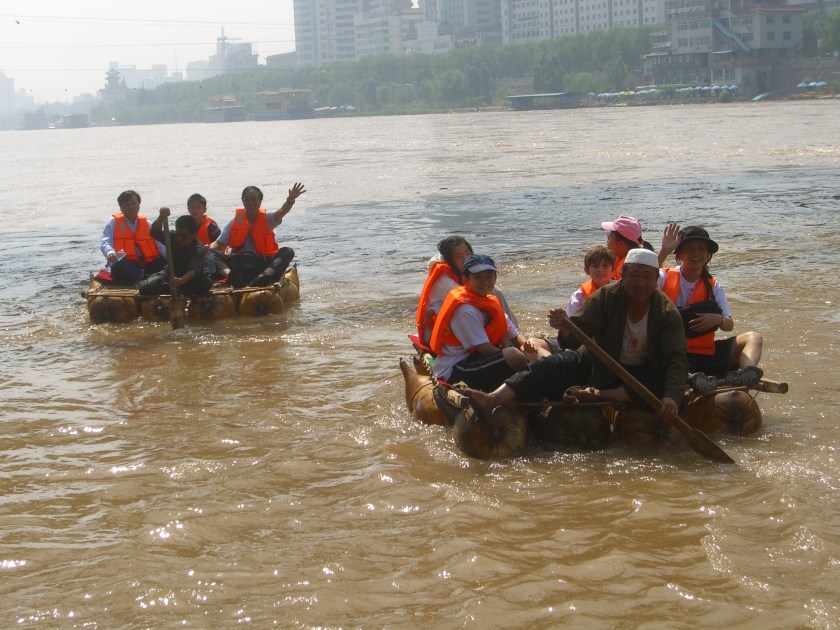
When I saw these boats on the Yellow River outside of Lanzhou for the first time, I was mesmerized.

100 years ago. 1000 years ago. Kids the age of our kids would have ridden on the same boats across the same river at the same place.  Were these the first inflatable boats?

The wool must have first been shorn and put away to be made into thread, to be woven into cloth. Then meticulously, the head would have been severed and the flesh, the sinew, the bones, and internal organs would have been removed from that single orifice. Back in the day, there were no raft specialists living on the Yellow River. It would have been the boatmen, the raftsmen, who first painstakingly removed the precious internal organs, the lungs, the heart, the stomach, and the intestines, before taking out the meat and bones. Were there scraping and cutting tools specially designed for removing organs, bones, and meat? Sheep carcasses didn’t need to be discarded.  Through a process of trial and error, these craftsmen learned how to dry and scrape and tie and sew the carcasses so that no air was able to get out. The one hole for air was ingeniously cut into one of the hoofs and the owners, after blowing the sheep full with air, would simply fold the trotter in half and tie a few loops of sinew around the hoof.

I imagined ancestors of today’s rafters seeing the floating carcass of a bloated sheep on the river . . .

Big Joe (周大哥) and his two younger brothers, Erdi and Sandi, trudged along a high bank of the Huang He as it meandered across the southern part of the province we call Gansu. They had gone to their normal swimming hole, but found men building a giant water wheel where they used to play. Up ahead was an area  Erdi and Sandi had told him looked like a great new place to swim and bathe at the end of a hot day in the fields. As they eased themselves into the water, in the distance Erdi spotted a couple of black dots far up the river and warned his two siblings. Probably some kind of dead animals. His mother had told him when he was young that he should never touch these animals because it might make him sick. Still, the closer they got, the more he was drawn. His parents had always told him not to let anything go to waste and floating past him were two sheep carcasses which would eventually rot and sink into the river.  The Huang He was a massive river and Big Joe and his brothers knew they could never afford to own one of the cool wooden barges carrying merchants and soldiers from the northeast. As the dead sheep got closer, Sandi shouted, “Look, Erdi, there are kittens on top of that dead sheep.”  Sure enough, two forlorn-looking calico kittens were trapped on the carcass of one of the sheep.

“I’ll get ‘em.” Shouted Sandi as he waded into a shallow trough of the Huang He. Too late. Big Joe could only watch as his brother plunged slow motion into a deep hole and was caught in a strong current. Sandi was a pretty good swimmer, but he was no match for the Huang He.

“Grab the sheep!” yelled Big Joe “and hang on.”

Without thinking, Sandi reached out and grabbed a hunk of wool dragging in the water. As he pulled himself closer, he found that the sheep was buoyant enough for him to climb on top. The poor cats didn’t know what to do. “It’s OK,” said Sandi with a smile. “I’ve come to rescue you.”

At the same time, he thought, “Who’s going to rescue me?”

Big Joe and Erdi ran along the bank shouting, “Paddle in, San Di. Use your hands.”

But Sandi had a better idea. Now that he knew the sheep was strong enough to hold him, he lowered himself back into the water and began to kick. In no time, he found himself getting closer and closer to the river bank. Just before dark, his feet felt the bottom and he was able to walk onto the shore with his calico kittens. He also pulled the stinky sheep on shore.

Big Joe and Erdi ran down to the riverbank and they all hugged. Erdi had some little fish that he gave to the kittens so they were happy, too.

Sandi just sat with a big grin on his face. “You know those dream boats we always wanted, but never could afford?” Sandi asked his brothers. Pinching his nose with one hand, with the other he pointed his finger at the dead sheep and said, “Meet the future.”

The rafts we rode on were made of 12 sheep, and saplings, tied together with sinew and twine. Probably not much different from those made 1000 years ago. Riding on the Huang He on those rafts was a magical trip on a way-back machine.

Chinese Odyssey 56

Then we climbed on the first

“rubber raft” made from sheep.

As we crossed the Huang He,

some of us fell asleep.

Around Gansu and Qinghai,

Tibetans abounded.

In a town called Xia He,

we all stood confounded

Monkey King vs. the White-Boned Demon – 3 Strikes and You’re Out

Monkey King from Mei Zhong Kuai Bao孙悟空三打白骨精 Sūn Wù Kōng sān dǎ Bái Gǔ Jīng) from 西游記 Xīyóu Jì (Journey to the West)

In CO 30, I wrote about the birth of Sun Wu Kong, the Monkey King, and mentioned how that after he was freed from his internment under the mountain, he and his piggy friend, Zhu Ba Jie (猪八戒 Zhū Bājiè), helped the monk, Tripitaka (三藏經), aka Tang Sanzang (唐三藏) aka Tang Seng (唐僧) aka Táng Zhēn (唐甄), bring the Buddhist scriptures from India to China. This ancient trio of superheroes was often joined by another monk called  Sha Seng (沙僧) aka Shā Wùjìng (), and Tang Seng’s faithful white steed, Bai Long Ma (白龍馬).

“Sun Wu Kong and the 3 hits of the White-Boned Demon” is one of the most loved of the Monkey King stories.

Bái Gǔ Jīng 白骨精 (the White-Boned Demon) hunkered down and licked her lips when Tang Seng passed by.  She knew that if she tasted the flesh of Tang Seng, she would live forever.

In the White Tiger Mountain Range, there lived a young peasant girl who plowed the fields with her mother and father. Unseen by the innocent young girl and her family, Bai Gu Jing flew down and put deadly poison into their drinking water. The young girl took a ladle, and after first serving her parents, she then drank a ladle full of water herself. Within minutes, the entire family lay dead. Bai Gu Jing cackled softly as she moved the bodies to a safe place where they wouldn’t be found.

Soon after, Tang Seng and his followers walked into the clearing.  Sun Wu Kong’s skin began to tingle and he knew he was in the presence of pure evil. “Master”, Sun Wu Kong addressed Tang Seng, “Nearby there are many beings who would like nothing better than a taste of your flesh.” With his magic staff, Monkey drew a perfect circle around his friends and warned them. “Nothing can harm you within the confines of this magic ring. Stay inside while I search for food and water. If you step outside of the circle, you put yourself in great peril.”

As you might expect, Zhu Ba Jie felt his piggy tummy rumbling and soon began to complain. Where is that lazy monkey? I’m famished!” Unbeknownst to Zhu Ba Jie and the rest of the family, Bai Gu Jing had moved her spirit into the body of the young girl and walked on a path towards Tang Seng and Zhu Ba Jie.

“Handsome sir”, she addressed the pig. “Master” she bowed to Tang Seng. “It’s so nice to welcome you to our home.” Bai Gu Jing (disguised as the young girl) moved toward them and was surprised when she could not step into the invisible barrier which protected them.

“Where are you going with that delicious looking basket of food?” asked Piggy.

“I’m taking it to my elderly parents, but I would be happy to share it with you” the girl responded and spread a small cloth on the ground outside of the circle and carefully displayed the food.

“Oh, yes” cried Piggy. “We would love some.” Zhu Ba Jie jumped out of the magic circle and lumbered towards the feast. Bai Gu Jin could barely refrain herself from devouring the pig, but she knew the real prize was the monk.

Hunger finally got the best of Tang Seng, as the sun was setting. As soon as Tang Seng stepped out of the circle, Bai Gu Jing made her move, but Sun Wu Kong came out of nowhere and pummelled Bai Gu Jing with his red cudgel. Neither Tang Seng nor Zhu Ba Jie had seen Bai Gu Jing’s approaching attack, so they were both shocked that the Monkey King would murder this nice young girl.

“What have you done?” shouted Tang Seng. Only the monkey king could see the injured spirit separate from the young girl’s body and move to assuage her wounds.

“Didn’t you see?” cried Sun Wu Kong. That was Bai Gu Jing in disguise.” Tang Seng and Zhu Ba Jie approached the dead girl, but there was nothing to suggest that the girl was Bai Gu Jing. Piggy did notice that the food that he had found so appealing had turned into rocks and sticks, but he said nothing to Tang Seng.

Sun Wu Kong quickly pushed Tang Seng and Zhu Ba Jie back into the magic circle so they would be protected in the event Bai Gu Jing returned.

Tang Seng then began murmuring a Buddhist chant and each time he repeated the chant, the golden headband on the monkey king grew tighter. When Monkey finally cried out in pain, Tang Seng scolded him and reminded Sun Wu Kong about the preciousness of life.

As Sun Wu Kong was recovering from his headache, an old lady approached them. Hiding behind the old lady so only Sun Wu Kong could see her, was Bai Gu Jing.

Zhu Ba Jie cried out. “Master, master. The young girl’s mother is coming. What do we do?”

Tang Seng once again stepped out of the circle and approached the women. “Venerable lady, your daughter is dead. She was accidentally killed by my overprotective disciple. Please forgive us. Please forgive us.”

“My poor innocent daughter. How could anyone suspect her gentle soul to be a threat to anyone? How could you? How could you?” She rushed towards Tang Seng.

Again, neither Zhu Ba Jie nor Tang Seng saw the transition from an old lady to the White-Boned Demon.  What they did see was the lightning speed of Sun Wu Kong’s staff as it broke open the head of the old lady – unaware that Bai Gu Jing had already killed the old woman earlier that day. In the eyes of Tang Seng and Zhu Ba Jie, Sun Wu Kong had murdered yet another innocent woman whose only crime had been to react to the death of her daughter.

“Wu Kong”, yelled the master. “You’ve done it again. Another innocent person died due to your overreaction to an imaginary threat. You may no longer accompany me on my sacred journey. I cannot be protected by a murderer. Leave now, and never return.”

“But Master,” cried Sun Wu Kong. “The old lady was Bai Gu Jing as well. Didn’t you see her fangs as she came in to kill you? Did you not see the speed and power of her movements? Those were not the moves of an old lady. That was Bai Gu Jing!’

“Leave now, Monkey. I am no longer your Shifu (master).

“Shifu. Shifu.” Monkey pleaded as he watched Tang Seng and Zhu Ba Jie continue on.

But the Monkey King could not leave. Sun Wu Kong knew that his master and his friend were in grave peril and that the violence he had been guilty of committing was only to protect his master and the scriptures. So, he followed at a distance and when they were stopped by an old man, Sun Wu Kong’s hair once again stood on end.

“Nan wu a mi to fo, nan wu a mi to fo”  The old man was chanting a time-honored Buddhist prayer. Hiding behind him was Bai Gu Jing.

Zhu Ba Jie asked Tang Seng. “Master. May I go bless that old man and give him an offering.”

Tang Seng responded. “No, let me go. You’re too ugly. I’m afraid you would frighten him off.” Zhu Ba Jie stood pouting.

Tang Seng approached the old man and said. “Greetings, honorable gentleman.”

“Hello, kind sir.” said the old man. “Welcome to our countryside.”

“Do you have a family?” enquired Tang Seng

“I have a young daughter.” Responded the old man. She left this morning and has not yet returned. My wife went out looking for her, but she hasn’t come home either.”

“Master” whispered Zhu Ba Jie loudly. “Those were the two people that the monkey killed.”

As the old man reacted, Tang Zhen shouted out. “We are so sorry. Forgive us, please.”

“Forgive you?” Bai Gu Jin shouted as she threw down the husk of the old man and appeared in all of her ugliness and splendor. “Ha, ha, ha! Not only will I forgive you, I will consume you. I will eat you and then I will live forever. And since you banished Sun Wu Kong, no one will come to your rescue.”

Bai Gu Jin stepped forward to devour Tang Seng, but this time, Sun Wu Kong dealt the death blow and Bai Gu Jing ceased to exist.

“Wu Kong, you’re here! How?” asked Tang Seng.

“You are my shi fu, master. Wherever my master is, that is where I will be.” That was the only response the Monkey King had to give.

Chinese Odyssey 52

A monkey, a pig,

and a priest on a quest

set out on a journey

which took them out west.

Their harrowing stories

are known far and wide;

Tang Seng, Zhu Ba Jie,

Sun Wu Kong was their guide

When the end is the beginning

Tiger Leaping Gorge Sea of Clouds blurry

The old lady on the road was right. I probably knew more about China than most foreigners, but I had still barely scratched the surface. But, I was discovering words and ideas on my “journey” that I kept bumping into, no matter where I was in China, and many of them led back to Lǎo zǐ  (老子) and the Dào Dé Jīng (道德经), that 5000 character, 81 chapter canon which forms the foundation of  Daoism a.k.a. Taoism. There is something compelling and homegrown about the character “道 dào”, which translates as “path” or “way”. Growing up in the West where the scientific method makes one search for answers. Paths and ways must have beginnings and end points. . . mustn’t they? Yet, according to the Dao De Jing, 有 “yǒu”(to have) and 無  “wú”  (to lack) are born from one another. Difficult and easy complement each other.  It is only because people accept certain ideas of beauty, that the concept of ugliness even exists. Does contrast define? Can there be a path with no beginning and no end point?

Laozi forced me to think differently. The lessons are often simple and profound which makes them even more difficult to translate into English. Take for example, wú wéi (無爲 ). Wu wei is often translated as “non-action”, but what is action? Is it movement? Can you be involved in “action” without instigating or influencing action? Wu wei does not mean non-doing or non-action, but rather not attempting to influence action.” Sort of a ‘go with the flow.’ Indeed, Laozi said that the highest good was like water. Water is content with wherever it is. But even when water moves, it is never the instigator of the move. Water is powerful like the Dao.

Laozi said that the space where there is nothing is the most important space. It is into the space of a cup where there is nothing that tea is poured. It is into the space where there is nothing that light flows into a building. And it is into the space where there is nothing that a wheel moves into. Just as we appreciate and take advantage of what is, we should also recognize the usefulness of what is not.

In the Dao De Jing, we are introduced to the simplicity and the power of the “uncarved block” and asked to question both wisdom and knowledge and to embrace selflessness and lessening of desire. Once the block is carved, there will be names. Like Zhuangzi’s “ugly tree” (see CO 2), Laozi believes that straight only manifested itself next to the crooked, that it was the hollow that could be made full, and that one can be defined without defining oneself. Laozi warns us that we should not tamper with Heaven and that those who tamper with it, lose it. One does not glorify nor boast about what one has done. One of my favorite passages is where Laozi said that when Dao was lost, only power remained. When power dissipated, there was human kindness; after human kindness left, there was morality; and then ritual. Laozi said that ritual was “the mere husk of loyalty and promise keeping” and eventually led to brawling which is “the beginning of folly.” (Laozi and Arthur Waley. The Way and Its Power: A Study of the Tao Tê Ching and Its Place in Chinese Thought. New York: Grove Press, 1958. Print.)

Laozi says that the loftiest power can appear as an abyss; the way into the light can seem dark;  the purist state can look faded and disheveled; and the loveliest music can have the subtlest notes. The Dao is often hidden in plain sight. One can therefore see without looking and by doing nothing can achieve everything.

I was on the edge of the precipice and staring into the west of China – the void. I knew how to float and to swim. It was time to leave that part of China where I could touch the bottom of the pool and move into the deep end.

Chinese Odyssey 50

“You think you know China,

you’ve been to the core.

Your journey’s just started,

Go west and see more”

How could she have known that

from “reading” my face?

Yet her message was clear,

no doubt. Not a trace.

“Tyranny is More Ferocious than Tigers” Tai Shan

MINOLTA DIGITAL CAMERA

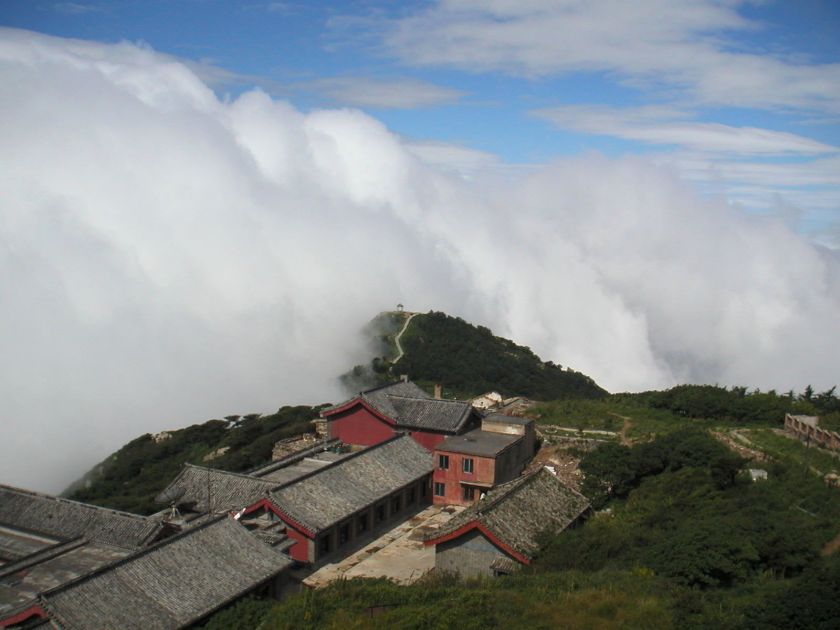
During his travels, Confucius was approaching the foot of Mount Tai (Taishan) when he encountered a lone woman weeping and obviously distraught. When he asked why she was sad, she told him that her son had recently been devoured by a tiger. She went on to say that her husband and her father-in-law had also been killed by tigers in the same area. Confucius invited her to join his retinue and asked why she remained in this place. The woman politely declined his offer and said that in this place, she felt free and was not subject to the tyranny of the government. His words, “Tyranny is more ferocious than tigers” (苛政猛于虎 kē zhèng měng yú hǔ) are still used today to describe how some people believe that the benefits of living in isolation or in isolated communities outweigh the benefits of living near a repressive government.

Buddhism, Daoism, and Confucianism all have long histories in Shandong Province. Mount Tai (泰山 Tài Shān) is located near the city of Tai ‘an in the middle of Shandong, and is, perhaps, the most revered of all China’s “sacred mountains”. It is said that 72 emperors from China’s ancient past journeyed to Taishan to pay homage and make sacrifices to Heaven and Earth and pray for peace and prosperity Fengshan Ceremony (封禅仪式 fēng shàn yí shì). There are over 6,000 steps one needs to climb in order to summit the east peak of Mount Tai, but these days, most people opt for the combination bus and cable car ascent. Expedience does, however, have its costs. Many of the hundreds of stone tablets and engravings, numerous temples and ruins, and a scattering of archways, gates, pavilions, and kiosks line the steps up the mountain.

Some of the earliest artifacts of Chinese history come from the province of Shandong. During the Neolithic period (4100 to 2600 BCE), the Dawenkou culture (大汶口文化  Dàwènkǒu wénhuà) existed alongside the Yangshao culture (仰韶文化 Yǎngsháo wénhuà) and there is strong evidence that there was strong interaction between the two cultures. There is also interesting research going on which suggests links between Dawenkou culture and Austronesian languages and culture. The Dawenkou culture was also believed to have been the first to practice trepanation (boring a hole in the skull to relieve pressure) in prehistoric China.

But it’s the ceramics that I find most fascinating. Some of the pottery was made on pottery wheels and was colorfully decorated with geometric patterns similar to those found in indigenous pottery throughout the world. Black “egg-shell” Longshan pottery from the Neolithic Age has been discovered which was both delicate and amazingly strong. Sophisticated tools and ornaments were made out of jade and bone.

登泰山而小天下  Dēng Tàishān ér xiǎo tiānxià

If you want to see how small the world is, climb Tai Shan.

Chinese Odyssey 41

 Once tigers roamed foothills

surrounding Mount Tai

but now tourists ride,

they don’t climb to the sky.

Gondolas replaced

six thousand stone stairs.

So, welcome back tigers.

return to your lairs!

Confucius – 子曰:学而时习之,不亦说乎

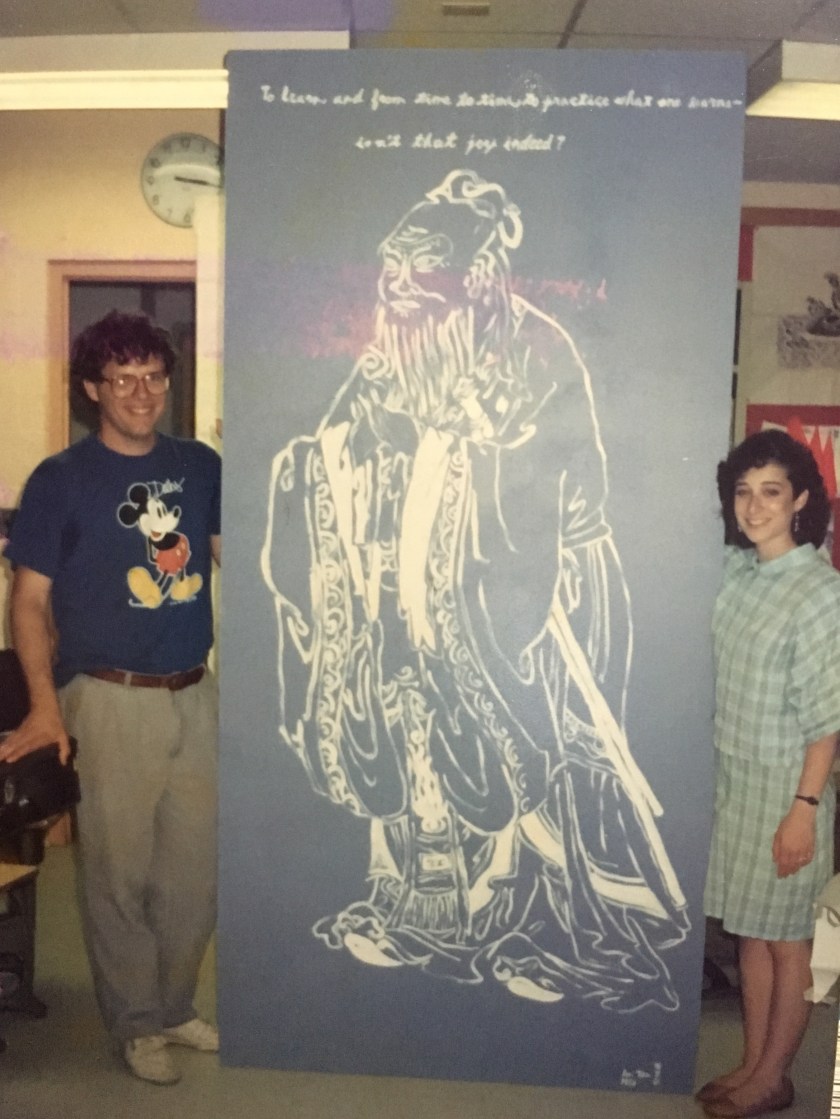
ConfuciusThe Master said:  “To learn, and from time to time, to practice what you learn, isn’t that joy indeed?”

My first introduction to Confucius was in primary school, where we would share “Confucius says” pearls of wisdom that, I’m pretty sure, Confucius never said. Still, even as nine-year-olds, we all knew the name, Confucius. I can’t think of any other Chinese historical figure that has that kind of name recognition.

The writings and teachings of Confucius are one of the “3 pillars of Chinese Culture”. The impact of Confucius on, not only China, but on Japan, Korea, and much of south-east Asia, is immense. In much the same way as teachings from the Bible, the Quran, and the Torah continue to influence the way people behave today, Confucianism continues to inform both behavior and relationships in China. Yet, Confucius was not a religious teacher.

The man we call Confucius is known by most Chinese as Kongzi (孔子 Kǒngzi), or Kong Fu Zi (孔夫子 Kǒng fū zǐ.)  Born in B.C.E, 551, Confucius lived in the “Spring and Autumn Period” during the Eastern Zhou Dynasty (東周  Dōngzhōu), about 500 years before the birth of Christ. He was born in the town of Qufu ( Qǔ fù) in the province of Shandong.

Confucius believed that the sages of old truly understood social harmony and had, through the Book of History (書經 Shū Jīng) and the Book of Odes, (詩經 Shī Jīng), made that wisdom available to people living during the time of Confucius. By studying both Zhou and Shang societies, religion, and political institutions, the chaotic state of affairs which existed during the Spring and Autumn period could be rectified. In addition to the classics, there was also a rich oral history that surrounded Confucius. He loved hearing stories of the legendary Kings preceding the Zhou Dynasty. He recounted many of these stories and lessons of life in the Analects (論語 Lúnyǔ), a collection of his thoughts and dialogues with his disciples. The Confucian Analects is one of the Four Books and the Five Classics (四書五經 Sìshū Wǔjīng), which are the classical texts compiled after Confucius’ death, and which make up the core of Confucianism.

Confucius felt it was his mission to instruct rulers at high levels of government in order to revitalize learnings that had been around for centuries. He believed that the rites, rituals, and ceremonies  (礼 lǐ) had been developed over generations of human wisdom and that they both represented core social values and helped create social order. Confucius also stressed virtues like ren (  rén), sometimes translated as “righteousness” or “humanity” or even “love” or “kindness.” How do human beings live together in harmony? Only by continuing to nurture our own inner character through education and reflection.

One of the ways that people could begin to live in harmony was to adhere to the three fundamental bonds ( 三纲 Sān Gāng),  which are the basis for the most important of human relationships. Although one cannot discount a hierarchy, there is equally a sense of reciprocity and definition of roles in these relationships. The ruler not only mentors the ministers but takes care of them (君臣 jūn chén); the father teaches, encourages, and protects the son (父 子 fù zǐ); the husband respects, supports and nurtures the wife (夫 婦 fū fù). They all have obligations to one another.

Confucius was the ultimate idealist. He believed that people could improve themselves and their interactions among their families and their states through love, respect, understanding, and consideration of the needs of others. But core to those requirements was honesty. And that meant being able to criticize unjust rulers and refusing to serve corrupt officials.

The Master said: Water that floats a boat can also capsize it.  子曰:“水可載舟,亦能覆舟”

 Good government demanded stellar officials who had mastered the five virtues: 

  • Li (礼 lǐ), propriety, ritual etiquette, manners, duty, and respect. Confucius clearly identified roles between rulers and ministers, fathers and sons, husbands and wives, elder brothers and younger brothers and even friends.
  • Ren (仁 rén), benevolence, or kindness to one’s fellow man. Confucius believed that there should be no limit to benevolence, even if it means laying down one’s life for another.
  • Xin (信 xìn), honesty, truthfulness, faithfulness, and sincerity. One’s word is one’s bond.
  • Yi (义 yì), righteousness, honesty, integrity; strongly associated with justice
  • Zhi (智 zhì), wisdom, knowledge of right and wrong; a strong moral compass

The Master said:   One cannot be an outstanding teacher, without continuing to acquire new knowledge. 

子曰:“溫故而知新,可以爲師矣。Zǐ yuē: Wēn gù ér zhī xīn, kě yǐ wéi shī yǐ.”

Chinese Odyssey 40

We continued our journey, 

in a hard sleeper car, 

to the land of Confucius,

a bright rising star.

Now children can learn

about filial piety,

Will little emperors dance

to odes of propriety?

Shandong – Robin Hood on Steroids

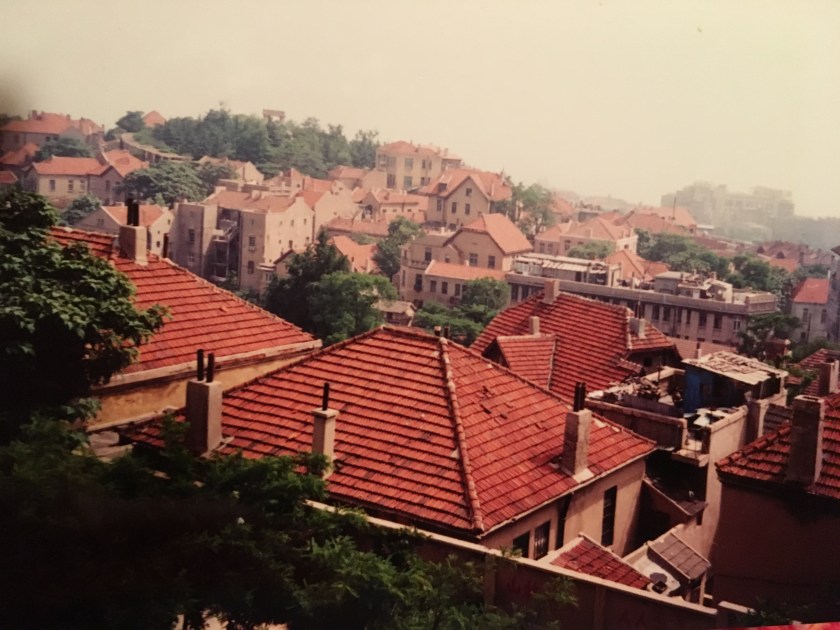
BaDaGuan in Qingdao copyBadaguan ()

Most people know Qingdao (青岛) as Tsingtao . . . like the beer. Today, quite a few are pronouncing the name of this city of nine million people as “ching dow” which is fairly close to the correct pronunciation. Located on the coast, in the province of Shandong (山东), Qingdao is about 500 km due north of Shanghai. In 1897 during an observation of the Chinese coast, the German high command decided that Qingdao would be the perfect place for a German naval base. They had been eying this sleepy little fishing village since the early 1890s and gradually transformed Qingdao into a modern port. The weak Qing government was bullied by Germany to cede a portion of Qingdao (about 200 square miles) to the Germans as a “concession”. The Germania-Brauerei was established in 1903 as a joint venture between German and British investors.  This was the birth of Tsingtao Beer. In addition to outstanding beer, Germans in Qingdao had developed amazing schools and established several  Protestant and Roman Catholic missions. The Germans also based their Far East Squadron in Qingdao. The Japanese, with the aid of 1500 British troops, wrested Qingdao from the Germans in 1914, but the Republic of China reasserted its control in 1922. The bombing of German ships in the harbor by a Japanese Farman seaplane is said to have been the first air to sea battle in history. The Japanese then re-occupied Qingdao in 1938 and remained there until their surrender at the Tientsin racecourse in October of 1945. The US Navy, at the invitation of the KMT, was then allowed to station its Western Pacific Fleet in Qingdao until the Red Army, under the leadership of the Chinese Communist Party, finally took control in 1949.

One of China’s most beloved novels has several different titles in English. In 1948, Pearl Buck named it “All Men are Brothers”. “Outlaws of the Marsh” and variations of that theme are also popular English titles for translations. The Chinese title, however, Shuǐhǔ Zhuàn 水滸傳, translates to “The Water Margin Story”. It is about a band of outlaws and is based on an actual historical figure, Sòng Jiāng 宋江, the charismatic leader, and his followers, who roamed the hills and marshes of Shandong and Henan during the Song Dynasty. Song Jiang led attacks and started a rebellion against the government who initially felt powerless against this Chinese style Robin Hood, the “Protector of Justice (呼保義 Hū Bǎoyì)”. 

The authorship of “Shui Hu Zhuan” is unclear. Stories have circulated about Song Jiang and his band of outlaws since they were active in the 12th century. There were early manuscripts of the book in the 14th century, but the first full-on 100 chapter version doesn’t appear until the Ming Dynasty in the 16th century.

In the “Water Margin Story”, Song Jiang commands 108 “Stars of Destiny” (宿星 sù xīng),  former “demonic overlords” who had been accidentally redeemed. These erstwhile bad guys then took it upon themselves to turn over new leaves and became heroes who dedicated themselves to fighting for justice.

Kind of like Clark Kent, “mild man and reporter for a great metropolitan newspaper”, Song Jiang, by day, serves as a clerk for a county magistrate, but this identity underlies the complexity of who he really is, both a trained scholar and a martial arts warrior. He is a handsome, dark complexioned man with “phoenix eyes”.  There’s a little bit of everything in the Water Margin – love, lust, loss, betrayal, violence, death, flight, and secret hideouts in the Liangshan Marsh ( Shuǐ Pō Liáng Shān).

In the book, Song Jiang is eventually caught, his face branded with a prisoner tattoo, and he is exiled to a prison camp in Jiangzhou (江州), in present-day Jiangxi. Considered by the people as a great patriot, who first and foremost loved China, Song Jiang was given a chance to prove his loyalty to the Emperor by commanding his band of outlaws against Liao rebel forces invading the Song. Song Jiang survives these campaigns, but at a terrible price. Two-thirds of the “108 Stars of Destiny” perish.

In the end, Song Jiang is rewarded by the Emperor Huizong (宋徽宗 Sòng Huīzōng), by being named as Governor of Chuzhou. Not long after, he is poisoned by corrupt officials. But after his spirit visits the Emperor in his sleep, he is once again redeemed by the Emperor and rewarded posthumously for his loyalty and courage.

It was a breath of fresh air when we stepped out of the train and began to explore the hills and tunnels of Qingdao with our three young daughters in the mid-’90s. The area called Badaguan () still had many of the old German style mansions and villas and an underground passage Chiang Kai-shek used to get from his villa to the beach.   I also remember the Laoshan hills (山 Láo Shān), to the northeast of Qingdao, where the local folks told us the Qingdao Beer was too pricey for them. They preferred the local Laoshan Pijiu, anyway. No arguments from us. It was perfect.

Chinese Odyssey 39

Shanghai to Qingdao

the train chugged along,

played xiangqi, ate noodles

sang Chinese folk songs.

Walked under a mountain

to a German cathedral.

Shared a walk on the beach

with seagulls and people.