Tales from Hangzhou

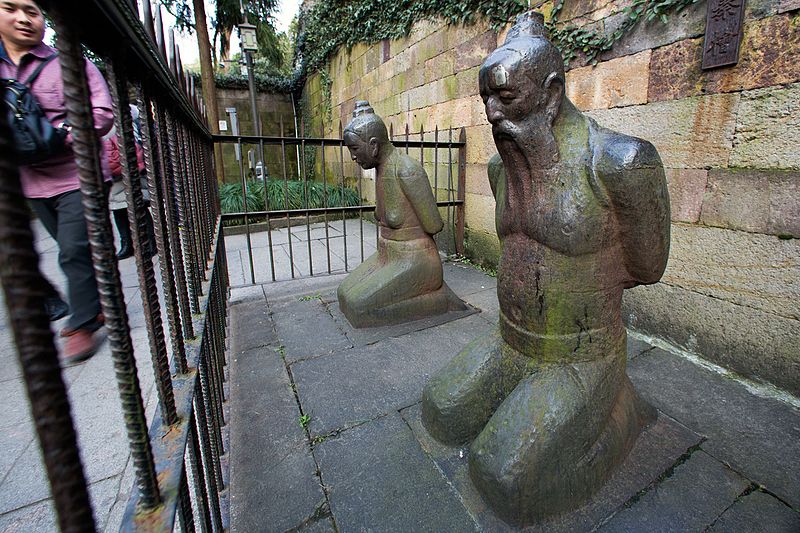
qin hui and lady wangQin Hui and Lady Wang  –  Morio [CC BY-SA 4.0 (https://creativecommons.org/licenses/by-sa/4.0)%5D, from Wikimedia Commons

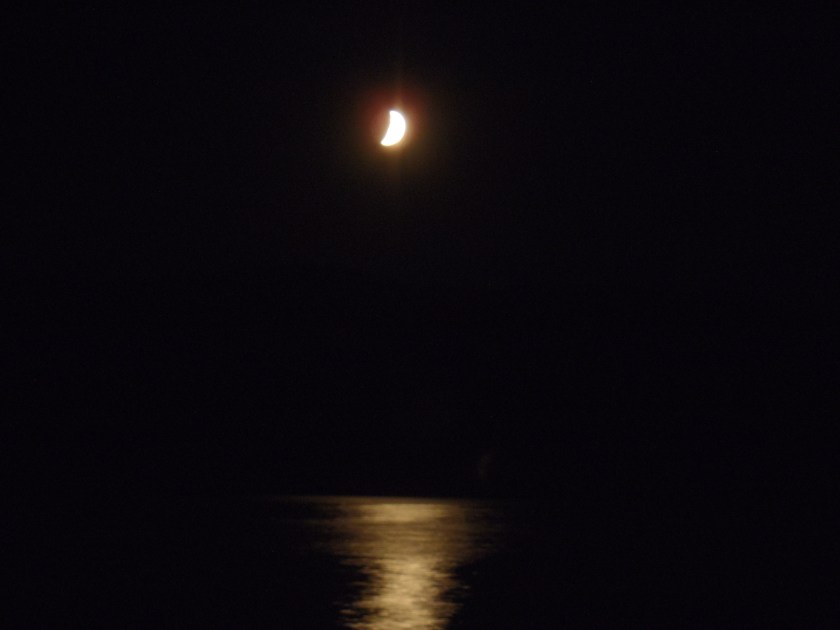
My introduction to Hangzhou was poetry. When I first gazed on West Lake, I couldn’t wait to search out Ping Hu Qiu Yue aka Placid Lake Autumn Moon (平湖秋月 Pínghú Qiūyuè). It was the nexus of West Lake, where one could watch clouds flying and the reflection of distant hills, while sipping the perfect cup of Long Jing Green Tea under a full Autumn moon. Visually, it was all I had hoped for. I knew the tea house would look and feel old and weather-worn, but that was OK. Pen and notepad in hand, I sat down to compose a poem. Unfortunately, a very loud and excited member of our China tour named Bill, from the Bronx, saw me sitting alone and thought I wanted company. I never did get my poem written. Thankfully, I can borrow and share one from Tang Dynasty poet, Su Shi (aka Su Dongpo 苏东坡.)

 曲:

盘。

看?

 Yang Guan Qu: Zhong Qiu Zuo by 苏轼 Su Shi

Mu yun shou jin yi qing han

Yin han wu sheng zhuan yu pan.

Ci sheng ci ye lou chang hao,

Ming yue ming nian he chu kan ?

Mid-Autumn Composition by Su Shi

Sunset clouds together and then dissipate, air clear and cold

Milky Way without a sound, moon moves across the sky。

This life, like this evening, not always so good

Next year, where will I be living to see this moonlight?

I did, however, get to see much of the West Lake the poets wrote about. There was the mountain crag called the “Peak Who Flew in from Afar” (飞来峰 Fēilái Fēng), that legend claims transported itself from India, the Six Harmonies Pagoda (六和塔 Liùhé Tǎ), which, for centuries served as a lighthouse on the Qiantang River, and the Broken Bridge (断桥duàn qiáo), backdrop for the Legend of the White Snake, where a young boy innocently consumed immortality pills, thinking he was eating sweet dumplings. The sweets seller,  actually one of the eight immortals, seeing what had happened, made the boy regurgitate the pills into the water by Broken Bridge where they were consumed by a small white snake swimming by. As you might imagine, there is a lot more to that story.

My favorite tale, however, is about the patriot, Yue Fei (岳飛 Yuè Fēi). He was born into a poor, but very patriotic family. When he was young, his own mother engraved the tatoo, 盡忠報國 jìn zhōng bào guó  “serve the country with the utmost loyalty”, on his back, and that message served as Yue Fei’s driving force. Yue Fei later managed to become both educated and a respected general in the Jin military. While fighting to recover Kaifeng, the Northern Song capital,  Yue Fei was called back to Hangzhou by the Emperor Gaozong (宋高宗Sòng Gāozōng), but he failed to heed that call initially. Qin Hui (秦桧) falsely accused Yue Fei of being a traitor to his country on some trumped up charges and Yue Fei was put to death. Although later history points much of the finger of guilt at Emperor Gaozong, it was Qin Hui and his wife, Lady Wang, who were to ultimately be remembered – in a very unique manner – as traitors to China.

One of the most popular pastries in China is called You Tiao (油條). Some people liken You Tiao to a donut without sugar, but it’s shape is a bit like that of two foot-long hotdogs glued together. In Taiwan, we used to eat youtiao with steaming hot doujiang (soybean milk) for breakfast. In Hong Kong, people will often eat these alongside their morning jok, aka congee (粥 zhōu).

The story goes that a doughmaker and his friend were sitting around at the end of the day, reeling about the unjust death of Yuefei and the dispicable nature of Qin Hui and his wife, and the doughmaker picked up a couple of pieces of remaining dough and said. “This is what I’d really like to do with those two. He stuck two long pieces of dough together, fashioned faces for each, and dropped them into boiling oil. Take that, you traitors, you “deep-fried devils” (油炸鬼 yóuzháguǐ). The Cantonese term, yàuhjagwái, is still popularly used for youtiao.

I would be remiss, however, if I didn’t update my story to the year 2018. As my Chinese friends would say, “bian hua hen da” (變化很大  biànhuà hĕn dà) – the change is enormous. I really didn’t recognize Hangzhou the last time I went there. I flew into a small, but very modern, airport.  My friend, Stan, said its faster for him to fly from the old Songshan airport in Taipei to Hangzhou than it is to go from his home in Taipei to the main Taipei airport. Streets once crowded with bicycles are now jammed pack with cars, and the air is a constant grey from the accompanying smog. Although many of the low-rise places along West Lake itself have been preserved, high rise, modern architecture abounds. There is a Starbucks now not far from Ping He Qiu Yue. Maybe great poems are being written there now over Caramel Macchiatos.

Chinese Odyssey 35

Our next stop, Hangzhou,

placid lake, autumn moon

broken Bridge, riding bikes—

took a break around noon.

Paid respects to Yue Fei,

ate some zongzi for free.

Like the Emperor Qian Long,

sipped Dragon Well tea
 

The Yellow Mountains

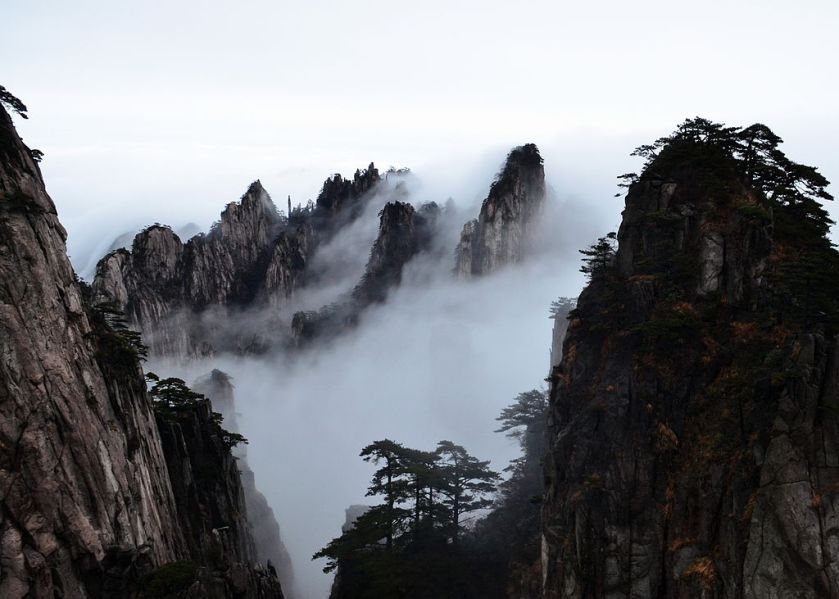
the yellow mountains颐园新居[CC BY-SA 4.0 (https://creativecommons.org/licenses/by-sa/4.0)%5D, from Wikimedia Commons

Huangshan is a range of mountains located in the southern part of Anhui province. Photos like this one illustrate the types of natural features that greet those who find their way here. Sunrises, sunsets, peaks, crags, promontories into seas of clouds, pine trees and natural springs abound. Huang Shan is latticed with trails and steps. On these paths, one finds hikers, and artists, painters, and poets. After one visits Huang Shan, the landscapes on the scrolls that formerly appeared magical, finally make sense. They’re real.

More than a thousand years ago, there was a poet and a painter by the name of Wang Wei (維 Wáng Wéi).  Although Wang Wei is acclaimed as one of the great painters of the Tang Dynasty, none of his original paintings have survived. His poetry, however, continues to live.

In 1980, Fred Fang-Yu Wang (王方宇 Wáng Fāngyǔ), a professor of Chinese at both Yale and Seton Hall Universities, published a a book of his own calligraphy called “Walking to Where the River Ends”,  where he connected his calligraphy to the poetry of Wang Wei.  Although nowhere in this volume is Huangshan mentioned, I can’t help but connect Wang Fangyu’s calligraphy and Wang Wei’s poetry to this amazing range of mountains. Wang Fang-Yu starts off the book with a poem by Su Shih (軾 Sū Shì), an eleventh  century poet who wrote of Wang Wei, “in every poem, there is a painting. In every painting, there is a poem.” (Wang, Fred Fang-Yu. Walking to Where the River Ends. Compiled by Suzanne Graham Storer and Mary De G. White, Hamden, Archon Books, 1980.)

In his book, not only does the author introduce us to the poetry of a beloved Chinese poet, but he opens doors to appreciating Chinese calligraphy through his own calligrahic interpretations. In the index, he then gives both figurative and literal interpretations in English which encourage the reader to conjure up their own images and wonder how they might create a poem in English which would begin to do justice to the images created by the Chinese characters. Here’s an example from the poem used as the title for this book. The English words were the literal translations provided by Professor Wang.  Mary de G. White then took Professor Wang’s literal translation and created a poem which works in English:

Walking to Where the River Ends     (行到水窮處)

 行到水窮處,(walk, to, water, end, place)

xíng dào shuǐ qióng chǔ,

坐看雲起時(sit, watch, clouds, end, time)

zuò kàn yún qǐ shí。

偶然林叟 (accidentally, meet, forest, old man)

ǒu rán zhí lín sǒu ,

談笑無還期 (chat, laugh, have not, return, time)

tán xiào wú huán qī

Walking to Where the River Ends  by Wang Wei

“Walking to where the river ends

I sat and watched the clouds rise

By chance I met an old man in the forest

We talked and laughed

and forgot when it was time to go home.”


Chinese Odyssey 34

Trails wove through mountains

Running narrow and steep

hiding treasures which paintings —

and poetry — keep

reminding us how

little time has affected

the clouds and the cliffs

which the pools reflected.


Cold Mountain (寒山 Hán Shān)

Hanshan and Shide

This stone rubbing is from an engraved stone stele in the Han Shan Temple in Suzhou.

from Gary Snyder’s translation:

“White clouds gather and billow.
Thin grass does for a mattress,
The blue sky makes a good quilt.
Happy with a stone under head
Let heaven and earth go about their changes.”

Snyder, Gary, Gary Snyder, and Hanshan. Riprap & Cold Mountain Poems. San Francisco: Four Seasons Foundation, 1965. Print.

One of my all time favorite poets is thought to have lived more than 1000 years ago in Tang Dynasty China. No one knows what Han Shan’s real name was nor where he was from, but the cave called Cold Mountain, where he is said to have lived, is in the province of  Zhejiang, about a day’s foot journey from the sacred range of mountains called Tian Tai (天台).

One commonly held story is that an official by the name of Lu Jiuyin 閭丘胤 Lǘqiū yìn went to Mount Tiantai in order to meet Han Shan.  He was told that there were actually two Bodhisattvas living there, Han Shan 寒山 and Shi De  拾得.  Asked how he might know them, he was told, “If you see them, you won’t recognize them; if you recognize them, you won’t see them.” He didn’t see them, but they saw him.  And when they did, they laughed out loud and ran away, obviously having no desire to meet him.

When I first read Gary Snyder’s translation of 24 of Han Shan’s 300 poems, the translations and interpretations – by the young 24 year old budding poet – of the words and antics of Han Shan, spoke to me, and now, nearly 50 years later, I’m still listening.

Patrick Murphy noted in his preface of Snyder’s book, Riprap & Cold Mountain Poems: “These poems are something more than translations precisely because Snyder renders them as a melding of Han Shan’s Chinese Ch’an Buddhist mountain spirit trickster mentality and Snyder’s own mountain wilderness meditation and labor activities. The suite of 24 poems was published in the 1958 issue of The Evergreen Review, and the career of one of America’s greatest poets was launched.”

It was partly the sacrilege of Han Shan’s poetry that appealed to me. I loved that I never knew whether Han Shan and Shi De were Zen (Ch’an) Buddhists or Daoists or neither or both. Neither did religion own them, nor did they necessarily embrace a religion. I loved that they worked hard at menial tasks and were true to their own natures. They knew then that the answers were not to be found in the gadgets and the glitz and the glamour that so defined success in the eyes of so many. In years past, they may have been “boomers” who worked the buck rakes and beaver slides on the large cattle ranches in Montana, or the “old uncles” in American Chinatowns sipping Po-lay and reading the China Times, after the Chinese exclusion act insured that these men would remain bachelors until the act was repealed in 1943. Today, these old people might be homeless street sleepers in any large metropolitan area in the world. These men and women lived and live largely solitary lives where they had/have a fair amount of down time to  contemplate the secrets of the universe. If you see them, you won’t recognize them; if you recognize them, you won’t see them.

To learn more about Han Shan, check out: https://terebess.hu/zen/chang/hshan.html#a

Chinese Odyssey 32

Once again there were pictures

emblazoned on sails;

not Han Zi, not words.

More like fish without scales

swimming into the night.

Through menacing clouds

the mountains were yellow.

There were no more crowds.

Lu Xun – China’s Greatest early 20th Century Author

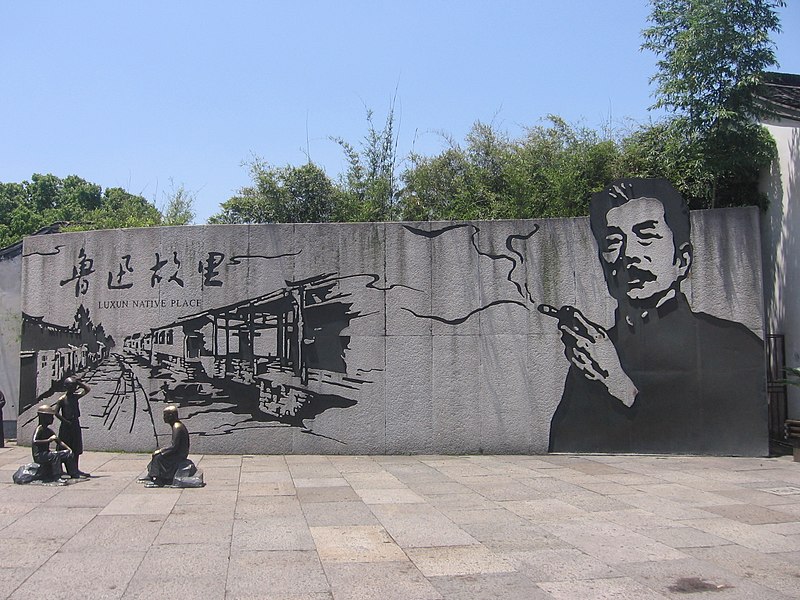
Lu Xun Native PlaceZhou Guanhuai [CC BY-SA 4.0 (https://creativecommons.org/licenses/by-sa/4.0)%5D, from Wikimedia Commons

What was it about Lu Xun’s writing that led Mao Ze Dong to call him the “commander of China’s Cultural Revolution“?

Although Lu Xun  (迅 Lǔ Xùn) aka Lu Hsun – had a formal education, he was much more interested in the stories he heard from uneducated peasants than in the great works of literature. Born in 1881, he was 38 when the 1919 May 4th movement championed writing in the vernacular “白话” instead of in classical Chinese (文言文). Lu Xun opened windows into the lives of uneducated peasants, of women who were branded by superstitions and beliefs which relegated them to roles of shame and dishonor they could never hope to climb out of. His writings were not hopeful. They were often dark and desperate and were an honest reflection of the lives of vast numbers of Chinese lǎo bǎi xìng 老百姓 (common people) during the early part of the 20th century. His most popular works were his short stories. Many are available on-line and I’ll mention three which I have read and believe would be a good introduction to Lu Xun.

Probably, the most iconic Lu Xun story is “The True Story of Ah-Q”.  Nobody knew what Ah-Q’s name really was or where he came from. It is evident from the beginning though, that Ah-Q is a loser – in everything he tries. He has no family. His only claim to fame is that the handi-work he does around town to pay for his food and drink seems to be acceptable. He is a blowhard, a braggart and a drunk, all of which bring on more ridicule and bullying from the townspeople. Ah Q represented much of China’s peasant population in the tragedy of his life, and the reader can’t help but feel that his lot was not his fault.

In the story, “Medicine”, a peasant couple whose son is dying of tuberculosis spend their last penny on steamed bread soaked in the blood of an executed criminal. The story was a powerful scream aimed directly at the ignorance which was burdening the masses. Ironic that Lu Xun himself would die at the age of 55 from the same disease.

“New Years Sacrifice” was one of the saddest stories I read. It was an almost voyeuristic glimpse at the lives of widows who were blamed for their own bad fortune both in this life and in the next. After being forced to remarry, Xiang Lin’s wife found herself pregnant and for the briefest of moments was happy with the son she bore until tragedy visited her again in the form of a wolf.

So much of what Lu Xun wrote was a commentary on the superstitions that enveloped China during the chaos of China’s Republican period. Maybe the reason that Lu Xun became Mao’s revolutionary poster boy was that he died in 1936. Mao Zedong, along with 4,000 stalwarts had completed the two year, 6,000 mile Long March which cemented his position as the undisputed leader of the revolution only one year earlier. The revolution was still young and those who died in its name were heroes. Although Lu Xun never joined the Communist Party, Mao understood Lu Xun to be someone who appreciated the plight of the peasants and was trying through his writing to help them rise up.

“The True Story of Ah-Q” (阿Q正传) and “The New Year’s Sacrifice”(祝福)  are both available in the Public Domain to read in English.

Chinese Odyssey 28

Xiamen had been open

for less than a year.

The colors were drab

but the air was quite clear.

Lu Xun used to write

in the Nan Putuo temple

and the Gulangyu

musical island felt gentle.

The I Ching Metaphor

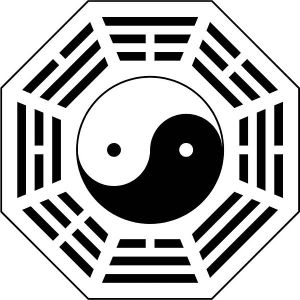
Ba Gua
BY-SA 4.0 (https://creativecommons.org/licenses/by-sa/4.0)%5D, from Wikimedia Commons

It was the end of the summer of 1970. A good friend had written me a letter saying that she was going to have to beg out on our open ended and barely planned adventure to Mexico in the Fall. She had thrown the coins and the I Ching had responded. Like many college students in the ‘60’s, I had also read the I Ching and somehow her choice made perfect sense. The Vietnam War Draft lottery had taken place on December 1, 1969 and my number was 256. I went back to the University of Montana and enrolled in the U of M’s first ever Chinese Language class.

The earliest of China’s “Classics” and the source for much of what is observed and practiced in many Chinese temples today is the I Ching,  aka 易經 Yì Jīng, aka The Book of Changes. The I Ching dates back to at least the beginning of Zhou Dynasty 1000 BCE, and parts may predate the Zhou by hundreds of years. It is a book of cosmology and divination.

The most basic of the building blocks of the I Ching are the two lines. They are a solid line (一) representing the yang and a broken line (- –) representing the yin. The yin (陰 yīn) is represented by dark or the feminine. Other attributes and characteristics of yin include earth, receptive, water, and the negative. The yang (陽 yáng) is represented by light or the masculine. Other attributes and characteristics of yang include heaven, active, fire, and the positive. An interesting observation is that there is a bit of yin in all of yang and a bit of yang in every yin.

There are only 8 possible ways that these two lines can be put together in groups of three, and those eight trigrams most commonly appear in a symbol known as the Ba Gua (八卦 Bāguà) or the 8 Trigrams. The 8 trigrams in the Ba Gua surround the symbol for the Yin and the Yang. Each of the trigrams have a name representing 8 forces of nature. These are Heaven or sky (creativity), lake or marsh, fire, mountain, thunder, wind, water, and Earth (receptivity.)

By combining two sets from these 8 trigrams, there are sixty-four possible hexagrams. Each of these hexagrams has a number and a name. They also have a description. After that description, each of the lines is explained. Like the poems in the Kau Cim, the lines and descriptions are open to multiple interpretations. But for me or anyone else with such a cursory understanding of the I Ching to attempt to interpret those lines completely out of context is ludicrous.

I thought of the I Ching on my plane ride back to America. My knowledge and understanding of the I Ching was similar to my understanding of China. I had a very basic knowledge of the pieces, but I was a long way from understanding how they all fit together.

Chinese Odyssey 20

I’d had my first taste

but I yearned to see more

Taiwan and Hong Kong were

too far from the core.

Sacred mountains awaited,

great cities, and art.

Next time I’d try harder

to get to the heart.

Religious Medley

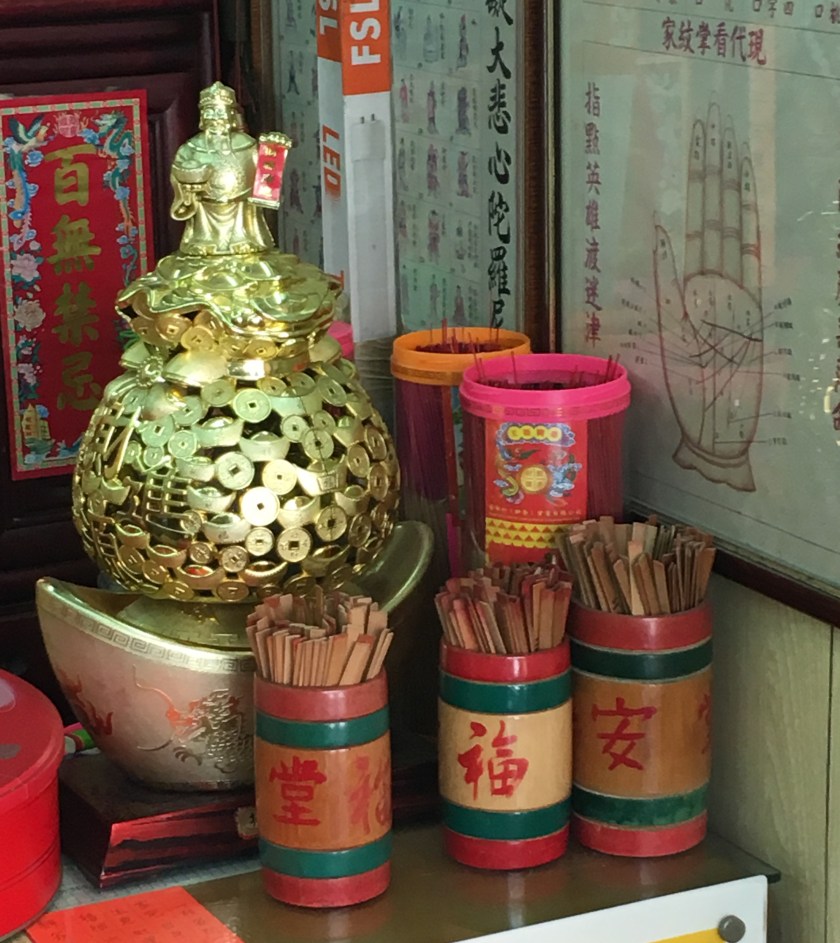
Kau Cin Sticks copy

Growing up in Tulsa, Oklahoma, the buckle of the Bible Belt, the only religion I knew was Christianity. In the Christian church, there was Catholicism and there were a multitude of Protestant denominations. Each one had their own special set of beliefs and interpretations. Of course, we had a couple of Jewish synogogues, but I always thought that one had to be Jewish to go to synagogue. I knew there were other religions in the world, and I assumed they had denominations as well. What I wasn’t prepared for was the blending of religion, philosophy, ancestor worship, and traditional folk religions which had naturally evolved in both Taiwan and Hong Kong.

One of the things I wanted to study when I went to Taiwan was Daoism (see Chinese Odyssey 2.)  One of my teachers at FuJen University found a book for me entitled 老子(Lǎozǐ.) It had the classical text (文言文 wényánwén) and an explanation in the common vernacular (白話 báihuà.) Local friends had pointed out Daoist temples around Taipei and I thought these would be the perfect places to go to learn more about the teachings of Laozi and Zhuangzi. I was taken aback to find what appeared to be a huge disconnect between the Daosim I had been reading and the Daoism that was being practiced as a religion in Taiwan. I learned that in Chinese, what I had read was called 道家 Dào Jiā. What I was seeing in the Taiwan Daoist temples was called 道教 Dào Jiào, the religion of Daoism. What I was told was that although some people in Taiwan adhered strictly to the tenets of Daoism and Buddhism, far more blended one or both of those religions with the various folk religions which had evolved in Taiwan as people from southeastern Fujian came in and joined the aboriginal Taiwanese (原住民 yuánzhùmín) Austronesian people who had arrived in Taiwan some 8,000 years earlier.

Walking around Hong Kong, I found there to be numerous temples which did not call themselves Buddhist or Daoist or Confucianist, but were dedicated to historical or quasi historical figures. General Che Kung aka Chēgōng (車公) helped to suppress a rebellion in the Sung Dynasty. Mo Tai, aka Kwan Tai aka Guān Dì (關帝) is often referred to as the God of War. He was a great warrior during the Period of the Three Kingdoms. My personal favorite has always been Kwun Yum aka Guānyīn (觀音) whose first manifestations were as a male, but who is now most often portrayed as the “Goddess of Mercy.” And since Hong Kong has historically been a home for fisherman, some of the most visited temples are dedicated to Tin Hau, aka Tiān Hòu (天后) who, according to the stories, was a young girl from a fishing village in Fujian.

A popular place of worship in Hong Kong is the Wong Tai Sin Temple (黃大仙祠.) According to legend, Wong Tai Sin (黃大仙) nee Huáng Chū Píng (黃初平) was a poor shepherd who became a Daoist priest in Zhejiang province in the 4th century CE. One of the largest and most visited temples in Hong Kong, it is dedicated to Daoism, Buddhism, and Confucianism.

The sense of smell may be one of our most powerful connections to the past. That is certainly the case with incense (香 xiāng) burning inside temples throughout China. When walking down side streets in Hong Kong, Taiwan, or mainland China, I smile when I get a waft of incense which burns 24-7 in many temples. Incense is burned to please the gods, immortals, and ancestors. Families often include incense in their praying. They will buy sticks of incense, light several sticks at once, and pray (拜拜 bài bài) by bowing several times in front of an alter holding the burning incense in their hands. I’ve been told that incense also helps to keep away the mosquitoes.

At the Wong Tai Sin temple in Hong Kong, anyone can come in and pray in any of a myriad of spaces. You can also have your fortune read by men and women in Cantonese, Mandarin, and in English. The most popular way of finding your fortune is by using Fortune Sticks (Kau Cim aka 求籤 Qiú Qiān). At Wong Tai Sin, you can have a professional fortune teller help you or you can borrow sticks and do it yourself. There are 100 sticks in a bamboo tube with the #’s 1-100 written on them. There is a way to shake the tube until finally one stick comes out. To make sure that your fortune is correct, you then drop the jiaobei (珓杯 Jiǎo Bēi) blocks. These two wooden blocks are in the shape of crescents with a flat side and a rounded side. The way they land on the floor tells you whether your fortune is suitable or not. Once you’ve determined that your number is correct, you take it to a window and they will give you a poem. It’s up to you and/or your fortune teller to interpret your poem so that it will answer the question you asked. Nowdays if you have your own sticks and blocks, you can do it yourself and go onto a Wongtaisin website for the poems in Chinese and in English.

Chinese Odyssey 19

A stick in a temple

decided my fate.

The mainland of China

would just have to wait.

“You need to go home

to a far distant shore

but we know you’ll come back

to learn even more”


So Long, Taiwan

OLYMPUS DIGITAL CAMERA

Taiwan was my “ground zero” for learning about China. It was kind of like experiencing snow for the first time or maybe even a first kiss. One has all sorts of notions about what one might feel, but the experience itself is different in a multiplicity of ways. Lots of huge events occurred while I was in Taiwan.  Chiang Kai Shek died on my birthday in 1975. The USA recognized the People’s Republic of China as the official government of China on January 1, 1979. A new word was coined for relationships in Taiwan: “denormalization.”

One story I was totally ignorant of when I arrived, was that of the two million mainlanders who descended on the island of Taiwan at the end of the 1940’s. Many of these KMT soldiers, government officials, and others who supported the Nationalist cause set up house in military dependents’ villages called 眷村 juàn cūn. These villages were poorly constructed on public land with building materials scavenged from the neighboring communities. They were built as temporary shelters, since the KMT had every intention of returning to the mainland. Soldiers would reunite with their families and live out their lives in their ancestral villages. But sadly, that never happened. They were mostly men. Most of those who were married had left their wives and children behind. Young men left their mothers and fathers, brothers and sisters. Many never saw their mainland families again.

In 1985, my friend, Stan Lai (賴聲川 Lài Shēng chuān) wrote an amazing play called “Peach Blossom Land” (暗戀桃花源 Ànliàntáohuāyuán). It was really two plays within a story. The play starts as the story of young love between two students, one a young man from Manchuria, and the other, a beautiful young lady from Yunnan (1st played by Bridgit Lin (林青霞 Lín Qīng Xiá). As they walk along the Bund in Shanghai, they sadly reminisce on the toll the war has taken and cheerfully plan meeting up again after both paying a final visit to their families. The moment is shattered when the audience becomes painfully aware that they are actually watching a play, “Secret Love”, being rehearsed.

It turns out that the umbrella story which frames the rehearsal of Secret Love, also frames a second play, a slapstick comedy based on the Eastern Jin Dynasty story, Peach Blossom Land. The play rehearsals were double booked to rehearse in a theatre in Taiwan. Secret Love jumped forward 50 years when it resumed. The young man was an old man dying in a hospital in Taiwan. Although he had married a Taiwanese woman once he understood that he would not return to the mainland, he never forgot the love of his life. The bittersweet ending of the story is that of many mainland refugees in Taiwan. Once they were finally allowed back into the mainland, many found that their wives had remarried, their children didn’t know them, and that their parents and siblings were gone. They were happy, of course to meet again, but sad for all they had missed out on.

30 years after “Peach Blossom Land” was first released in Taiwan, it still resonates with people of all generations and remains one of the most popular plays in all of China.

Another play Stan wrote which dealt with this fracture between the “two Chinas” was called “The Village” 寶島一村 (宝岛一村 Bǎodǎo Yīcūn). It took place in one of the military dependents’ villages in Taiwan. The audience was able to watch as the young KMT soldiers scrounged to set up their temporary accomodations. We heard the struggles of people attempting to communicate in Chinese dialects as different from one another as are French, Spanish, Portuguese and Italian. We saw leaders emerge from the groups, marriages happening between mainlanders and Taiwanese, and strong women who made the most wonderful dumplings ever,  step forward. As anyone knows who has ever lived in Taiwan, nothing brings a family or community together better than “bao”-ing jiaozi (making dumplings). Still there was a constant yearning for China by the first inhabitants of the village that succeeding generations never really understood.

Shakespeare said, “Parting is such sweet sorrow.” Li Bai likened saying good-bye to the setting of the sun in his well known poem, “Taking Leave of a Friend” (送友人). Parting from the mainland in 1949 was more like hunkering down in an emergency before a big storm. One always expects to return home.

Chinese Odyssey 15

’til one day while eating

some stinky doufu,

I saw something strange

which was certainly a clue:

In an old woman’s cart

was the same bowl I’d found

as a nine year old kid

digging holes in the ground.


Grinding an Iron Bar into a Needle

OLYMPUS DIGITAL CAMERA

磨杵成針,  磨杵成针 mó chǔ chéng zhēn

China’s golden age for art and literature occurred over 1,000 years ago during the Tang Dynasty (618 – 907 CE).  The form of literature which reached its zenith during that time was poetry. From the tens of thousands of poems written during the Tang Dynasty, 300 poems were selected in the mid-18thcentury, which Chinese school kids continue to memorize and recite to this day.

Of those Tang Dynasty poems, several were written by one man from Sichuan by the name of Li Bai (Lǐ Bái 李白). When I first started reading Chinese literature in translation, I was immediately drawn to Li Bai. He loved to drink alcohol and some people thought that he wrote some of his best poetry when he was “in his cups”. He seemed to be much more fun-loving than many of his contemporaries. One of those poets was a man from Henan by the name of Du Fu (杜甫 Dù Fǔ). Du Fu had a more serious outlook on life, and was not nearly as carefree as Li Bai. He was sometimes referred to as a poet saint (詩圣 shī shèng). They only really met a few times, but during those meetings forged a strong friendship. There are several poems in which each poet reflects the depth of their relationship.

I mention Li Bai because the idiom, “Grinding an iron bar into a needle” starts with him. When Li Bai was young, he was not a very diligent student. He was much more interested in watching birdies and eating fruit he found on the ground, than he was in studying. One day on his way to school, he happened upon an old woman filing an iron bar. Curiosity got the best of him and he asked, “Old woman, what are you doing?” (Calling a person “old lady” or “old gentleman” in Chinese is a respectful way of addressing an elderly person.) The old woman responded. “I’m making a needle out of this iron bar.” To which Li Bai responded, “That’s going to take forever. Let me try.” Li Bai took up the file and filed really hard for what seemed like a long time. Finally, he gave up. “I quit”, he said. To which the old lady responded, “That’s OK. I’m going to keep on filing, because I know that eventually this iron bar will become an excellent needle.” Li Bai never forgot the old lady’s words. Eventually he understood that his studies were like filing the iron bar. He became an accomplished scholar and one of the most famous poets of all time.

I can’t write about a poet and not include a poem. “Thoughts on a Quiet Night” 静夜思 (Jìng yè sī ) was memorized by most Chinese of my generation if they were educated in Chinese schools. As a Confucian scholar, Li Bai spent many years on the road in the service of the emperor. When Li Bai wrote “Thoughts on a Quiet Night”, the mid-Autum festival (the 15thday of the 8thmonth according to the Lunar calendar) was approaching and he was yearning to be home.

床前明月光
疑是地上霜
举头望明月
低头思故乡

Chuáng qián míngyuè guāng
Yí shì dìshang shuāng
Jǔtóu wàng míngyuè
Dītóu sī gùxiāng

At the foot of my bed

the moonlight is shining,

or is that frost on the ground?

I raise my head,

and see the moon in the sky.

I lower my head,

thinking of home.


Chinese Odyssey 13

One step at a time

the pieces connected

I struggled sometimes

and was often corrected.

And then I discovered,

much to my dismay,

I had spoken no English

for an entire day.

A journey of 1,000 miles . . .

IMG_0392

千里之行,始于足下

qiān lǐ zhī xíng , shǐ yú zú xià

A journey of a thousand miles begins with a first step

More than two thousand years ago, a man known by the name of 老子(Lǎozǐ), wrote those words. My hope is that many people outside of China today stand poised ready to take their first steps in the understanding of China.

Laozi lived around the same time as Confucius. Daoism (Taoism) is looked upon in China both as a philosophy and as a religion. The canon (written text) of Daoism is called the Dàodéjīng(道德经) Arthur Waley translated this title as The Way and Its Power. The word Dao ( 道) is often translated as the “path” or the “way”. In the first of the 81 passages that make up the original text of Daoism, we learn that “dào” and the word “míng (名 )” meaning “name”, cannot really be defined by words. In other passages, we learn that water is one of the softest and pliable of all substances while being one of the strongest and most powerful forces in the universe. And we learn that opposites define one another (there would be no “ugliness” if there were no “beauty”). One of Laozi’s followers, Zhuangzi, wrote some amazing parables based on passages from the Dàodéjīng.

The Worthless Tree

One day, a man by the name of Hui Zu struck up a conversation with the philosopher, Zhuangzi. “See that big ugly old tree. It’s called a Stinky Tree. Butt ugly. Trunk twisted. The entire tree is riddled with knots and knotholes. There’s no way anyway could even make one good board from it. Check out the branches. Different sizes and shapes going this way and that. Not one thing about this tree makes any sense. Kind of like school. Big and worthless.

Zhuangzi thought for a minute and then responded. “Have you ever seen a wild cat crouching and waiting for its prey? The cat sits immobile while the mouse scurries around. In the end, the mouse always ends up in the trap. Water Buffalos are massive, almost as big as clouds. They’re really big and strong, but they can’t catch mice.”

“You’re telling me that tree is worthless. Uproot it then, and plant it where there is nothing else – in empty space. After it’s taken root, walk around it. Sit under it and enjoy its shade. No one’s ever going to cut it down.”

“Worthless? We should all be so worthless.”

(based on Thomas Merton, The Way of Chuang Tzu, Abbey of Gethsemani, 1965)

China Odyssey 2

I dug pretty fast

but didn’t get far

when my shovel went clink

I’d found me a jar.

Inside was a map

there were mountains and rivers

but the words had no letters

that gave me the shivers.

The Frog at the Bottom of the Well

OLYMPUS DIGITAL CAMERA
Ming Tombs 1982

One day a turtle walked up to a circle of rocks and peered down into a well. “Hullo-o-o-o” he shouted down. But instead of the echo he was expecting to come back he was met with a perky “Hello!”

The turtle looked down and saw that at the bottom of the well, the sun was shining on a small frog lounging on a sand bank.

“What are you doing down there?” shouted the turtle. “Want to come up here and play?”

“Why should I?” asked the frog. “I’ve got everything I need down here. I have sunshine and my own private beach. There are dozens of bugs I can reach with my tongue whenever I’m hungry. Giant leaves protect me from the rain. I’ve got it all”

The turtle thought for a while and then asked. “Don’t you ever miss walking through the forest or sliding down sand dunes or seeing the waves crash on rocks. How about butterflies and birds and amazing flowers I get to see every day on my walks?”

At that, the frog paused. He really didn’t have a response.

In Chinese, this idiom 成語 (chéngyǔ) is called 井底之蛙  (Jǐng Dǐ Zhī Wā) – “The Frog at the Bottom of the Well”)

I grew up with Aesop’s fables. I knew that the fox really did covet the grapes that he dismissed as probably being sour anyway. Sort of like the frog in the well who came to the realization that he might not have it all but was too proud to admit it. One of my great surprises when I started to learn Chinese was the wealth of fables and idioms that are woven throughout the fabric of Chinese history and literature.

I was born in Montana and  grew up in Oklahoma. About the closest I ever came to China was eating sweet and sour pork at the Pagoda restaurant at the corner of 51st and Peoria in Tulsa.  As life would have it, a few twists and turns set me on a course which would cause me to spend more than half of my life in China. I became fascinated by much of what I learned about China and Chinese – almost none of it through formal education.

The more I learned about China, the more “treasures” I uncovered. Poetry, philosophy, and language study opened doors into worlds I never knew existed. A few years ago, I wrote a poem about my journey through China I called “China Odyssey”, where I cracked a few doors opened, but not quite wide enough. With China being an ever more dominant player in the world we live in, I decided to revisit my poem and open a few of those doors just a little bit wider. So join me, if you’d like and explore China – one stanza at a time.

China Odyssey 1

When I was a young boy

my best friend would say

“If you dig a hole deep

and in just the right way

You will end up in China

a land full of mystery

of pandas and dragons

and whole lots of history.”