Chipping Away

Chinese Odyssey 84

The mountain called Zhongguo

which we had ascended 

the tip of an iceberg

to be apprehended

The thousand mile journey’s

first step had been taken

The runway approaching

our time to awaken.   

Often at the beginning of school I will ask my students to raise their hands if they love to learn. In years past, only a few hands went up, but today some students are becoming more savvy as to what “learning” really means. Truth be told, I know very few people who don’t like to learn. In the past, most learning was structured and students often paired “learning” with school.  A goal of mine has always been to remind students that “learning” does not just mean school and that some of our most profound learning happens outside of school.

 Zhuangzi (莊子 Zhuāng Zǐ) told the story “Cutting up an Ox”, about a prince who happened into a butcher store one day just as the butcher split an entire ox carcass in two in one fell swoop. Mesmerized by what he had just witnessed, the Prince queried. “How did you do that?”

“Dunno.” Said the butcher.  “I just go with the Dao.” He thought for a minute and continued.

“When I first saw an ox, all I saw was a giant mass. It was too massive to comprehend.”

This got me thinking. When I took my first serious steps into China, it appeared to me in much the same way. A giant mass. Where do I begin? I could liken myself to the parable of the five men, each with a missing sense, attempting to describe an elephant.

“Towards the end of my third year as a butcher, I began to notice that although I had slowed down my pace, the results were more satisfactory. I saw distinctions. Nowadays I don’t even see the ox with my eyes. My whole body and spirit participates, free to work with no plan. I wait and watch for the openings and when they appear, I guide my knife in their direction. There are no joints that require sawing through.  There is no bone that needs to be chopped or hacked.”

When I stood in front of the window of the Fu Hsing Bakery on Hsin Yi Lu in Taipei all those years ago, the cleavers I held in my hand were my text book and my Chinese-English dictionary. I cut and I hacked I’m sure, but gradually found the spaces for myself. Taipei was a friendly place for Americans in the early 1970’s and slowly but surely, with a lot of help from my Chinese friends, I learned how not to  saw and hack.

Instead of forcing doors open, I found new ways in. Instead of learning Chinese a chapter at a time, I began living in China. Through my studies of Tai Qi, I discovered how to slow down my movements in deliberate and measured ways and discovered that just because western medicine could not physically map the flow of qi, did not mean qi could not be mapped.

In Zhuangzi’s story, the butcher told the Prince that in the beginning he sharpened his knife every day. As he became more adept at his craft, he only needed to hone the edge once a week and later one time a year. His words to the Prince, “I have used this same cleaver nineteen years. It has cut up a thousand oxen. Its edge is as keen as if newly sharpened.”

The Dao had taught him to let the knife find its way. “There are spaces in the joints that can only be found by the thinness of the blade and when those spaces are found, the knife flows through them like water. When I feel the tough places coming, I slow down, I watch carefully, sometimes I almost stop. Finally, the blade finds its way, and ‘thump’, the part falls away.”

Daoism is all about letting go of the need to control. It is about finding not only ones place but ones role in the flow of all things. Like Laozi said in the Dao De Jing. “There is nothing in the world which is softer and more yielding than water. But when it attacks things hard and resistant there is not one of them that can prevail.”

In the end, the Prince acknowledged that the butcher had taught him how to live his life.

An oft quoted line from Laozi states that “A journey of a thousand li begins with a single step”. A less well known line from the same chapter of the Dao De Jing says, “‘Heed the end no less than the beginning. And your work will not be spoiled.”

Today’s  post is the final post to accompany my poem,“ A Chinese Odyssey”. I would love to hear your thoughts and comments about the entire blog or individual posts. I’m sure I made mistakes along the way and would love to have those corrected. I’m not sure when or if the blog will continue, but would appreciate your thoughts on a continuation of” The Panda in the Room” journey. Thanks for your support.

Stay well. 身體健康!

Peter

peterdratz@gmail.com
Yani’s Monkeys

Chinese Odyssey 83

The map that I’d found

when I was pre-teen

Each mountain and river

were places I’d seen

The words without letters

I now understood,

See, the writing was mine

And it looked pretty good.

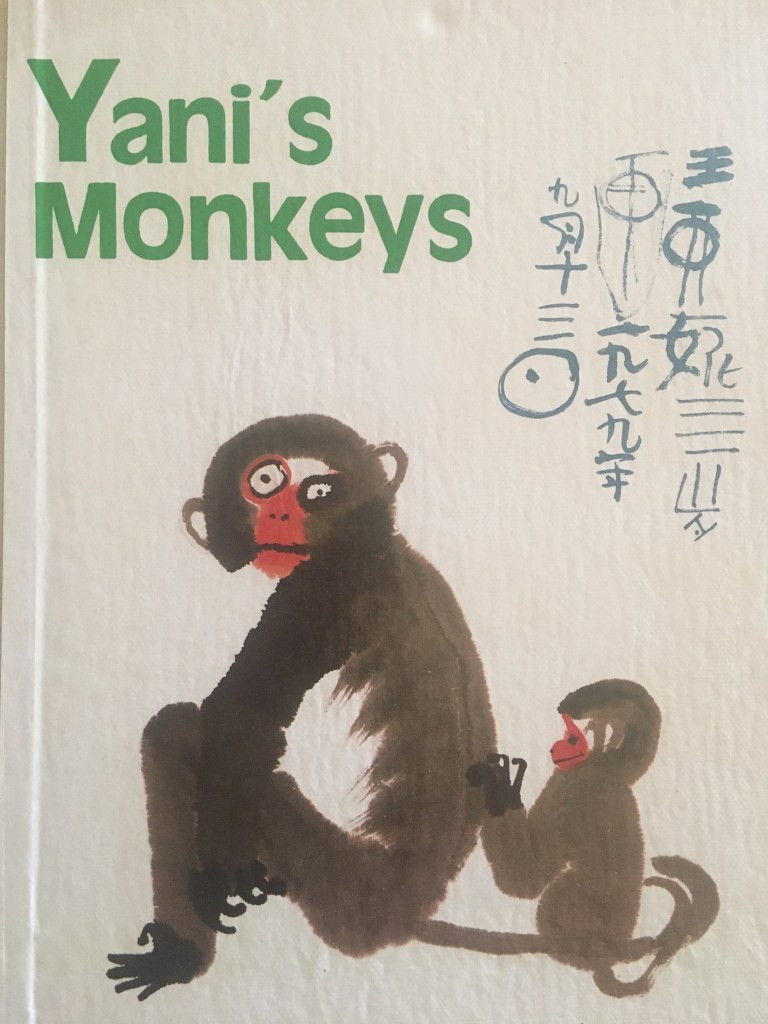
Wang, Yani. Yani’s Monkeys. Foreign Languages Press, 1984.

Someone once told me that China looked like a big chicken and someone else showed me how Taiwan look like a sweet potato.  To one who has always struggled with creating visual art, that worked for me. Although I have a vivid imagination, I’ve always found it virtually impossible for me to transfer my ideas into visual images. I have, however,  always loved looking at drawings, paintings, sculptures, photos – all kinds of art. I marvel at not only the art work I contemplate  in museums, but equally at that produced by my students and my daughters over the years and imagine the map in my poem looking like something Chinese artist Wang Yani might have drawn.
 
One of the most extraordinary artists and presenters I’ve had the fortune of seeing , fourteen year old Wang Yani stood very still on a dais in a small lecture hall at the Nelson-Atkins Museum of Art in Kansas City, Missouri in 1989. A large sheet of white paper was placed on the ground in front of her on the stage and for a few moments, Yani just stared at the paper. Then something happened. She reached down, picked up a brush, mixed some colors on a palette and began to lay blotches of black, brown and red onto the paper. Once she started, she could not be stopped. Each stroke was intentional and meaningful. Yani moved swiftly from one area of the painting to another with an intensity that entranced her audience. Truth be told, I can’t remember if Yani painted monkeys or cats or cranes that day, but I do remember that in the span of 20-odd minutes I was looking at a scene that would make any child smile. There were multiple animals playing on the page with trees and jungles and it all seemed to be moving. Yani’s animated art felt alive.
 
Wang Yani was certainly a child prodigy. First discovered before she was even three years old, Yani painted the picture on the cover of her book at age 4. Wang Yani hails from the Guangxi Zhuang Autonomous Region in southern China. In the area where she lived there were tall pine trees, groves of bamboo, coconut trees, and orchards filled with fruits of many shapes
and colors. Yani would walk among the trees with her artist father and describe sunsets in clouds and flames that “helped the sun cook its meals”. Yani would gather sticks and twigs and leaves and bark and pretend that they were animals. After a visit to the zoo at age three, Yani developed a fascination for monkeys, the ways that they played and screeched and cuddled.
 
Yani, for her part, didn’t really understand the fuss. “It’s simple,” she said. “I just paint what I see.” But I continued to be astounded at how that transfer took place. To Yani, every picture told a story. I was reminded of the artist/calligrapher Wang Fang Yu and his painting where he created a painting of Wang Wei’s saying, “In every picture there is a poem and in every poem there is a picture.” Yani’s art has be described as 写意 (xiĕ yì) “Idea writing” aka free lance or literati painting. Images and words appear to be spontaneous and simple but are, at the same time, incredibly detailed, accurate and bold.
 
Wang Yani’s artist father, Wang Shiqiang, painted in a more traditional, western style. Although he coached Yani on “concentration”, Wang Shiqiang really tried hard not to influence his daughter’s  style. In her early years, there were no art books in her home. When Yani’s talent began to really emerge, Wang Shiqiang put his own art tools away, so as not to influence Yani’s work.
 
I like to imagine that the map in the beginning of the poem was a map drawn in the style of Wang Yani. As a nine-year old boy, my imagination would have included mountains and rivers, bamboo and pandas, and the Great Wall of China. Even though I couldn’t paint like Wang Yani, I inhabited some of the worlds she created. I ran through the jungle bare footed, scurrying up tree trunks, jumping from one tree to another, always finding a branch to grab and a vine to carry me forward. Unlike Mowgli, I was not a “man child.” I’m not sure what I was, since I never focused on me. But like Mowgli, all of the animals, the monkeys, the lions, the elephants, the venomous snakes, and the giant crocodiles were my friends. The trees were my roads, and the pools and waterfalls were my resting places. All my body needed were the fruits and nuts which grew in abundance.
As an adult I see so many more parts of China – its deserts and plains, the Three Gorges river project, its modern cities, Maglev trains, and suspension bridges, and, of course its masses of people. I can’t help but wonder what Wang Yani’s paintings might look like if she had been born in Shanghai or in Hong Kong.

Gatekeepers

Chinese Odyssey 82

From Hai Kou to Hong Kong

the angels were sleeping

On board Hong Kong Air

no cell phones were beeping

I pondered our journey

the things we had shared

We’d seen most of China

But was I in error?

Beginnings are mostly about relationships. In the beginning of every trip with kids is excitement. We’re starting off on an adventure where we only have a rough idea of what awaits us. Instead of traveling with the familiar family and close friends, we are with people we barely know or don’t know at all – and we’re going to be together with these same folks 24/7 for the next 14 days. Combined with the excitement is the anxiety. Whenever we crossed the border into China, we knew we weren’t in Kansas anymore. In the 1980’s in Xiamen, that meant the only western item we could find was Coca-Cola in the Friendship store. In 2020, it means we can’t access Facebook or use Google unless we have a VPN.

Endings are easier than beginnings. I rarely slept on the plane rides back home. It was my time to reflect on the ”middle”. Did the kids have fun? What did they learn? Did we do everything we said we would do? What was the frosting on the cake?

Thomas Merton, in his interpretation of Zhuangzi cautions us “to be on our guard” in regards to what we think we understand. Merton expands by saying,  “. . . tasting is one thing and swallowing is another, especially when, having only tasted, one proceeds to identify the thing tasted with something else which it seems to resemble.”

We’d seen most of China

But was I in error?

What does it mean to “see” China and how can we best interpret what we see? Who are the guides, the docents, the ferrymen, and the gatekeepers? 

Oftentimes gatekeepers are ignored once one passes through the gate – never a thought that they may have been the ones who created the gate in the first place. Such a gatekeeper was Dr. Lin Yutang. Born in 1895, in the southern province of Fujian, son of a Presbyterian minister during the closing years of the Qing Dynasty, Lin Yu Tang was educated at St. John’s College in Shanghai and from there he studied for a Master’s Degree in Comparative Literature at Harvard University in Boston. Lin went on to earn his Doctorate in Linguistics from Leipzig University in Germany.

Lin Yutang was the first academic that I know of who, urged by author Pearl Buck, made a concerted attempt to explain China to the West in his book, My Country, My People, first published in 1935. At the time of its publication, most Westerners based their understanding of China and the Chinese on biased news reporting based on insufficient research and comprehension and misinterpretation of what they were seeing. Lin Yutang had lived almost half of his life in China. Few doubt his understanding of things Chinese. His book was well received in the USA, reprinted seven times in the first four months of its publication.

In My Country, My People, Lin divided his book into two main parts which he called Bases and Life. In “Bases”, Lin talked about Chinese people, the characteristics of the people, the Chinese mind and Ideals of Life. In reading this, one has to consider that it was published in 1935 and may not describe modern characteristics of Chinese people. Still Lin opens a window for us to look at Chinese characteristics circa 1935, In “Life”, Lin discussed ways women were perceived (Even though footbinding was outlawed in 1912, it was still being practiced in rural parts of China), social and political life, literature, art, and the art of living. In a particularly touching quote from the book, Lin Yutang said, “When one is in China, one is compelled to think about her, with compassion always, with despair sometimes, and with discrimination and understanding very rarely.” He concludes his last chapter by saying, China “enables us to see life steadily and see life whole, with no great distortions of values. It taught us some simple wisdom, like respect for old age and the joys of domestic life, acceptance of life, of sex, and of sorrow. It made us lay emphasis on certain common virtues like endurance, industry, thrift, moderation, and pacifism.” I have strong doubts that Chinese would characterize themselves by using the same words today, but would Westerners in the year 2020 use the same vocabulary and same expressions to characterize themselves as those that might have been used in 1935. Very unlikely.

We certainly had not seen most of China. We’d barely scratched the surface.

Was I in error? Probably, sometimes at least. But I like to consider myself at the autumn of my studies of China where Lin suggested “its leaves are a little yellow, its tones mellower, its colors richer, and it is tinged with a little sorrow . . . “  Fortunately, my friend and colleague was usually at my side when I was in China. She, like Lin, had spent her early life in China. Although I had some knowledge and opinions, I would almost always defer to her when it came to understanding the contexts of what we were seeing and experiencing.

The Flying Nymphs of Mogao

Chinese Odyssey 60

In the grottoes of Mogao

high up on the walls

were angels and fairies

who flew through the halls

The message apsara

had helped us to find

“perfection of wisdom,

brings peace to the mind.”

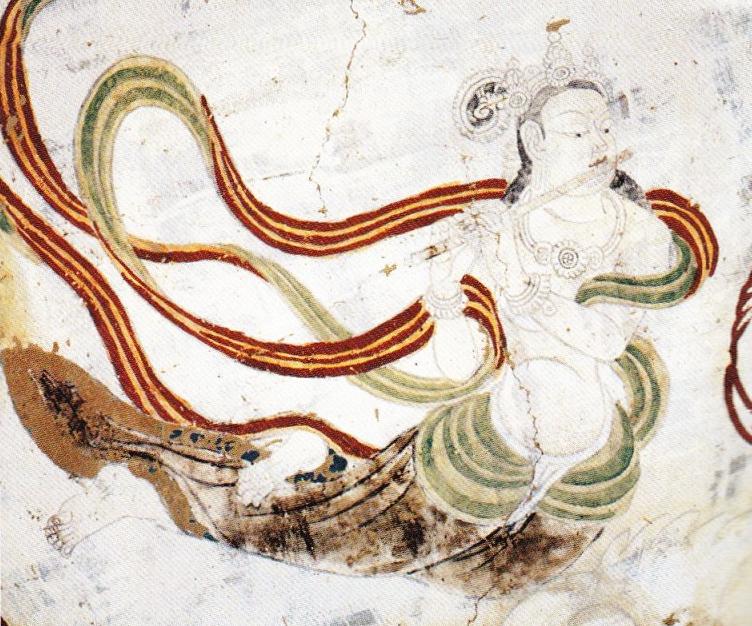
File-Apsara_playing_a_Chinese_flute_-_Yulin_Cave_15https://upload.wikimedia.org/wikipedia/commons/8/8f/File-Apsara_playing_a_Chinese_flute_-_Yulin_Cave_15.jpg

Sometimes alone, sometimes in pairs or groups, pale and dark, Chinese and foreign, mostly female. They danced, flew, played musical instruments, performed acrobatics with colorful ribbons, rode on horseback, and protected others.  Similar but somehow different images from Buddhist temples in Ankgor Wat and Hindu temples in India. They called them “apsara”, but at Mogao, the question emerged whether or not these were apsara at all. I had learned that apsara were “cloud and water” female spirits, nymphs or fairy like figures, whose major role appeared to be that of pleasing men.” What really got me thinking however was an article called “The Case for Feitian”. Feitian (飛天) is the Chinese name for the figures one finds decorating the walls of many of the caves of Mogao. Fei means “to fly” and “tian” means “sky” or “heaven.” The more I studied the 5,000 feitian from the 700 plus caves at Mogao, the more I began to see that these figures were unique. They were not all idealized figures of women. Some of these apsaras were male and some of the male and female figures were muscular and most were more modest than those on the walls of temples in India and Cambodia. Had the feitian been influenced by Buddhist or Hindu art? Without a doubt. Were there strong Chinese influences on these figures created over the course of nearly 1,000 years? Definitely.

The Oxford Dictionary defines apsara as “a celestial nymph, typically the wife of a heavenly musician.” Your Dictionary provided an even more interesting definition: “In Hindu and Buddhist tradition, one of a race of beautiful female supernatural beings that inhabit the sky, dance for the entertainment of other celestial beings, and often attempt to seduce mortal men practicing asceticism.” The same dictionary explores the origin of Apsara as “ āp, ap- water and saras as things that flow, lake -the Apsaras being depicted as delighting in water.” “Apsara.” Apsara Dictionary Definition | Apsara Defined, http://www.yourdictionary.com/apsara.

When Le Zun (Lè Zūn 樂尊) stepped into the Hexi Corridor (Héxī Zǒuláng 河西走廊 ) in the 4th century C.E. and discovered pure, sweet spring waters near the present city of Dunhuang, he decided that would be a nice place to rest after his arduous journey across the Gobi Desert. In the evening, watching the sun set, images arose out of those mountains. Among the figures he saw in the heavens were thousands of fairy like apparitions dancing and playing music. Le Zun knew he had stumbled onto a sacred spot. A few years later, he was joined by another monk by the name of Faliang (Fǎ Liáng 法良) who had a similar vision. The word spread among Buddhist pilgrims that this was a sacred spot .  During the next millennium, mostly during the Tang Dynasty, over 500 caves were carved into the sandstone and filled with an amazing collection of Buddhist art. According to Karin Dienst’s article “Bringing ancient Buddhism to light” published by Princeton University, there were “2,000 Buddhist sculptures, 45,000 square meters of murals and more than 60,000 texts.”

Like so many places in China, one needs to plan a trip to the Mogao caves. As more Chinese enter the middle class and have more expendable income, the first place many Chinese want to see is China. Whether its climbing up stairs to the Great Wall at Mutianyu, or following the trails and stairs cut into the rocks of Huangshan or exploring the Buddhist art on the caves of Mogao, there will be crowds of people – all pilgrims hoping to see the fairy like apparitions seen by Le Zun so many centuries ago.

When the end is the beginning

Tiger Leaping Gorge Sea of Clouds blurry

The old lady on the road was right. I probably knew more about China than most foreigners, but I had still barely scratched the surface. But, I was discovering words and ideas on my “journey” that I kept bumping into, no matter where I was in China, and many of them led back to Lǎo zǐ  (老子) and the Dào Dé Jīng (道德经), that 5000 character, 81 chapter canon which forms the foundation of  Daoism a.k.a. Taoism. There is something compelling and homegrown about the character “道 dào”, which translates as “path” or “way”. Growing up in the West where the scientific method makes one search for answers. Paths and ways must have beginnings and end points. . . mustn’t they? Yet, according to the Dao De Jing, 有 “yǒu”(to have) and 無  “wú”  (to lack) are born from one another. Difficult and easy complement each other.  It is only because people accept certain ideas of beauty, that the concept of ugliness even exists. Does contrast define? Can there be a path with no beginning and no end point?

Laozi forced me to think differently. The lessons are often simple and profound which makes them even more difficult to translate into English. Take for example, wú wéi (無爲 ). Wu wei is often translated as “non-action”, but what is action? Is it movement? Can you be involved in “action” without instigating or influencing action? Wu wei does not mean non-doing or non-action, but rather not attempting to influence action.” Sort of a ‘go with the flow.’ Indeed, Laozi said that the highest good was like water. Water is content with wherever it is. But even when water moves, it is never the instigator of the move. Water is powerful like the Dao.

Laozi said that the space where there is nothing is the most important space. It is into the space of a cup where there is nothing that tea is poured. It is into the space where there is nothing that light flows into a building. And it is into the space where there is nothing that a wheel moves into. Just as we appreciate and take advantage of what is, we should also recognize the usefulness of what is not.

In the Dao De Jing, we are introduced to the simplicity and the power of the “uncarved block” and asked to question both wisdom and knowledge and to embrace selflessness and lessening of desire. Once the block is carved, there will be names. Like Zhuangzi’s “ugly tree” (see CO 2), Laozi believes that straight only manifested itself next to the crooked, that it was the hollow that could be made full, and that one can be defined without defining oneself. Laozi warns us that we should not tamper with Heaven and that those who tamper with it, lose it. One does not glorify nor boast about what one has done. One of my favorite passages is where Laozi said that when Dao was lost, only power remained. When power dissipated, there was human kindness; after human kindness left, there was morality; and then ritual. Laozi said that ritual was “the mere husk of loyalty and promise keeping” and eventually led to brawling which is “the beginning of folly.” (Laozi and Arthur Waley. The Way and Its Power: A Study of the Tao Tê Ching and Its Place in Chinese Thought. New York: Grove Press, 1958. Print.)

Laozi says that the loftiest power can appear as an abyss; the way into the light can seem dark;  the purist state can look faded and disheveled; and the loveliest music can have the subtlest notes. The Dao is often hidden in plain sight. One can therefore see without looking and by doing nothing can achieve everything.

I was on the edge of the precipice and staring into the west of China – the void. I knew how to float and to swim. It was time to leave that part of China where I could touch the bottom of the pool and move into the deep end.

Chinese Odyssey 50

“You think you know China,

you’ve been to the core.

Your journey’s just started,

Go west and see more”

How could she have known that

from “reading” my face?

Yet her message was clear,

no doubt. Not a trace.