Republicans in China

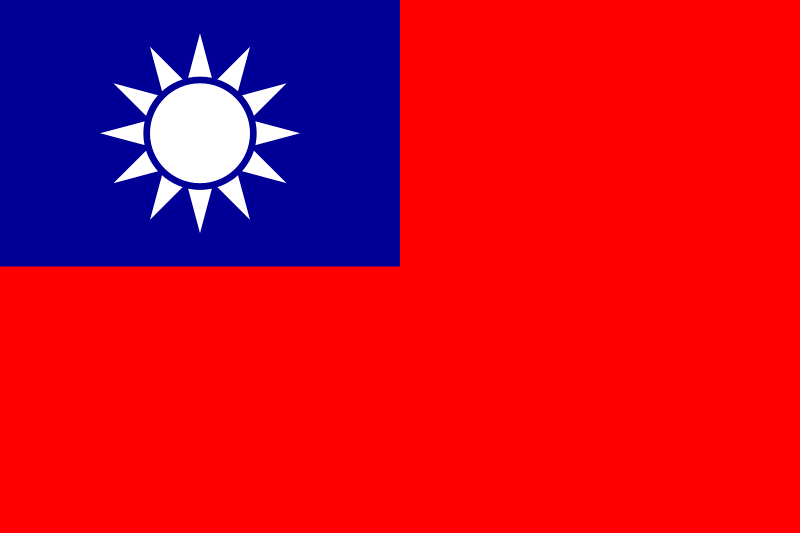
800px-Flag_of_the_Republic_of_China.svg

When Americans see the word, “Republican”, we immediately think of a political party. There are Republicans, Democrats, and Independents. In this post, the term “Republicans” refers to the people who wanted to change China from a system ruled by emperors and their families to a “republican system” where elected representatives of the people controlled the government. Many historians call the period between 1911-1949 in China, the “Republican Period” since the official English name of China at that time was “The Republic of China”.

Before the Republican Period, China was ruled by a succession of dynasties.  Some dynasties, like the Han lasted for centuries. Others, like the Qin, only a few years.  What all dynasties had in common was that they were lead by emperors who ruled with a “mandate from Heaven”. In Chinese, the word for revolution (革命 gé mìng) literally means “removing the mandate”. When an emperor no longer had the” mandate from Heaven,” the dynasty was toppled and a new dynasty began.

The Qing 清 (aka Ch’ing or Manchu) Dynasty was the last imperial dynasty in China. A coalition of anti-Qing forces from both inside and outside of China culminated with the Wuchang Uprising in Hubei on October 10,1911, forcing Puyi (溥儀 Pǔ yí), the last emperor of China to abdicate his throne on February 12, 1912 at the ripe old age of six.

The Qing Dynasty began when the Manchurians defeated the Chinese Ming armies in 1644. At that time, Manchuria was not considered a part of China, so China felt that it had been occupied by a foreign power. Early emperors of the Qing were strong, but by the beginning of the 19th century, the Qing had begun to decline. The Opium Wars lead to an ever increasing European presence and the British acquiring a foothold in Hong Kong. Movements to resist the Qing included the Taiping Rebellion where a deluded failed scholar who thought he was the younger brother of Jesus Christ lead a rebellion where upwards of 20 million people died. The Boxer Rebellion, at the beginning of the 20th century, promised followers that China could rid itself of the scourge of foreign invaders who seemed to be dividing China up like a pie, and the infamous Empress Dowager built a marble party boat with money promised to the Chinese navy, all set the stage for revolution.

Dr. Sun Yat-sen 孫逸仙 SūnYìxiān (aka 孫中山 Sūn Zhōngshān) has often been referred to as the father of modern China. He is one of a small number of “modern” Chinese to still be revered in both Taiwan and in the People’s Republic of China.  Dr. Sun had a vision of a constitutional republic based on three principles: Democracy 民權 (mín quán), Nationalism 民族 (mín zú), and Welfare of the People 民生 (mín shēng). When the Qing forces were defeated, Sun Yat-sen became the provisional President of the new republic. Although Sun ruled for less than a year, his “3 principles of the people” continued to be the political backbone of the Republic of China.

The Republican period in China was a time of turmoil. In the beginning, “Warlords” with their own militaries both divided and controlled large portions of China. The Nationalist Party (國民黨 Guómíndǎng, aka Kuomintang or KMT) was made legitimate by Sun and ultimately recognized by his followers in 1919, and a young Generalissimo Chiang Kai Shek (aka 蔣介石 Jiǎng Jièshí, aka 蔣中正 Jiǎng Zhōngzhèng) was rapidly establishing himself as Sun Yat Sen’s successor and as the emerging leader of the KMT.

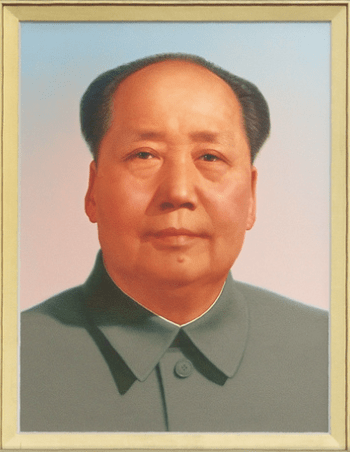
At the same time, a former librarian at Beijing University and primary school history teacher in Changsha, by the name of Mao Ze Dong (毛澤東 Máo Zé Dōng), joined the fledgling Chinese Communist Party. At the time of Sun’s death in 1925, the communists and nationalists seemed to be coexisting amicably, but in 1927, with the help of the infamous Green Gang, Chiang Kai-shek ordered a campaign in Shanghai where more than 5,000 Communists were killed. This and other similar communist purges continued until 1934 when tens of thousands of communist troops followed Mao and other communist leaders nearly 4,000 miles in the “Long March” from Fujian to Shaanxi, with Chiang Kai Shek and the KMT in hot pursuit.

Besides the ongoing civil war between the Communists and the Nationalists, China was also being invaded and occupied during this period of time by the Japanese. An incident in 1937 at the Marco Polo bridge just south of Beijing was the spark which would lead to the Japanese domination of much of eastern China, the Rape of Nanjing, and the eventual occupation of Hong Kong by the Japanese on Christmas day, 1941. Although the Allied troops in WW2 tried to get the Communists and the Nationalists to team up against the Japanese, this idea met with very little success. In one incident in Xi’An in 1936, the Communists actually kidnapped Chiang Kai Shek to force him to team up and fight against the Japanese.

With the retreat of the KMT to Taiwan in 1949, and the establishment of the People’s Republic of China, the Republic of China ceased to exist in mainland China.  The Republic of China is NOT the official name in English for China. The official name for China is The People’s Republic of China. However, the Republic of China remains the official name in English for Taiwan. To the rest of the world, it remains a conundrum.

Chinese Odyssey  9

I packed up my suitcase

and jumped on a plane.

It was off to Taiwan

and an ocean of rain.

Some called it “free China”

where KMT landed

soldiers from China

that Chiang had commanded
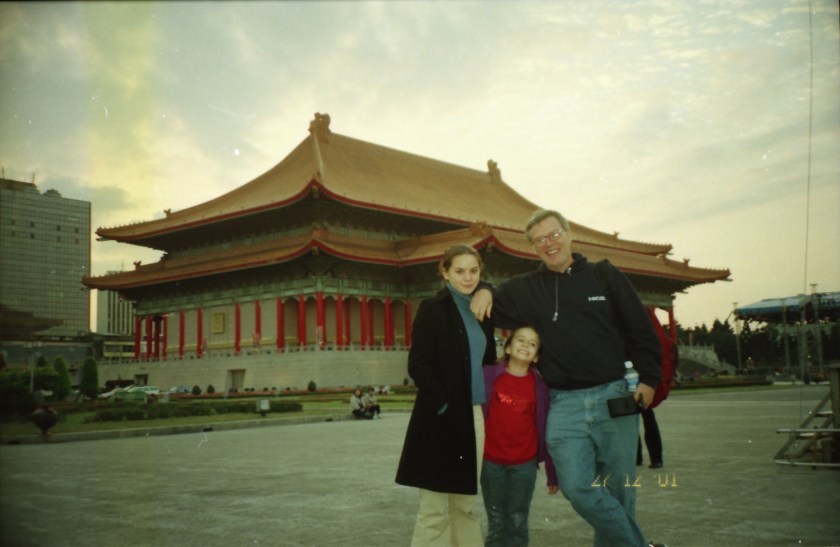


When Taiwan was China

Peter, Katie, Ana Sun Yat Sen - I played this venue copy

I began my studies of Chinese at the University of Montana – on a whim. As a student of the 60’s, the James Legge translation of The I Ching: The Book of Changes and translations of the Tang dynasty poets Li Bai, Tu Fu, and Han Shan by Arthur Waley, Kenneth Rexroth, and Gary Snyder were on my reading list. Chinese was cool. My first Chinese language teacher was Father John Wang, a Catholic Priest from Shandong province who was also head of the U of M Spanish department. We studied a chapter of John DeFrancis’ Beginning Chinese every week, and we finished the year by reading “The Lady in the Painting”(畫兒上的美人). By the end of my first year, I was hooked. I wanted to go to China. Unfortunately, for an American in the mid-1970’s, mainland China was not an option. Father Wang said, “No problem. Go to Taiwan.”

At that time I was working on a ranch on Horse Prairie, near Dillon, Montana to support my university studies and was thinking about picking up my first horse, a dun mare.  I checked prices on tickets to Taiwan and the cost of the horse, and the cost of a round trip ticket to Taiwan were about the same. So I did what any red-blooded American would have done. I flipped a coin. Taiwan won. Father Wang assured me that his brother (also a Catholic priest) would find me a job teaching English for 60 NT$ an hour (about $1.50 US) and living in Taiwan was cheap, so I said OK. I cut my hair, borrowed a corduroy coat from a friend, and was on my way.

America, at that time, recognized Taiwan as the “real” China. Chiang Kai-Shek was still President and Mandarin was called Guoyu (the national language). The Kuomintang (Nationalists or KMT) ruled with an iron fist – and the people in Taiwan seemed to really like Americans. One of my first impressions of the Chinese in Taiwan was how gracious and welcoming the people  were. Later, I found out that most Chinese had a similar opinion of people from Taiwan. An oft heard expression among Chinese was “台灣人的 人情味很濃 “ (Táiwān rén de rénqíngwèi hěn nóng) which literally means “the hospitality of the people from Taiwan is really thick.” It really meant, “People from Taiwan are really nice.”

The first people in Taiwan were, most likely, not Chinese. The indigenous people in Taiwan were Austronesian. Chinese have been settling in Taiwan for centuries, however. Most came from Fujian and the dialect of Chinese which was most common in Taiwan before the KMT came in 1949 was the southern Min dialect (also called Taiwanese), the same dialect which is spoken in Xiamen (Amoy), Fujian.  The Dutch occupied Taiwan for about 20 years in the mid-17th century. The Dutch called Taiwan “Ilha Formosa” (beautiful island). Taiwan is still referred to by many as “Formosa”.  China ceded Taiwan to the Japanese in the Treaty of Shimonoseki after losing the first Sino-Japanese War in 1895 during the waning years of the Qing Dynasty. Taiwan remained a part of Japan for 50 years until the end of WW2 when it was reunited with China. When I first went to Taiwan, I encountered quite a few old people who did not speak Guoyu. They only spoke the Taiwanese dialect of Chinese and Japanese.

On January 1, 1979, America joined a majority of nations by formally recognizing the People’s Republic of China as the legitimate government of China. The USA acknowledged that there was only one China and that Taiwan was a part of China. At the writing of this post, there are currently 17 countries (out of 193 member states of the United Nations) – plus the Holy See in the Vatican – who continue to have diplomatic relations with Taiwan.

Chinese Odyssey 8

I read something new

in those dots, strokes, and lines.

Gates will soon open,

just look for the signs

An island awaits you

with jungles and snakes.

Fly over the pole

then put on your brakes.

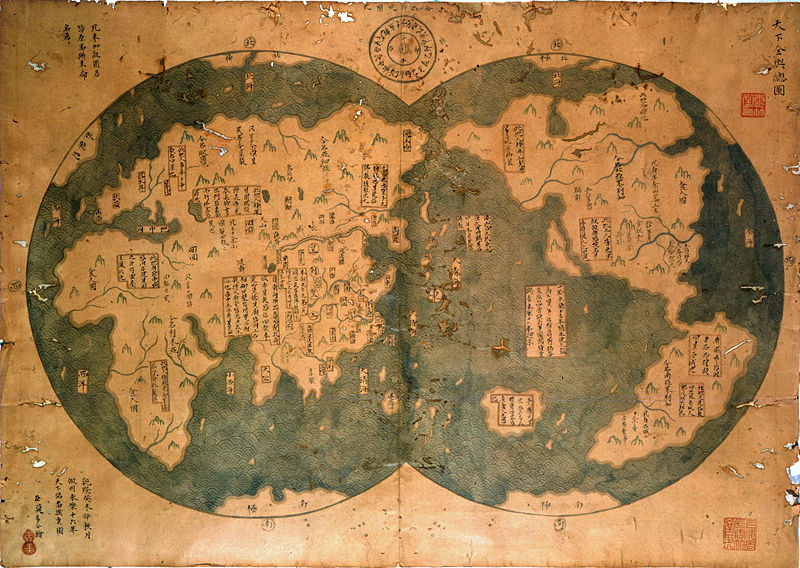
鄭和 Zhèng Hé –Explorer Extraodinaire

Zheng He Maphttps://commons.wikimedia.org/wiki/File:Zhenghemap.jpg

Growing up in the West, I learned that the 15th century was the “age of exploration”. I marvelled at the stories of Christopher Columbus, Fernando Magellan, and Vasco de Gama and imagined myself as a member of their crews. I devoured Robinson Crusoe, Gulliver’s Travels, and Homer’s Odyssey. It wasn’t until adulthood that I first discovered Zheng He (pronounced Jung Huh). When I began learning about him, the word “marvel” took on a whole new dimension.  It was like jumping from little leagues into the majors. Zheng He didn’t explore with a small fleet of ships like European explorers. He commanded an armada of over 200 ships and more than 25,000 men. His largest ship about the size of a  professional football pitch. The Santa Maria (Columbus’ flagship) on the other hand, was a mere 36 metres in length. I wonder what maps and other information about the rest the world Zheng He used when he and other explorers from different parts of the world explored their world during the “age of exploration”.

Born near Kunming, Yunnan in southwestern China into a Muslim family, Zheng He’s original name was Ma He. As a young boy, he was captured by soldiers of the Ming Dynasty. Like many boys of a similar age who were captured, Zheng He was castrated so he could serve the Ming Court and not pose a threat to the women of the imperial court. Not only did Zheng He became a loyal member of the Ming court, his outstanding service was rewarded by his being sent to Beijing  (then known as Beiping), where he gained favor with Zhu Di, the 4th son of the founder of the Ming Dynasty. Zhu Di later went on to become the Yong Le emperor. Ma He proved to be a great warrior and respected commander, and after fighting fiercely in several military campaigns for the Ming, he became a favorite of Yong Le. Emperor Yong Le showed him great honor by bestowing upon him the surname of Zheng. There are several stories as to the origin of the name, but my favorite is that “Zheng” was the name of Yong Le’s beloved horse who had been killed during a seige in Nanjing. Maybe since the “Ma” in Ma He’s name meant “horse”, Emperor Yong Le was honoring him by giving him the name of his favorite horse. At any rate, his new name, “Zheng He” was the name that stuck.

In his sea voyages, Admiral Zheng He, traveled south through what is now Indonesia, Malaysia, and the Philippines and west to India continuing south down the eastern coast of Africa. Five of Zheng He’s seven long voyages occurred during the reign of the Emperor, Yong Le. Some writers and historians believe that Zheng He could have sailed even well beyond Africa but evidence for that is a bit sketchy.

Chinese Odyssey  7

Years later while rummaging

through some old boxes

I heard a soft clink

amongst shorts, shirts, and soxes.

The jar, I remembered.

Inside was a map —

still cryptic, yet clearly

a beckoning trap.

Red China


Screen Shot 2018-07-31 at 1.28.45 PM

WW2 ended in 1945, but the civil war in China continued to rage. Although America and its allies supported Chiang Kai-Shek and the KMT (aka the “Nationalists”), Mao Zedong was definitely gaining headway among the Chinese masses. There were attempts made to broker a peace between the Communists and the Nationalists in 1945 Chongqing, but neither the Communists nor the KMT were willing to lay down their arms. By 1948, the Communists were clearly in control of the majority of China and in 1949, Chiang Kai-Shek asked America, the UK, France, and the USSR to intercede. But by then it was too late. On October 1, 1949, Mao Zedong declared the birth of the People’s Republic of China and two months later, on December 8, 1949, the KMT officially moved its government and nearly 2 million troops and support personnel from Chongqing in Sichuan, to Taipei, Taiwan. The purpose of this move was to regroup and the plan was to recapture the Chinese mainland from the communists with the help of America and other supportive allies. Of course, that never happened. There was never a peace treaty or an armistice signed between the Communists and the KMT. Taiwan continues to officially call itself the Republic of China  (https://www.taiwan.gov.tw/index.php).

In 1951, the USA became involved in the Korean conflict and fought against both the North Koreans and the Chinese in Korea. But aside from stationing US troops on the island of Taiwan, the US did little to assist the Republic of China (the English name for the “official government” of China) now hunkered down in Taiwan, in its goal to recover the mainland.

America, in the 1950’s was in the throes of the Cold War. Communists were our sworn enemies. The USSR (The Union of Soviet Socialist Republics) and the Peoples Republic of China were considered to be huge threats to the American way of life. The United States was also the biggest financial supporter of the French and the South Vietnamese during their struggle against Ho Chi Minh and the communist North Vietnamese. When the French decided to call it quits in 1954, the USA was left holding not only the financial weight of that war, but the belief was that Vietnam was a communist domino which America could not allow to fall. If Vietnam became communist, the commonly held idea was that Cambodia, Laos, and Burma would be quick to follow.

In actuality, the Peoples Republic of China was having a tough go of it in the 1950’s.  Their vision was of a communist China but what would that mean? For one thing, Mao declared that  women would hold up half of the sky (女人撑起半边天- Nǚrén chēng qǐ bànbiāntiān) Men and women would be equals. There would also be serious land reform. Large chunks of land were taken from the wealthy landlords and given to the peasants and many land owners were killed in the process. In the beginning, China tried to model itself after the USSR, but relations between these two huge communist superpowers began to deteriorate. Both human caused and natural disasters (sometimes a combination of the two) lead to the deaths of millions of  Chinese during the late 1950’s, but China had shut itself off to most of the rest of the world at that time, so the west knew very little of the suffering that was happening in Red China.

Although the color red is usually associated with good fortune in Chinese, during the 1950’s, the red in Red China referred to “Communist China” (the Peoples Republic of China) as opposed to “Free China” (the Republic of China aka Taiwan.)  In the same way that the USSR was separated from western Europe by the metaphorical “Iron Curtain”, Red China was separated from the free parts of Southeast Asia by a “Bamboo Curtain” which prevented the free world from seeing what was really happening in China.

Chinese Odyssey 5

The world was huge.

China could have been Mars.

Confucius and communists

chopsticks and stars

Chow mein and chop suey

both came from Chun King.

Fortune cookies were made

in a place called Peking.


The Middle Kingdom

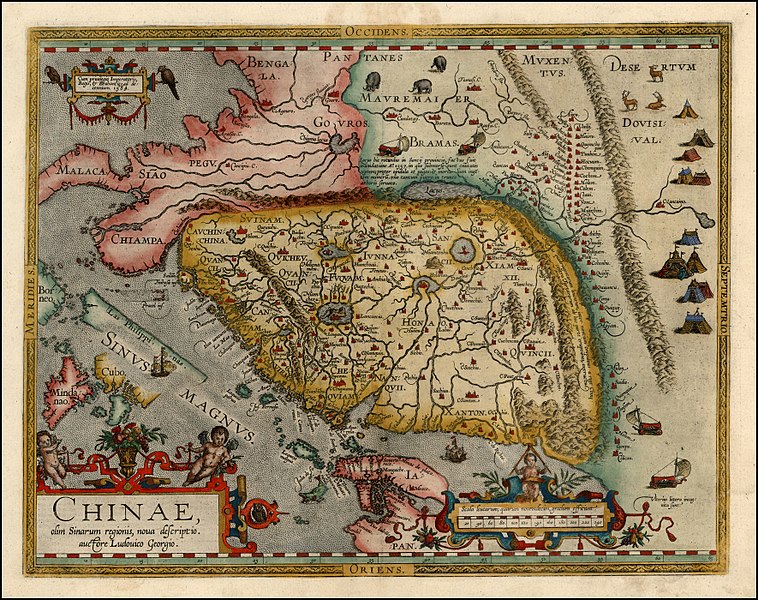
758px-CEM-11-Chinae-nova-descriptio-2521
By Abraham Ortelius (1527-1598), Luis Jorge de Barbuda (also known as Ludovicus Georgius, fl. 1575-99) [Public domain], via Wikimedia Commons
If you said the word “China” to a Chinese speaking person who did not speak English, he would have no idea what you were saying. To the Chinese, China has always been 中國(Zhong Guo) – the “Middle Kingdom”.

I grew up learning that the word China was derived from the Qin (pronounced ‘Chin’) Dynasty, the first imperial dynasty of China (221-207 B.C.E.) Many scholars believe the word China to have Sanskrit origins which predate the Qin Dynasty.

The official name of China is the People’s Republic of China (中华人民共和国) Zhōnghuá Rénmín Gònghéguó.

Taiwan also continues to lay claim to the title, the Republic of China (中華民國) Zhōnghuá Mínguó).

Chinese Odyssey 4

To a nine year old kid

it all seemed like a riddle

Going up to go down

You’d end up in the middle.

Yet I knew what it meant

much clearer than clear

“around” meant the Earth

the ultimate sphere