Gatekeepers

Chinese Odyssey 82

From Hai Kou to Hong Kong

the angels were sleeping

On board Hong Kong Air

no cell phones were beeping

I pondered our journey

the things we had shared

We’d seen most of China

But was I in error?
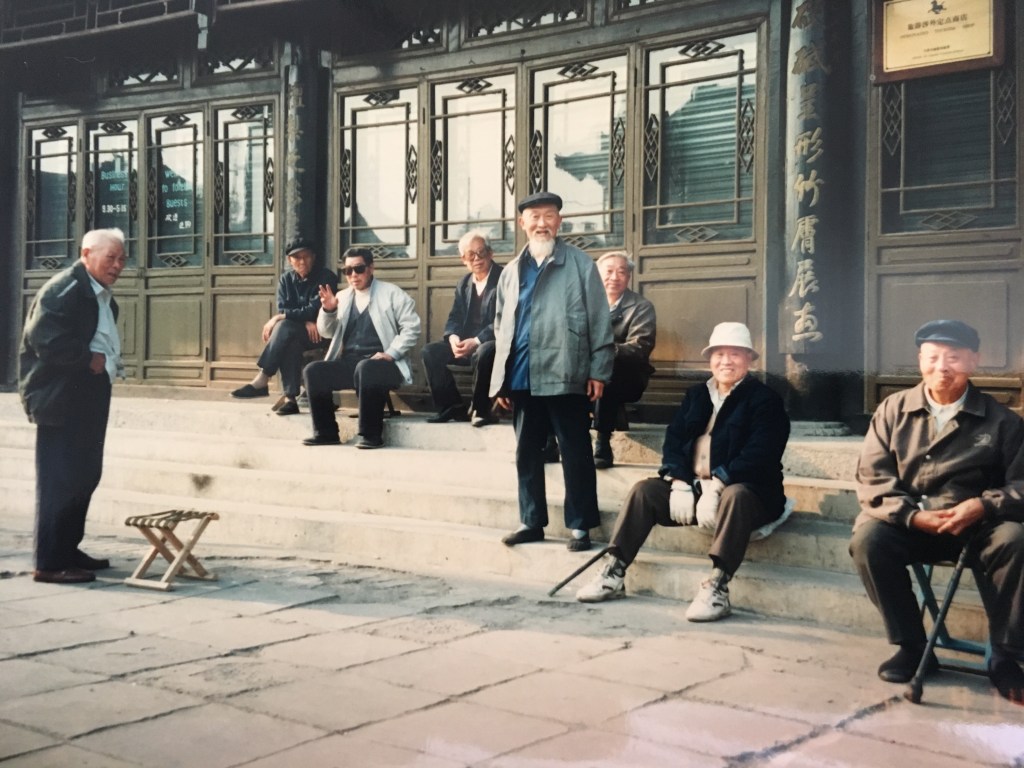
Beginnings are mostly about relationships. In the beginning of every trip with kids is excitement. We’re starting off on an adventure where we only have a rough idea of what awaits us. Instead of traveling with the familiar family and close friends, we are with people we barely know or don’t know at all – and we’re going to be together with these same folks 24/7 for the next 14 days. Combined with the excitement is the anxiety. Whenever we crossed the border into China, we knew we weren’t in Kansas anymore. In the 1980’s in Xiamen, that meant the only western item we could find was Coca-Cola in the Friendship store. In 2020, it means we can’t access Facebook or use Google unless we have a VPN.

Endings are easier than beginnings. I rarely slept on the plane rides back home. It was my time to reflect on the ”middle”. Did the kids have fun? What did they learn? Did we do everything we said we would do? What was the frosting on the cake?

Thomas Merton, in his interpretation of Zhuangzi cautions us “to be on our guard” in regards to what we think we understand. Merton expands by saying,  “. . . tasting is one thing and swallowing is another, especially when, having only tasted, one proceeds to identify the thing tasted with something else which it seems to resemble.”

We’d seen most of China

But was I in error?

What does it mean to “see” China and how can we best interpret what we see? Who are the guides, the docents, the ferrymen, and the gatekeepers? 

Oftentimes gatekeepers are ignored once one passes through the gate – never a thought that they may have been the ones who created the gate in the first place. Such a gatekeeper was Dr. Lin Yutang. Born in 1895, in the southern province of Fujian, son of a Presbyterian minister during the closing years of the Qing Dynasty, Lin Yu Tang was educated at St. John’s College in Shanghai and from there he studied for a Master’s Degree in Comparative Literature at Harvard University in Boston. Lin went on to earn his Doctorate in Linguistics from Leipzig University in Germany.

Lin Yutang was the first academic that I know of who, urged by author Pearl Buck, made a concerted attempt to explain China to the West in his book, My Country, My People, first published in 1935. At the time of its publication, most Westerners based their understanding of China and the Chinese on biased news reporting based on insufficient research and comprehension and misinterpretation of what they were seeing. Lin Yutang had lived almost half of his life in China. Few doubt his understanding of things Chinese. His book was well received in the USA, reprinted seven times in the first four months of its publication.

In My Country, My People, Lin divided his book into two main parts which he called Bases and Life. In “Bases”, Lin talked about Chinese people, the characteristics of the people, the Chinese mind and Ideals of Life. In reading this, one has to consider that it was published in 1935 and may not describe modern characteristics of Chinese people. Still Lin opens a window for us to look at Chinese characteristics circa 1935, In “Life”, Lin discussed ways women were perceived (Even though footbinding was outlawed in 1912, it was still being practiced in rural parts of China), social and political life, literature, art, and the art of living. In a particularly touching quote from the book, Lin Yutang said, “When one is in China, one is compelled to think about her, with compassion always, with despair sometimes, and with discrimination and understanding very rarely.” He concludes his last chapter by saying, China “enables us to see life steadily and see life whole, with no great distortions of values. It taught us some simple wisdom, like respect for old age and the joys of domestic life, acceptance of life, of sex, and of sorrow. It made us lay emphasis on certain common virtues like endurance, industry, thrift, moderation, and pacifism.” I have strong doubts that Chinese would characterize themselves by using the same words today, but would Westerners in the year 2020 use the same vocabulary and same expressions to characterize themselves as those that might have been used in 1935. Very unlikely.

We certainly had not seen most of China. We’d barely scratched the surface.

Was I in error? Probably, sometimes at least. But I like to consider myself at the autumn of my studies of China where Lin suggested “its leaves are a little yellow, its tones mellower, its colors richer, and it is tinged with a little sorrow . . . “  Fortunately, my friend and colleague was usually at my side when I was in China. She, like Lin, had spent her early life in China. Although I had some knowledge and opinions, I would almost always defer to her when it came to understanding the contexts of what we were seeing and experiencing.
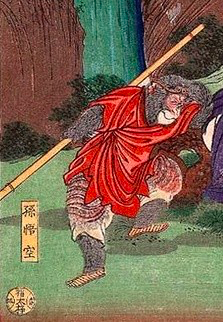
Monkey King – The Origin Story

Sun Wu Kong - Yoshitoshi

Tsukioka Yoshitoshi [Public domain or Public domain], via Wikimedia Commons

Every Chinese child knows about Sun Wu Kong (孫悟空 Sūn Wùkōng), the Monkey King. Hatched from a magical rock, he grew up on Flower Fruit mountain. At the base of the mountain flowed a stream, where one day the young monkey convinced his friends to follow the stream to its source, and there they discovered a beautiful waterfall. The young monkey, on a dare, jumped into the waterfall to see what would happen. To his surprise, he found himself inside a giant cave. He quickly jumped back through the water curtain and goaded his friends in. Monkey and his friends had found their new home in the magical Water Curtain Cave. To reward him for his resourcefulness, the other monkeys and his many animal friends decided that the monkey born from stone would be their king.

For a while, the Monkey king was happy in his new role, and romped and frolicked and ate and drank and played. After many years of this kind of living, however, the Monkey King became despondent. He had concluded that he was mortal and was going to turn old and die. He went looking for a master who could teach him how to live forever. After spending years on the road looking for immortals, sages, and Buddhas, he finally happened upon an enlightened master who was impressed by the stone monkey’s cleverness and agreed to take him on as a student. He then gave him a new name, Sun Wu Kong, which means “Sun, who knows emptiness.”

Sun Wu Kong happily took to the life of a disciple and years passed by. When the master delivered his teachings though, Sun Wu Kong found it very difficult to sit and listen. He explained to his master that he found the teachings so exciting he could not contain himself and needed to jump about. Sun Wu Kong was clever and very quickly learned spells and transformations which amazed his teachers. He also acquired his only weapon. It looked like a walking stick with gold bands on either end and he could vary the size to his wishes. It was perfect. He could somersault 60,000 miles in one full loop, and by taking one hair out of his body and blowing on it, he could create an army of monkeys just like him. All in all, Sun Wu Kong acquired the ability to make 72 transformations. So, he decided to return to his kingdom at Flower Fruit Mountain.

As his powers increased, however, so did his ego. With every victory, Sun became more aggressive and proud and he was beginning to upset the immortals who wondered how he had ever achieved such great powers. To appease him, the immortals finally awarded him the title, “Great Sage, Equal to Heaven.” Sun Wu Kong loved his new name and he aspired to sit on the throne of Heaven. Finally, the Buddha challenged the Monkey to jump off the palm of his hand. If he succeeded, he would indeed, be awarded the title he so desired. Monkey laughed as he accepted the challenge and leapt off the hand somersaulting many times before landing at the base of five pink pillars. Thinking this was the end of the world, Sun Wu Kong peed on a pillar after writing “Great Sage, Equal to None” on one of the pillars as proof that he had made it there. The Buddha then showed Sun Wu Kong his hand, and held Sun’s nose close to the base of one finger where Sun not only smelled his own urine, but saw the words he had written there. With that, Sun Wu Kong was sealed under the Mountain of the Five Elements where he would serve out a long penance.

And that is only the beginning of the story. After centuries of penance, trapped under the weight of the mountain and his ego, Sun Wu Kong was released and became an heroic disciple of the Buddha. Along with a pig, a horse, and the monk,Tang Zhen (Tripitaka), Sun Wu Kong undertook the perilous journey of transporting the teachings of Buddha from India to China.

In 1981, transportation options were limited in Fujian. There were trains, but they were like something out of the 19thcentury. Riding on narrow gauge tracks, their coal fire engjnes belched out black billowing smoke. We were warned not to wear anything light colored because the windows were wide open the whole way from Quanzhou to Wu Yi Shan (武夷山 Wǔyí Shān).

Wu Yi Shan are mountains where immortal beings lived during the Sung Dynasty. There are steep crags and demon shaped rocks said to have been placed there by the Gods. In the past there were hundreds of temples and “boat coffins” on the faces of the cliffs which  was home to a large Daoist community. We hiked along a trail to a water fall they had named the Water Curtain Cave (水帘洞 Shuǐ lián Dòng) and were told that some people believe it to be the Water Curtain Cave. But the cave we saw behind the water did not have quite the splendor or the drama I would have expected.

The name of the book about the monkey king is actually “Journey to the West” (西游记 Xī Yóu Jì). It was most probably written by Wu Cheng’en(吳承恩 WúChéng’ēn), a Chinese writer and poet who lived in 17th century late Ming and early Qing Dynasties. The translation I’m most familiar with is one simply called “Monkey” by Arthur Waley. Although not the complete work, it does offer a fantastic first look at the Monkey King. (Wu, Cheng’en, and Arthur Waley. Monkey. , 1958. Print.)

 Chinese Odyssey 30

We traveled up north

to a place called Quanzhou.

Climbed a statue of Laozi

in a green bamboo grove.

Took a smoky black steam train

through hills of Wuyi.

Saw the king’s water curtain

Sun Wu Kong, the monkey.

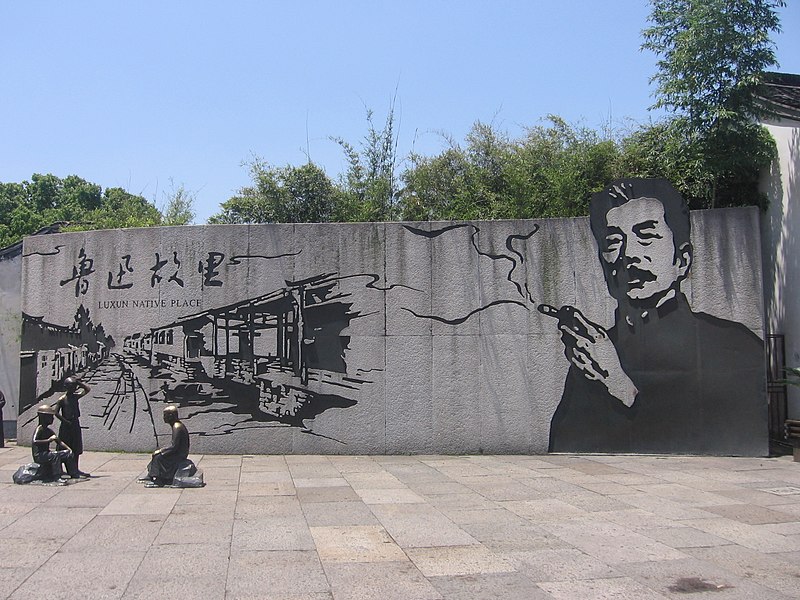
Lu Xun – China’s Greatest early 20th Century Author

Lu Xun Native PlaceZhou Guanhuai [CC BY-SA 4.0 (https://creativecommons.org/licenses/by-sa/4.0)%5D, from Wikimedia Commons

What was it about Lu Xun’s writing that led Mao Ze Dong to call him the “commander of China’s Cultural Revolution“?

Although Lu Xun  (迅 Lǔ Xùn) aka Lu Hsun – had a formal education, he was much more interested in the stories he heard from uneducated peasants than in the great works of literature. Born in 1881, he was 38 when the 1919 May 4th movement championed writing in the vernacular “白话” instead of in classical Chinese (文言文). Lu Xun opened windows into the lives of uneducated peasants, of women who were branded by superstitions and beliefs which relegated them to roles of shame and dishonor they could never hope to climb out of. His writings were not hopeful. They were often dark and desperate and were an honest reflection of the lives of vast numbers of Chinese lǎo bǎi xìng 老百姓 (common people) during the early part of the 20th century. His most popular works were his short stories. Many are available on-line and I’ll mention three which I have read and believe would be a good introduction to Lu Xun.

Probably, the most iconic Lu Xun story is “The True Story of Ah-Q”.  Nobody knew what Ah-Q’s name really was or where he came from. It is evident from the beginning though, that Ah-Q is a loser – in everything he tries. He has no family. His only claim to fame is that the handi-work he does around town to pay for his food and drink seems to be acceptable. He is a blowhard, a braggart and a drunk, all of which bring on more ridicule and bullying from the townspeople. Ah Q represented much of China’s peasant population in the tragedy of his life, and the reader can’t help but feel that his lot was not his fault.

In the story, “Medicine”, a peasant couple whose son is dying of tuberculosis spend their last penny on steamed bread soaked in the blood of an executed criminal. The story was a powerful scream aimed directly at the ignorance which was burdening the masses. Ironic that Lu Xun himself would die at the age of 55 from the same disease.

“New Years Sacrifice” was one of the saddest stories I read. It was an almost voyeuristic glimpse at the lives of widows who were blamed for their own bad fortune both in this life and in the next. After being forced to remarry, Xiang Lin’s wife found herself pregnant and for the briefest of moments was happy with the son she bore until tragedy visited her again in the form of a wolf.

So much of what Lu Xun wrote was a commentary on the superstitions that enveloped China during the chaos of China’s Republican period. Maybe the reason that Lu Xun became Mao’s revolutionary poster boy was that he died in 1936. Mao Zedong, along with 4,000 stalwarts had completed the two year, 6,000 mile Long March which cemented his position as the undisputed leader of the revolution only one year earlier. The revolution was still young and those who died in its name were heroes. Although Lu Xun never joined the Communist Party, Mao understood Lu Xun to be someone who appreciated the plight of the peasants and was trying through his writing to help them rise up.

“The True Story of Ah-Q” (阿Q正传) and “The New Year’s Sacrifice”(祝福)  are both available in the Public Domain to read in English.

Chinese Odyssey 28

Xiamen had been open

for less than a year.

The colors were drab

but the air was quite clear.

Lu Xun used to write

in the Nan Putuo temple

and the Gulangyu

musical island felt gentle.