Slow Boat to China

Project China Mark Nicks

Hong Kong is located in the southeastern part of China. It is surrounded by the province of Guangdong. Adjacent to Hong Kong to the northeast is the province of Fujian. Located in the southeastern part of Fujian is the city of Xiamen. The distance from Hong Kong to Xiamen is only about 300 miles, as the crow flies. Fujian is the Chinese province directly across from Taiwan, separated by the Taiwan Strait. Taiwan is about twice the distance from Fujian as Cuba is from the state of Florida. Today, if we want to travel from Hong Kong to Xiamen, we can choose to take a 40 minute flight or a 5 hour high speed train.

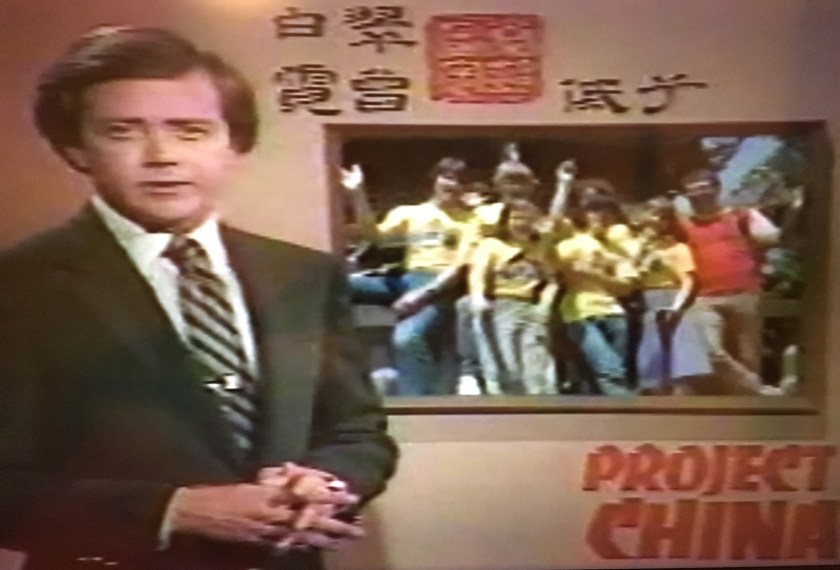
In June 1981, our only travel option was the Jimei passenger ship, the proverbial slow boat to China. From Hong Kong to Xiamen would take us 22 hours plus some change. Our six Tulsa high schoolers joined a rather odd assortment of 20+ individuals from all over the USA. Our kids were the youngest of the bunch. At 80 plus, Abe Gurvitz, a dentist from Boston shared the senior mantle with Frankie Wu from Prairie City, Kansas. We also had a smattering of missionaries, college students, and recent graduates along for the adventure. Accompanying us all was a news crew from Tulsa’s KJRH TV station. Reporter, Mark Nicks and cinematographer, John Ross were never far from our sides.

In earlier posts, we established that names for people, places, and things Chinese often have very different names, depending on their context.  China is called Zhongguo in Chinese; Taiwan is also known as Formosa; Hong Kong is Xianggang in Mandarin (aka Putonghua); Macau is known by most Chinese as Aomen; Canton can refer to either the province of Guangdong or city of Guangzhou; Kongzi is the Chinese way of saying Confucius; Zheng Chenggong is what most Chinese call Koxinga; just to name a few. In today’s post, there are some really different names. Xiamen is still called Amoy by many and Quemoy is most often referred to as Jinmen (or sometimes Kinmen.) Both Amoy and Quemoy are names which sound closer to the names used by local inhabitants in their dialects.

Just before arriving in Xiamen, we passed by the island of Quemoy (Jinmen) which sits less than 2 miles off the coast of mainland China, where we were awed by a Taiwan (ROC) flag the size of a football field waving in the breeze (much to the chagrin of the PRC I’m sure.) Just a few years earlier, Quemoy and Amoy had traded progaganda laden missiles every other day. Landmines were strewn along the beaches to stop an invasion from the mainland. The island is latticed with tunnels. Nearly 100,000 KMT troops were stationed in Quemoy during the Cold War with over 500,000 missiles lobbed in 1958 alone. Intermittent shelling went on until 1978, just three years prior to our arrival. When we lived in Taiwan, I used to hear stories of Taiwanese soldiers swimming over to Xiamen on a dare to watch a movie in a local theatre and come back with a movie ticket stub. Friends of ours who served in the Taiwan military told us that was crazy. Still, it makes for a good story and I can’t help but wonder.

At the time we arrived, Xiamen had only been opened to foreigners for one year. The only other non-Chinese we saw there were an American teaching couple who had been living in Xiamen for 8 months. Our food was very local. Much of the produce was grown on campus. Fruits and vegetables were smallish and very unlike the perfectly shaped and equally sized produce that we were used to in American supermarkets. The good stuff got shipped to Hong Kong where it commanded a much higher price. Even Coca-Cola had yet to reach these hinterlands. It was water, tea, a sickly sweet orange soda, or . . . local beer. I had met with parents before leaving and had told them that beer was not illegal for their kids to consume in Xiamen and it might be safer and healthier than some of the other alternatives. Some parents signed off on that, so beer began to be served with our evening meal.

Today, things are a little different. Anyone can board a plane in Taiwan and fly to Jinmen. It’s even easier in China. In  Xiamen, there is an hourly “Cross-Strait Ferry” from Xiamen to Jinmen which takes about one-half hour. You can only buy one-way tickets because tickets in Xiamen are sold in ¥RMB (Renminbi) and tickets sold in Jinmen are in $NT (new Taiwan dollars.)

Chinese Odyssey 27

Accompanying us

was a Tulsa news crew;

Oklahoma to Xiamen

turned into a coup.

On a boat called the Jimei —

Hong Kong to Amoy —

passed flags of two Chinas,

drank milk made of soy.
When Oklahoma said “Ni hao”

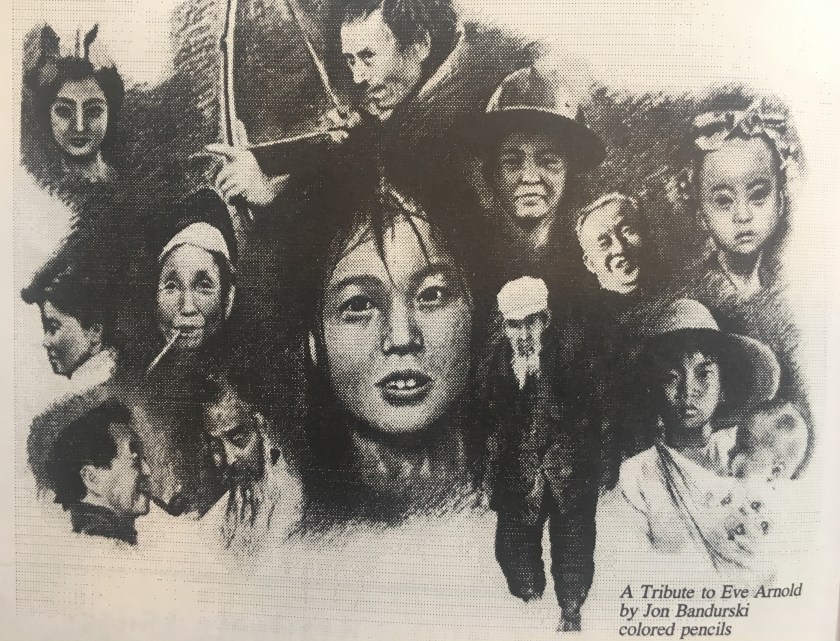
Jon Bandurski Drawing copyAccording the The Oklahoma Historical Society, the Chinese were the first Asians to settle in Oklahoma. Soon after the 1889 Land Run, a Chinese entrepreneur set up the Tom Sing Laundry in Guthrie (near Oklahoma City). Other laundries and restaurants followed. The 1940 census showed only 110 Chinese living in Oklahoma. By 1980 that number had increased to 2,461. (https://www.okhistory.org/publications/enc/entry.php?entry=AS006).
The 1980’s was a good decade for improved connections between Oklahoma and China.

  • In 1980, Tulsa established a “Sister City” agreement with Kaohsiung in Taiwan.
  • In 1980, Booker T. Washington High School and G.W. Carver Middle School offered Mandarin Chinese as a part of our foreign language curriculum in Tulsa.  At B.T. Washington, we published the “American Express” 美國快報, which later became the “Chinese American Express” 美中快報, a student newsletter which invited  young students of Chinese from all over America to contribute their experiences and perspectives regarding the learning of Chinese.
  • In 1981, I accompanied six high school students and a news crew from KJRH in Tulsa to Xiamen University, in southern Fujian Province where we spent 8 weeks studying Chinese. Xiamen had only been open to foreigners for one year at that time. KJRH won a Peabody Award (along with Hill Street Blues) for their documentary, “Project China.”
  • In 1985, Oklahoma and Gansu Province became “Sister States.”
  • In 1987, Tulsa established a “Sister City” agreement with Beihai in the Guangxi Zhuang Autonomous Region in China.
  • Later, that year, the Tulsa Global Alliance put together “Operation Breakthrough: China’s Middle America Initiative” in Tulsa where former President Gerald Ford was a Keynote speaker and Chinese scholar and interpreter, Perry Link, exposed Oklahomans to Chinese comedy in the form of Cross Talks. 100 Chinese governors, mayors and business leaders from 14 provinces and cities met and set up business deals with entrepreneurs from Oklahoma and middle America.
  • In 1989, 15 year old Booker T. Washington high school sophomore, Jon Bandurski became the first Tulsa Public School student ever to live for six months with a Chinese family in Shekou, near Shenzhen in southeastern China (near Hong Kong) where he studied Chinese and art for six months at Yucai School. Jon was the best unofficial ambassador the United States ever sent to China. When he wasn’t studying, he played soccer for the school team and even DJ’d for a school radio program.

Chinese Odyssey 25

It was in Oklahoma,

kids learning Chinese

thought they should go, too.

They even said, “Please!”

From a high school in Tulsa

six students departed

on a life-changing trip

destinations, uncharted


Learning Chinese in America

Dodge Foundation 1984

You can take the cowboy out of China, but you can’t take China out of the cowboy. In Spring, 1979, I needed to go back to Oklahoma. My sister’s kidneys were failing from Type 1 diabetes. She needed a kidney transplant. After prelimary tests at Taipei’s Veteran’s Hospital 臺北榮民總醫院,  Táiběi Róngmín Zǒngyīyuàn, and a follow up consultation with the head of the Nephrology department at UCLA, I was good to go. No kidneying.

Everything worked out well. During my recuperation, I received a note from H.J. Green, the Principal of Booker T. Washington High School, in Tulsa. BTW was a magnet school located in the heart of north Tulsa. Even before it became an official “magnet” for the Tulsa Public Schools, Booker T. had been a magnet for Tulsa’s Black community. When it opened its doors to students from all over Tulsa, to purposely promote racial integration, it did so with the promise of combining a stellar athletic program with an academic curriculum which was second to none. We were home to Tulsa’s 1stever International Bacculaureate program and students from all over Tulsa wanted in. HJ Green was a visionary and he really wanted a Chinese language program at Booker T. Even after I confessed that I had never taught Chinese before, HJ was willing to give me a try.

Before the 1980’s, there weren’t a lot of Chinese Language programs in the USA. Two of the early intensive programs were the Defense Language Institute Foreign Language Center at the Presidio in Monterey, California, and the LDS Missionary Training Center in Utah, but they both had pretty specific agendas and clientele. Universities like Harvard, Stanford, and Yale had developed Chinese language programs in the US, and also had well established programs in China, Taiwan, and Hong Kong. But all of these programs were for adults who had graduated from high school.

The earliest initiative in secondary school education that I’m aware of in the US was from the Carnegie Foundation in the early 1960’s. There were 230 high schools involved. But by the end of the 1960’s, when the funding stopped, so did most of the programs. By the 1980’s few of the programs which had been seeded by the Carnegie Foundation were still in existence. The second wave came with the Geraldine R. Dodge Foundation. From 1982, the Dodge foundation helped start and fund 60 high school programs in the US.

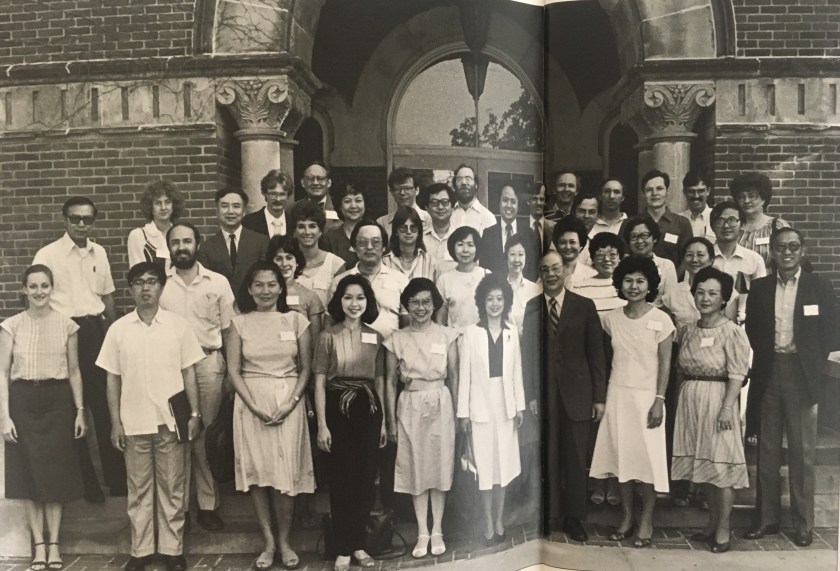
In 1982, I was at the right place at the right time. In Tulsa, Nancy McDonald wrote a grant proposal to the Geraldine R. Dodge Foundation and Timothy Light from Ohio State University was sent to check us out. I was fortunate to meet and to learn from amazing people like Dr. Light, T.T. Ch’en and Zhou Zhi Ping from Princeton, Perry Link from UCLA, Ron Walton from the University of Maryland, and John Berninghausen from Middlebury College. Nearly every summer in the 1980’s, secondary school Chinese language teachers from all over America met and helped one another become better teachers of Chinese. One summer 20 of us converged at the Beijing Language and Culture University (at that time called 北京语言学院 Běijīng Yǔyán Xuéyuàn) to learn together with 20 Chinese language teachers from all over China.

Chinese Odyssey 21

So I boarded the plane

and headed due west.

I had more great teachers.

My Chinese progressed

Then one day while watching

my clothes tumble dry

a voice called out softly

“Get ready to fly.”